Welcome, fellow traveler. You’re here to crack one of travel's oldest codes: finding the absolute cheapest time to book flights. Let me tell you, the secret isn't some magic date on the calendar. It’s about understanding the rhythm of airline pricing—a wild, ever-changing dance of demand, seasons, and surprisingly clever algorithms.
Unlocking the Rhythm of Airline Prices
Think of flight prices less like a fixed menu and more like a stock market for seats. This guide is your playbook for mastering that market, turning what feels like random luck into a reliable, money-saving strategy. We're going to pull back the curtain on the data and share the exact approaches that seasoned travelers use to make their dream trips happen without draining their bank accounts.
Once you learn the rhythm, you can stop overpaying for the journey and start putting that money toward the experience itself. Let’s dive right in and look at the "sweet spots"—those crucial booking windows that consistently deliver the best deals.
Understanding the Booking Timeline
The path to a cheap flight follows a surprisingly predictable curve. When airlines first release their schedules, prices are often sky-high. Then, they drop into a prime booking window before spiking again as the departure date gets closer.
This timeline gives you a perfect visual of the game plan. It shows you exactly when to act and when to wait.
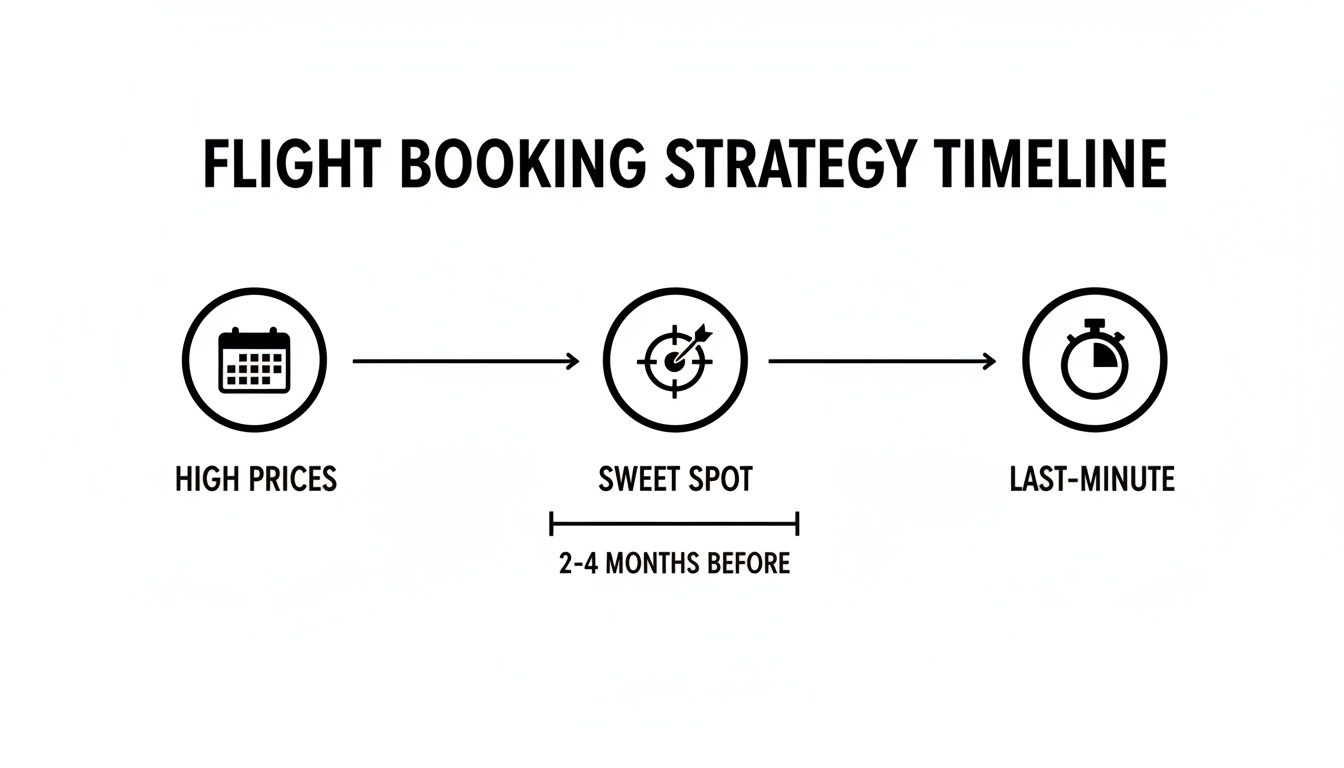
As you can see, jumping the gun or waiting until the last minute are the two most expensive mistakes you can make. The real magic happens right in that middle ground, where airlines are actively competing for your booking.
Why Timing Is Everything
So, what’s behind this pattern? It’s not random. Airlines use incredibly sophisticated software to predict demand and adjust prices in real-time. When you book inside that ideal window, you're hitting the market at a point where demand is steady but not frantic, and airlines are motivated to fill those seats with competitive fares.
The core principle is beautifully simple: avoid booking when everyone else is. Steer clear of those last-minute panic buys and the super-early periods when prices are set at a high, standard rate.
Nailing this timing is a cornerstone of smart travel planning. In fact, managing your flight booking window is just one piece of a bigger puzzle. For a complete look at managing your travel funds, check out our guide on the 7 travel budget categories that save you money in 2025.
Quick Guide to Flight Booking Sweet Spots
To make it even easier, here’s a quick-reference table that breaks down the best times to book based on where you're headed.
Think of this table as your starting point. These windows give you the highest probability of finding a great deal, but remember to stay flexible and keep an eye on price trends as your dates get closer.
Now, let's dig a little deeper into the specific timelines for each of these trip types.
Domestic vs. International Flights: A Tale of Two Timelines
Finding the perfect time to book a flight isn't a simple, one-size-fits-all secret. The way you approach a quick weekend trip to see family is worlds away from how you'd plan a once-in-a-lifetime international adventure. Mastering these different rhythms is your key to unlocking serious savings, no matter where you’re headed.
I like to think of it like this: booking a domestic flight is a sprint, while an international journey is a marathon. Each one has a unique pace and requires a different strategy to win.
The Domestic Dash: Your Prime Booking Window
For flights within your own country, there's a definite sweet spot where prices consistently bottom out. This is the prime booking window, and it’s pure gold for your wallet. If you book too early, you’re paying a premium for no reason. Wait too long, and you’ll get slammed with last-minute price hikes that airlines reserve for desperate business travelers.
So, when is this magic window? Typically, it falls one to three months before your departure date. This is when airlines are actively managing their seat inventory and competing for travelers like you, which naturally drives prices down.
The data doesn’t lie: booking a domestic flight 28 to 61 days in advance consistently lands you the lowest fares. The absolute sweet spot often hits right around 43 days before takeoff. This timing shatters the old myth of finding amazing last-minute deals; airlines almost always jack up prices in the final two weeks. For trips in busy months like March and April, locking in your tickets within this window is a surefire way to save. Want to dive deeper? Check out the research behind flight booking windows.
The International Marathon: Planning for the Long Haul
Heading overseas? You need to take the long view. The planning timeline is much more drawn out, but the rewards for being patient and strategic are huge. Booking an international flight is kind of like planting a garden—you can't just rush it and expect amazing results.
For these long-haul trips, the ideal booking window stretches much further out, usually from four to eight months in advance. Why so early? It comes down to higher demand, more complex routes involving airline partnerships, and the simple fact that there are fewer seats to go around.
An international flight is a bigger investment, and airlines know that travelers plan these trips further ahead. By starting your search early, you position yourself to catch early-bird discounts and avoid the steep price climbs that begin around the three-month mark.
This extended timeline also gives you the breathing room to track price trends, set up fare alerts, and pounce when the price is right. This patient, observant approach is absolutely essential if you're planning a multi-country backpacking trip. If you need some help structuring that kind of adventure, you can check out our guide on how to plan a backpacking trip.
Navigating Timelines by Destination
Of course, not all international destinations play by the same rules. The best time to book can shift dramatically depending on where you're going and when. A summer trip to Europe has a completely different booking rhythm than a winter escape to Southeast Asia.
Here’s a practical breakdown to get you started:
- Flights to Europe: Start looking four to six months out, especially if you're traveling in the summer. Prices really start to jump once you get inside that three-month window.
- Flights to Asia: For most destinations in Asia, it's smart to start your search five to seven months in advance. This gives you a fantastic shot at finding great deals before peak season demand really kicks in.
- Flights to the Caribbean & Mexico: The booking window here is a bit shorter and feels more like domestic travel. Aim for two to four months out, but I’d add an extra month or two if your trip falls over a major holiday like Spring Break.
- Flights to South America: A booking window of four to six months is a solid bet for snagging reasonable fares to this part of the world.
When you understand these regional patterns, you can plan any trip with confidence. You’re no longer just guessing; you’re making strategic moves to ensure you never overpay for your next adventure.
The Best Days and Times to Finalize Your Booking

You’ve figured out the perfect booking window, which is a huge step. Now, let’s zoom in. Does it really matter if you click “buy” on a Tuesday morning versus a Saturday night? The short answer: absolutely. The day you book and, even more critically, the day you fly can unlock one final, massive layer of savings.
For years, we've all heard the legend of "cheap Tuesday." The story goes that airlines release their weekly sales on Monday night, competitors scramble to match prices, and a sweet spot opens up for savvy bookers. While it's not the ironclad rule it once was, there’s still a kernel of truth there.
Airlines often operate on a weekly sales cycle, which means booking mid-week can give you an edge. Think about it—most people are browsing for flights on the weekend. With more eyes on the screen, prices have a tendency to creep up. Searching between Tuesday and Thursday helps you sidestep that weekend rush.
Shifting Focus From When You Book to When You Fly
Here’s the real secret, though. While the day you purchase your ticket gives you a small advantage, the day you actually travel is the ultimate game-changer. This is where a little bit of flexibility pays off in a big way.
Airlines price their seats based on demand, pure and simple. And when do most people want to fly? Fridays and Sundays, to squeeze every last drop out of their weekend. By simply zigging when everyone else zags, you can find incredible deals.
The single most powerful move you can make is to shift your departure and return dates away from the weekend chaos. Flying on a Tuesday, Wednesday, or Saturday is consistently cheaper than flying on a Sunday or Friday.
This one small adjustment can save you a truly surprising amount of cash. Often, the money you save by flying mid-week is enough to cover an extra night at your hotel, a fantastic meal out, or that tour you thought was just out of reach.
Unlocking Mid-Week Travel Savings
Let’s make this real. Imagine you're planning a trip from Chicago to Denver. A standard Sunday-to-Friday itinerary might set you back $350. But what if you just shifted your trip by one day to a Saturday-to-Thursday schedule? That exact same flight, on the same airline, could plummet to $220.
That’s $130 back in your pocket, just for avoiding the peak travel days. For a family of four, that's over $500 in savings. You get the same incredible trip, but for a dramatically different price. This is one of the easiest and most effective budget travel hacks you can master.
The Advantage of Off-Hours Flights
The time of day you fly also plays a huge part in the final price. Just like weekends are the most popular days, certain times of day are more desirable. Most people prefer a comfortable mid-morning or early afternoon flight, which creates another golden opportunity for savings.
Keep an eye out for flights at less popular times to find the lowest fares:
- Early Morning Departures: Those first flights of the day (think 5 AM to 7 AM) are almost always the cheapest.
- Late-Night or Red-Eye Flights: Flights that take off late in the evening and land the next morning are another fantastic source of deals.
Sure, choosing one of these flights might mean an extra cup of coffee, but the financial reward is more than worth it. You won't just save money; you'll often be rewarded with shorter security lines and less crowded airports, making the whole experience a lot smoother. Combine a mid-week departure with an off-hours flight, and you’ve got a powerhouse strategy for finding the absolute best deals.
Navigating Peak Seasons and Holidays
Booking a flight for a quiet week in October is one thing. Nailing a great deal for Christmas week or the middle of summer break? That’s a whole different ballgame. When demand goes through the roof, the usual rules of flight booking get tossed out the window. This is your playbook for conquering high-demand travel and turning what seems impossible into an amazing, affordable trip.
Think of peak season flights like tickets to a blockbuster movie on opening night. Everyone wants one. If you wait too long, you’ll either pay a fortune or miss out completely. The secret is to get way ahead of the crowd by booking much, much earlier than you would for a regular off-season trip.
Holiday Travel: The Early Booker Wins
For major holidays like Christmas, New Year's, and Thanksgiving, you can forget about the standard booking windows. Demand is so predictable and intense that airlines have zero reason to offer last-minute deals. If you wait until the typical one-to-three-month domestic window, you're almost guaranteed to pay the highest prices of the year.
The strategy here is brilliantly simple: book exceptionally early.
- Christmas & New Year's: Start your serious searching six to eight months in advance. No, that's not a typo. Prices will hit their sweet spot around September, and once October rolls around, fares begin a steep, steady climb that simply doesn't stop.
- Thanksgiving: You'll want to have your flights locked in by late summer, ideally three to five months out. The closer you get to Halloween, the scarier the prices become.
- Summer Vacation (June-August): For those popular summer getaways, start your hunt when there's still snow on the ground. Booking three to five months before your trip—preferably before April—is your best bet for grabbing a reasonable fare before the summer surge hits.
Here’s a pro tip for holiday travel: flexibility is your secret weapon. If your schedule allows you to fly on the actual holiday, like Christmas Day or Thanksgiving Day, you can often score huge savings compared to the mad rush on the days immediately surrounding it.
Discovering the Magic of Shoulder Seasons
So, what if you want that perfect summer weather without the peak-season price tag? The answer is the shoulder seasons—those glorious periods just before and after the busiest travel times. These are the weeks in late spring (April-May) and early fall (September-October) that savvy travelers absolutely live for.
Picture a popular beach destination. Peak season is a crowded, expensive party. The off-season might be too cold or rainy. The shoulder season is like arriving just before the party starts or staying for a quiet chat after most guests have left. You get all the incredible atmosphere with none of the chaos.
This simple shift in timing unlocks a powerful combination of perks:
- Lower Flight Costs: With less demand, airlines are forced to offer much more competitive prices.
- Fewer Crowds: You can actually experience those iconic landmarks and beautiful landscapes without being elbow-to-elbow with thousands of other people.
- Great Weather: You often get the best of the destination's climate, avoiding the blistering heat or bitter cold.
- More Authentic Experiences: When you're not lost in a sea of tourists, you have a much better chance to connect with the local culture.
For instance, a trip to Europe in May gives you beautiful spring weather and flights that cost a fraction of what they would in July. Likewise, visiting the U.S. National Parks in September means gorgeous hiking temperatures and far more manageable crowds than in August. Embracing the shoulder season is one of the best-kept secrets in travel, transforming your trip from just a vacation into something truly memorable. It's a fantastic way to explore some of the most cheap places to travel abroad while seeing them at their absolute best.
By planning far ahead for major holidays and strategically using shoulder seasons for your flexible trips, you can outsmart the system. This isn't just about saving money; it’s about creating better, more enjoyable, and more sustainable travel adventures.
Your Essential Smart Traveler Toolkit
Knowing when to book is half the battle, but the other half is knowing how. Having the right tools in your back pocket can make the difference between a good deal and a truly incredible one.
Think of it this way: you wouldn't try to build a bookshelf without a drill and a measuring tape. These digital tools are your travel-hacking essentials—the gear that turns you from a casual searcher into a savvy booking pro. Let's get them set up.
Harnessing Powerful Flight Search Engines
Your first move should always be to get a bird's-eye view of the landscape. That's where flight search engines, or aggregators, come in. These platforms are the foundation of your search, scanning hundreds of airlines and booking sites in the blink of an eye.
Here are the heavy hitters you need to have bookmarked:
- Google Flights: This is my go-to for its sheer speed and simplicity. Its calendar view is a goldmine, instantly showing you the cheapest days to fly across an entire month. You can see right away if leaving a day earlier could save you a hundred bucks. It's that easy.
- Skyscanner: Perfect for the adventurous and flexible traveler. Skyscanner's legendary "Everywhere" search lets you plug in your home airport and see the cheapest destinations you can fly to, anywhere in the world. It’s a fantastic way to discover your next trip based on your budget.
- Momondo: Momondo excels at piecing together creative itineraries, often mixing and matching airlines to find a final price that other sites miss. It’s fantastic for uncovering those clever "hacker fares" that can lead to big savings.
Comparing Essential Flight Booking Tools
With so many options, it helps to know which tool to grab for which job. Here’s a quick-glance comparison to help you build your strategy.
Each of these tools offers a unique angle. The real power comes from using them together to confirm you’ve left no stone unturned in your hunt for the best fare.
Setting Up Intelligent Price Alerts
Here's a secret that seasoned travelers live by: you don't find the best deals by searching obsessively. You let the deals find you.
Flight prices can bounce around multiple times a day. Trying to keep up manually is a recipe for frustration. Price alerts are your personal deal-hunting robots, working 24/7 to notify you the second a price drops into your target range.
The goal isn't just to find a cheap flight; it's to book with the confidence that you got the best price possible. Price alerts remove the guesswork and let you know the exact moment to act.
This is where an app like Hopper really shines. It goes beyond simple notifications. Hopper crunches massive amounts of historical data to predict whether your flight's price will rise or fall. It will literally advise you to "buy now" or "wait for a better price," giving you a clear, data-driven green light.
Setting up a "watch" on Hopper for your dream trip is one of the smartest, simplest things you can do to save money.
Advanced Tactics for Deeper Savings
Ready to go pro? Once you have the basics down, a few extra tricks can help you squeeze out even more savings.
First, always search in incognito or private browsing mode. Some booking sites use cookies to track your activity. If they see you're repeatedly searching for a specific flight, they might nudge the price up to create a false sense of urgency. An incognito window gives you a clean slate every time.
Another powerful tactic is using a Virtual Private Network (VPN). A VPN can make it look like you're browsing from a different country. Why bother? Because airlines often price the same flight differently depending on the country of purchase. A ticket from New York to Paris might be cheaper on the airline's French website. A VPN lets you check.
Finally, never forget the power of points and miles. If you travel with any regularity, the right credit card is your best friend. Your everyday spending on groceries and gas can be earning points that translate into free flights and upgrades. To get started, check out our deep dive into the best credit cards for travel rewards in our complete guide.
With this toolkit, you're no longer just a passenger—you're the pilot of your own travel budget.
Your Flight Booking Questions Answered
Let's dive into some of the questions I hear all the time from travelers trying to crack the code on flight deals. Think of this as a quick-fire round to clear up the lingering myths and give you the confidence to book your next trip like a pro.
Is Booking on a Tuesday Still a Secret Weapon?
Ah, the old Tuesday trick. For years, this was the secret handshake of savvy travelers. The lore was that airlines launched sales on Monday nights, and by Tuesday morning, competitors had scrambled to match them, creating a brief, beautiful window of low prices.
While pricing is way more dynamic now, there's still a grain of truth here. Weekends are peak planning time for most people, which means more search traffic and, often, higher fares. Booking mid-week can help you sidestep that rush.
But the real power move isn't just about when you book, but when you fly. The cheapest days to actually be in the air are almost always Tuesday and Wednesday because demand is simply lower. The best strategy? Watch your specific route for a few days to get a feel for its unique rhythm before you pounce.
Should I Book a Round Trip or Two One-Way Tickets?
This is one of those rules that has completely flipped on its head. It used to be a no-brainer: booking a round-trip ticket on a single airline was almost always cheaper. And sometimes, it still is.
But budget airlines have changed the game. Now, you can often find surprising savings by booking two separate one-way tickets—a move some people call a "hacker fare." This gives you the freedom to mix and match airlines, grabbing the absolute cheapest flight for your departure and your return.
You might fly out on Spirit and come home on Frontier for less than a single round-trip ticket on a major carrier. It takes a little extra clicking, but the savings can be well worth it.
Flight aggregator tools are your best friend here. Platforms like Skyscanner and Kiwi.com were built for this, automatically piecing together these creative combinations to find the rock-bottom price. Always check both a round-trip and two one-ways before you commit.
How Far in Advance Is Too Early to Book?
It feels responsible to lock in your plans way ahead of time, but when it comes to airfare, being the early bird doesn't always get you the best deal. In fact, booking more than six to eight months out can be a costly mistake.
Here’s why: Airlines release their schedules about 11 to 12 months in advance, but they don’t start actively managing prices or launching sales until much, much closer to the departure date. If you book that early, you're paying a high, generic "placeholder" price.
You'll miss out on all the sales and competitive price adjustments that happen inside the prime booking window. As we've covered, that sweet spot is generally:
- 1-3 months out for domestic trips
- 2-6 months out for most international journeys
Booking within these windows gives you the best shot at catching the fare at its lowest point. A little patience goes a long way.
Will Flight Prices Drop at the Last Minute?
The romantic idea of waltzing up to an airport, finding a ridiculously cheap last-minute seat, and jetting off on a whim? For the most part, that’s a scene from a movie, not a modern travel strategy.
Airlines have gotten very good at pricing psychology. They know that last-minute bookers are rarely spontaneous adventurers; they're usually business travelers on urgent trips or people facing emergencies. These travelers aren't shopping for a deal—they need a seat, and they'll pay a premium for it.
Because of this, prices almost always skyrocket in the final two weeks before a flight. Waiting for a last-minute price drop is like betting your vacation budget on a lottery ticket. The safer, smarter, and overwhelmingly cheaper approach is to book within the prime window. Securing that ticket in advance is your surest path to savings and peace of mind.
At Travel Talk Today, we believe smart planning is the key to unlocking incredible experiences without breaking the bank. Our guides are designed to give you the confidence to explore the world affordably and thoughtfully. Start planning your next adventure with us.