Picture this: you’ve just arrived in a new city, buzzing with excitement for the trip ahead, and you walk up to the hotel check-in desk, only to be turned away. It's a gut-wrenching feeling, and it happens more often than you'd think. So, what's the real story on the age to rent a hotel room?
While you're legally considered an adult at 18 in most places, many hotels draw their own line in the sand, often requiring guests to be 21 or even 25 to check in.
Your Guide to Hotel Age Policies
Don't let a hotel's internal rules derail your plans. This guide is here to help you sidestep that dreaded moment at the front desk. Think of hotel age policies not as obstacles, but as puzzles you can solve with a bit of inside knowledge. My goal is to give you the confidence to book your next trip without a shred of uncertainty.
Your age really does shape your booking experience. Different age brackets unlock different levels of access and come with different expectations from hotels. The image below breaks down the most common differences for travelers who are 18+ versus those who are 21+.
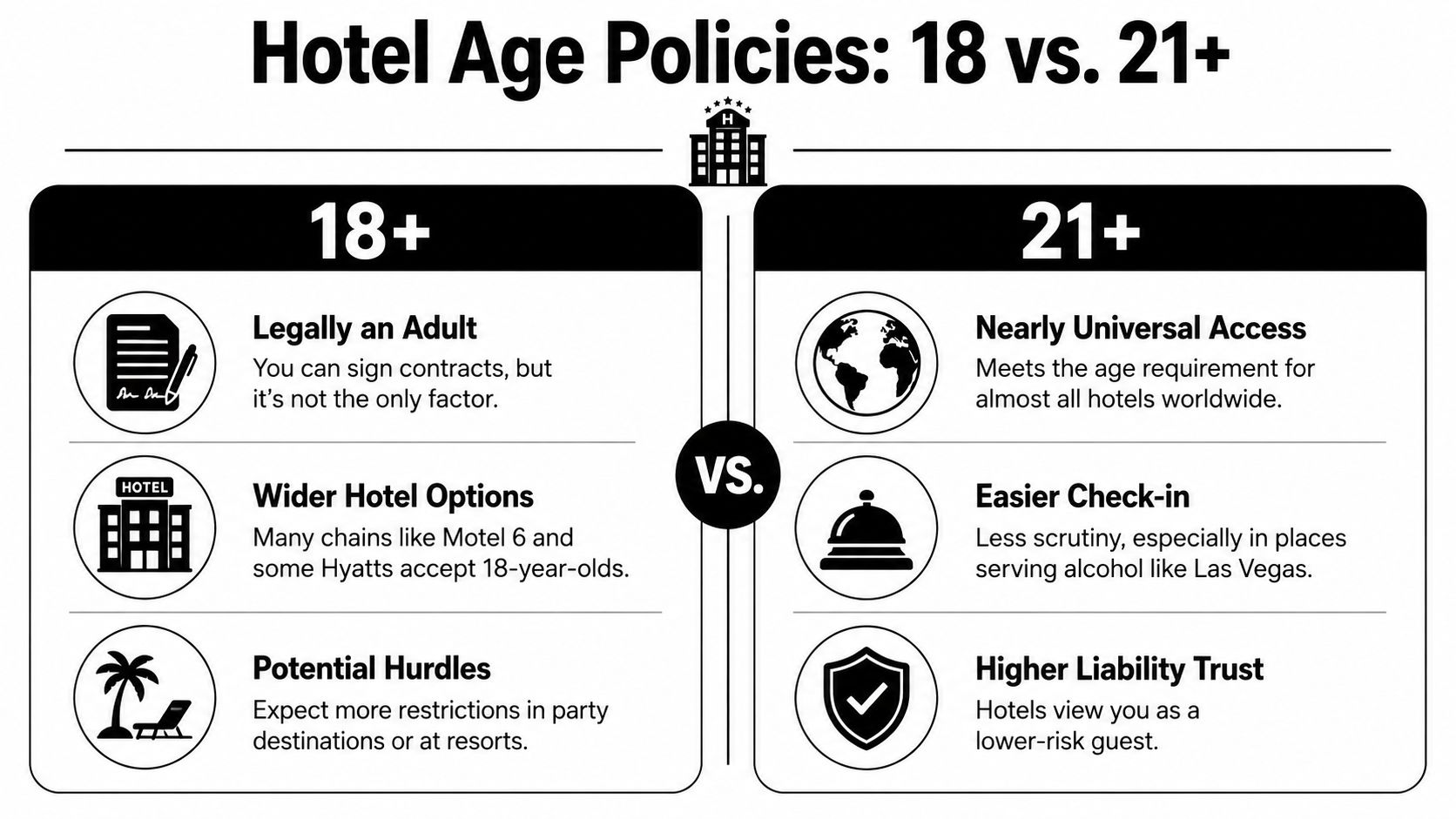
As you can see, hitting 18 opens a lot of doors. But turning 21 is the real game-changer, giving you almost universal access and a much smoother check-in, especially in places known for their nightlife.
Why the Rules Change from Place to Place
Booking a hotel as a young adult is all about preparation. It’s knowing what to ask and where to look. A hotel in a sleepy suburban town has entirely different concerns than a sprawling resort in Las Vegas or Miami. The first might happily welcome an 18-year-old, while the second bumps the minimum age to 21 to sidestep any issues with underage drinking and wild parties.
It all comes down to this: hotel age rules are less about judging your maturity and more about protecting the hotel from liability. Once you understand their side of the story, you can predict where you might find stricter policies and plan around them.
To get you started, here’s a quick-reference table that gives you a snapshot of what to expect across different regions and from some of the biggest names in the hotel industry.
Quick Reference for Common Hotel Age Requirements
| Region or Brand | Common Minimum Age | Key Considerations |
|---|---|---|
| Most of the U.S. | 21 | State laws vary, but 21 is a common hotel policy to avoid alcohol liability. Always call the specific location. |
| Las Vegas, NV | 21 | Due to casino and alcohol access, 21 is the standard and is strictly enforced. |
| Florida (Spring Break) | 21-25 | During peak seasons like spring break, many hotels raise their minimum age to 25 to prevent parties. |
| New York City | 18-21 | Varies widely. Many hotels accept guests at 18, but some in nightlife-heavy areas require 21. |
| Marriott Bonvoy | 18-21 | Officially, the policy is 18, but individual franchise locations (especially resorts) can set it at 21. |
| Hilton Hotels | 18 | Hilton's corporate policy is 18, but it's one of the most frequently overridden rules at the local level. |
| IHG Hotels | 18 | Similar to Hilton, the corporate standard is 18, but local properties have the final say. |
| Hyatt Hotels | 18-21 | Most Hyatt hotels allow check-in at 18, but some locations and resort properties require you to be 21. |
This table is your starting point—a handy overview before we dive into the specific strategies that will make you a booking pro. For even more expert insights, be sure to explore our other travel tips and make every single trip a success.
Cracking the Code: Why Hotel Age Policies Are All Over the Map
Ever been baffled when the hotel on one corner welcomes 18-year-olds, but the one across the street won't even look at you unless you're 21? It can feel totally random, but there’s a method to the madness. Once you understand the "why," you can stop crossing your fingers at the check-in desk and start planning your trips with confidence.
Here’s the key: a hotel stay isn't just about renting a room. It's about entering into a legal contract. For the hotel, that contract is loaded with responsibility and potential risks, and the minimum age policy is their number one tool for managing them.
Liability and the Law
At its heart, that reservation you made is a binding agreement. In most of the U.S., the legal age of majority—the point where you can legally sign a contract—is 18. That’s the absolute floor. But here's the catch: contracts with minors can often be voided. This means a younger guest could theoretically walk away without paying, leaving the hotel in a tough spot financially.
A hotel's age rule isn't a judgment on your maturity. It's a business decision, plain and simple, driven by liability, local laws, and the unique risks of their location.
This is exactly why so many hotels set their own, higher age limits. Hotels are private businesses, and as long as they aren’t discriminating against a legally protected group, they have the right to set a policy requiring guests to be 21 or even 25.
Location, Location, Location... and Liability
Where a hotel is located has a massive impact on its age policy. The risks a hotel in a bustling city faces are worlds apart from those of a quiet roadside motel.
- Party Destinations: Think Las Vegas, Miami Beach, or New Orleans. Hotels here almost always require guests to be at least 21. With bars, clubs, and casinos just steps away, enforcing a 21+ rule is the simplest way to sidestep any issues with underage drinking and the huge liabilities that follow. During spring break, some Florida beach hotels will even bump the minimum age to 25.
- Quiet Suburbs: On the flip side, a hotel in a sleepy suburban town or near an airport is dealing with a much lower-risk crowd. These places are far more likely to stick to the 18-year-old minimum because they primarily serve families, people on business trips, or travelers just passing through.
- Event Hotspots: A hotel near a huge concert venue like Red Rocks Amphitheater might be more lenient, knowing full well that they’ll have plenty of responsible, 18+ concertgoers looking for a place to crash.
Seeing the world through this lens of risk changes everything. You’re no longer just a traveler hoping for the best; you're a savvy planner who knows how to read the signs and book your stay like a pro.
You've been dreaming of that cross-country road trip or a weekend getaway to a new city. The excitement is building... but a surprisingly common hurdle can bring your plans to a screeching halt right at the check-in counter. When it comes to the age to rent a hotel room in the United States, the rules can feel like a tangled mess.
You’re legally an adult at 18, right? Yes, but in the eyes of a hotel, it's not that simple. Their policies are often shaped by their own assessment of risk, especially in destinations famous for nightlife and big events. It’s less about your maturity and more about their liability.
State Rules vs. Hotel Policies
Here’s where things get tricky. In most of the US, you can legally sign a contract (like a hotel reservation) at 18. So why do so many hotels insist you be 21? It’s a business decision, plain and simple, often tied to things like in-room minibars and reducing liability for underage drinking.
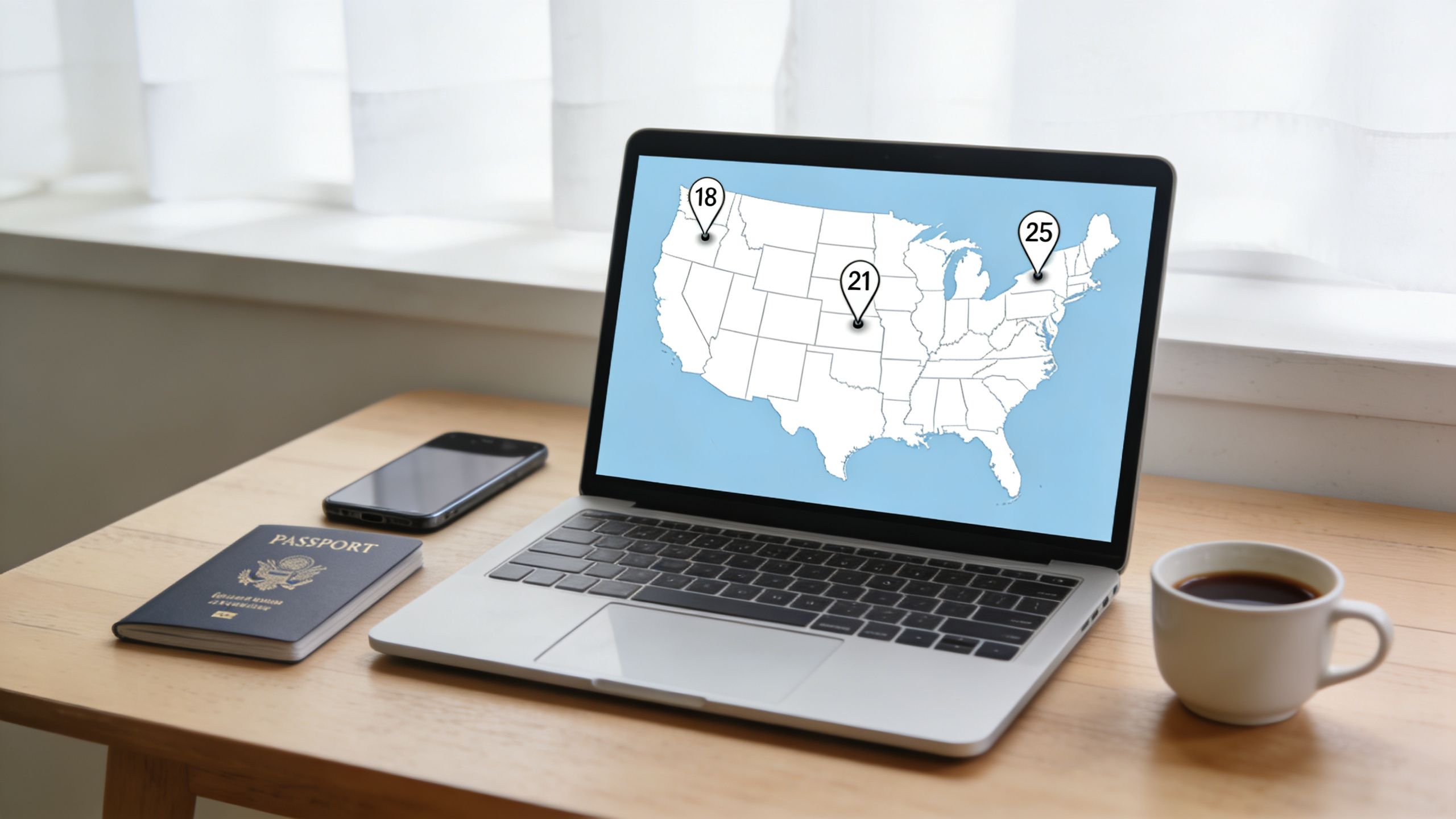
While the default age is technically 18, individual hotels and even entire cities can set a higher bar. For instance, a detailed guide by Max's Luxury Rides highlights the unique case of Maryville, Illinois. The town passed a local ordinance that flat-out prohibits hotels from renting to anyone under 21, specifically to clamp down on underage parties. This shows just how varied the rules can be from one town to the next.
Your best bet is to assume nothing and plan ahead.
A Look at Major Hotel Brands
Think you’re safe booking with a big brand? Think again. A hotel’s policy can change dramatically from a city-center business location to a sprawling beachside resort, even under the same brand umbrella.
- Marriott: The official company policy welcomes guests 18 and older. But don't be surprised if a specific franchise, especially one in a party town like Miami or a ski resort, raises that age to 21.
- Hilton: Hilton also sets its corporate standard at 18. In my experience, however, this is one of the most frequently overridden policies at the local level. You absolutely must verify with the specific property.
- Hyatt: Hyatt is known for being one of the more reliable brands for 18-year-old travelers. Still, the rule isn't universal—always check with resort locations or prime urban hotels, which might require you to be 21.
The most powerful tool you have is your phone. A quick call directly to the hotel’s front desk is the only way to get a guaranteed answer and book with absolute certainty.
Getting ahead of this issue turns a potential trip-ruining disaster into a minor checklist item. By doing a little homework, maybe with the help of the best travel apps for planning, you can navigate the booking process like a pro.
Your adventure is out there waiting. With a little preparation, nothing is going to stand in your way.
A Global Look at Hotel Age Policies
There’s an incredible sense of freedom that comes with stepping off a plane into a brand new country, ready to explore. But that excitement can come to a screeching halt if you hit a snag with something as basic as checking into your hotel. You might assume the minimum age is the same everywhere, but that’s a rookie mistake.
It’s actually a complex patchwork of local laws, cultural norms, and individual hotel policies. While 18 is a common baseline in many parts of the world, it's definitely not a guarantee. Getting a handle on this is your first step to becoming a truly savvy world traveler.
Europe vs The World
For young adventurers, Europe often feels incredibly welcoming. If you're backpacking from one major city to the next, you'll find most hostels and budget-friendly hotels in places like London or Berlin are perfectly happy to check in an 18-year-old with a valid ID and a credit card.
Once you venture further, however, the rules can change dramatically. In parts of Asia and the Middle East, it's not uncommon for the minimum age to jump to 20 or even 21. This isn’t always just about legal liability; it often ties into local culture. In Dubai, for instance, some hotels might require proof of marriage for a young couple wanting to share a room, reflecting regional customs.
The most important lesson for any global traveler is this: never assume. A policy that's standard in one country might be completely different just one border away. Always, always do your research before you click "book."
This is crystal clear when you look at popular travel destinations. A quick glance at travel resources like Trip.com shows that while 18 is often the standard, you'll run into exceptions. Many traditional ryokans in Tokyo require guests to be 20, the legal age of adulthood in Japan. In Bangkok, upscale resorts often set their own limit at 20 or 21, and in Seoul, the magic number is 19, which is the Korean age of majority. Knowing these little details is what separates a smooth trip from a stressful one.
Popular Hubs at a Glance
Let’s break it down with a few more examples to give you a clearer idea of what to expect:
- London, UK: You're generally in the clear at 18. It’s one of the most accessible major cities for younger solo travelers.
- Sydney, Australia: Much like the UK, the standard check-in age is 18. Just be aware that some hotels might raise the age requirement during major holidays or big events like New Year's Eve.
- Bangkok, Thailand: This is a mixed bag. While many affordable spots will welcome you at 18, a lot of the fancier hotels and resorts bump the minimum age to 20 or 21.
Mastering these nuances is what empowers you to travel with confidence. And if this has you fired up to see more of the globe, check out our guide on the best countries for digital nomads and start dreaming about where your journey will take you next.
Smart Strategies for Booking a Room Under 21
Hitting that "21 and over" roadblock when you’re trying to book a hotel is frustrating, but it’s definitely not the end of your travel plans. It’s less about finding a secret loophole and more about knowing how the system works and showing them you’re a serious, responsible traveler.
Your first move? Think outside the traditional hotel box. The hostel scene, for instance, has completely transformed. Forget what you think you know—many now offer sleek private rooms that are perfect for solo travelers or couples. They’re built for a younger crowd and almost always welcome guests 18 and up, so you’ll find a great social vibe, too.
Broaden Your Search Beyond Hotels
Another fantastic option is the world of vacation rentals. On sites like Airbnb or Vrbo, you’re dealing directly with property owners who set their own age rules. You'd be surprised how many hosts are happy to rent a private room or an entire apartment to an 18-year-old, especially if you have a few positive reviews on your profile.
- University Dorms: A great hack for summer or holiday travel is to see if local universities rent their empty dorms. They’re safe, affordable, and perfectly suited for younger guests.
- Modern Hostels: Seek out boutique hostels with private room options. You get the community atmosphere and the security of a hotel, often at a much better price.
- Vacation Rentals: Don’t be afraid to send a polite message to an Airbnb host. A quick note explaining your trip and your maturity can often be all it takes to get approved.
Master the Hotel Booking Process
If your heart is still set on a hotel, don't throw in the towel just yet. A few smart moves can seriously boost your chances. Start by zeroing in on brands known for being more flexible—many Hyatt and Motel 6 locations, for example, stick to an 18+ policy. It also never hurts to join a hotel's free loyalty program. It signals that you're a committed traveler and can give you a slight advantage.
Don't let a "21+" policy be the end of your travel dreams. Think of it as a prompt to get creative. Your resourcefulness is your greatest asset, proving that with the right approach, the world is wide open for exploration.
Paying for your stay upfront with a non-refundable booking can also be a game-changer. When you remove the financial risk for the hotel, they’re often more willing to bend their own rules. And while it’s not a golden ticket, a parental consent form can sometimes tip the scales. This is just a simple letter from a parent or guardian confirming they’ll cover any costs, adding another layer of reassurance for the hotel.
These creative solutions can make all the difference, especially when you're looking for affordable adventures. To get more ideas, check out our guide on cheap travel destinations for students and start planning your next journey.
Your Pre-Booking Checklist for a Smooth Check-In
There’s a special kind of confidence that comes from being truly prepared. Before you even think about booking, let's walk through a simple ritual that will guarantee you peace of mind and get you past the front desk and into your room without a single hiccup.
First things first, let's get your essentials in order. You absolutely must have two things on hand when you arrive:
- A valid, government-issued photo ID to prove you are who you say you are and, crucially, to verify your age.
- A credit or debit card in your name to cover the security deposit for any potential incidental charges. Hotels are sticklers about this.
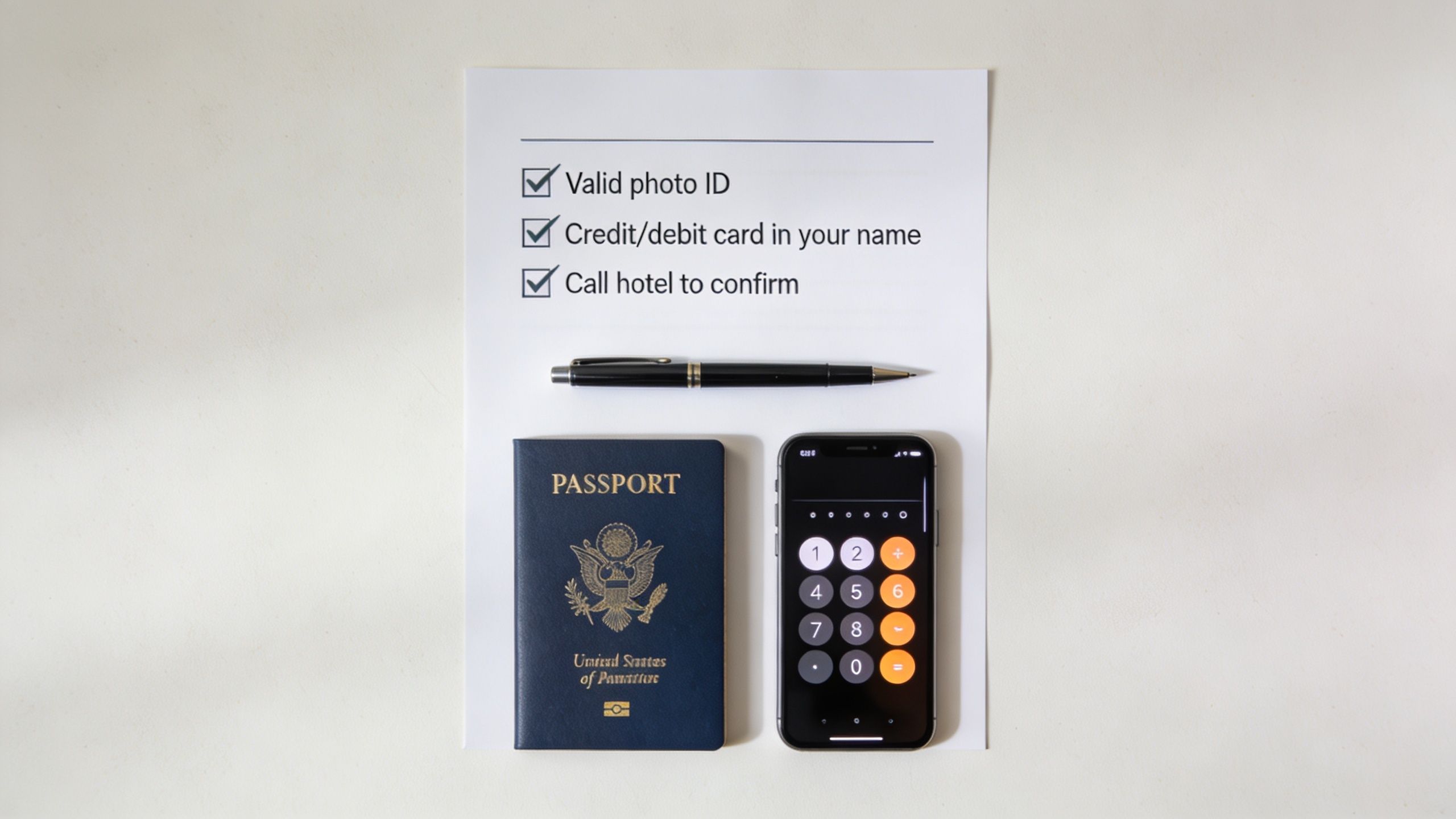
Once you have these items secured, you're ready for the most important part of this whole process.
The Single Most Important Step
I’ve learned this the hard way, so you don't have to: corporate policies and what you read online can be wildly out of date or just plain wrong. Rules often change from one hotel to the next, even within the same brand. The only way to know the real age to rent a hotel room is to go straight to the source.
The single most critical action you can take is to call the specific hotel property directly to confirm its age policy before you book. This one phone call can save you from a trip-ruining disaster.
Don't feel awkward about it—the front desk staff fields this question every single day. Just pick up the phone and be direct. A simple, "Hi, I'm interested in booking a room. Could you please tell me the minimum age for check-in at your specific location?" is all it takes.
This one simple action cuts through all the noise and guesswork. It puts the power back in your hands, allowing you to book with total confidence, knowing there won't be any gut-wrenching surprises when you get there. For more tips on getting all your ducks in a row, our complete travel planning checklist will guide you through every step.
Your Top Questions About Hotel Age Rules, Answered
Trying to figure out hotel age policies can feel like decoding a secret language. Let's cut through the confusion. I've heard every question in the book from young travelers, and I'm here to give you the real answers so you can book your next trip with confidence.
Can a Hotel Really Turn Me Away if I’m 18?
The short answer? Yes, they can. It's a tough pill to swallow, but while you're legally an adult at 18, hotels are private businesses. They have the right to set their own policies to protect their property and manage risk.
Think of it like a "house rule." Because age (over 18) isn't a federally protected class in the same way as race or religion, a hotel's 21+ or even 25+ policy is perfectly legal. The only catch is they have to apply that rule to everyone, without discrimination.
I Have a Credit Card. Does That Help Me Get a Room?
Having a credit card in your name is absolutely essential for booking, but it's not a magic key that unlocks any door. When you get to the front desk, they'll still ask for your ID to verify your age. If you don't meet their minimum, the credit card won't change their minds.
A credit card proves you can cover the bill and the security deposit, but your ID proves you meet their age requirement. You need both to check in. One without the other just won't work.
Which Hotel Chains Are My Best Bet as an 18-Year-Old?
This is where a little research goes a long way. While you should always call the specific hotel you plan to book, some brands are generally more welcoming to 18-year-old travelers. Motel 6 is a classic, reliable choice, and many properties under the Choice Hotels umbrella also stick to an 18+ rule.
What about the big names? Chains like Hyatt and Marriott often have a corporate policy that allows check-ins at 18. The big "but" is that individual franchise owners, especially at resorts or in party-heavy cities like Las Vegas or Miami, can raise that minimum to 21.
Can't My Parents Just Book the Room for Me?
I see this question all the time, and it’s a strategy that sounds good in theory but almost always ends in disaster. Hotels are very strict about this: the person whose name is on the reservation must be there at check-in.
They must also be the one to present a matching government-issued ID and the credit card used for the booking. If your parents book it for you but aren't there to check in, the hotel will likely refuse you the room on the spot. It's a hard lesson that can leave you stranded.
At Travel Talk Today, we believe that with a bit of smart planning, the world is yours to explore. Use these insights to get ahead of the game and turn your travel dreams into your next great memory. Start planning your adventure at https://www.packlight-journeys.com.