You're probably staring at a map of Aix-en-Provence, wondering whether the market is a single square, a weekly event, or one of those romantic ideas that sounds better in photos than in real life. Aix makes that confusion easy. The city's markets don't sit neatly in one place. They spill, shift, and change character depending on the day.
That's also why the aix en provence market is worth planning properly. Done well, it's not just a browse between coffee and lunch. It becomes the pulse of your visit. You taste apricots still warm from the Provençal sun, compare olive oils with the person who pressed them, and wander from produce to linens to old books without ever feeling like you've left the same living, breathing scene.
I've always found that Aix rewards travelers who slow down by half a step. If you rush in looking for a checklist, the market feels crowded and scattered. If you arrive with a loose plan, a reusable bag, and enough curiosity to linger, the city opens up.
An Invitation to Provence's Most Vibrant Market Scene
By mid-morning in Aix, the air smells like sliced melon, herbs, soap, coffee, and warm stone. Chairs scrape across café terraces. Vendors call out prices. Someone leaves with a paper-wrapped wedge of goat's cheese, someone else with a bunch of flowers, and a third person with a striped tablecloth tucked under one arm as if they've just bought a piece of Provence itself.

What makes Aix special isn't only the produce or the beauty of the squares. It's the way daily life and travel overlap here. Locals stop for vegetables, flowers, and conversation. Visitors arrive for the colors and end up learning the rhythm of the city. That's the difference between sightseeing and the kind of authentic travel experiences that stay with you.
Why the market matters
The market is one of the clearest ways to understand Aix. You see what the region grows, what people cook, what they carry home, and what they still value enough to buy face-to-face rather than from a shelf.
Aix also gives you range. You can come for a fast produce run, spend a long morning drifting between antiques and fabrics, or build an entire half-day around a picnic shop.
The best market mornings in Aix start with a purpose and leave room for detours.
How to use this guide
Some travelers want the exact market days. Others want to know what's worth buying, how to avoid wasting money, and where to pause for coffee instead of trying to “see it all.” That's the playbook here.
You'll get the schedule decoded, a practical shopping strategy, and a few market-day routes built around different travel styles. If you like places that feel rooted rather than staged, Aix delivers.
Decoding the Aix Market Schedule
Arrive in Aix at 8:30 on the wrong morning and the city can feel smaller than you expected. Come back on a Tuesday, Thursday, or Saturday with a plan, and the center opens up into food stalls, flowers, brocante tables, linens, books, and the kind of browsing that turns into a long lunch. Timing changes the experience here more than first-time visitors expect.
Aix follows a rhythm that is easy once you know which market suits your style.
The market rhythm that matters
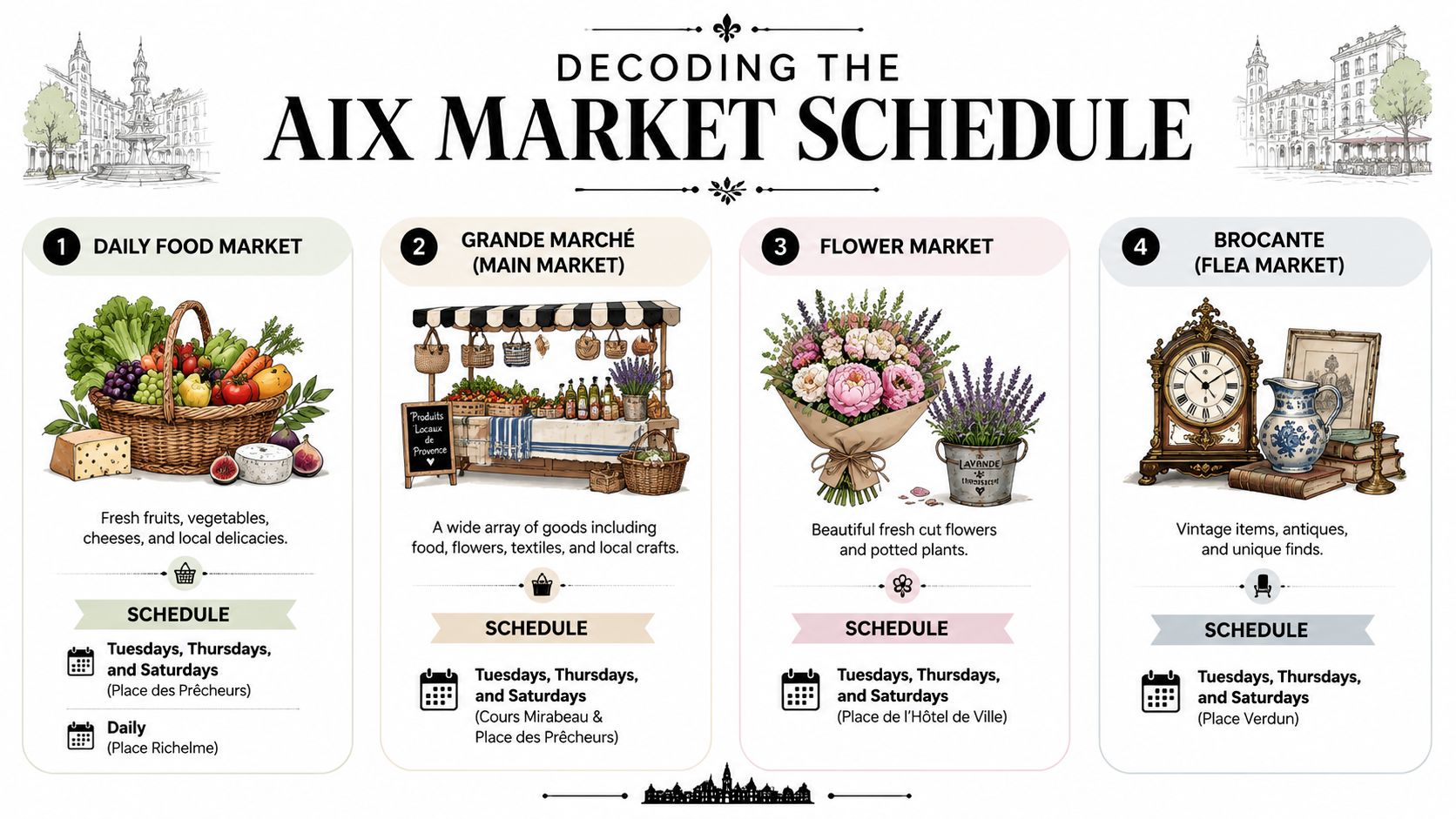
Place Richelme is the steady anchor. The daily food market runs year-round in the mornings, and it is the best starting point for travelers who care more about what ends up on the table than what ends up in a shopping bag. Produce, cheeses, olives, honey, herbs, and seasonal fruit are the focus, as noted in this guide to Aix market days.
On Tuesdays, Thursdays, and Saturdays, Aix shifts gears. Stalls spread through Cours Mirabeau, Place des Prêcheurs, Place de l'Hôtel de Ville, and nearby streets, and the morning becomes broader and more atmospheric. Those are the days for textiles, ceramics, antiques, books, flowers, and the slower pleasure of comparing one stall to the next.
That's the key distinction. Place Richelme suits cooks, picnic planners, and anyone who wants a calm first pass through Provençal food culture. The larger market mornings suit photographers, browsers, and shoppers who want variety.
Aix-en-Provence Market Cheat Sheet
| Market Type | Location | Days | Specialty |
|---|---|---|---|
| Daily food market | Place Richelme | Daily | Fruits, vegetables, cheeses, olive oil, honey, regional delicacies |
| Grande Marché | Cours Mirabeau, Place des Prêcheurs, adjoining squares | Tuesday, Thursday, Saturday | Textiles, crafts, antiques, books, mixed goods |
| Flower market | Place de l'Hôtel de Ville | Tuesday, Thursday, Saturday | Fresh flowers and plants |
| Brocante and antiques | Place Verdun | Tuesday, Thursday, Saturday | Flea market finds and decorative pieces |
What each market is best for
For food-focused travelers: go early to Place Richelme. The mood is more practical than performative, which usually means better conversations with vendors and less crowd pressure when choosing cheese, fruit, or something for lunch.
For photographers: prioritize Place de l'Hôtel de Ville and the stretches around Cours Mirabeau on a tri-weekly market day. Morning light on pale stone, striped awnings, buckets of flowers, and linen stalls gives you strong visual contrast before the squares get too busy.
For budget shoppers: start with the food market, then move to Place Verdun or the mixed stalls later in the morning. Prices on antiques and decorative objects vary widely, and patience matters more than speed. A careful sweep often beats an impulse buy in the first ten minutes.
For thoughtful shoppers: the best day is the one that leaves enough time to ask where something was made. Aix has plenty of attractive goods, but not all of them are local. If provenance matters, use the quieter first hour to ask direct questions and favor edible products, flowers in season, or craft items with a clear maker story.
Practical rule: Pick one priority for the first hour. Food, photos, antiques, or gifts. Aix rewards focus more than frantic box-ticking.
A simple way to choose your day
Use this filter before you go out:
- Choose a daily market morning for a slower pace, food shopping, and a more local feel.
- Choose Tuesday, Thursday, or Saturday for the fullest mix of stalls and the widest range of non-food shopping.
- Choose Place de l'Hôtel de Ville first if flowers and photographs matter more than buying volume.
- Choose Place Verdun if you enjoy secondhand finds, old objects, and the uncertainty that comes with brocante hunting.
If you like to map out your morning in advance, keep a travel planning checklist for market days and city walks handy. Aix is compact, but market mornings go better when you already know whether you are there to shop, shoot, snack, or wander.
Seasonal and spatial quirks
Market layouts shift during holidays, festivals, and seasonal installations in the city center. Regulars adapt quickly. Visitors often assume the usual setup will be waiting in the usual square, then lose time circling.
Treat Aix as a chain of linked market pockets rather than one fixed event. Start with your main goal while your attention is fresh and your tote bag is still light. Then branch out.
That approach works especially well for travelers trying to shop responsibly. Buy cold items first only if you are heading straight back to your apartment. Save fragile flowers or bulky ceramics for the end. If you want the most local, least wasteful version of an Aix market morning, buy what you can carry comfortably, ask vendors simple questions, and leave room for one good spontaneous find instead of five forgettable ones.
Sourcing Your Provençal Treasures What to Buy
The best buys in Aix aren't always the flashiest ones. A market stall piled with lavender sachets can be lovely, but the things that tend to feel most memorable later are the ones tied to daily Provençal life. A bottle of olive oil you'll use. A wedge of goat's cheese shared at lunch. A tablecloth that changes how your kitchen feels back home.

The edible souvenirs worth carrying
Place Richelme is strong on the foods people eat in this region. Look for goat's cheese, olive oil, lavender honey, garlic, aromatic herbs, jams, syrups, wines, and calissons, alongside seasonal produce such as tomatoes, apricots, peaches, melons, strawberries, radishes, beans, and plums.
A good buying strategy is to think in layers. One fresh item for immediate eating. One pantry item for later. One giftable item that travels well.
Some of the most dependable choices are:
- Goat's cheese: Buy what you'll eat within a day or two. Ask what's milder and what's firmer.
- Olive oil: Taste before buying if offered. Choose the bottle you can imagine finishing at home, not the one with the prettiest label.
- Lavender honey: Easy to pack and distinctly regional.
- Calissons: These almond-orange flower sweets are one of Aix's signatures and make a smarter souvenir than generic candy.
The non-food finds that feel local
The larger market days bring out the classic Provençal household goods and wearable souvenirs. You'll see textiles, pottery, jewelry, bags, hats, shoes, tablecloths, and decorative objects. Some are practical. Some are playful. Some are impulse buys you'll regret by dinner.
What tends to work best:
- Provençal table linens if you want something useful and regionally evocative
- Straw hats or berets if you'll wear them
- Pottery if you've got luggage space and wrap it well
- Lavender products or soaps if you want lightweight gifts
If sustainable choices matter to you, discernment is helpful. Buy fewer things, but ask where they were made. The most satisfying purchases usually come with a conversation. That mindset fits naturally with sustainable tourism principles because it favors local craft over disposable souvenirs.
A market souvenir should feel like a continuation of place, not proof that you were there.
How to tell the real thing from filler
Authenticity at markets isn't about rustic packaging. It's about context. A producer who can explain their olive oil, honey, or cheese is usually a better bet than a stall that leans only on visual charm.
For crafts, inspect finish and function. Does the fabric feel durable? Is the soap scented in a way that smells botanical rather than harsh? Would you still want the object if it had no “Provence” story attached to it?
That question weeds out a lot.
Shop Smart A Guide to Market Etiquette and Budgeting
You arrive just after breakfast, the market already humming, a paper bag of fruit in one hand and too many beautiful options in front of you. This is the moment when Aix rewards a little strategy. Shop well here and the morning feels relaxed, generous, and full of small conversations. Shop clumsily and you spend more, carry too much, and miss the best of it.
Good market manners matter because Aix still feels like a working market, not a staged attraction. A vendor notices the traveler who says bonjour, waits their turn, and asks before picking up produce. That traveler usually gets clearer answers, better recommendations, and sometimes a little extra warmth that makes the whole exchange easier.
Etiquette that makes everything easier
The basics are simple, but they change the tone fast.
- Greet first: Start with bonjour before asking a question.
- Let the vendor lead with produce: If you are unsure, point and ask rather than handling everything yourself.
- Ask before taking photos: Especially if a person or a carefully arranged stall is the subject.
- Step aside after ordering: Pay, collect your change, then pack your bag without blocking the next customer.
- Bring your own tote: It saves waste and makes heavier market mornings much easier.
One more point on bargaining. In Aix, hard negotiation rarely plays well, especially on food. Prices on produce, cheese, bread, and prepared specialties are usually the prices. A polite request can make sense on textiles, soaps, household goods, or if you are buying several items from the same stall. Tone matters more than tactics.
How to spend less without shopping badly
The best savings usually come from restraint, not performance. Buy what you can use, compare one or two stalls before committing, and avoid the common traveler mistake of purchasing the first charming thing they see at 9 a.m. with no sense of what the rest of the market offers.
Timing helps too. Early shopping gives you the best selection, which matters for picnic ingredients and anything seasonal. Later in the morning, some non-food vendors may be more flexible if you are buying multiple items, but this is never guaranteed. Food stalls are less likely to negotiate, and I would not push it.
Cash still helps. Many vendors now take cards, but not all, and small purchases are easier when you have notes and coins ready. Set a clear spending cap before you arrive. I like to split it into two parts: one amount for planned buys such as lunch, gifts, or pantry items, and one smaller amount for impulse purchases. If you tend to overspend while traveling, this kind of trip budgeting approach that keeps daily spending realistic works well in Aix because temptation is everywhere.
A practical budget by traveler type
Different shoppers should budget differently.
A foodie gets the best value by buying a same-day meal instead of stocking up on fragile things that will not travel well. Put most of the budget toward produce, cheese, bread, and one take-home item such as honey or calissons.
A photographer may spend very little on goods and more on a long coffee, a pastry, and time. Save room in the budget for a café stop and buy only one object that feels tied to the morning you had.
A budget shopper should compare quality before price. The cheapest tablecloth or soap is often the one that feels generic by the time you unpack at home. One well-made useful item beats three forgettable ones, and it is usually the more sustainable choice too.
What usually works
- Doing one slow lap before buying anything expensive
- Asking where an item was made
- Buying edible gifts that travel well and get used
- Using cash for small purchases and keeping coins handy
- Choosing fewer, better things over souvenir clutter
What usually backfires
- Treating every stall like a place to negotiate
- Buying fragile items before the rest of your day
- Assuming every market product is locally made
- Overbuying food because it looks romantic in the moment
- Stopping in the middle of a busy stall to decide
Respect gets remembered. In Aix, that often matters more than chasing the last euro.
Your Perfect Market Day Sample Itineraries
Different travelers need different versions of the same city. Aix is especially good at that. One person wants lunch ingredients. Another wants shadows, flowers, and façades. Another wants the thrill of finding something useful and unexpected for less than a boutique would charge.
The foodie's half-day
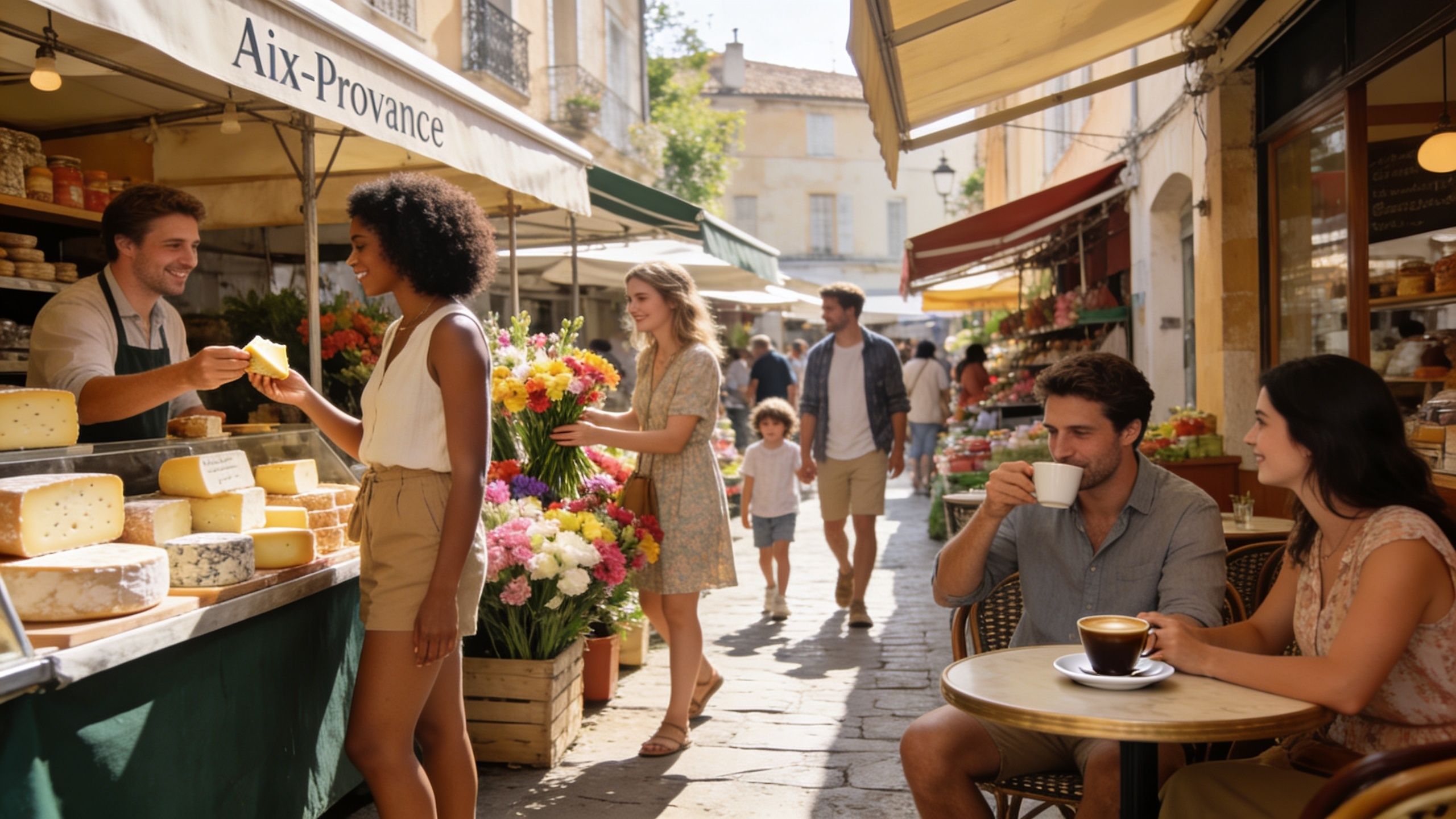
Start early with coffee near Place Richelme, then head straight into the produce stalls before the square gets busier. Buy what you can eat the same day. Think tomatoes, melon, herbs, cheese, bread, honey, maybe a sweet like calissons to finish the picnic.
Then move slowly. Taste if invited. Ask what's best that morning. The point isn't to gather a gourmet fantasy haul you can't carry. The point is to build a lunch from the region around you.
A simple foodie route looks like this:
- Coffee first: Sit near the square and watch the market wake up.
- Buy lunch in parts: Produce, cheese, bread, then one sweet item.
- Add one bottle or jar: Olive oil, syrup, or honey for home.
- End in shade: Find a fountain, bench, or quiet square for a picnic.
The photographer's route
Photographers should think in textures and transitions, not just stalls. Begin when the light is still gentle and the stone façades haven't flattened into midday brightness. The flower market and the edges of the larger market are often richer than the busiest center because people still pause there.
Look for hands, baskets, awnings, stacked fruit, old shutters, and café life just beyond the stalls. Aix photographs well when you include both commerce and architecture in the same frame.
Go early for light, stay later for character.
A good route is to begin at Place de l'Hôtel de Ville, drift toward Place Richelme, then walk into Cours Mirabeau as the city becomes more animated. If you enjoy designing city days around mood and movement, there's something useful in this kind of tightly edited one-day city itinerary approach, even if the destination is entirely different.
The budget shopper's mission
The budget-minded traveler should choose a Tuesday, Thursday, or Saturday and save the broad browsing for later in the morning. Start with a scan, not a purchase. Walk the textile and brocante areas first so you know the price range before committing.
Then go back for the best object, not the first object. Maybe it's a tablecloth, a hat, a ceramic dish, or a stack of second-hand books that fits your bag and your budget.
The mission works best with three rules:
- Set a spending ceiling before you start
- Buy one memorable item instead of several average ones
- Negotiate only when it makes sense, especially on multiples
That's where Aix rewards patience. The traveler who circles back usually buys better than the traveler who grabs the first charming thing in sight.
Discover Local Favorites Vendor Spotlights
The smartest way to find great vendors in Aix isn't to chase a list of names. Market lineups change, seasons shift, and the best stall one month may not be the one that catches your eye the next. What doesn't change is the pattern of quality.
How to spot a strong food stall
At produce stands, look at who's buying. Locals rarely waste time on weak fruit. If a stall has repeat customers, brisk turnover, and produce that looks seasonal rather than overly polished, that's a good sign.
For cheese, olive oil, or honey, look for sellers who engage easily and know their products without turning the exchange into a performance. The best stalls usually feel calm and specific.
A few signals to trust:
- Locals waiting patiently
- A focused range rather than endless variety
- Clear willingness to explain origins or flavors
- Products that look handled, tasted, and bought, not merely displayed
Where to linger after you buy
The daily farmer's market in Place Richelme runs 365 days a year from 8am to 1pm, and the cafés around it are ideal for observing local life. For travelers who want deeper context, the town hall also offers English-guided tours that explain the tradespeople and produce traditions in more detail.
That combination matters. The market is better when you don't treat it like a transaction zone. Buy something, then sit nearby. Watch who comes and goes. Listen to the cadence of the square.
My favorite kind of market stop
I always like the stalls where tasting leads the interaction. Olive oil producers who pour a little into a cup. Cheese sellers who cut a small sample. Honey vendors who let you compare one floral note against another. Those exchanges slow you down enough to make a better choice.
The cafés do the same thing in another form. They remind you that the market is part of the city's social fabric, not a temporary attraction laid out for visitors.
Taking the Spirit of the Market Home with You
Aix stays with you most clearly through small details. The fragrance of herbs on your hands after handling a paper bag. The weight of a peach that has real perfume. The sight of pale morning light moving across a square while café cups clink nearby. Those are the things that outlast the shopping itself.
The aix en provence market works best when you approach it as both a practical errand and a cultural ritual. You buy lunch, yes. You might also buy soap, honey, or a linen cloth. But the deeper value is in how the market teaches you to pay attention. To seasons. To craftsmanship. To the difference between a souvenir and something you'll use and remember.
A thoughtful market visit also does something many polished travel experiences don't. It connects your spending to people. Small producers, independent sellers, and craftspeople benefit when travelers choose direct, local purchases over generic retail. That's one of the simplest ways to travel more ethically without turning the trip into homework.
If you only remember one thing, let it be this. Don't rush Aix. Arrive hungry, greet people properly, buy less than you think you need, and leave space for one unexpected find. That's usually when the city feels most generous.
Go for the produce if you like. Go for the colors if you're a photographer. Go for the bargains if you're traveling on a budget. But once you're there, let the market become more than its purpose. Let it become the morning you remember when the rest of the trip starts to blur.
If you want more practical, thoughtful trip planning in this same spirit, take a look at Travel Talk Today , a resource for travelers who want to explore well, spend wisely, and connect more fully with the places they visit.