Stop Overpaying for Flights: Your Adventure Starts Now
You find a destination that fits the mood exactly. A city you've wanted to photograph for years, a coastal town that promises a slower week, a reunion that suddenly feels possible. Then you open a flight search tab, see a brutal fare, and close the dream just as fast.
That's the moment most travelers assume the price is the price. It usually isn't. Cheap flight hacks work best when you stop treating airfare like a fixed cost and start treating it like a search problem with patterns, tools, and trade-offs.
At Travel Talk Today, we believe travel should be accessible and meaningful, not reserved for people who book luxury trips on a whim. The good news is that many of the best ways to lower airfare don't require gaming the system. They require better timing, wider search habits, smarter routing, and a little patience.
This guide gets straight to it. These are 10 practical cheap flight hacks that help you move from passive fare-watching to deliberate booking. Some save money by expanding your options. Some save money by helping you wait. Some help you avoid the classic mistakes that make a cheap fare expensive later.
If you've got a destination in mind, or even just a rough budget and a restless streak, this marks the beginning of your next trip.
1. Flexible Date Searching and Off-Peak Travel

A fare that looks painful on Friday can look very reasonable if you leave on Thursday and come back Monday instead of Sunday. That small shift is one of the most reliable ways to cut airfare without sacrificing the trip itself.
The mistake is searching as if your first idea is the only version of the trip. Better results come from treating dates as a range, then narrowing only after you see the price pattern.
Build the search the right way
Start with a calendar-based tool such as Google Flights or another search engine that shows prices across a full month. Enter your route, then widen your trip by a few days on both sides before making any decisions. Google's own tips for finding cheaper fares recommend comparing flexible dates and nearby airports because small adjustments often expose lower-priced combinations on the same route, as outlined in Google Flights travel tips.
Use this workflow:
- Search your ideal trip as a range: If you want a five-day trip in May, search a wider May window first instead of locking in exact dates.
- Scan for cheaper departure and return pairings: The lowest outbound flight does not always combine with the lowest return.
- Check shoulder-season weeks: Late spring and early fall often give you a better mix of fare value, manageable crowds, and decent weather.
- Compare nearby airports only if the math works: A cheaper fare from an airport 90 minutes away is only a win if parking, rail, or bus costs do not erase the savings.
Practical rule: Search broad first. Book narrow once you know which date pair actually saves money.
This works best for travelers who can trade a little schedule certainty for a better total trip. I use it most aggressively on city breaks and longer leisure trips, where shifting by two or three days rarely changes the experience much but can change the fare a lot.
Off-peak and shoulder-season travel also improve the trip on the ground, not just in the booking engine. You spread your spending across periods when local businesses need it more, avoid the worst crowd pressure in places that get overrun in peak months, and usually move through the destination at a more human pace. That is a practical budget choice and, in many places, a better way to travel.
2. Incognito Browsing and Cookie Clearing
A lot of travelers swear by private browsing. I treat it as a clean-search habit, not a magic trick.
There's a reason this tip survives. Repeated searching across the same route can clutter your decision-making, and private windows help you separate one search session from the next. Even when the browser itself isn't the deciding factor, a clean session makes comparison easier and reduces the temptation to chase the same fare all day.
Use it as a workflow, not a superstition
Open a private or incognito window before you start comparing dates and airports. Then keep your process consistent across platforms so you're not mixing cached sessions, logged-in views, and old filters.
That means:
- Start fresh each session: Use a new private window when you rerun a route.
- Compare across tools: Check the fare in more than one search engine before booking.
- Log out if needed: Loyalty accounts and saved settings can change what you see, especially once ancillaries get layered in.
Value here is discipline. You're less likely to revisit the same route obsessively, less likely to confuse a fare with one that included bags or seat selection, and more likely to make a clean final comparison.
Don't rely on incognito mode alone. If the route is expensive, the bigger win usually comes from changing dates, airports, or the ticket structure.
If you use this tip, keep it in its proper place. It's a supporting hack, not a primary one. The strongest savings usually come from flexibility and tracking, while private browsing just helps you search with fewer distractions.
3. Price Alerts and Fare Tracking Tools
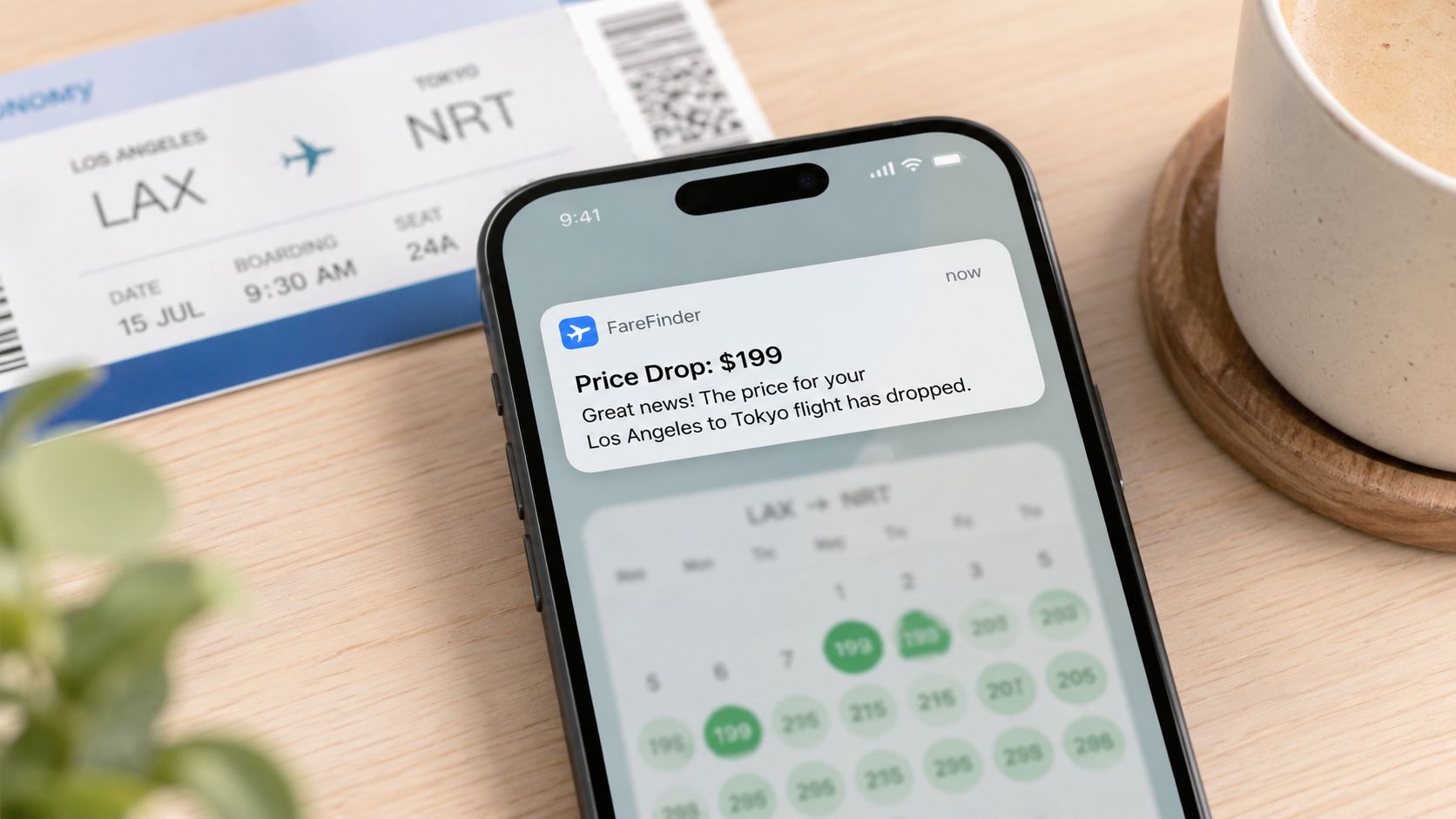
You check a fare at breakfast, again at lunch, and once more before bed. The price moves a little, your confidence drops a lot, and you still do not know whether it is time to book. Price alerts solve that problem better than constant manual searching.
Set them early. Then track the route in a way that matches how you travel, not just the neat version of the trip you first had in mind.
Build a tracking setup you can act on
A single alert is better than nothing, but a small group of alerts is what makes this method useful. Create one for your ideal route, then add nearby airports and a few date variations you would realistically accept. Fare drops often show up in the second-best version of the trip, not the first.
My rule is simple. If I would book it, I track it.
That usually means:
- Your main route first: The exact airport pair and dates you want most.
- Alternate airports next: Especially if your city has more than one practical option.
- One or two date shifts: A day earlier or later can change the fare enough to matter.
- A separate folder or label: Alerts pile up quickly, and organization keeps you from missing the one that fits.
The primary advantage is speed with judgment. When an alert comes in, you should already know your limits on bags, connection times, arrival hours, and total trip cost after fees. Cheap fares lose their appeal fast once a budget airline adds a cabin bag or a self-transfer turns into an overnight scramble.
That is also where this hack fits the bigger picture of smarter travel. Alerts reduce impulsive booking, which usually leads to better trip design. Instead of grabbing the first low number you see, you can wait for an itinerary that supports a slower pace, a better airport, or a routing that wastes less time and money.
Google Flights, Hopper, Skyscanner, and airline alerts all have their place. The best choice is the one you can stick with for a week or two without forgetting about it. I usually trust search tools to spot movement across options, then verify the final fare directly with the airline before I pay.
One warning. Alerts are only useful if you pre-decide what counts as a good buy. Without that, every notification feels urgent, and you end up back in the same cycle of reactive searching.
4. Connecting Flights and Why Hidden-City Tickets Aren't Worth It
You find a fare that is $180 cheaper, but it adds a stop. That can be a smart trade if the connection is built into one ticket, the layover is realistic, and the airport setup works in your favor. I book these all the time when the savings are meaningful and the schedule still leaves room for a sane travel day.
Connections are not only a pricing trick. They can also support a better style of travel. A few extra hours in Lisbon, Istanbul, or Reykjavik can turn transit time into an actual break in the trip. For travelers trying to spend less while traveling more thoughtfully, that is often a better outcome than paying a premium for the fastest possible routing.
How to test whether a connection is actually worth it
Start with the nonstop fare so you know the baseline. Then compare one-stop options on the same route and sort them by total trip time, not just price.
After that, check the parts that usually cause problems:
- Layover length: Give yourself enough time for terminal changes, immigration, security, or a late inbound flight.
- Single ticket vs. self-transfer: One ticket is usually safer because the airline is responsible if the first flight is delayed.
- Bags: Through-checked luggage matters. If bags will not be transferred automatically, the "cheap" fare can become stressful fast.
- Airport quality: Some airports are easy for a 70-minute connection. Others are not.
- Arrival time: Saving money is less impressive if you land at 2 a.m. and spend the difference on taxis or an airport hotel.
That process takes a few minutes, but it prevents the classic mistake of buying the lowest fare and discovering later that the itinerary only works on paper.
Hidden-city ticketing is different. It means booking a connecting flight and intentionally getting off at the layover city instead of flying the final segment. The pitch sounds clever. The trade-offs are not. Checked bags usually continue to the ticketed destination, missed final segments can disrupt the rest of the booking, and airlines can penalize travelers who repeatedly break fare rules. Dollar Flight Club's overview of cheap flight hacks and trade-offs points budget travelers toward safer methods such as standard fare searches and alerts rather than loophole-based tactics.
The better workflow is simple. Price the nonstop. Price the legal connection. Check bag rules, airport transfers, and total travel time. Then book the option you would still feel good about if the first flight runs 45 minutes late.
Boring works here. It saves money without putting the whole trip at risk.
5. Airline Miles, Credit Card Points, and Loyalty Programs
Miles and points aren't a shortcut for everyone, but they're powerful if you're organized. The mistake is treating them like free travel detached from real spending. The smart approach is to match them to the trips you already take and the money you already spend.
If you travel even semi-regularly, airline and bank programs can give you optionality. That matters because cheap flight hacks aren't only about cash fares. Sometimes the best move is reducing your out-of-pocket cost when the cash price is stubborn.
Where points help most
Longer, more expensive routes usually offer the strongest emotional value. A redemption that makes a long-haul trip finally feasible often feels more meaningful than shaving a little off a short hop.
Build around simplicity:
- Pick a small ecosystem: One or two airlines, or a flexible bank points program, is easier to manage than trying everything.
- Watch fees and restrictions: A “free” flight can still be annoying if change terms are harsh or routing is poor.
- Compare cash and points every time: Don't redeem just because you can.
I like loyalty programs most when they support a broader travel style. One well-used card, one airline alliance you fly, and a habit of checking award options before paying cash. That's enough.
This hack also rewards slower travel. If you're taking fewer, longer trips instead of many rushed weekends, you can use points strategically on the routes that matter most and spend your actual budget on time on the ground.
6. Budget Airlines and Alternative Carriers
Budget airlines can be fantastic. They can also turn into fake bargains if you ignore the fine print.
The base fare is only the starting point. Once you add bags, seat selection, airport transfers, and inflexible policies, the cheapest-looking option can lose quickly. Still, for short-haul trips or light packers, low-cost carriers remain one of the most practical cheap flight hacks available.
When they work best
They work best when your travel style already fits the model. You're carrying little, you don't care where you sit, and you're comfortable with a stricter experience if the savings are real.
Here's the cleanest way to evaluate them:
- Price the full trip, not the headline fare: Include baggage, seats, and transport from the arrival airport.
- Read the cabin bag dimensions: Low-cost carriers often enforce them tightly.
- Avoid fragile timing: If the ticket is separate from another flight, give yourself room for disruption.
A traveler heading from one European city to another with a small backpack might do brilliantly on Ryanair or easyJet. A family with checked luggage, child seats, and a tight arrival schedule might be better off on a traditional carrier with fewer surprise costs.
Cheap fares reward simplicity. The more extras you need, the less useful the budget-airline model becomes.
Used selectively, these carriers can open up regional travel in a big way. They're especially strong when you're building a longer trip and need a practical intra-region flight that doesn't need frills.
7. Fly to Alternate Airports and Gateway Cities
You find a cheap fare to “Paris,” click through, and realize the lowest option lands far outside the city, after midnight, with a transfer that costs almost as much as the savings. The better move is to compare airports and gateway cities before you fall in love with the first fare.
Good flight shopping starts with geography, not just destination names. A city can have multiple airports with very different fares, transport links, and airline competition. In some cases, the cheapest long-haul ticket is not to your final stop at all. It is to a nearby hub where trains, buses, or short regional flights give you a cleaner and cheaper way in.
Build the search around the region
Use airport codes, nearby-city searches, and the map view in your flight tools to widen the net. Google explains how exploring nearby airports and flexible destinations can reveal lower fares in its Google Flights travel search tips. That matters here for a different reason than later booking tactics. The point is not booking structure. It is market access. More airports and more city pairs usually mean more pricing pressure and more chances to find a sensible entry point.
A practical workflow looks like this:
- Search the main city first: Get a baseline fare and schedule.
- Check every airport within easy ground reach: One airport may have lower taxes, more budget competition, or a better arrival time.
- Price one or two gateway cities nearby: For example, fly into a major hub, then finish the trip by rail.
- Add all onward costs: Include train tickets, bus fares, airport transfers, and one night of lodging if the timing is awkward.
- Check total travel strain: A cheaper fare loses value if it adds a 4 a.m. bus ride, a risky self-transfer, or an arrival so late that the first day is wasted.
This works especially well in Europe and Southeast Asia, where dense rail networks, short regional flights, and multiple airports create real flexibility. It also suits slower travel. Entering a region through a lower-cost hub often gives you time to move overland, see more, and avoid paying a premium just to force a direct route.
I use this tactic most often on trips where the destination city itself is expensive to fly into, but the surrounding region is not. The savings are real when the onward leg is simple. They disappear fast when travelers ignore transfer times, baggage rules, or the price of reaching the city center.
Cheap travel is rarely about finding one magic fare. It is about building an itinerary that still makes sense after every extra cost is counted.
8. Open-Jaw Tickets and Multi-City Routing
Round trips are familiar, but they're often clumsy. If your trip moves in one direction, your flight plan should too.
Open-jaw tickets let you arrive in one city and leave from another. Multi-city searches go a step further by stitching several legs into one plan. Both are useful when you want to explore a region without backtracking to your original arrival point just to fly home.
How to make this work in practice
Use the multi-city search tab rather than forcing everything into a round-trip template. Enter the trip exactly as you intend to travel it. Fly into one city, move overland or with a regional flight, then depart from where your trip naturally ends.
This is especially helpful for a route like arriving in Lisbon and departing from Madrid, or landing in Bangkok and leaving from Singapore after traveling south over time. The itinerary matches the trip instead of distorting it.
A few guardrails matter:
- Compare against two one-ways: Sometimes open-jaw wins, sometimes it doesn't.
- Plan your overland leg early: Train demand and regional flights can shape the actual cost.
- Leave recovery time at the end: Don't schedule your final long-haul departure too tightly after a complicated regional segment.
This is one of my favorite cheap flight hacks because it saves money indirectly too. You don't waste time and ground transport returning to where you started. You also travel in a cleaner line, which tends to feel more immersive and less frantic.
9. Book on the Right Day and Fly on the Right Day
You spot a fare on Thursday, assume it will hold, then check again on Sunday and find a lower price. That kind of swing is common enough to matter, especially on routes with heavy leisure demand.
The useful rule here is simple. Treat booking day and departure day as two separate tests. Old advice about one universally cheap booking day does not hold up well, but weekly demand patterns still create openings for travelers who compare a few options instead of buying on autopilot.
According to Expedia's 2025 Air Hacks Report, Sunday bookings can be cheaper than Friday bookings, Friday departures can price lower than Sunday departures on average, international travelers can save by departing on Friday instead of Sunday, and domestic travelers often see lower fares on Saturday than on Monday.
Use timing as a workflow, not a superstition
Here's the practical way to apply that:
- Check the route on two booking days: Price it once before the weekend, then again on Sunday.
- Test departure dates separately: Search the same itinerary with Thursday, Friday, Saturday, Sunday, and Monday departures if your schedule allows.
- Watch total trip cost, not just airfare: A cheaper Friday flight can be offset by an extra hotel night or higher weekend rates.
- Use this for slower travel when you can: Leaving on a lower-demand day often fits better with longer, less rushed trips, and that usually means fewer expensive last-minute decisions on the ground.
One caution matters. These patterns are averages, not guarantees. School holidays, major events, and thin regional routes can break them fast. I use day-of-week pricing as a filter, not a law.
That mindset keeps this hack useful. You are not chasing a magic day. You are running a short, repeatable check that can trim cost without adding much effort, and sometimes without changing the trip at all.
10. Separate One-Ways, Smart Windows, and Self-Connection Discipline
A smart split-ticket itinerary often beats a standard round trip, especially on routes where one airline dominates the outbound and another underprices the return.
This works best as a controlled workflow, not a quick bargain grab. The savings can be real. So can the downside if a delay breaks your connection, your bag does not follow, or a terminal change turns a legal connection into a stressful sprint.
Google Flights explains how to compare one-way fares, track date-by-date pricing, and test nearby airports. That is the better frame for this section. Use booking windows as a starting point, then verify the route by direction, airport, and connection risk instead of relying on a repeated rule of thumb.
Build the fare first, then stress-test the trip
I use a simple sequence here:
- Search each leg separately: Price the outbound and return as one-ways before checking the round-trip fare. Some carriers price one direction competitively and the other aggressively.
- Test a few date windows: Check your ideal dates, then shift each leg by a day or two. A split itinerary can fall apart if one leg only works on a narrow pricing window.
- Compare protected versus self-connected options: If the savings are small, keep the single-ticket itinerary. Protection matters.
- Add airport reality to the math: Separate tickets can mean a terminal change, a bag recheck, passport control, or even changing airports across a city.
- Put a cash value on the buffer: A longer layover costs time, meals, and sometimes an airport hotel. Include that before calling it a deal.
The key difference from alternate-airport strategy is responsibility. In Section 7, the point was where to fly. Here, the point is who carries the risk once you stitch separate tickets together. On a self-connection, that is usually you.
A practical example. You book a low-cost flight into a major hub on one airline, then add a separate onward ticket on another carrier because the through-fare is much higher. That can be a strong move for slower travel, especially if you plan an overnight stop, travel with carry-on only, and treat the hub as part of the trip instead of a rushed transfer point.
Discipline matters more than cleverness here.
Leave a serious buffer. Travel with carry-on when possible. Recheck visa and entry rules even for short stopovers. If the first flight is late, the second airline usually does not care that the delay started on another ticket.
Used well, separate one-ways give you more control over price and routing. Used carelessly, they turn a cheap fare into an expensive recovery day.
10-Point Cheap Flight Hacks Comparison
No single trick wins every search. The right move depends on your route, your time budget, your tolerance for risk, and whether you are building a trip around speed or around price.
Use this table as a decision tool, not a checklist to blindly follow.
| Hack | Best For | What It Usually Gets You | Real Cost or Risk | My Practical Take |
|---|---|---|---|---|
| Flexible Date Searching and Off-Peak Travel | Travelers with wiggle room on departure day or season | Better fares, calmer airports, and trips that feel less rushed | You may need to shift vacation days, weather expectations, or event timing | This is often the cleanest savings available because you are changing demand, not trying to outsmart a booking system. It also supports slower, lower-stress travel. |
| Incognito Browsing and Cookie Clearing | Travelers who want a clean search process before booking | A fresh comparison view across tools and devices | Results are inconsistent, and it will not rescue an overpriced route | I use it for tidy testing, not because I expect magic. Compare across search engines first. Browser tricks come second. |
| Price Alerts and Fare Tracking Tools | Planned trips where you can wait and watch | Better timing, sale alerts, and fewer impulse bookings | You need patience and enough lead time to act when a fare drops | This is one of the highest-value habits in the whole playbook. Set alerts early, then let the market come to you. |
| Connecting Flights and Why Hidden-City Tickets Aren't Worth It | Travelers open to longer itineraries and legal stopovers | Lower fares and sometimes a chance to see an extra city | More travel time, tighter margins on delays, and possible visa or transit issues | Standard connections can be smart. Hidden-city ticketing is usually not. The short-term savings rarely justify the baggage limits, loyalty penalties, and disruption risk. |
| Airline Miles, Credit Card Points, and Loyalty Programs | Frequent travelers and organized points users | Lower cash cost, better cabins, or useful extras like bags and seat selection | Award availability can be uneven, and bad redemptions waste value | Points work best with a plan. I focus on programs I can actually use, then compare redemption value against the cash fare before transferring anything. |
| Budget Airlines and Alternative Carriers | Short-haul travelers, carry-on packers, and simple trips | Very low base fares on the right routes | Baggage, seat, and airport-transfer fees can erase the headline bargain | Always price the full trip, not the first screen. A budget airline can be excellent for a short regional hop and poor value once add-ons stack up. |
| Fly to Alternate Airports and Gateway Cities | Travelers visiting a region, not just one airport code | More route options and fares that can be meaningfully lower | Extra train, bus, or hotel costs if the airport is far from where you need to be | This works best when the ground segment fits the trip naturally. If the gateway city is worth a night or two, the savings often hold up better. |
| Open-Jaw Tickets and Multi-City Routing | Longer trips across a country or region | Less backtracking and a more efficient route | Planning takes more effort, and some combinations price poorly | One of the smartest ways to save both money and time. It often turns a rushed loop into a cleaner itinerary with fewer wasted transit days. |
| Book on the Right Day and Fly on the Right Day | Travelers who can test several departure patterns | Better odds of finding a weaker demand day to fly | There is no universal booking day, and rigid rules lead to missed deals | I do not chase myths here. I test a range of departure days and book when the fare is good for that route, not when a social post says I should. |
| Separate One-Ways, Smart Windows, and Self-Connection Discipline | Experienced travelers who can manage buffers and backup plans | More control over routing and occasional savings on mixed carriers | Missed-connection risk, recheck hassles, and recovery costs fall on you | This can work well if you treat the stop as part of the trip and leave real breathing room. If the savings are small, buy the protected through-ticket and keep your day intact. |
The pattern is simple. The best cheap flight hacks are the ones that still make sense after you add baggage, ground transport, time loss, and connection risk. That is how a low fare becomes a good trip, not just a cheap booking.
Your Passport to Smarter, More Affordable Travel
Cheap flights rarely come from one trick. They come from a better process.
That's the big shift behind all of these cheap flight hacks. You're no longer typing in one route, hoping for a miracle, and accepting whatever the first screen gives you. You're widening the search, letting alerts do the monitoring, comparing whole-trip costs instead of headline fares, and choosing routes that fit the way you want to travel.
That matters for more than your wallet. A smarter airfare strategy often leads to a better trip. Flexible dates can place you in a destination when it's calmer and more livable. Gateway cities and open-jaw tickets can turn a rushed vacation into a more natural journey through a region. Even something as simple as choosing a legal connection over a risky loophole can mean less stress and fewer ugly surprises halfway across the world.
The strongest habit in this entire guide is probably this: stop chasing certainty where none exists. There isn't one perfect booking day for every route, one secret browser trick that always wins, or one airline that's always cheapest. There is, however, a repeatable playbook. Search broadly. Track fares. Test alternate airports. Compare one-way and multi-city options. Factor in baggage, ground transport, and connection risk before you call a fare cheap.
That's how seasoned travelers think. They don't confuse a low sticker price with a good deal. They look at the full chain of the trip, from departure airport to final arrival, and they make choices that hold up in real life.
If you're planning your next trip now, don't try to master all 10 strategies at once. Pick one or two and use them well. Set up a proper fare alert matrix. Run your route through a flexible date calendar. Try an open-jaw search instead of a round trip. Check whether a nearby airport or gateway city changes the numbers in your favor. Once you do that a few times, booking starts to feel less mysterious and much more strategic.
Travel gets more meaningful when it becomes more accessible. When you spend less on getting somewhere, you give yourself more room for the parts of travel that matter. More nights in a place worth lingering in. More budget for local food, trains, museums, guides, and small businesses. More freedom to say yes to the trip in the first place.
The world is still there. The fare on your screen isn't the final word. Use the tools, trust the process, and book more thoughtfully.
Travel Talk Today helps you turn smart airfare strategy into better trips, with practical guides on meaningful, affordable travel, slow itineraries, volunteering abroad, and budget-friendly planning. Explore more thoughtful travel ideas at Travel Talk Today.