Booking apps have made one part of sustainable travel harder, not easier. You can compare prices in seconds, but it is much harder to tell whether a place is reducing waste and supporting its community, or just dressing up ordinary operations with a few green words.
That confusion hits budget and solo travelers first. If you are watching every dollar, you do not have room to pay extra for a bamboo toothbrush and a vague promise about caring for the planet. You need a stay that is actually run with care, priced fairly, and easy to verify before you book.
I learned this the expensive way. More than once, I booked a place that marketed itself as eco friendly because it asked guests to reuse towels, then arrived to find plastic water bottles everywhere, weak recycling practices, and food shipped in from far away. A good green stay works like a well-packed backpack. Every part has a purpose, nothing is wasteful, and the whole setup makes the trip easier, not more complicated.
The good news is that you do not need a luxury budget or a degree in sustainability to distinguish genuine efforts from greenwashing. A few simple checks can tell you a lot. Is the building designed to stay comfortable without wasting energy? Does the property hire locally and point guests toward local businesses? Are refill stations, lower waste systems, and honest details visible in the listing, or hidden behind feel-good language?
If you want a broader foundation before choosing where to stay, this guide on how to travel sustainably pairs well with what follows. The focus here is practical: how to find eco friendly accommodations that are genuine, affordable, and worth your trust.
Your Journey to More Meaningful Travel Starts Here

Sustainable travel is no longer a niche idea. As noted earlier, a large majority of travelers now say it matters to them. The key question is less whether people care and more whether they can tell the difference between a truly responsible stay and a listing dressed up with a few green phrases.
That question matters most when money is tight and you are booking on your own. A luxury traveler can absorb a bad choice more easily. A solo traveler on a budget usually cannot. If you spend extra on a place that turns out to be all marketing, you lose twice. You waste money, and you miss the chance to support a property that is doing the work.
Good eco friendly accommodations are often better places to stay, full stop. Care for water, energy, waste, and local people tends to show up in the details you feel as a guest: a quieter room, less wasteful design, food with a sense of place, staff who know the area, and a property that feels connected to its neighborhood instead of sealed off from it.
A well-run green stay works like a well-packed carry-on. Nothing flashy needs to happen. It functions better because every choice has a purpose.
Better travel, with clearer standards
Many travelers still assume sustainable means rustic, expensive, or inconvenient. In practice, it often means the opposite. Better insulation can mean better sleep. Refill stations can be easier than buying bottled water every day. A locally run guesthouse can offer more useful advice, more character, and better value than a generic chain room.
The hard part is that greenwashing blurs the picture. Plenty of properties highlight towel reuse while saying little about energy use, local hiring, food sourcing, or waste systems. For budget and solo travelers, learning to spot that gap is one of the best travel skills you can build.
If you want the wider context first, this guide to how to travel sustainably in practical ways gives a strong foundation.
Why meaningful travel starts with where you sleep
Your accommodation shapes more of your trip than you might expect. It affects how much waste you create, where your money goes, how easily you can use public transport, and whether your visit benefits local residents or bypasses them. One booking will not change the world. A pattern of smarter bookings does change where tourism money flows.
That is the encouraging part. You do not need perfect choices. You need better filters.
Once you know what honest effort looks like, eco friendly accommodations stop feeling vague and expensive. They become easier to compare, easier to verify, and much more realistic for travelers who care about both impact and price.
Beyond the Buzzwords What Makes an Accommodation Green
A green stay works like a three-legged stool. If one leg is weak, the whole thing becomes unstable. The three legs are environmental impact, social impact, and economic impact.
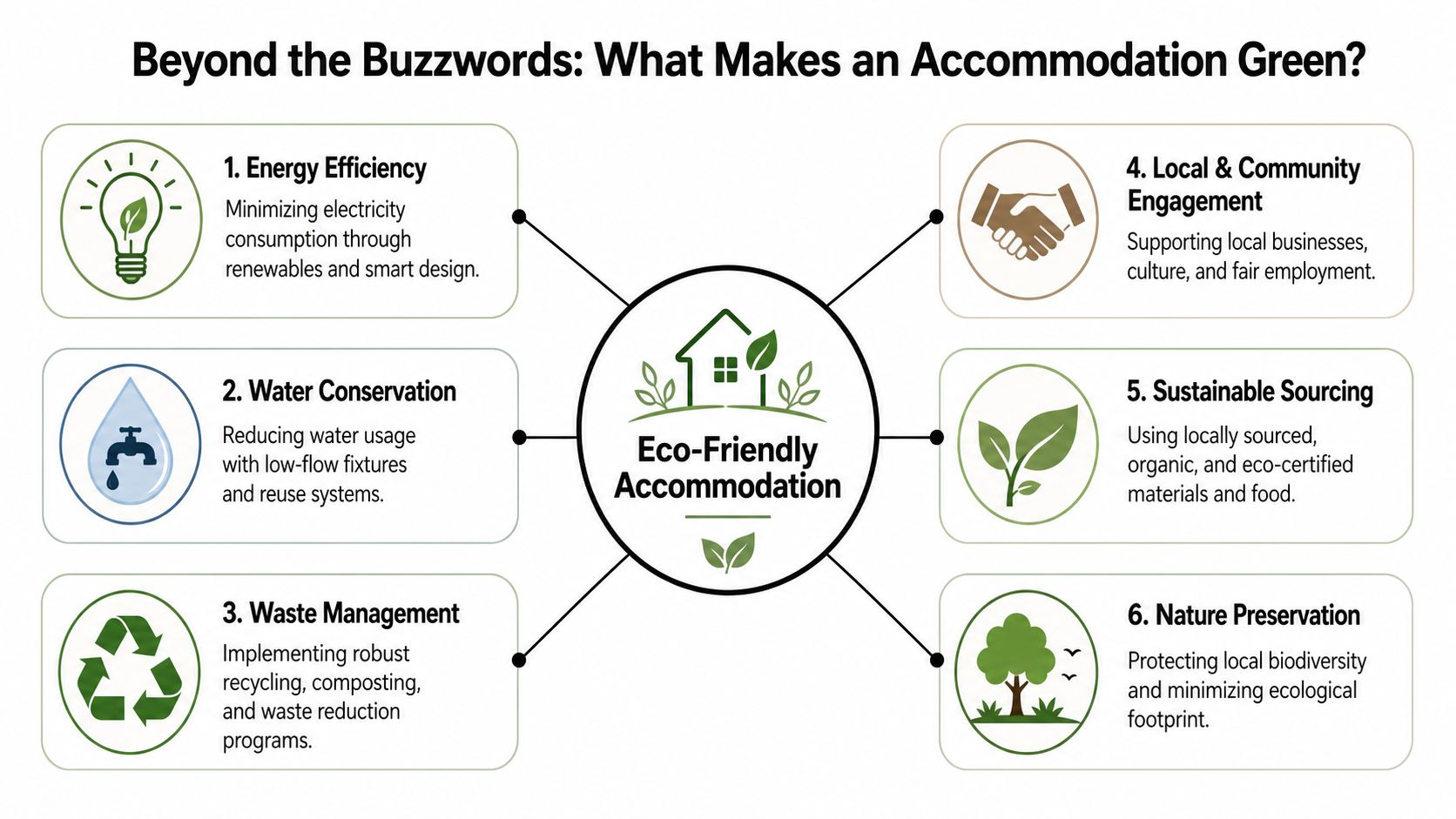
Greenwashing usually hides in plain sight. A property shows you the easiest leg to display, usually the environmental one, and hopes you will assume the other two are solid as well. Budget and solo travelers get hit hardest by this because they often have less time, less money, and fewer chances to recover from a disappointing booking.
As this overview of sustainable tourism practices explains, better travel choices support both places and the people who live there.
The environmental leg
This is the visible part. You can often spot it in photos or amenity lists before you even book.
Look for signs such as efficient heating and cooling, LED lighting, refill stations, low-flow fixtures, waste sorting, less single-use plastic, and buildings designed to use less energy in the first place. These steps matter because they cut the resources a stay uses every day, not just during a marketing campaign.
Here is the catch. Plenty of ordinary hotels now offer towel reuse cards, recycling bins, or refillable toiletries. Those are good steps, but they are baseline signals, not proof of strong sustainability on their own. If a listing only mentions a few easy wins, treat that as the start of your check, not the end of it.
The social leg
At this point, many “eco” claims start to thin out.
A stay can reduce water use and still treat the surrounding community as an afterthought. Real sustainability includes people. That means local hiring, fair working conditions, partnerships with nearby farms or guides, respect for local culture, and some evidence that tourism money stays in the area instead of leaking straight out of it.
For a solo traveler, this leg often shows up in practical ways. Locally rooted places tend to give better neighborhood advice, recommend independent businesses, and connect you to the destination instead of sealing you off from it. That is good for the community and often better for your trip.
A simple test helps here. Read the property description and ask, “Who benefits if I book this?” If the answer is only the hotel brand, the sustainability claim is incomplete.
The economic leg
This one sounds abstract, but it is what makes good practices last.
An accommodation needs a business model that can keep operating without wasteful shortcuts or underpaid labor. It does not need to be fancy. In fact, some of the best examples are modest guesthouses, farm stays, hostels, and small inns that buy locally, hire locally, and keep overhead low through smart efficiency rather than luxury extras.
That is good news if you travel on a budget. Affordable and sustainable are not opposites. They often support each other. A place that insulates well, avoids disposable products, serves seasonal food, and works with local suppliers can control costs while reducing impact.
Here is a quick way to size up all three legs:
| Pillar | What you're looking for | Why it matters |
|---|---|---|
| Environmental | Lower energy, water, and waste | Reduces the stay's direct footprint |
| Social | Local jobs, fair treatment, community ties | Helps tourism benefit residents |
| Economic | Practices that can last without exploitation | Makes sustainability more believable over time |
Perfection is not the standard. Honest effort is. The best green accommodations, especially outside the luxury tier, usually show a pattern of practical choices across all three areas instead of one polished eco headline.
How to Decode Eco Certifications and Avoid Greenwashing
When you're comparing eco friendly accommodations, the logo itself isn't the point. The point is what stands behind it. Some labels reflect detailed standards and verification. Others are little more than self-description.
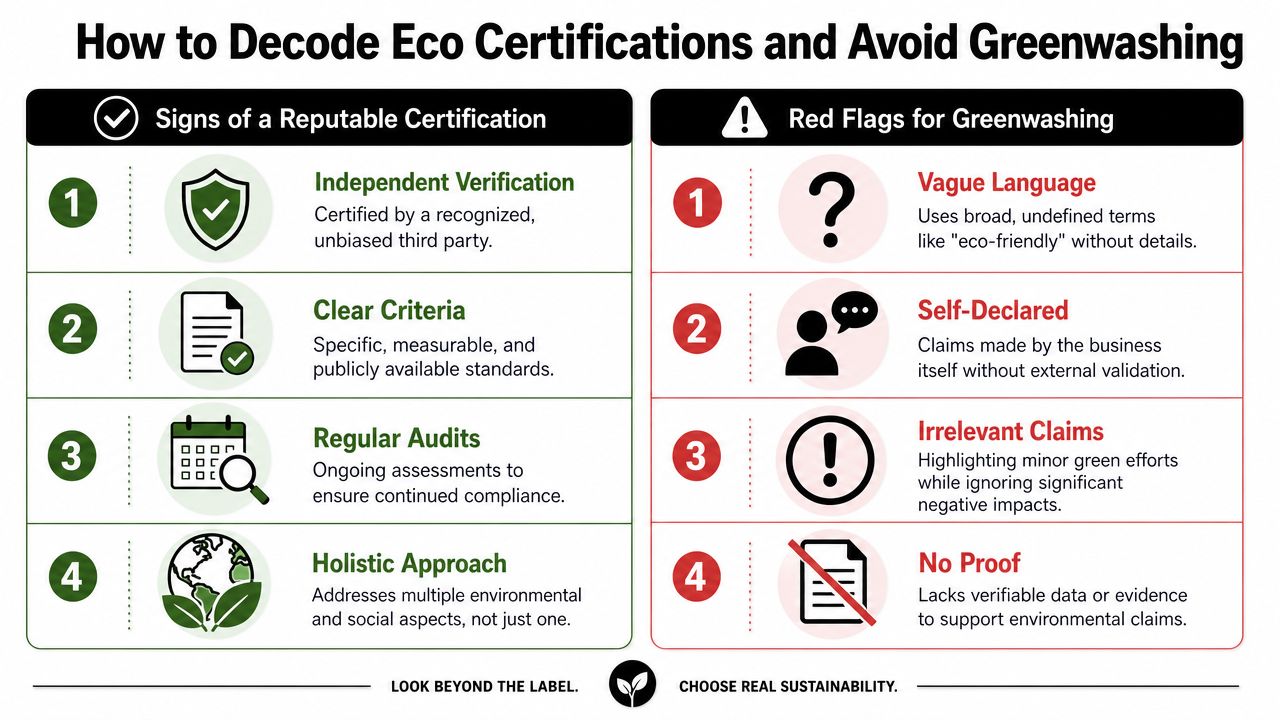
The fastest way to cut through the noise is to sort claims into three tiers.
Tier one means rigorous outside verification
This is the gold standard. A third party sets criteria, the property has to meet them, and there's something concrete behind the badge.
A good example is the EU Ecolabel. To qualify, tourist accommodations must show that at least 50% of their electricity comes from renewable sources and that boilers exceed 88% efficiency, according to the EU Ecolabel criteria document for tourist accommodation. That tells you two useful things. First, the standard is specific. Second, the property can't hide behind fuzzy language.
If you see a certification, ask yourself:
- Is it third-party verified?
- Are the criteria public?
- Does it cover more than one area, such as energy, water, and operations?
- Does the property explain its certification instead of just displaying a badge?
Tier two means useful but narrower signals
Some certifications or standards are regional, smaller in scope, or more common among independent stays. That doesn't make them worthless. It just means you should read more carefully.
For budget travelers, this tier matters a lot because hostels, guesthouses, and homestays may not have the budget or structure for the most heavyweight labels. In those cases, the best sign is often a combination of a smaller credible certification plus clear public information on what the property does.
Tier three means platform labels and self-declared claims
Greenwashing flourishes under these conditions. Booking platforms can be helpful for discovery, but their filters and badges are often a starting point, not proof.
A property saying “eco-conscious stay” or “green hospitality experience” may mean something. It may also mean the owner swapped plastic straws for paper ones and stopped there.
If the claim is broad but the details are missing, trust the details you can see, not the adjective.
Red flags that usually mean marketing first
Greenwashing often follows familiar patterns. Watch for these signs:
- Vague wording: “Earth-friendly,” “natural,” or “sustainable-minded” without examples.
- One tiny action made to sound huge: A hotel that highlights towel reuse but says nothing about energy, water, sourcing, or staff.
- No dedicated sustainability page: If the claim matters to the brand, it should be easy to find and explain.
- No mention of verification: Real standards are usually named directly.
- Stock-photo sustainability: Lots of leaves and wood textures, very little operational detail.
A simple trust ladder
When I'm booking, I use this mental order:
- Verified certification with clear criteria
- Property with specific, detailed practices on its own site
- Consistent guest reviews that mention those practices
- Platform badge with no supporting detail
That order keeps me from getting seduced by branding.
A budget traveler doesn't need to become a certification expert. You just need to learn one habit: reward specificity. Real sustainability usually sounds a little boring because it deals in systems, not slogans.
Finding Green Stays Without the Luxury Price Tag
One of the biggest myths in travel is that eco friendly accommodations are mostly treehouse resorts, remote villas, and expensive wellness retreats. That image leaves out the traveler who's comparing hostel dorms, guesthouses near train stations, or simple homestays with shared kitchens.
That gap is real. As Tilted Map points out in its guide to finding sustainable hotels, most advice focuses on high-end eco-lodges and doesn't give budget travelers a clear framework for vetting hostels and homestays. So let's make the framework simple.
If low price matters, start with the kinds of stays that already tend to use fewer resources per guest: hostels, family-run guesthouses, farm stays, and small apartment rentals with practical systems in place. Then verify.
Use filters as a lead, not a verdict
Booking platform filters can save time. I use them. But I don't stop there.
Open the property's own site and look for pages titled Sustainability, Our Values, About Us, or Community. You want signs that the place can explain itself without relying on the booking platform's wording.
Then compare that with budget basics. If you're already trying to book cheap hotels without sacrificing quality, apply the same discipline here. Read the boring pages. They're often more revealing than the glossy photos.
What affordable and genuine often looks like
Budget-friendly sustainability is usually less glamorous and more practical:
- A hostel kitchen with clear recycling and compost instructions
- Bulk soap dispensers instead of mini bottles
- Natural ventilation and shade instead of heavy air-conditioning dependence
- A guesthouse breakfast built around local produce
- Simple furniture that looks durable, repairable, and local rather than trendy and disposable
These signs don't prove everything. But together they tell a story.
Questions worth sending before you book
If the website is thin, send a short message. You don't need to interrogate anyone. A few calm questions can tell you a lot.
Try asking:
- Do you have any third-party sustainability certification or public sustainability policy?
- Do you employ local staff and source food or supplies locally?
- How do you reduce single-use plastics and manage recycling or waste?
- Do you have water-saving or energy-saving systems in place?
A property that's doing the work can usually answer clearly. A property that's just borrowing eco language often replies with generalities.
Affordable sustainability usually hides in plain sight. It looks like good operations, not luxury branding.
Don't confuse rough edges with dishonesty
Small places won't always have polished language. Some of the most sincere eco friendly accommodations have clunky websites and uneven photos. Don't punish them for that. Look at whether their choices make sense, whether they're specific, and whether guest reviews line up.
Budget travel rewards patience. The same is true here.
Inspiring Examples of Eco Accommodations Worldwide
The most encouraging part of this topic is how many different forms eco friendly accommodations can take. They don't all look like the same Scandinavian cabin on a design blog. Some are rustic. Some are urban. Some are authentically local in ways that feel almost invisible until you stay there.
The community-run lodge
A community-run lodge in a forest or river region often shows the social pillar better than a polished city hotel. The rooms may be simple, but the important part is how the stay connects to local livelihoods. Local guides lead walks. Meals reflect the region. Money circulates close to where you sleep.
That kind of accommodation teaches an important lesson. Sustainability isn't only about lower utility use. It's also about who has agency and who receives the benefit of tourism.
The low-energy hostel in a cold climate
In Europe, some hostels and guesthouses use Passivhaus-style design or similar principles. The headline feature isn't flashy. It's performance. Buildings designed with strong insulation and airtightness need far less heating, which is why the National Forest sustainable accommodation guide points to standards like Passivhaus as a serious signal of lower operational energy use.
For travelers, that can translate into spaces that feel stable and comfortable without wasteful heating habits. It's one of the clearest examples of sustainability built into the bones of a place, not added later as decoration.
The farm stay that closes loops
Farm stays can be wonderful teachers because they make systems visible. You see where food comes from. You notice composting. You understand seasonality. You eat what grows nearby because that's what's available, not because someone wrote “farm-to-table” on a chalkboard.
If that style of travel appeals to you, this piece on agritourism in Italy is worth a look. Even outside Italy, the principle travels well. Stays connected to working land often make sustainability easier to observe because they can't hide the basics.
The best eco stay I ever booked didn't advertise itself as revolutionary. It simply made wasteful choices feel unnecessary.
The urban guesthouse that gets the fundamentals right
You don't need dramatic wilderness for a meaningful stay. A city guesthouse can be a strong eco choice if it occupies an existing building, reduces waste, supports local shops, and gives guests a low-impact base for walking and transit. For solo travelers, this kind of place often offers the best mix of affordability, safety, and genuine local connection.
The point of these examples isn't to create a fantasy checklist. It's to widen your imagination. Eco friendly accommodations aren't one aesthetic. They're a pattern of decisions.
Your Pre-Booking Eco Friendly Accommodation Checklist
A good checklist keeps you from booking based on one shiny claim. Use this before you pay.
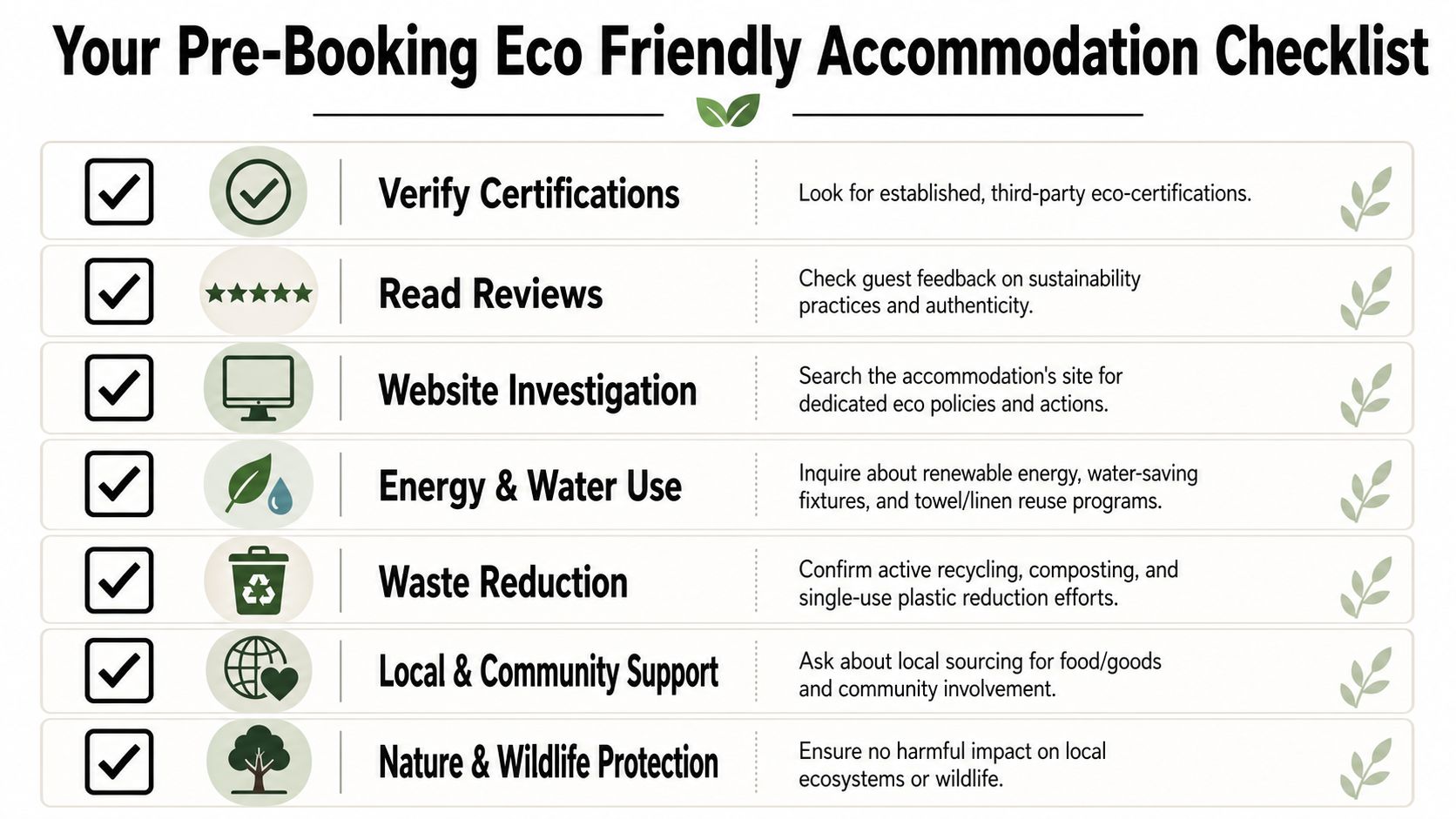
If you already use a travel planning checklist for logistics, add these questions right next to price, location, and cancellation terms.
The seven-question filter
- Can I find a real sustainability page? Look for concrete actions, not just values language.
- Is there a third-party certification mentioned by name? If yes, check whether the property explains it.
- Are the claims specific? “Solar power,” “greywater reuse,” or “local staff hiring” says more than “eco-minded.”
- Do reviews mention sustainability unprompted? Guest comments can reveal whether the practice is visible and consistent.
- Does the property talk about people as well as resources? You want signs of local employment, local sourcing, or community support.
- Do the photos match the claims? Refill stations, sorting bins, shaded design, bikes, gardens, and durable materials can support the story.
- Would I still choose this place if the word eco disappeared? This last question is useful. If the stay still seems well-run, comfortable, and fairly priced, that's often a good sign.
My quick scoring method
I keep it very basic:
| Result | Meaning |
|---|---|
| Yes on most questions | Strong candidate |
| Mixed answers | Worth messaging before booking |
| Mostly vague or missing | Move on |
The goal isn't perfection. The goal is confidence. You want enough evidence to feel that your money is supporting a place that's making real choices, not renting a green image.
Travel Better Book Smarter and Change the World
A booking choice can feel small. In practice, it works like a vote cast with your travel budget.
Every night you pay for sends a signal. Owners notice which listings get booked, what guests ask about, and which features earn trust. If travelers keep rewarding vague "eco" language and polished photos, more properties will sell the image. If travelers reward clear proof, fair pricing, and real care for local communities, more places will copy that instead.
That matters even more for solo travelers and budget travelers, because greenwashing often targets the fear that sustainable travel must be expensive, exclusive, or complicated. It does not. As noted earlier, sustainable stays can be competitively priced, and sometimes cheaper than the flashier alternatives. A key skill is learning to separate substance from marketing.
A good way to frame it is this: you are not searching for perfection. You are looking for honesty. A simple guesthouse that hires local staff, cuts waste, and explains what it does plainly may have a lighter footprint than a stylish hotel covered in leafy slogans.
That shift in mindset changes everything.
You stop chasing labels and start checking evidence. You stop assuming the highest price means the highest standards. You start noticing the places that treat sustainability as part of running a good business, not as a decoration for the booking page.
Use the checklist on your next trip. Ask one more question than you usually would. Reward detail over buzzwords, and clarity over branding. Over time, those smarter reservations shape the market, protect the places people come to see, and make travel feel more aligned with your values.
If you want more practical, grounded advice like this, explore Travel Talk Today . It's built for travelers who want affordable trips, sharper decisions, and experiences that leave a positive mark on the places they visit.