You're probably here because the idea won't leave you alone. A huge, spotted fish gliding just under the surface. Blue water, fast heartbeat, mask fogging a little as you lean over the side of a small boat and wait for the guide's signal.
That dream is real in Mexico. It's also easier to get wrong than most travel articles admit.
A lot of advice about swimming whale sharks mexico gets flattened into a simple promise: go in season, book a tour, jump in. In practice, the quality of the day depends on timing, weather, crowding, boat handling, guide discipline, and your own readiness for a small-boat wildlife trip. The best encounter isn't the one where you got closest. It's the one where the animal stayed calm, the guide stayed in control, and everyone came back feeling lucky instead of rushed.
Mexico remains one of the strongest places in the world to plan this kind of trip because whale sharks show up reliably on two coasts in different seasons, which gives travelers far more flexibility than a single short wildlife window. But flexibility can create false confidence. Pick the wrong coast for your dates, or book with an operator that treats the sharks like a theme-park attraction, and the day can feel expensive, crowded, and disappointing.
This guide is built for travelers who want the magic without pretending the trade-offs don't exist. It's for solo travelers who care about boat safety as much as shark safety. It's for small groups who'd rather have a respectful encounter than a chaotic one. And it's for anyone who wants to leave the water feeling awe, not regret.
Your Dream of Swimming with Giants
The first thing often underestimated is the animal itself. Whale sharks are not abstract bucket-list icons once you're in the water with them. They are massive, unhurried, and strangely elegant. The species is the largest fish in the sea, reaching up to 18 meters (60 feet) according to World Adventure Divers' Mexico whale shark guide.
That scale changes the experience. You don't feel like you're watching a spectacle staged for tourists. You feel like you've briefly entered another creature's world.
Still, the romance of it can hide the practical reality. Most Mexico encounters are snorkeling-only experiences under regulation, not scuba dives, and that's part of what keeps the interaction lower impact and more manageable for mixed-skill travelers. You'll likely be on a small boat, waiting for short windows, getting in and out quickly, and listening closely for direction. It's not a lazy drift. It's a controlled wildlife encounter.
Awe works best with structure
The travelers who enjoy this most aren't always the strongest swimmers or the most experienced snorkelers. They're the ones who arrive with the right expectations.
A few mindset shifts help:
- Think encounter, not performance: You're not there to “nail” the perfect swim. You're there to meet a wild animal on its terms.
- Expect short in-water windows: Many first-timers imagine long, uninterrupted swims. In reality, the day often unfolds in bursts.
- Measure success differently: A calm, ethical pass with one shark can feel more meaningful than a frantic chase through a crowded patch of ocean.
Practical rule: If a tour markets closeness, guaranteed spectacle, or nonstop action more than safety and animal welfare, keep looking.
I've found that the best whale shark days usually have the same tone from the start. The guide doesn't overpromise. The captain moves with patience. The briefing is clear. Nobody is encouraged to break rules for a better photo. That kind of discipline protects the experience itself.
Why Mexico still stands out
Mexico works for this dream because the country gives travelers options. You're not tied to one tiny season in one single bay. But that benefit only matters if you choose the right region for your travel window and accept that ethical wildlife tourism comes with limits.
Those limits are good. They're the reason the moment still feels wild when it happens.
Pinpointing Your Perfect Whale Shark Season and Location
You find cheap flights to Cancun for late August, book fast, and assume the hard part is done. Then weather shifts, boats cluster in the same offshore zone, and the day you pictured months ago suddenly depends on details most articles skip. Season matters, but so does choosing a region that fits your travel dates, tolerance for crowds, and backup options if conditions turn.
Mexico stands out because you have two realistic paths. The Yucatán side usually aligns with summer travel. Baja California Sur works better for many fall and winter itineraries. That split gives solo travelers and small groups more flexibility, especially if you are trying to keep costs under control by pairing the swim with a wider Mexico trip.
Whale Shark Hotspots in Mexico Compared
| Factor | Yucatán Peninsula (Cancun/Isla Mujeres) | Baja California Sur (La Paz) |
|---|---|---|
| Best-known season | Summer | Fall to early spring, depending on local conditions and rules |
| Trip style | Offshore Caribbean boat run | Sea of Cortez based outing |
| Common planning appeal | Easy add-on to Cancun or Isla Mujeres travel | Good fit for Baja itineraries and cooler-season Mexico trips |
| Main trade-off | Heavy demand and more boat pressure in peak periods | Timing can be less straightforward by exact area |
| Good for | Travelers already heading to the Riviera Maya or nearby islands | Travelers building a Baja trip and avoiding the Caribbean summer window |
The Yucatán option
For many travelers, the Yucatán is the simplest place to make this happen. You can stay in Cancun or Isla Mujeres, get to the dock without complicated transfers, and fold the tour into a beach itinerary with very little extra planning.
That convenience has a cost. More boats. More competition for position. More pressure on guides to deliver a sighting on a busy day.
If your priority is the highest chance of encountering whale sharks during the well-known Caribbean season, this is usually where people start. If your priority is a quieter wildlife experience, the trade-off becomes less comfortable. I tell travelers to be honest about that before they book, because disappointment often comes from crowding, not from the sharks themselves.
Conditions on the surface matter too. Nautilus Liveaboards' Mexico planning advice notes that surface encounters are often stronger on sunny days, while cloudier conditions can reduce visibility and push activity deeper. Their guidance also supports booking the earliest available departure in the strongest part of the season and keeping a buffer of a few days in case weather changes your odds.
Put the tour early in your itinerary. That gives you room to rebook if weather, visibility, or port decisions interfere.
If you are building a broader regional plan, the best Yucatán Peninsula attractions can help you shape a trip that still feels worthwhile even if the whale shark day gets moved or canceled.
The Baja option
Baja California Sur suits travelers who miss the Caribbean window or prefer the pace of the Sea of Cortez. La Paz is the name that comes up most often, but the useful question is not whether Baja has whale sharks. It does. The useful question is which exact operator is running trips from which departure point during your dates.
That distinction matters because timing can vary within Baja, and local access rules and conditions are not identical across the region. A traveler with fixed December dates may find Baja far more practical than the Yucatán. A traveler with a flexible July schedule will usually have stronger odds on the Caribbean side.
Baja can also work well for solo travelers who want a less resort-heavy trip. Costs on the ground still vary, but the overall rhythm often feels less frantic than peak summer in Cancun.
How to match the region to your trip
Use your calendar first, then filter by experience style.
Choose the Yucatán if you are traveling in summer, want the easiest logistics, and are comfortable accepting higher boat traffic in exchange for convenience. Choose Baja if your travel window falls later in the year, you prefer a different regional itinerary, or you want to avoid building your whole trip around the Caribbean peak.
A few planning decisions improve your odds:
- Match coast to month: Start with when you can travel, then narrow the region.
- Book close to the strongest local window: Cheap dates are not a bargain if conditions are regularly weaker.
- Leave at least some weather flexibility: One extra day can save the whole plan.
- Ask about the exact departure area: “La Paz” or “Isla Mujeres” is not enough detail if you care about timing and conditions.
What undermines the trip is simple. Booking one inflexible day at the tail end of a trip. Assuming every Mexico whale shark tour offers the same experience. Treating a seasonal wildlife encounter like a guaranteed theme-park reservation.
The right choice is the one that gives you a fair shot at a calm, respectful day on the water, not just the destination with the loudest marketing.
How to Choose a Responsible and Safe Tour Operator
Most travelers spend too much time comparing price and not enough time comparing behavior. That's backwards.
In the Yucatán, many tours are concentrated in one offshore area called “Afuera,” which can create crowding and boat competition, as noted by Hudson and Emily's whale shark trip report from Isla Mujeres. That single fact should change how you book. In a crowded wildlife zone, the operator matters as much as the season.

Ask questions that reveal real operating standards
A polished website doesn't tell you much. Direct questions do.
Send the operator a short message before booking. Ask:
- Are you SEMARNAT-authorized for whale shark tours?
- How many swimmers enter the water at one time?
- Do you provide a full safety briefing before departure?
- How do you handle situations when multiple boats are near one shark?
- What happens if weather or visibility is poor?
- Do you provide flotation support and snorkeling gear?
The answers should feel specific, calm, and operational. If the reply is mostly sales language, that's useful information too.
Red flags worth taking seriously
Some warning signs are easy to miss because they're framed as exciting.
- Promises of spectacle: If a company leans hard on seeing “hundreds” of whale sharks, that can create unrealistic expectations and encourage poor decision-making on marginal days.
- Vague language about permits: “Licensed” or “authorized” should be clear, not slippery.
- No mention of in-water limits: Responsible operators usually explain how entries are managed.
- Too much focus on the photo: If every piece of marketing is built around your shot rather than the animal's welfare, the priorities may be off.
What a good operator usually gets right
A strong operator tends to show discipline before you ever board the boat.
Look for these signs:
- Clear rules in writing: They explain no touching, controlled approaches, and why rules exist.
- Small-group management: They care about who is in the water and when.
- Guide presence in the water: They don't just point and send people overboard.
- Conservation mindset: Even if they don't market themselves as activists, they talk about impact.
For travelers who want a broader framework for evaluating ethical experiences, these sustainable tourism practices are a helpful gut check.
A reputable operator won't make you feel like a difficult customer for asking detailed safety questions. They'll sound relieved that you care.
Extra vetting for solo travelers
Solo travelers, especially women, should screen for the boat environment as much as the wildlife rules.
Ask whether there's a clear check-in process, whether staff explain the return timing and meeting point, and whether gear help is offered without fuss. A solo traveler needs a crew that communicates well, not one that assumes everyone arrived with a buddy and sea legs.
I'd also look for operators that answer emails professionally and directly. Good communication on land usually predicts better communication offshore.
The best tour companies don't just get you near whale sharks. They reduce chaos. That's what you're really paying for.
Budgeting and Booking Your Whale Shark Adventure
Here's the part most articles dodge. A whale shark day in Mexico isn't only the tour price. Your total spend usually includes transport to the departure point, accommodation positioned for an early start, tips, motion-sickness prep, maybe dry storage for electronics, and often the cost of leaving enough schedule flexibility to rebook if conditions turn.
That doesn't mean it has to become a luxury trip. It means you should budget around the day carefully.
What the tour price usually covers
In many cases, operators bundle the core boat-day essentials. In practice, you'll often see offers that include:
- Boat transport: The offshore transfer is the main cost driver.
- Snorkeling setup: Mask, fins, snorkel, and flotation support are commonly included.
- Guide service: This matters more than almost any other line item.
- Basic food or drinks: Often simple, practical, and enough for the trip structure.
What might be extra depends on the company. Hotel pickup, marine park add-ons, photo packages, and gear upgrades can all change the final cost. Ask for the exact inclusion list before paying.
How to keep the trip affordable
A few booking choices make a real difference:
- Book direct first: Compare the operator's direct price with hotel desk offers and third-party marketplaces. Middlemen can be convenient, but they don't always add value.
- Stay nearby the departure point: One well-placed night can be cheaper than a long transfer and far less stressful before dawn.
- Bring your own basics if you already own them: A rash guard, dry bag, and snorkel you trust can improve comfort without adding rental friction.
- Build a buffer day instead of paying for last-minute fixes: Flexibility is often the cheapest insurance against disappointment.
If you're trying to keep the whole trip grounded, these travel budgeting tips help frame wildlife experiences inside a larger, realistic Mexico budget.
Two honest budget styles
Backpacker style
This traveler keeps the whale shark day as the trip's splurge and saves on everything around it. They stay in a hostel or simple guesthouse near the dock, use public transport where possible, bring their own reusable water bottle and sun layer, and avoid paying commissions through concierge desks. They also leave at least one open day rather than forcing a tight in-and-out schedule.
The result is a trip that feels intentional, not cheap in the wrong places.
Mid-range style
This traveler spends more for convenience, especially on location and rest. They choose a quieter room close to departure, confirm inclusions carefully, and may pay a bit more for an operator with better communication and smaller-feeling logistics. They're not buying luxury for show. They're reducing stress before a weather-sensitive wildlife day.
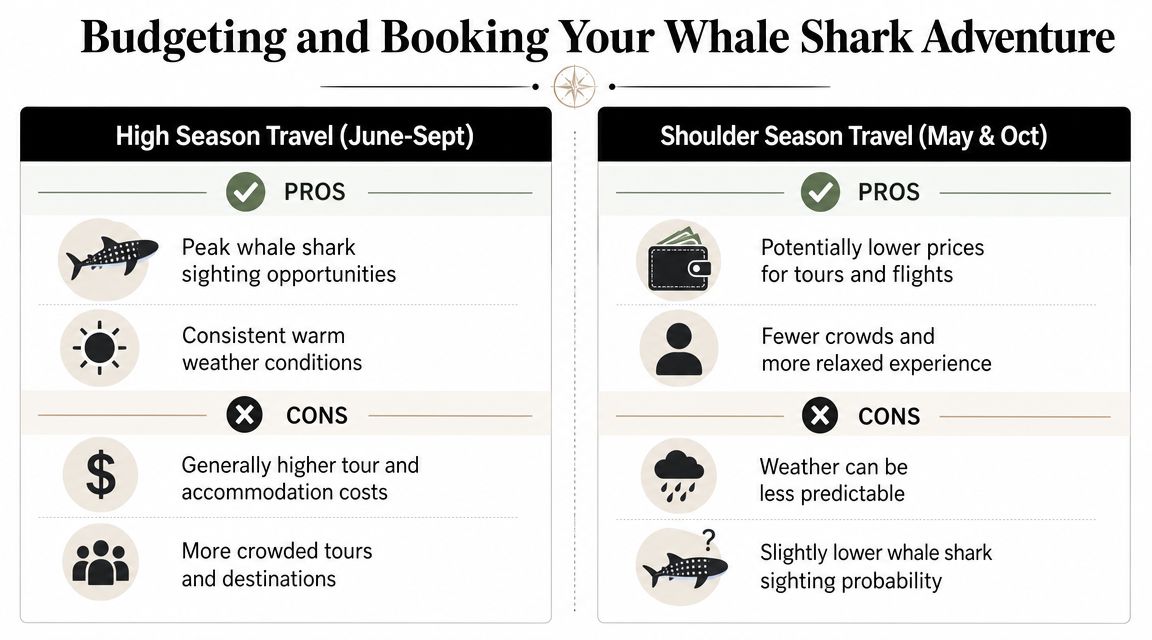
High season versus shoulder timing
The trade-off is straightforward. Peak months usually give you the strongest odds, but they also bring more demand and more pressure on boats and accommodation. Shoulder periods can feel calmer and sometimes more affordable, but they ask you to accept more uncertainty.
That's a fair trade if your whole trip doesn't depend on a single perfect encounter. It's a poor trade if the whale shark swim is the main reason you flew to Mexico.
Your Day on the Water Safety Protocols and Etiquette
The day starts earlier than many people expect. You're usually up before your body wants to be, trying to eat just enough breakfast without tempting seasickness, and checking that you've packed the essentials you can use in saltwater conditions.
The small details matter. Wear a secure swimsuit or swim shorts, a rash guard if you like sun protection, and sandals you won't mind getting wet. Pack a towel, dry clothes, drinking water if allowed, and a simple dry bag for your phone and wallet. If you're prone to motion sickness, deal with that before the boat leaves, not after the horizon starts moving.
The briefing tells you a lot
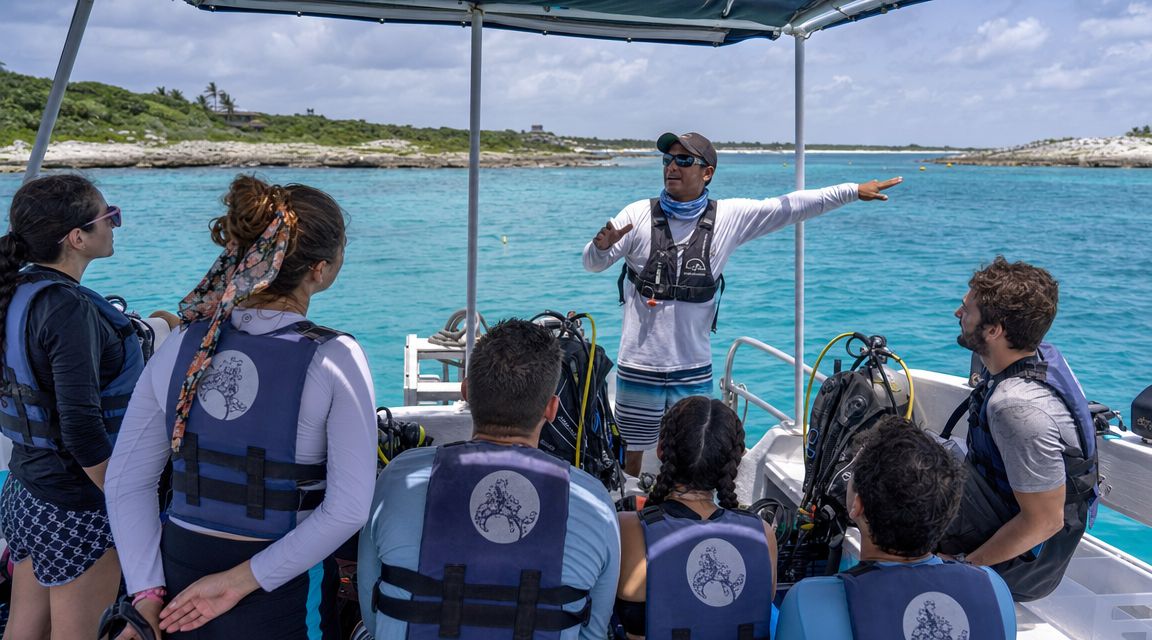
Pay attention to the guide before you ever see a shark. Good operators use the briefing to establish control. They explain entry order, how to sit and move on the boat, how to enter the water quickly, and what happens if conditions change.
That briefing isn't filler. Offshore wildlife trips carry more risk from logistics than from the animal itself.
For solo travelers, pay attention to whether staff are organized. Are they checking gear properly? Are they scanning for who looks nervous or unsteady? Are instructions clear enough that a first-timer could follow them? That matters just as much as marine knowledge. If you're weighing whether extra trip protection is worth it, a good travel insurance comparison can help you think through coverage for weather disruptions and activity days.
The in-water rules are strict for a reason
Mexico's whale shark interaction rules are not decorative. According to Enva Tours' explanation of Cancun whale shark safety rules, swimmers must stay about 1 meter from the whale shark's body and 3 meters from the tail, approach from the side, and many reputable operators allow only 2 swimmers at a time with a guide.
That setup protects both sides of the encounter.
- Approach from the side: Coming from the front or behind can disrupt the shark and create confusion.
- Keep distance from the tail: The tail is powerful, and this is the part of the animal you don't want to crowd.
- Don't touch, block, or chase: Touching or crowding can cause the shark to dive, ending the opportunity for everyone.
- Exit when told: If the shark changes direction or drops deeper, the encounter is over. Respect that immediately.
The best swimmers on these trips aren't the fastest. They're the ones who can stay calm, follow the line of travel, and leave space.
How the encounter usually feels
The entry is fast. You'll hear the guide call the moment, shuffle to the edge with your mask already on, and slide in with purpose. Then the noise of the boat drops away.
For a few seconds, your whole job is simple. Face forward. Breathe slowly. Stay beside the guide. Keep the shark's path clear.
Photography can wait if it interferes with that. If you bring an action camera, keep it simple and never use flash. Some days visibility will be dreamy. On others, glare, swell, or plankton-rich water will humble your expectations. That's normal wildlife travel.
Practical safety that doesn't get enough attention
For solo travelers especially, the overlooked risks tend to be human and logistical:
- Seasickness: It can ruin the day faster than any wildlife factor.
- Boat re-entry: Ask how to reboard and listen carefully.
- Heat and dehydration: Offshore sun wears people down even when they're in water.
- Rushed entries: If a crew creates panic to get people overboard, that's poor operations, not excitement.
When the day is run well, you come back tired, salty, and satisfied. When it's run badly, people get scattered, dizzy, and too focused on the next jump to act safely. Choose accordingly.
Beyond the Swim Supporting Whale Shark Conservation
A whale shark trip can stay a thrilling personal memory, or it can become the moment you start traveling differently. The difference usually comes down to whether you treat the rules as obstacles or as part of the privilege.
The ethical frame matters. These sharks are wild animals in a working marine environment, not performers. When you book operators that control group size, follow approach rules, and don't sell fantasy over reality, you help reward the kind of tourism that gives the species some breathing room.

What support can look like
You don't need to become a marine biologist to help.
A few meaningful actions:
- Choose conservation-minded operators: Your booking is a vote for how this industry behaves.
- Share responsibly: Don't post content that glamorizes touching, crowding, or rule-breaking.
- Contribute to identification projects when available: Whale sharks have unique spot patterns, and some conservation efforts use photographs to identify individuals.
- Learn the bigger picture: Understanding what sustainable tourism means in practice makes wildlife choices sharper across your whole trip, not just this one day.
Why restraint is part of the magic
A lot of travelers think regulation takes the romance out of wildlife travel. I think the opposite is true. Rules preserve the wildness that made you want this experience in the first place.
When a guide keeps you back, they aren't reducing the moment. They're protecting it. When a captain pulls away from a crowded scene instead of forcing another rushed drop, that choice says something valuable about the future of whale shark tourism in Mexico.
A respectful encounter might feel shorter than you wanted. It will almost always feel better afterward.
If you do this well, the memory that stays with you won't just be the size of the animal. It'll be the feeling that, for a brief stretch of blue water, people behaved like guests.
Travel that matters starts with better questions, smarter planning, and choices you can feel good about after you get home. Travel Talk Today helps travelers build trips that are affordable, thoughtful, and grounded in real-world trade-offs, whether you're planning a solo wildlife adventure or a longer slow-travel journey.