Most travelers ask the wrong question. They look for the single best airlines safety rating as if one number can settle peace of mind, when the job of a rating is to separate clearly stronger operators from the ones you should think twice about. Among airlines that are audited, overseen, and operating inside established systems, the gap is often tiny. The bigger divide is between carriers with serious independent oversight and carriers that don't show that same level of scrutiny.
That's why a good rating is useful, but not as a crown. It's a filter, a rough map, and a way to avoid confusing a polished brand with a well-managed operation. If you use it that way, the whole topic gets easier to understand, and a lot less misleading.
Why an Airlines Safety Rating Rarely Tells the Whole Story
A high ranking can look conclusive, yet aviation safety is not a school exam. Two airlines may appear close together because, within the audited and well-regulated tier, their operating standards can be similarly strong. AirlineRatings.com notes that its 2026 ranking had fewer than four points between positions 1 and 14, while positions 1 through 6 among full-service airlines were separated by only 1.3 points. That spread shows how list order can create more drama than the underlying data supports (AirlineRatings.com 2026 ranking note).
The number that matters is usually not the one people chase
A rating compresses several operating realities into one score. That makes comparison easier, but it can conceal the difference between an airline audited independently over many years and one that appears polished from the outside. For travelers, an 83 versus an 82 usually matters less than the presence of serious oversight and a documented operating culture.
Practical rule: use rankings to identify airlines you may prefer to avoid, rather than declaring one audited carrier dramatically safer than another.
A score also cannot show whether a carrier works within a well-regulated environment or whether its maintenance and training systems receive thorough review. Those conditions matter more than brand prestige or glossy marketing. Travelers can pair that mindset with this travel safety checklist for broader preparation.
The bigger divide sits between carriers with serious independent oversight and carriers that show less visible scrutiny. The airlines safety rating is most useful as triage: it helps sort out clearly weaker options, then directs attention to carriers that have already cleared a meaningful safety bar.
How Airline Safety Ratings Are Built From the Ground Up
A safety rating is not built from one decisive number. It works more like a case file, combining several kinds of evidence because each answers a different question. Accident history shows what has happened. Audits examine how an airline operates. Operating records indicate whether those practices hold up over time.
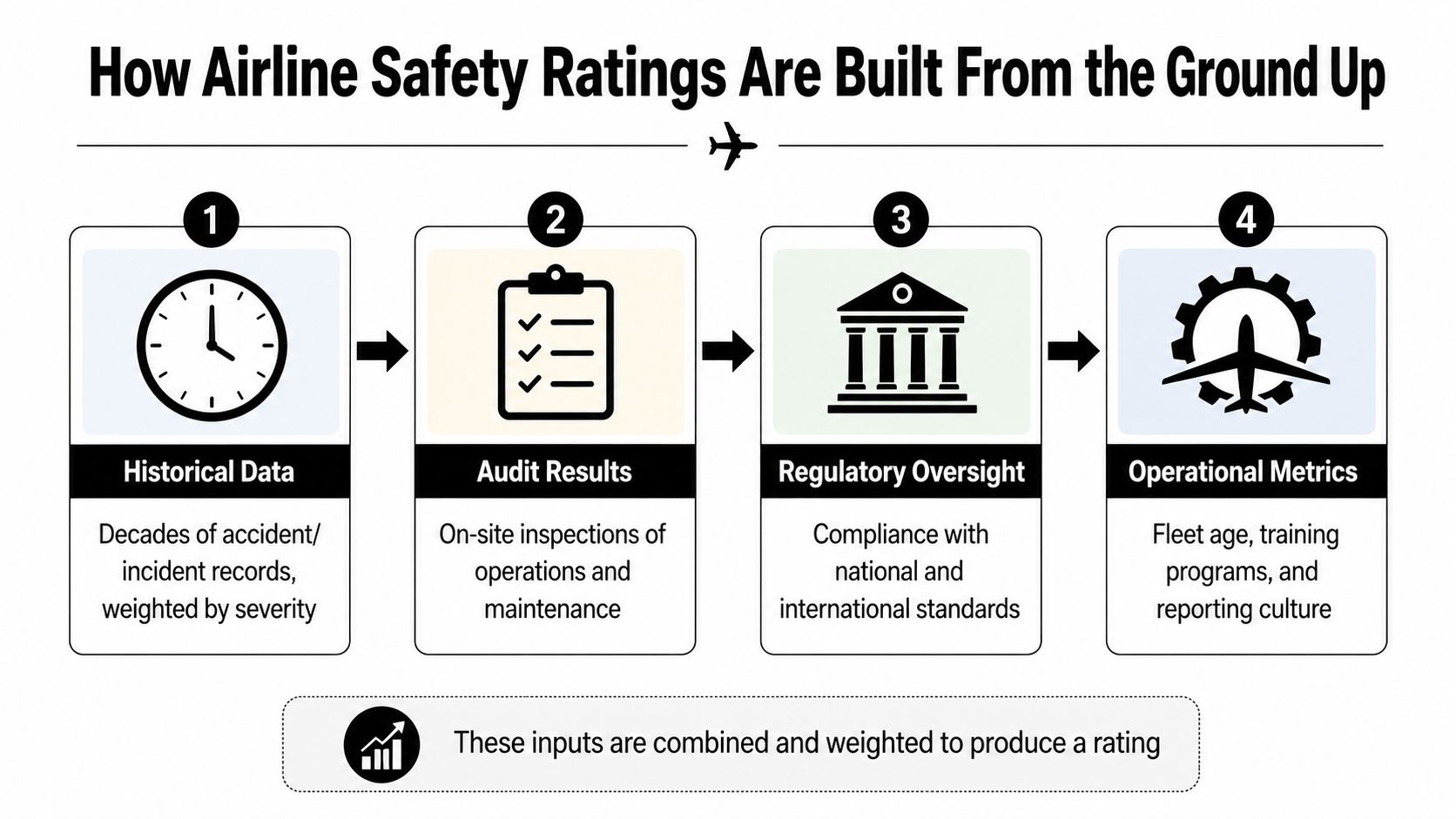
Four inputs that keep the picture honest
The first input is historical accident and incident data. It is the aviation equivalent of reviewing a company's financial record. The information matters, but major accidents are rare, so this measure changes slowly and cannot describe every part of present-day operations.
The second is third-party audit status, especially IATA's IOSA framework. AirlineRatings.com lists IOSA registry status among its five core safety parameters. Its explanation also identifies IOSA's 1,067 criteria, showing why an audit can reveal more about operating procedures than a headline score alone (AirlineRatings.com safety ratings).
The third input is a fatality-free operating record, generally weighted toward recent performance. It recognizes carriers that maintain disciplined operations without relying on a major event to expose weaknesses.
The fourth is the operating environment. Regulatory standards, infrastructure, geography, and route conditions can shape the risks an airline must manage. A carrier serving island destinations, for example, may operate within circumstances that deserve different context from a carrier in a highly standardized market. Travelers reviewing a route can also consult this Hawaii airports map and guide to understand the surrounding airport network.
Simple way to think about it: accident history records outcomes, audits examine the operating system, and the environment shows the pressure placed on that system.
Ratings blend these inputs because no single measure gives a reliable comparison. A clean recent record with limited independent scrutiny carries a different meaning from years of performance supported by documented audits. That distinction is more useful than treating a tiny gap between top-rated carriers as a meaningful ranking. The rating's real job is to separate clearly weaker operators from airlines that have already met a substantial safety threshold.
Comparing the Major Rating Systems Side by Side
Travelers encounter several kinds of airline safety information, and each answers a different question. A ranking summarizes comparative performance. An audit registry records whether an operator has passed a defined review. A regulator's record describes the standards governing the airline or its country. Treating all three as interchangeable creates false precision.
| System | What It Measures | Update Frequency | Key Limitation |
|---|---|---|---|
| AirlineRatings.com | A blended safety score using audit status, fatality history, incident factors, operating environment, and more | Updated periodically with annual-style rankings | The score can look more precise than it really is |
| JACDEC | A rolling risk index built from incident data and safety variables | Updated as its index is refreshed | Strong for trend comparison, less intuitive for casual readers |
| IATA IOSA | Whether an airline has passed a detailed operational audit | Registry status changes when audits are renewed | It is not a ranking, only a serious filter |
| FAA and EASA oversight records | Whether an airline or country operates under recognized regulatory standards | As oversight and certification status change | It says more about the regulator than a full airline comparison |
Why these systems are useful together
AirlineRatings.com is the easiest system to scan, which makes it useful for a first comparison. Its blended score can also encourage readers to treat a small difference between highly rated carriers as meaningful, even when the practical distinction is limited. JACDEC offers a rolling, risk-oriented view, so it can add context beyond a single annual-style list.
Rather than ranking airlines, the IATA IOSA registry signals whether an operator has passed a detailed operational audit. That status is a meaningful sorting tool, especially when a carrier's public score provides little explanation of the controls behind it. AirlineRatings.com includes audit status among the factors it considers, as described in its safety ratings methodology.
FAA and EASA records add regulatory context. They help clarify the oversight environment in which an airline operates, which matters when comparing carriers from different regions. A carrier may look strong in a blended ranking while operating under a regulatory system that deserves closer examination. Conversely, a demanding oversight framework provides useful background without serving as a complete airline comparison.
Ask what each system can reveal, and what it leaves out.
Use the systems as separate lenses. Start with a ranking for orientation, review audit status for evidence of operational scrutiny, and examine the relevant regulator's record for the surrounding standards. Agreement across those lenses strengthens confidence. A mismatch deserves attention, particularly when one carrier has documented auditing and another offers only a polished headline score.
The useful conclusion is rarely a single winner. Top-rated airlines may sit close together, while the wider gap between audited and non-audited operators can carry more practical meaning. Ratings work best as a filter for identifying clearly weaker choices.
The Numbers Behind Airline Safety in 2026
The most useful aviation safety number is usually the one adjusted for scale. Raw accident totals can distort comparisons because larger airlines operate more flights and have more opportunities for an event. Industry analysis therefore focuses on accidents per million flights or sectors, rather than the event count alone.
According to the IATA 2025 Safety Report, airlines recorded 51 accidents across 38.7 million flights in 2025. That produced an all-accident rate of 1.32 per million flights, or about one accident every 759,646 flights. The rate improved from 1.42 in 2024 to 1.32 in 2025, although the five-year average was 1.27. Over a longer period, the rate declined from 3.72 per million sectors in 2005 to 1.32 in 2025, a reduction of roughly 64%.
A lower accident frequency does not automatically mean every measure improved.
Accident frequency and fatality risk are not the same story
The IATA safety overview PDF reports that fatality risk rose from 0.06 to 0.17 per million sectors, even as the overall accident rate fell. These measures answer different questions. Accident frequency tracks how often events occur, while fatality risk reflects their potential severity. A rare, high-consequence event can push the second measure upward without reversing a longer-term improvement in the first.
IATA also reports stronger results for IOSA carriers, with an all-accident rate of 0.98 per million sectors in 2025. Earlier reporting showed the same broad pattern: the 2017-2021 average was 0.81 for IOSA airlines compared with 2.37 for non-IOSA airlines, as noted above. That separation is more informative than tiny score differences between airlines clustered near the top of a ranking.
The headline number can improve while the risk picture stays mixed. Aviation events are rare, so a single severe event can make one measure look worse for a period.
Ratings are most useful when they help identify clearly weaker operators. A narrow gap between two highly rated airlines may not support a meaningful winner. A wider gap between audited and non-audited carriers deserves closer attention. The trend rewards routine verification over headline-chasing.
Practical Safety Checks Every Traveler Can Use
A ranking is a starting point, not a booking strategy. If you want a more grounded decision, spend a few minutes checking the airline the way a cautious editor would. The goal isn't to become an aviation auditor. It's to avoid blind spots.
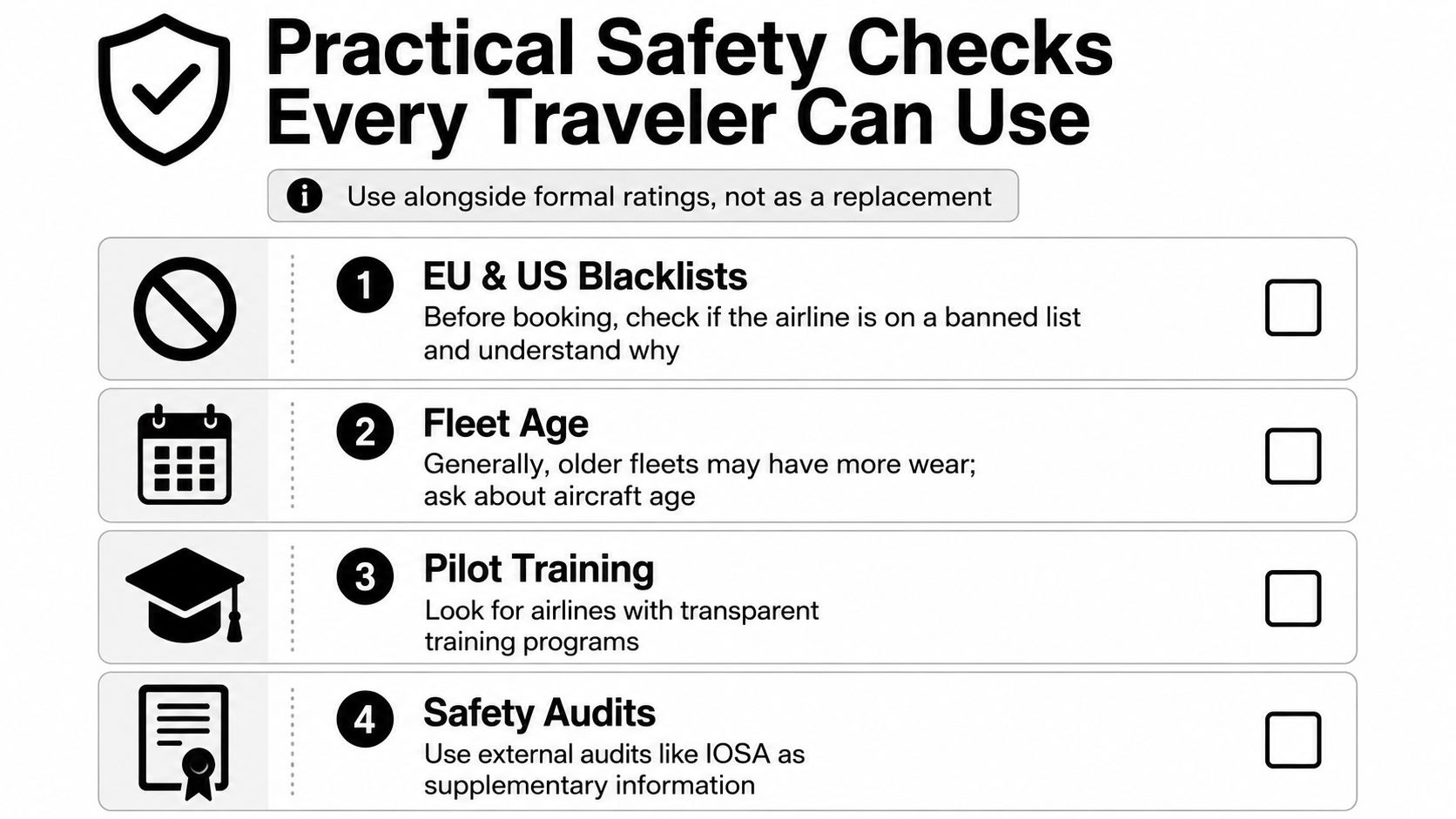
A quick pre-booking checklist
- EU and U.S. blacklists: Check whether the carrier appears on a banned or restricted list, then read the reason, not just the headline.
- IOSA registration: Look for audit-based oversight as a sign the airline has passed a serious operational review.
- Operating certificate: Confirm the airline is licensed by the relevant regulator, especially if you're booking through a third-party seller.
- Fleet and incident context: Review the aircraft type and recent incident history in a credible aviation database, then decide whether the route and airport environment add complexity.
Those checks are fast because they're mostly about confirmation, not deep research. A flight operated by a respected brand can still involve a wet lease, a regional affiliate, or an aircraft managed under a different certificate. That's why the question “Who's operating the flight?” matters more than most booking sites make it seem.
Ask this before you pay: who operates the aircraft, what type is it, and under which authority does it fly?
If the answer is vague, slow down. If the airline flies into challenging terrain, weather-prone regions, or airports with difficult approaches, that doesn't automatically make it a bad choice, but it does make context more important. For a broader comparison point alongside fares and tradeoffs, this guide to travel insurance comparison can help you think more clearly about the trip as a whole.
A few minutes of checking can meaningfully reduce your exposure to weak oversight. That's the practical side of safety ratings. They work best when you use them together with simple verification.
A Sourced Snapshot of the Current Top-Rated Airlines
A top-airline list is most useful as a filter, not a verdict. These names recur because they combine audit visibility, long operating histories, and disciplined procedures. Their order can change, but the meaningful divide is usually lower down. Small score differences among highly audited carriers matter less than the gap between those carriers and an operator with weak or unclear oversight.
| Airline | Notable Safety Credential | Notable Rating System(s) |
|---|---|---|
| Qantas | Long fatality-free jet operation history | AirlineRatings.com, JACDEC-style rankings |
| Cathay Pacific | Strong audit reputation and consistent oversight profile | AirlineRatings.com |
| Singapore Airlines | IOSA-aligned, highly standardized operations | AirlineRatings.com, IOSA-related filters |
| Emirates | Large-scale audited operation with long safety visibility | AirlineRatings.com |
| Qatar Airways | Frequently appears in top-tier safety lists | AirlineRatings.com |
| Air New Zealand | Strong operational reputation and audit presence | AirlineRatings.com |
| ANA | Long-term procedural discipline and strong oversight profile | AirlineRatings.com |
| EVA Air | Consistently strong safety reputation in rankings | AirlineRatings.com |
| Lufthansa | Established audit history and oversight visibility | AirlineRatings.com, IOSA-related filters |
What a top-tier list can and can't tell you
These airlines are useful reference points because rankings often place them near the top when they consider audit status, incident history, and operating discipline. The table therefore works as a shortlist, not as a promise that one carrier is universally safer than every other carrier.
Once airlines sit inside the same well-audited group, comparisons become fine-grained. A rating may confirm that a carrier belongs among strongly managed operators, yet reveal little about which of two such carriers is meaningfully better for a particular route. Airport conditions, aircraft assignment, operating authority, and schedule reliability can still shape the practical choice.
The rating's strongest job is sorting out clearly weaker carriers. Picking a single winner from the top tier often gives a false sense of precision, because tiny score margins can look more important than they are.
Fare structure and comfort still belong in the booking decision. A highly rated carrier may not fit your budget, route, or schedule, while a value-focused airline requires closer attention to the evidence behind its safety profile. This budget airline guide offers a useful comparison point for weighing lower fares and broader travel tradeoffs without treating price as a safety measure.
Read the table from the outside in. First identify whether an airline has visible, credible oversight. Then compare service, route, and price among the carriers that clear that basic threshold.
Using Ratings as Context, Not a Scoreboard
A good airlines safety rating should not push you into scoreboard thinking. Its best job is to set a floor, not to award a trophy. Once an airline is inside the well-audited, well-overseen group, the difference between one top carrier and another is often too small to support dramatic claims.
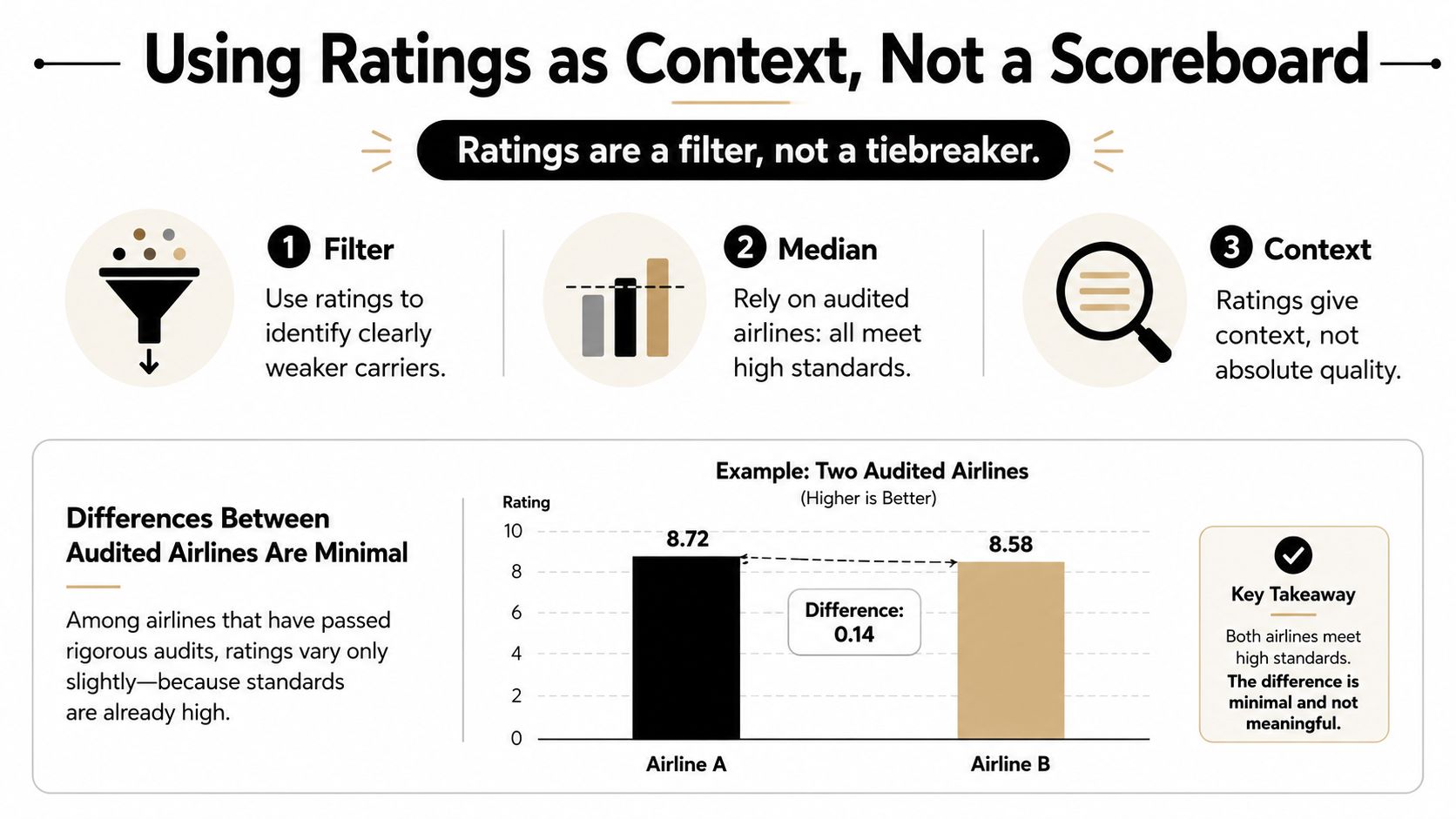
The smarter way to compare airlines
- Filter weaker carriers: Start by excluding airlines with poor oversight, weak audit visibility, or unclear certification.
- Trust audited peers: Once two or three carriers pass the same serious checks, treat them as broadly comparable on safety.
- Add route context: Weather, terrain, airport infrastructure, and operating authority can matter more than a tiny score gap.
That's the lesson behind the data. IOSA-backed airlines perform better than non-IOSA airlines, and IATA's long-run trend shows safety has improved dramatically over time (IATA safety overview PDF, IATA 2025 Safety Report). But within the top group, the numbers are close enough that you should let itinerary, price, and service quality decide the final tie.
A ranking is strongest when it keeps you away from the carriers you should question. It is weakest when it tries to crown one “winner” among several airlines already operating at a high standard. That's why the smartest travelers use two or three systems together, then look at the route itself before they book.
If you want more practical, plain-English travel guidance that makes safety, price, and smart planning easier to balance, visit Travel Talk Today for thoughtful trip advice that helps you choose with confidence and spend with more intention.