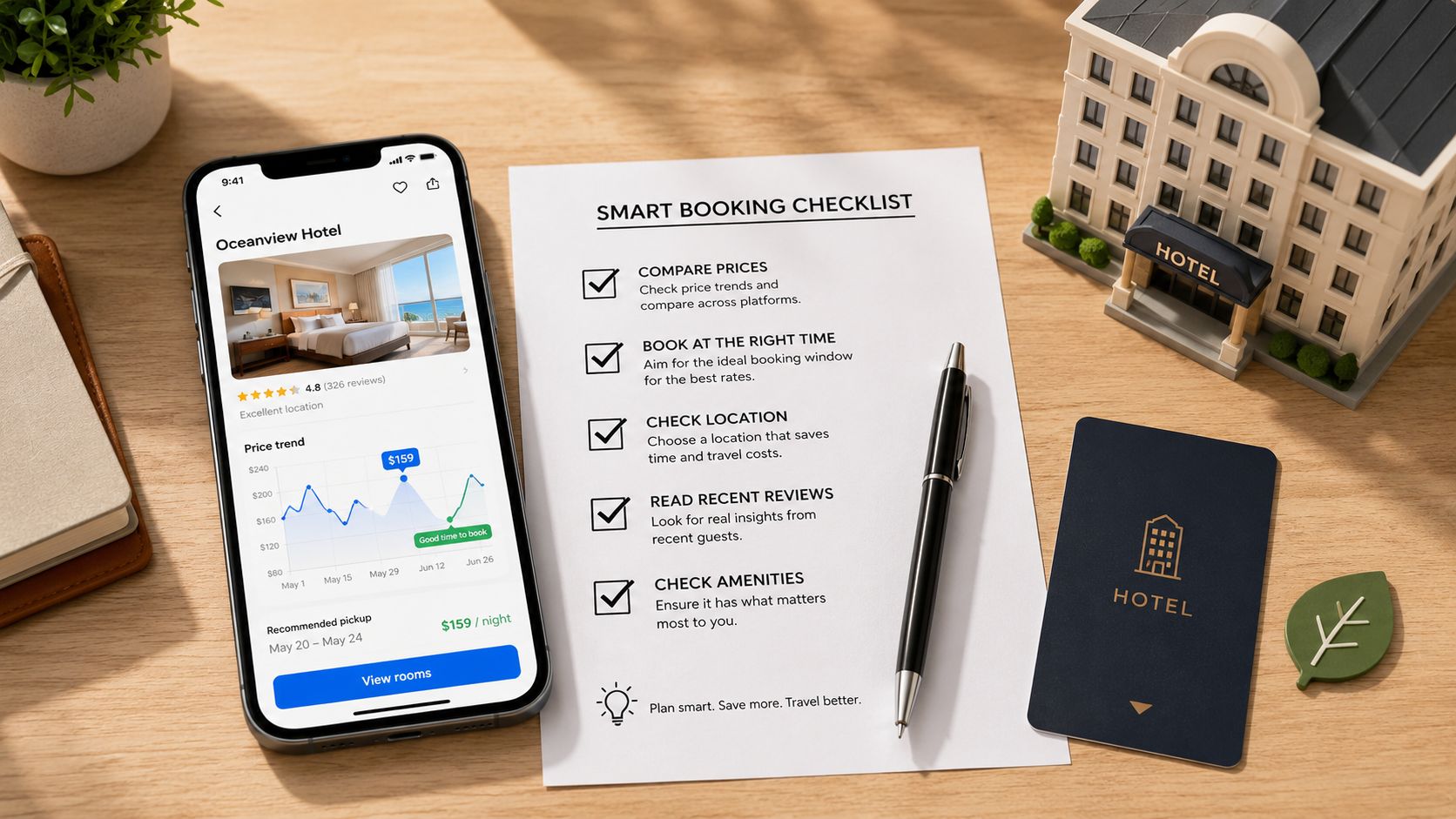
You're comparing two rooms that look almost identical. One costs less at first glance, but the other includes breakfast, has a better cancellation window, sits closer to public transport, and earns loyalty credit when booked through the hotel. Then a resort fee, taxes, payment terms, and recent reviews change the calculation again.
The smartest hotel booking tips don't focus on one magic booking day. They help you move through a practical workflow, from choosing the right season and discovering the actual price to checking loyalty benefits, negotiating directly, protecting uncertain plans, and selecting a safer, more meaningful place to stay. Hotel booking behavior also varies by trip type and destination. A large 2024 dataset covering more than 8 million reservations recorded an average booking lead time of 16.13 days, compared with 14.68 days in 2023, while Q4 reached 17.35 days. HotelHub's 2024 booking index shows why “book early” isn't a universal rule.
Use the list below as a decision path, not a collection of isolated hacks. Compare total value, including taxes, fees, flexibility, location, safety, and benefits, rather than judging a room by its displayed nightly rate alone.
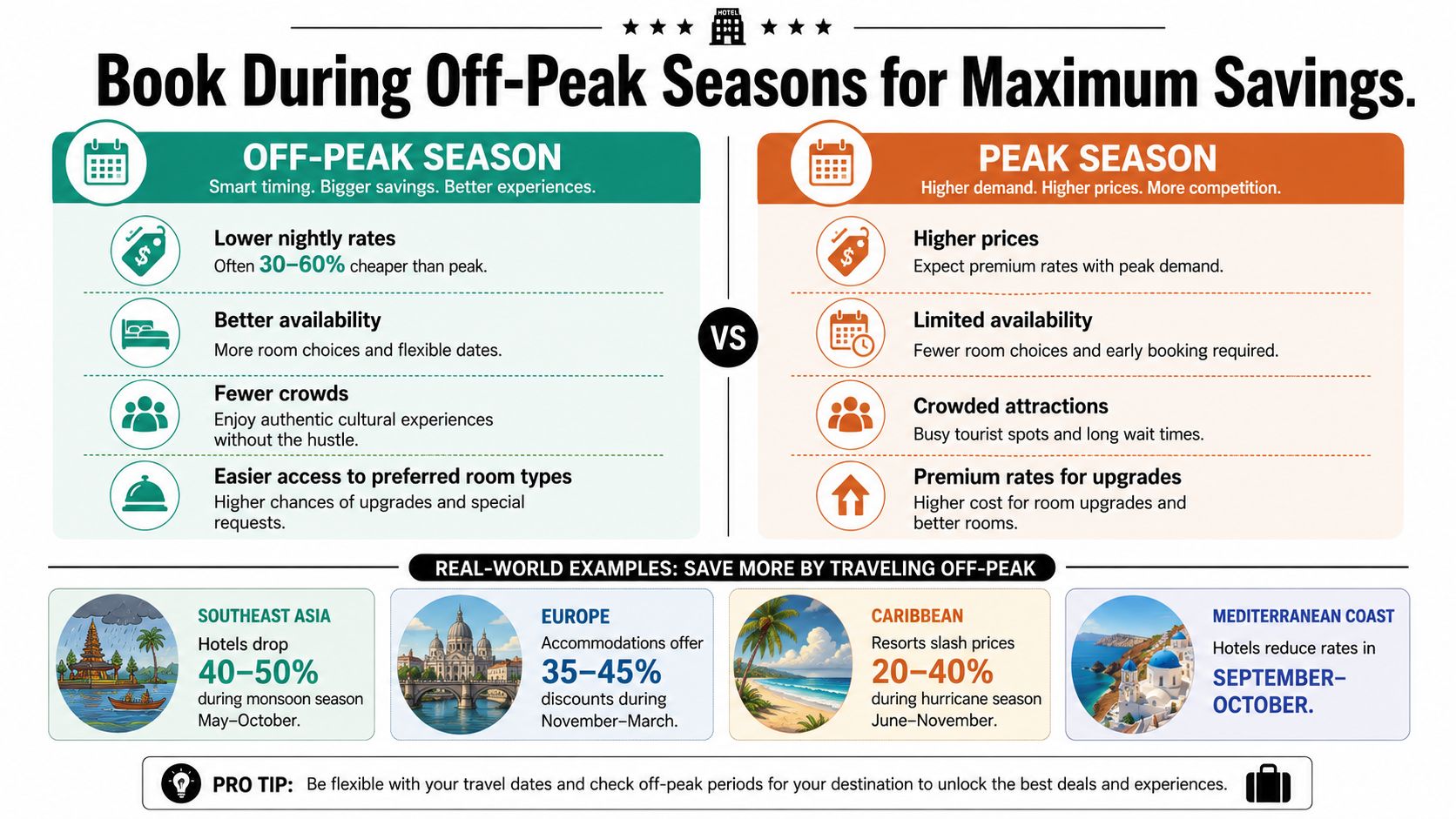
1. Book During Off-Peak Seasons for Maximum Savings
Demand shapes hotel pricing more than the calendar does. A destination's quieter months can offer better rates, more availability, and a calmer experience, but the cheapest period isn't always the best fit for your trip. Weather, local festivals, school holidays, transport schedules, and seasonal closures can matter as much as the room price.
Shoulder season often offers the strongest compromise. You may avoid the busiest crowds without accepting the least comfortable weather. A coastal destination can be pleasant just before or after its peak period, while a city break may work well outside major events and public holidays.
Trade comfort against the headline rate
An off-peak rate only creates value if the destination still delivers what you came to experience. Check rainfall patterns, heat, storms, daylight, and whether attractions operate normally. Search local holiday calendars before committing, because domestic demand can keep prices high even when international visitors are fewer.
Build a flexible date search around your preferred window. Moving the trip by a few days can reveal a meaningful difference, especially when you avoid weekends, conferences, festivals, or school breaks. Hotel email lists can also alert you to seasonal promotions before you begin comparing properties.
Practical rule: Choose the lowest-demand period you can enjoy comfortably, not simply the lowest rate you can find.
For a more thoughtful trip, consider how your spending reaches local businesses. A quieter visit can give independent restaurants, guides, and small lodging providers more support outside the busiest travel weeks. It can also make cultural interactions less rushed and reduce pressure on crowded neighborhoods.
Before booking, compare the full trip cost. A cheaper room in a remote area may require expensive transfers, while a slightly higher rate near a reliable transit line could save time, stress, and transport costs. Off-peak planning works best when the destination, weather, access, and purpose of the trip all remain aligned.
2. Compare Multiple Booking Platforms Strategically
Start with a metasearch engine, but don't stop there. Google Hotels, Kayak, and Trivago can show how the same property appears across booking channels, giving you a useful baseline before you decide where to reserve. The hotel's own website should be part of the comparison, especially if you care about loyalty credit, easier changes, or direct communication.
Look at the same room category, occupancy, meal plan, payment timing, and cancellation terms on every channel. A lower displayed rate may exclude taxes, breakfast, parking, or other charges. Two listings can look equivalent until you compare what you'll receive at check-in.
Use a repeatable comparison pass
Search once to identify suitable properties, then record the details instead of relying on memory. Check the official hotel site in a separate step, and contact the property if the terms are unclear. Some hotels may match a competing rate or add a useful benefit, but never assume that a direct rate is automatically the cheapest.
- Match the room: Confirm bed configuration, occupancy, view, accessibility, and included facilities.
- Compare the total: Review taxes, service charges, resort fees, cleaning charges, breakfast, and payment timing.
- Check the booking party: Identify whether the hotel or an OTA handles changes, refunds, and special requests.
- Save the evidence: Keep a screenshot or written record of the rate, terms, and confirmation details.
This guide to booking cheap hotels can support your comparison process, particularly when you're balancing price with comfort and hidden costs.
The best channel depends on the trade-off you're willing to accept. An OTA can offer convenience and broad inventory. Direct booking may offer a clearer relationship with the property and better access to member benefits. If the full price and conditions are equal, direct booking is often the cleaner choice. If the OTA offers a materially better deal, verify who will resolve problems before paying.
3. Leverage Hotel Loyalty Programs and Membership Cards
Loyalty programs become useful when your stays have a pattern. If you regularly choose the same chain, membership can bring member pricing, points, upgrades, breakfast, late checkout, or free-night opportunities. If you move between independent guesthouses and unrelated hotels, spreading your stays across several programs may create benefits too slowly to matter.
Join before you search. A free membership can reveal a member rate that isn't visible to an unregistered visitor, and booking directly helps reduce uncertainty about whether the stay qualifies for points. Always read the earning and redemption conditions, particularly for reservations made through third-party websites.
Concentrate benefits without forcing the wrong hotel
Consolidating stays with one group can make status easier to understand and manage. That doesn't mean you should choose an inferior location or pay substantially more just to collect points. Compare the effective value, including the room price, breakfast, upgrade probability, cancellation terms, and convenience.
A premium property may offer attractive perks, but a lower-cost independent hotel can still be the better decision if you'll spend most of the day exploring. Membership cards and travel credit cards may add benefits, yet they can also encourage spending or brand loyalty that doesn't suit your itinerary. Check your existing cards first, and understand transfer rules before moving points.

Loyalty should reduce your travel cost or improve your stay. It shouldn't persuade you to book a worse room in a worse location.
Use redemptions thoughtfully. A free night may be most valuable when the cash price is high, but flexibility matters more than theoretical value if your plans can change. Confirm blackout dates, resort charges, taxes, and whether elite benefits apply to reward stays.
For broader planning, review these travel rewards credit card considerations, then compare the result against a simple cash booking. Points are a tool, not a reason to ignore the total cost.
4. Use Price Alerts and Book at Optimal Times
A price alert gives you a decision process instead of a single guess. Set one for the hotel or destination, observe rate changes, and choose the price and conditions that would make you book. A clear threshold limits panic purchases and prevents endless checking.
The best booking window depends on demand, destination, room type, and flexibility. The 2024 HotelHub data shows that domestic booking lead times increased from 12.91 days in 2023 to 14.4 days in 2024, an 11.54% increase, while the overall annual average reached 16.13 days. The underlying HotelHub data points to a practical approach: monitor prices across a realistic period, then adjust your timing to the trip.
Pair an alert with a cancellation strategy
A refundable reservation can secure a suitable room while you continue watching prices. If a lower rate appears before the deadline, compare the full terms and confirm that you can cancel and rebook without losing deposits, benefits, or room availability. Keep the original reservation until the replacement is confirmed.
Use Google Hotels, Kayak, or the booking platform's alert tools. Treat price predictions as guidance, not a promise. Rates can rise while you wait, and a lower price may carry stricter conditions or apply to a less desirable room. Recheck the complete terms whenever the rate changes.
- Set a target: Define the total price and conditions that justify booking.
- Track availability: A lower rate has little value if your preferred room disappears.
- Check the calendar: Compare nearby dates, weekday patterns, and local events.
- Stop monitoring: Book once the value and flexibility meet your requirements.
This hotel timing guide can help you create a practical monitoring routine. The aim is not to predict every movement. Make the decision before continued uncertainty costs more than the possible saving.
5. Understand and Optimize Cancellation Policies and Travel Insurance
A hotel rate isn't fully comparable until you know what happens if your plans change. “Free cancellation” can mean cancellation by a specific local time, several days before arrival, or only under conditions listed in the rate details. A non-refundable price may look attractive, but it transfers the financial risk to you.
Read the policy before entering payment details. Note the exact deadline, time zone, deposit rules, no-show terms, modification restrictions, and whether changing dates creates a new price. Save the policy with the confirmation email, because the booking screen may change later.
Choose flexibility according to uncertainty
For a firm itinerary with low disruption risk, a non-refundable rate may be reasonable if the saving justifies losing flexibility. For a trip involving uncertain work, health, transport, visas, or family commitments, a refundable rate can be worth more than a small initial discount.
Travel insurance is a separate decision. A hotel policy may refund only the room, while insurance might address covered medical emergencies, interruptions, or other eligible events. Policies vary widely, so compare exclusions, documentation requirements, pre-existing-condition rules, and claim deadlines rather than buying based on the product name.

- Firm plans: Consider a non-refundable rate only when losing the booking would be manageable.
- Fluid plans: Pay for cancellation flexibility when changing dates could disrupt the trip.
- Complex trips: Compare travel insurance with the hotel's own terms and your existing coverage.
- Every booking: Record the cancellation deadline in your calendar.
Use this travel insurance comparison resource as part of your research. Insurance isn't a substitute for reading the hotel policy, and a flexible hotel rate isn't a substitute for broader protection.
6. Negotiate and Call Hotels Directly for Better Rates
Calling a hotel can reveal options that a search page doesn't explain well. Independent properties, family-run guesthouses, and smaller chains may have room to adjust a rate, add breakfast, arrange a transfer, or offer a better room when you're staying longer. They may also be able to explain renovations, access, noise, or local conditions more accurately than a listing page.
Approach the call with a specific request. Mention your dates, room needs, length of stay, and the rate you found elsewhere. Ask whether the property can match the comparable offer or improve the overall package. A lower room rate isn't the only useful outcome. Breakfast, parking, transport, or a quieter room can change the total value.
Make the conversation easy to approve
Hotel staff are more likely to help when you're clear and respectful. Avoid claiming that another property is cheaper unless you can describe the same dates, room, occupancy, taxes, and cancellation terms. Ask for the best available direct rate first, then discuss practical additions.
Longer stays and multiple rooms generally provide a stronger basis for discussion because the booking is more valuable to the property. Still, negotiation isn't guaranteed, particularly at a full hotel or a tightly managed chain. Treat the call as a way to clarify and improve the booking, not as an entitlement.
Ask for a complete package, not just a cheaper number. The best improvement may be flexibility, breakfast, transport, or a room feature you care about.
Before ending the call, repeat the final rate, inclusions, payment method, cancellation rules, and guest name. Request written confirmation by email and check it against your notes. If the hotel can't provide the terms in writing, book only when you're comfortable with the remaining uncertainty.
7. Book Longer Stays to Unlock Weekly and Monthly Discounts
Longer stays can reduce the friction and cost of repeated check-ins, cleaning, marketing, and empty nights. Hotels, serviced apartments, guesthouses, and extended-stay properties may offer weekly or monthly terms that don't appear in a standard nightly search.
Search for long-stay or monthly options separately. A booking platform may show a nightly rate first, while the property's own site or reservations team can explain a different arrangement. Ask what's included, because a lower long-stay rate may change housekeeping frequency, linen service, breakfast, deposits, internet access, or payment timing.
Calculate the life of the stay, not one night
A longer booking is valuable only if the location and room remain comfortable. Check workspace, storage, laundry, ventilation, kitchen access, noise, neighborhood access, and transport. A modestly cheaper room can become poor value if you need frequent taxis, paid laundry, or meals outside because the property lacks basic facilities.
Consider staying just outside the main tourist center, but verify the route to your daily destinations. A residential neighborhood may offer a more authentic routine and better access to local businesses, while an isolated property can undermine the savings.
- Ask about cleaning: Confirm whether housekeeping is daily, weekly, or charged separately.
- Clarify payment: Find out whether the property requires a deposit or staged payments.
- Review the exit terms: Understand whether you can shorten the stay and how the rate changes.
- Test the neighborhood: Check transit, groceries, pharmacies, and evening access before committing.
Slow travel can also support deeper community connections. Staying longer gives you time to use local shops, learn basic routines, and experience a place beyond its visitor circuit. Don't book a month just because the nightly rate looks attractive. Book longer when the pace suits the trip and the property can support daily life.
8. Choose Alternative Accommodations Carefully
Hostels, guesthouses, homestays, and local lodging platforms can change both the price and the character of a trip. They may offer shared kitchens, social spaces, local knowledge, and a more direct connection with residents. They also require more careful checking because standards, payment arrangements, privacy, and support can vary.
Recent reviews matter more than a polished property description. Look for repeated comments about cleanliness, noise, bed security, check-in reliability, water pressure, internet access, and the accuracy of the location. Review the property across more than one platform when possible, and check whether the host responds constructively to problems.
Match the format to your travel style
A dorm can be a good fit for a social solo traveler who values meeting people, but a private room may be better after long transit days. A homestay can provide cultural insight, yet it may involve household routines that differ from a hotel. A guesthouse may feel personal and flexible, while having fewer formal services if something goes wrong.
Use the accommodation's practical details as filters:
- Solo privacy: Check for female-only dorms, privacy curtains, lockers, and secure access.
- Arrival logistics: Confirm late check-in, reception hours, directions, and emergency contact methods.
- Location accuracy: Use Google Maps to verify the walk to transit, food, and essential services.
- Host credibility: Review response behavior, identity information, and the consistency of guest feedback.
These budget backpacking ideas can help you compare lower-cost lodging without treating the cheapest bed as the automatic winner.
Alternative accommodation can support local ownership and a slower travel style, but check local rules and community impact where relevant. Choose a place that respects residents, communicates clearly, and gives you enough information to make an informed decision.
9. Prioritize Safety and Research Neighborhoods Carefully
The cheapest property can become an expensive mistake if it leaves you uncomfortable, isolated, or dependent on costly transport. Neighborhood research should happen before you compare rooms, particularly when you're traveling alone or arriving after dark.
Read reviews written by travelers with needs similar to yours. Solo women may notice details that other guests overlook, such as lighting between the property and transit, reception behavior, door security, dorm arrangements, and whether staff respond well to concerns. Look for patterns rather than one dramatic comment.
Verify the route, not just the map pin
A property can appear central while sitting far from a practical station or on a difficult road. Use Google Maps and Street View to inspect the surrounding streets, transit connections, nearby food options, pharmacies, and the route from the airport or station. Check the journey at the times you expect to travel, and consider how you'll return after an evening out.
Ask the property direct questions before booking. Confirm reception hours, entry procedures, luggage storage, female-only rooms, room locks, emergency contacts, and whether staff can arrange a trusted transfer. A social calendar can help solo travelers meet people, but social spaces don't replace basic security.
- Review the entrance: Look for controlled access, staffed reception, and clear arrival instructions.
- Check the room: Confirm locks, lockers, windows, bathrooms, and occupancy details.
- Test the transport plan: Identify a practical route to major attractions and transport hubs.
- Keep an exit option: Choose terms that let you change properties if the location doesn't feel right.
Neighborhood choice also shapes the meaning of a trip. A local district near reliable transit may offer independent cafés, markets, and everyday interactions while keeping major sights accessible. Don't romanticize remoteness, though. If the route feels unsafe or impractical, the cultural benefit won't compensate for the stress.
9-Point Hotel Booking Tips Comparison
| Strategy | Implementation Complexity 🔄 | Resource Requirements ⚡ | Expected Outcomes 📊 ⭐ | Ideal Use Cases 💡 | Key Advantages ⭐ |
|---|---|---|---|---|---|
| Book During Off-Peak Seasons for Maximum Savings | Low 🔄, flexible dates required | Low ⚡, basic research on seasons/holidays | High savings 📊, 30–60% cheaper; fewer crowds | Budget-flexible travelers; shoulder-season trips | Major cost reduction; more authentic experiences |
| Compare Multiple Booking Platforms Strategically | Medium 🔄, cross-checking & tracking prices | Medium ⚡, metasearch tools, time to compare | Moderate savings 📊, 15–30% possible; better transparency | Detail-oriented planners booking in advance | Finds lowest total cost; reveals fees/promotions |
| Leverage Hotel Loyalty Programs and Membership Cards | Medium 🔄, enrollment & consolidation strategy | Low–Medium ⚡, frequent stays / card benefits | Long-term value 📊, free nights, upgrades, 15–25% member rates | Frequent/repeat travelers; multi-trip planners | Recurring perks, upgrades, member-only rates |
| Use Price Alerts and Book at Optimal Times | Low–Medium 🔄, set & monitor alerts regularly | Low ⚡, apps/email alerts, time for monitoring | Moderate–High savings 📊, 20–40% potential | Forward-planners comfortable monitoring prices | Automated capture of drops; data-driven timing |
| Understand & Optimize Cancellation Policies and Travel Insurance | Medium 🔄, read policies and compare plans | Low–Medium ⚡, small premium for flexibility | Risk mitigation 📊, protects bookings; modest extra cost | Uncertain itineraries; expensive/long trips | Flexibility to change plans; financial protection |
| Negotiate and Call Hotels Directly for Better Rates | High 🔄, active negotiation and follow-up | Low ⚡, phone/time; prepared rate references | Variable savings 📊, 10–25% possible | Longer stays; independent/boutique hotels | Access to unpublished rates; personalized terms |
| Book Longer Stays to Unlock Weekly & Monthly Discounts | Medium 🔄, commit to single location | Medium ⚡, upfront booking, longer commitment | High savings 📊, 20–50% nightly reductions | Digital nomads; slow travelers; extended stays | Substantial nightly discounts; stable costs |
| Choose Alternative Accommodations: Hostels, Guesthouses, Local Platforms | Low–Medium 🔄, vet hosts and reviews | Low ⚡, lower nightly cost; verification effort | Very high savings 📊, 40–70% cheaper; social benefits | Budget backpackers; cultural immersion seekers | Lowest cost options; local connections and kitchens |
| Prioritize Safety and Research Neighborhoods Carefully | Medium 🔄, intensive neighborhood vetting | Low–Medium ⚡, time to research reviews/maps | Safer stays with value 📊, balanced safety/cost | Solo female travelers; first-time solo travelers | Reduced risk; better local integration and peace of mind |
Turn Your Search Into a Confident Booking
A strong booking decision doesn't require perfect forecasting. It requires a sequence that catches expensive mistakes before you pay. Start with flexible dates if your trip allows them, then identify the neighborhoods and room features you need. Compare the same room across a metasearch engine, the property website, and any relevant loyalty portal.
Next, compare the full price, not the first number you see. Include taxes, fees, breakfast, parking, transfers, cleaning, deposits, and transport from the property to your daily destinations. A room with a lower nightly rate may cost more once you add the services and time that another property includes.
Check the review pattern and its recency. Look for comments about cleanliness, noise, staff communication, location accuracy, and safety. A high star rating is useful, but detailed recent feedback and responsive management can provide a stronger sense of how the property handles real guest concerns. Independent benchmark data from Shiji's 2026 global guest experience report recorded a Global Guest Review Index of 86.7%, with positive mentions at 76.1%, a management response rate of 68.8%, and an average response time of 3.5 days. The published guest experience insights illustrate why review sentiment and management responsiveness deserve attention alongside the star rating.
Then verify the policy. Record the cancellation deadline, time zone, deposit conditions, no-show consequences, and any restriction on changing dates. If your plans are uncertain, pay for flexibility when the risk justifies it. If you're booking direct, save the reservations phone number and request written confirmation of any negotiated benefit.
Digital ease matters too. The American Customer Satisfaction Index reported 86 for ease of making a reservation and 85 for website satisfaction in its 2026 lodging results, while overall lodging satisfaction reached 77 out of 100. The reported ACSI lodging findings reinforce a practical point: a fast, reliable booking process reduces friction, but it doesn't replace checking the underlying terms.
Printable hotel booking checklist
- Destination and dates: Confirm the neighborhood, check-in date, check-out date, and flexibility.
- Total price: Record taxes, fees, meals, parking, transfers, deposits, and the final amount.
- Room and occupancy: Verify beds, guests, accessibility, view, floor, and included amenities.
- Reviews: Note recent comments about cleanliness, noise, service, location, and management responses.
- Location and transit: Check walking routes, public transport, arrival logistics, and evening access.
- Safety features: Confirm locks, reception hours, controlled entry, lockers, and emergency contacts.
- Cancellation deadline: Write down the exact date, time, time zone, and refund conditions.
- Loyalty number: Add your membership details and confirm whether the rate qualifies.
- Direct contact: Save the hotel's phone number, email, address, and booking reference.
- Backup plan: Keep a refundable alternative, insurance information, or a clear change strategy when risk is high.
A lower price matters most when it also supports a safer, more comfortable, and more meaningful trip. Use Travel Talk Today's practical resources to weigh cost against local connection, responsible choices, and the confidence to travel independently.
Travel Talk Today offers practical, data-backed travel guidance, budgeting ideas, safety resources, and thoughtful destination planning for affordable trips. Visit Travel Talk Today to keep refining your hotel search, protect your booking decisions, and plan travel that supports deeper local experiences.