Vietnam has long been one of Southeast Asia's most affordable mainstream trips, with budget travelers commonly spending USD 20–35 per day on the ground. But a realistic 14-day backpacking trip usually lands around USD 700–1,400 once visas, insurance, and contingency spending are included, and that's the number that matters when you're building a plan.
The popular advice stops at the daily rate and leaves out the fixed costs that hit before you've even ordered your first bowl of phở. That's why so many travelers feel cheap on paper and squeezed in practice. Budget travel Vietnam works best when you price the whole trip, then decide where to trade comfort for savings and where not to.
Understanding the Full Cost of Budget Travel in Vietnam
The biggest mistake in Vietnam budgeting is treating USD 20–35 per day like the full answer. It isn't. That daily figure covers what you spend on the ground, but the trip total also has the fixed costs that show up before the practical moving starts: visa fees, insurance, and the buffer that keeps a cheap trip from turning into a stressful one. One independent breakdown puts those extras at $25 for the 90-day e-visa, $30–80 for two weeks of travel insurance, and $50–100 per day in contingency for upgrades, drinks, souvenirs, and unplanned activities, which is why a two-week budget can climb well past the headline daily spend (daytripsvietnam.com).
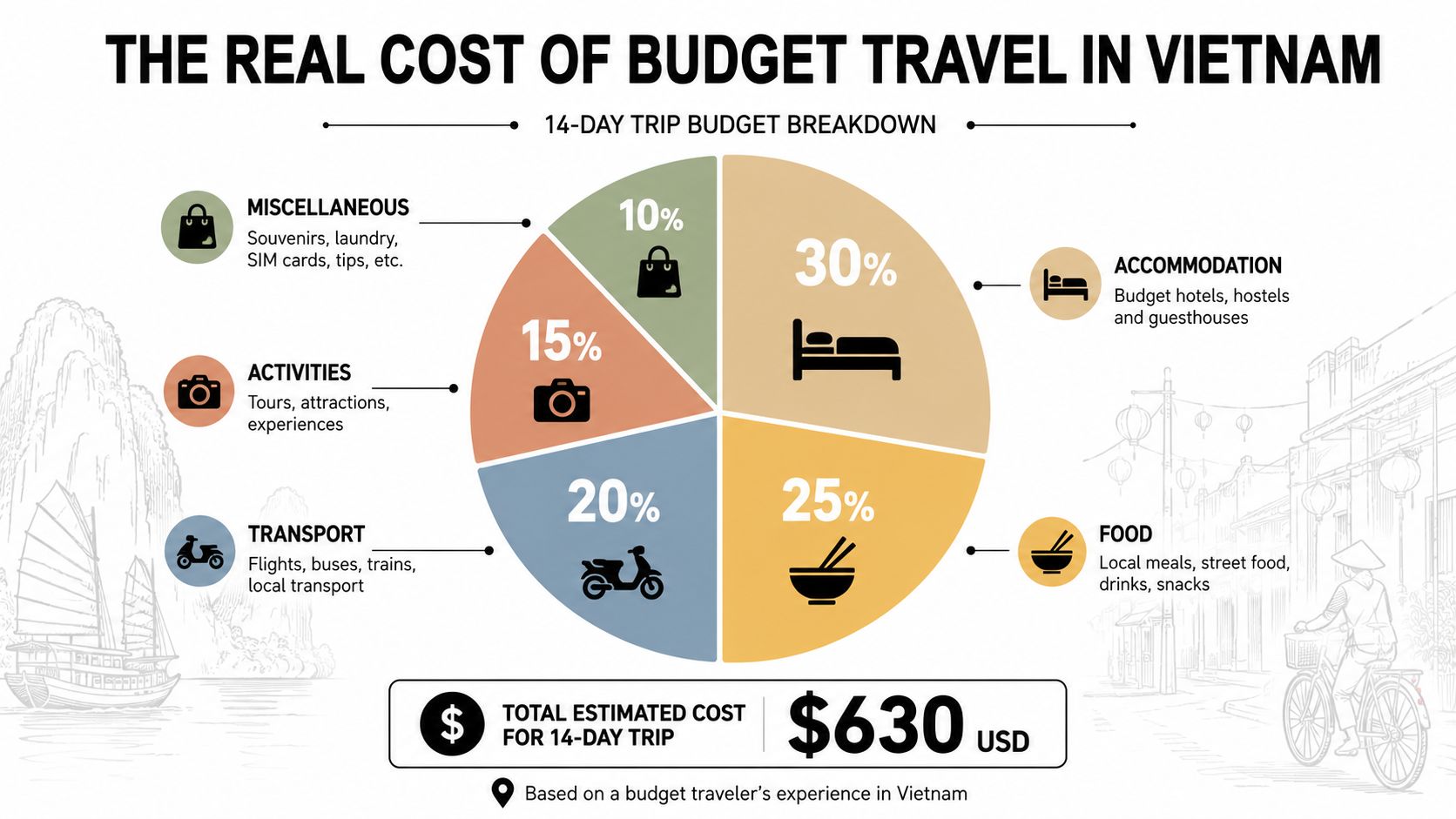
Vietnam is cheap at street level, but it is not friction-free. Hostel beds can sit around USD 8–15, street-food meals around USD 1–3, and local bus rides around USD 0.30–1 per trip (machupicchu.org). Those numbers keep the day low, but they do not protect you from the costs that arrive outside the daily rhythm, like visas, insurance, and the extra cash you need when plans change. A travel budget calculator helps separate the cheap days from the trip total before you book anything.
What a realistic 14-day budget looks like
If you want a planning number that will not trip you up later, use ranges instead of fantasy totals. A verified cost guide puts a 14-day backpacker trip at roughly USD 700–1,400, excluding international flights and visa costs, which already shows how wide the comfort gap can be (machupicchu.org). That range makes sense because the same country can support ultra-basic travel and a more comfortable mid-range version without forcing a completely different route.
The cleanest way to budget is to split your money into two buckets.
- Ground spend: accommodation, food, local transport, and entry fees.
- Trip friction: visa, insurance, contingency, and any upgrade money you know you will spend.
If your plan only works when every day goes perfectly, it is not a budget, it is a gamble.
Daily Budget Breakdown by Travel Style
Vietnam rewards travelers who pay attention to where the money disappears. A lean day and a comfortable day can look similar on paper, then diverge fast once you factor in room type, transport habits, and how often you pay for convenience. Use a travel budget calculator to test a few versions of the same trip before you lock in dates, because the cheapest-looking plan can still fall apart once fixed costs and buffer money are added.
Where the money actually shifts
A shoestring day stays cheap because the spending stays simple. Shared dorms, street food, and buses keep the base cost low, but the savings come from accepting slower movement and fewer paid comforts. If you are happy sleeping in a hostel, eating local meals, and planning around public transport, the day budget can stay tight without feeling punishing.
A mid-range day changes the trip in practical ways. You pay for a private room, better cooling, easier transfers, and a bit more flexibility when plans shift. That usually means less friction and better rest, but it also means you need to accept that a smoother day costs more even when you are still traveling carefully.
| Vietnam Daily Budget by Travel Style | Shoestring (USD) | Mid-Range (USD) |
|---|---|---|
| Accommodation | Shared dorms, basic guesthouses | Private room, better comfort |
| Food | Street stalls, simple local meals | Cafes, restaurants, more variety |
| Local transport | Buses, walking, shared rides | Grab, private transfers, fewer delays |
| Attractions | Free sights, low-cost entry | More paid activities and tours |
| Daily total | 20–35 | 40–80 |
The biggest swing factor is not lunch, it is movement. Hanoi and Ho Chi Minh City make it easy to spend a little more on taxis, coffee stops, and spontaneous plans because everything is close and available. Smaller towns often keep spending under control because there is less temptation to hop around, fewer overpriced shortcuts, and more reason to settle in for a few days instead of burning money on transfers.
The useful habit is to budget by category, not by wishful daily average. A good budget breakdown by category helps you separate what you can trim from what you should protect, especially when the hidden fixed costs sit outside the daily rhythm.
Budget style versus comfort style
Shoestring travel works best when your priorities are simple. You can accept shared space, local food, and slower transport in exchange for keeping the trip cheap. That style fits travelers who care more about staying on the road than about privacy or convenience.
Comfort travel works best when you need better sleep and less stress between stops. A private room, easier transfers, and occasional restaurant meals can save energy, but they reduce the margin you have for visa costs, insurance, and contingency money. That trade-off matters on a 14-day trip, because one expensive transfer or one missed booking can wipe out the savings from several disciplined days.
A practical way to plan is to assign each day a role. Use a very lean day after an overnight bus or train, a mid-range day when you want recovery or better sleep, and a flexible day near the end of the trip in case transport changes or weather disrupts your route. That keeps the budget realistic instead of pretending every day should cost the same.
One rule stays consistent across styles. Spend on rest and movement before you spend on extras that do not improve the trip.
Beyond the Tourist Circuit Slow Regional Travel
The Hanoi, Ha Long Bay, Hoi An route gets recommended because it is easy to package, not because it protects a tight budget. It stacks too many transfers into too few days, which usually means more ticketing fees, more time spent getting from place to place, and less room for the kind of slow travel that keeps spending under control. A better approach is to spend 3–4 days per region, settle into one base, and stop trying to “cover” Vietnam like a checklist.

Where the money goes
Underserved areas like Pu Luong, Ba Be, and Ha Giang come up again and again in traveler discussions for a reason. Guesthouses and eco-lodges in those regions can still run about $15–40 per night, and daily spending can stay around $30–50 (Reddit traveler discussion). The figures matter, but the real advantage is the rhythm of the trip. These places reward slower pacing, and slower pacing keeps transport costs down.
The classic circuit can work for travelers with very limited time. It still tends to funnel people into the same costly loop, quick arrival, quick departure, quick expense. Regional travel works differently. You settle into one place, take local trips, and let the region carry the itinerary instead of treating every stop like a layover between headline sights. That is the logic behind slow travel, where fewer moves usually mean better value and less fatigue.
Classic route versus regional route
The standard route suits first-timers who want the major sights and do not mind paying for convenience. Regional travel suits budget travelers who care more about local life than ticking off every famous stop. The difference is partly price, but it is also discipline.
If you want to keep a two-week trip under control, region-based travel makes the budget easier to manage. Fewer city hops mean fewer bus tickets, fewer booking mistakes, and fewer nights spent in transit accommodation that rarely feels like good value. You also protect space in the budget for hidden fixed costs such as visas, insurance, and a contingency buffer, the things many trip plans forget until they are already overseas. A route that stays in one region for longer gives those costs room to fit without forcing ugly compromises later.
For Vietnam, that often means choosing a base in the north, central coast, or highlands and building outward from there instead of sprinting between the best-known stops. You still get variety. You just stop paying for motion you do not need.
Skip one famous stop, and you often buy yourself three quieter days somewhere better.
Sample 7-Day and 14-Day Budget Itineraries
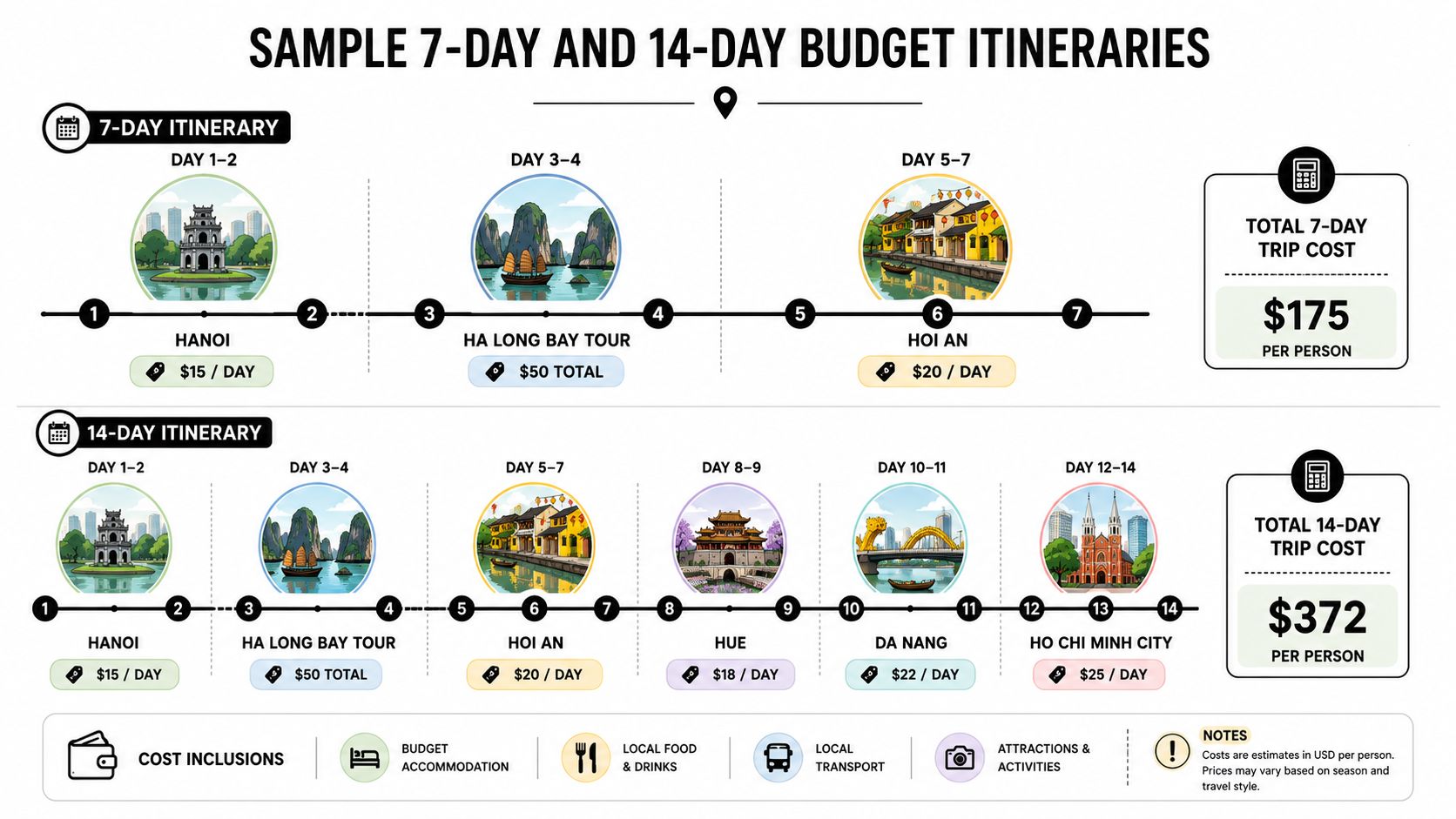
Theory gets useful when it becomes a route you could book. For budget travel Vietnam, a short itinerary should keep movement tight, while a longer one should use regional pacing to avoid paying for motion you don't need. The schedule below is built around that principle, not around trying to cram every famous stop into one trip.
A lean 7-day route
A fast budget route works best when you keep the number of bases small.
- Days 1–2, Hanoi: Use hostel accommodation and street food, keep days loose, and rely on local transport.
- Days 3–4, Ha Long Bay area: If you go, expect a paid excursion to become the trip's cost spike.
- Days 5–7, Hoi An: Slow down, walk more, and use the town as a lower-stress finish.
This kind of route can fit travelers who want a compact introduction without a lot of wasted transit. The daily spending pattern stays controlled because the trip doesn't zigzag across the country. For practical planning, overnight buses and trains need booking lead time, especially if your dates are fixed.
A fuller 14-day route
A 14-day version works better when you let the country breathe.
- Days 1–3, Hanoi: Base here first, then use day trips instead of changing hotels every night.
- Days 4–5, Ha Long Bay or nearby northern countryside: Pick one, not both, if you're watching the budget.
- Days 6–7, Hue: Good for slowing the pace before heading south.
- Days 8–9, Da Nang: Use it as a practical transit base rather than a destination you overpack.
- Days 10–14, Ho Chi Minh City: Finish with city energy and simple logistics.
The right itinerary isn't the one with the most pins on the map. It's the one where transport doesn't dominate your spending or your energy. A flexible spine also leaves space for weather changes and last-minute route swaps, which is useful because budget travel gets expensive when plans get brittle.
Seasonal Timing and Transport Hacks That Save Hundreds
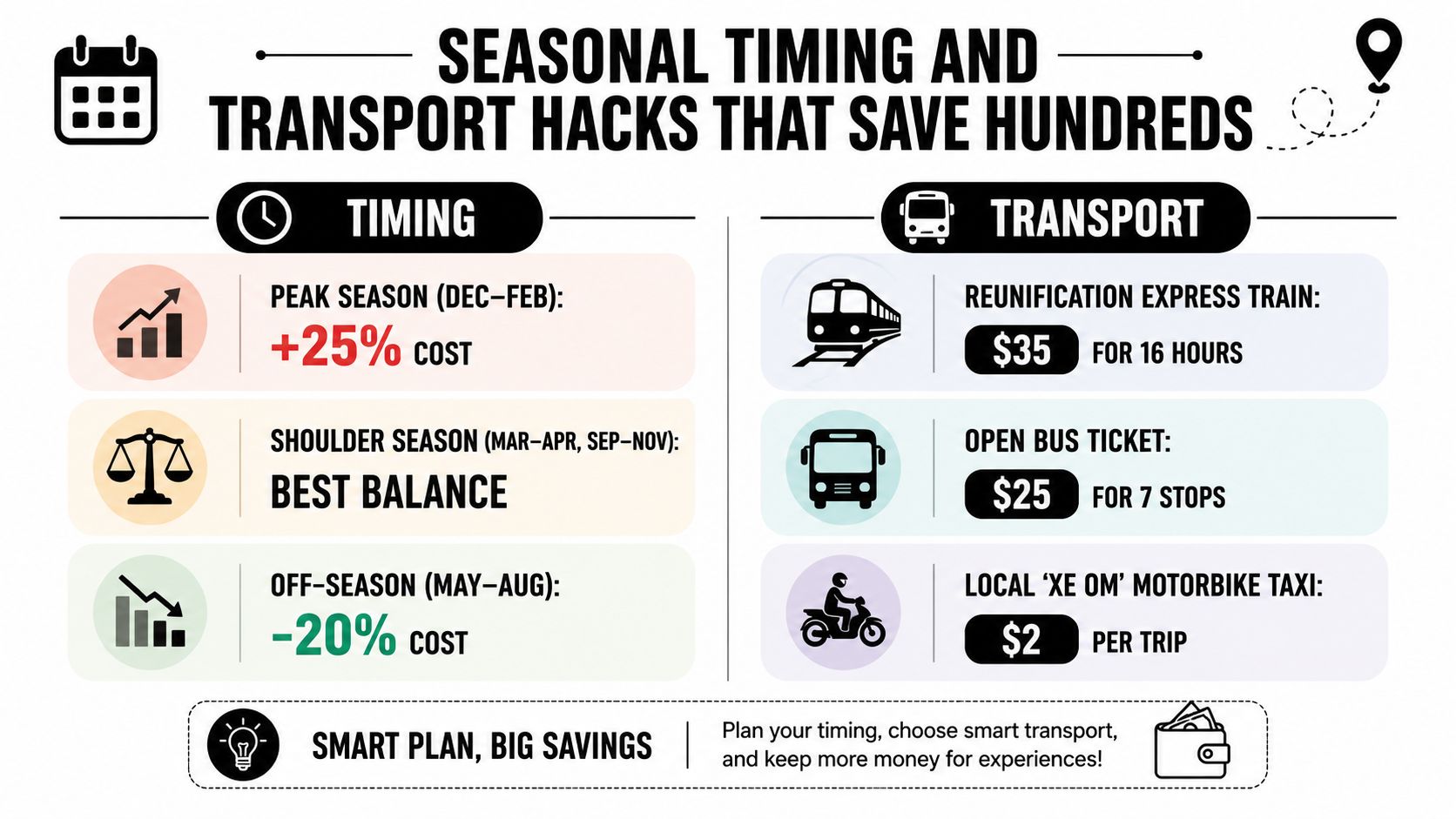
Vietnam stays affordable only if you respect the calendar. Peak season can push accommodation prices up 25–35%, while shoulder periods like April–May and September–October are often 20–30% cheaper than November–March (passportandstamps.com). That gap is big enough to change whether you sleep in a private room or a dorm, and it's one of the easiest budget wins available.
Timing that keeps prices sane
The sweet spot is shoulder season. Weather is usually workable, and prices are less punishing than during the busiest stretch. If your dates are flexible, that's where the budget starts looking like a budget again.
The other timing decision is your gateway city. Domestic flight competition often makes Ho Chi Minh City a cheaper entry point than Hanoi (passportandstamps.com). That doesn't mean Hanoi is bad, only that the cheapest route isn't always the one most guides default to.
Transport that protects your budget
Move long distances with restraint. Overnight trains and sleeper buses cost less in money and can save a night of accommodation, while domestic flights make sense when time matters more than the fare. If you need extra tactics, cheap flight hacks help when you're choosing between routes rather than blindly accepting the first fare you see.
The practical trade-off is comfort. Trains feel steadier, buses are more flexible, and flights are faster but can add airport transfers and baggage friction. On the ground, a motorbike taxi can be a cheap last-mile fix, but only if you're clear on the price before you ride.
Booking rule: the cheapest transport is the one you don't overuse.
Staying Safe and Traveling Smart on a Budget
Budget travel in Vietnam should feel economical, not careless. The best money-saving choices usually overlap with the safest ones, especially when you stick to places with clear pricing, reliable reviews, and decent lighting after dark. That's also why family-run guesthouses and locally owned homestays tend to be better value than anonymous chain options, because they usually give you context along with a bed.
A common real-world scenario is the airport or late-night ride. Use app-based taxis or agree on the fare before a motorbike pickup starts, because confusion over price is one of the fastest ways to lose control of a small budget. In busy nightlife areas, don't let a cheap room push you into a poorly located street just to save a few dollars, since the transport back and forth can erase the savings anyway.
Solo travelers, especially women traveling alone, usually do best when they choose accommodation with strong reviews, stay in central areas, and avoid late arrivals if they can. A hostel dorm can be fine if it's well run, but a quiet guesthouse with better access and a straightforward check-in often reduces stress more than it raises cost. The same logic applies to food, street stalls run by families often feel safer and more grounded than random high-turnover spots that exist only for transient traffic.
Don't save money by making yourself harder to find, harder to reach, or harder to trust.
There's also a quiet sustainability advantage in spending locally. Buying meals from small vendors, sleeping in community-run stays, and using regional transport keeps more money in the places you're visiting. That doesn't make the trip perfect, but it does make the budget more meaningful.
Your Vietnam Budget Planning Checklist
A Vietnam budget that holds up starts before you buy the flight. The hidden fixed costs come first, because visa, insurance, and a contingency buffer do not shrink just because you are traveling lightly. If you only plan for beds and meals, the trip looks cheaper on paper than it really is.
Use a simple structure in a spreadsheet or notes app, then keep it honest as you book.
- Pre-trip fixed costs: visa, insurance, and any transport you have already locked in.
- Daily costs: bed, food, local transport, and basic activities.
- Flex costs: upgrades, souvenirs, drinks, and side trips.
- Route costs: intercity buses, trains, or flights.
- Safety margin: money you leave untouched unless plans change.
Route choice matters more than a lot of budget guides admit. A fast loop with constant movement can look efficient, but every extra transfer adds ticket costs, food stops, and the kind of fatigue that pushes you toward more expensive convenience. A slower regional trip usually gives better value over two weeks, especially if you want to move beyond the classic tourist circuit and keep transport costs from eating the trip alive. A solid travel planning checklist helps you sort those choices before you book the wrong thing twice.
The usual mistakes are easy to spot. Travelers undercount the visa, skip insurance, and assume every day will land at the cheapest end of the budget range. They also pack in too many moves, then pay for the privilege of being rushed from place to place. Vietnam rewards the traveler who plans tightly, but leaves room for the fare surprise, the sick day, or the route that turns out more expensive than expected.
Build the budget, then leave it loose enough to live with. That is the difference between a trip that feels cheap and a trip that is sustainable.