You're probably here because the same thought keeps following you around: I love taking photos, I want more freedom, and I don't want my life reduced to waiting for two weeks of vacation each year.
That instinct is valid. So is the part of you that suspects the internet sells this career a little too easily.
If you've been asking how do I become a freelance photographer, the honest answer isn't “buy a camera and book a one-way flight.” It's learning to shoot well, price like a business owner, and build a client pipeline that works even when you're changing countries, time zones, and Wi-Fi networks. The travel part can absolutely fit. It just can't be the whole plan.
From Daydream to Day Rate A Realistic Introduction
A lot of people want the travel photographer life. Fewer want the spreadsheets, follow-up emails, rainy shoot days, customs questions, and editing backlog that come with it. The ones who last learn to want both.
The market also rewards realism. According to the U.S. Bureau of Labor Statistics photographer outlook, employment for photographers is projected to grow by 2 percent from 2024 to 2034, and the field is expected to have about 12,700 openings annually, mostly because people leave the profession rather than because the market is exploding. That changes how you should think about this career. You're not stepping into a gold rush. You're competing for trust, repeat work, and replacement opportunities.
That's why “be talented” isn't enough. A new freelance photographer has to be visible, easy to hire, clear about pricing, and reliable under less-than-perfect conditions. If you want to fund a life that includes movement, that pressure gets even sharper. You're not just selling images. You're selling confidence.
The fantasy version of this career starts with a plane ticket. The workable version starts with a niche, a rate, and a system.
There's still room for you. Plenty of room, if you stop chasing the broad label of “photographer” and start building a business around a specific kind of client and problem. For a travel-focused freelancer, that often means hotels, tourism brands, local experiences, retreats, editorial storytelling, creator content, or remote post-production work that travels well.
If travel freedom is the deeper goal, it helps to think bigger than flights and passports. Articles about how to travel the world usually focus on logistics. A photography career adds another layer. You need a way to turn images into invoices without burning through your savings first.
That's the version worth building. It's leaner, slower, and much more durable.
Mastering Skills and Gear on a Backpacker Budget
Most beginners spend too much time comparing camera bodies and not enough time studying light. That mistake gets expensive fast.
A client won't care that you own a premium lens if your framing is cluttered, your subject has raccoon-eye shadows, and your edit looks like five presets fighting each other. On a tight budget, skill is the only sensible place to start.

Learn the three things clients actually notice
Clients rarely describe photos in technical terms. They respond to whether the image feels clear, useful, and intentional.
Focus your practice on these:
- Light first: Learn open shade, backlight, hard noon light, window light, and mixed indoor light. If you can read light quickly, you'll work faster in unfamiliar locations.
- Composition second: Practice edge control, clean backgrounds, leading lines, subject separation, and simple layering. Strong travel work often looks better because it removes distractions.
- Story third: Don't just collect pretty frames. Build sequences. Wide shot, detail shot, action shot, portrait, context. That's what makes your work commercially usable.
A cheap camera in capable hands beats expensive gear used without discipline.
What to practice before buying anything else
Treat your home city like an assignment. Give yourself briefs instead of vague “photo walks.”
Try these exercises:
- A market story: Photograph a local food market as if a tourism client hired you.
- A neighborhood guide: Create ten images that would fit a boutique hotel's city page.
- A one-hour portrait session: Shoot a friend in changing light with one lens.
- A rainy-day challenge: Work anyway. Clients don't pause because conditions aren't ideal.
Practical rule: If you can't make strong work with a simple kit, a larger kit won't fix the problem.
Build a starter kit that travels well
You don't need a rolling case full of lenses to begin. You need gear that's dependable, lightweight, and cheap enough that one bad month won't wreck your cash flow.
A practical starter setup looks like this:
| Item | What to look for | Why it matters |
|---|---|---|
| Camera body | Reliable used mirrorless or DSLR body | Used gear lowers risk while you learn |
| Lens one | A general-purpose zoom or a normal prime | Covers most early client work |
| Lens two | A lightweight wide option if you shoot interiors or travel scenes | Useful for hotels, architecture, and location work |
| Storage | At least two memory cards | Redundancy matters more than capacity bragging |
| Backup | Small SSD or portable drive | Travel means more chances to lose data |
| Carry | Plain backpack or insert | Less attention, more flexibility |
| Power | Spare battery and charger | Dead batteries kill shoots |
Buy used from reputable dealers when possible. Cosmetic wear doesn't matter. Shutter reliability and sensor condition do.
If you're traveling light, look at your packing the same way experienced backpackers do. A good backpacking essentials list has the same logic as a good camera bag. Every item should earn its weight.
What not to buy yet
This matters as much as the shopping list.
Don't rush into premium tripods, specialty lenses, drones, subscription stacks, or backup camera bodies unless paying work already justifies them. New photographers often hide behind “upgrading.” It feels productive because it's concrete. It's usually avoidance.
Spend your first money on things that improve output and reliability:
- Editing software you'll learn to use
- Cloud or drive backup
- A clean strap or bag that helps you work comfortably
- A simple portfolio site once your images are ready
The early goal isn't to look established. It's to become useful.
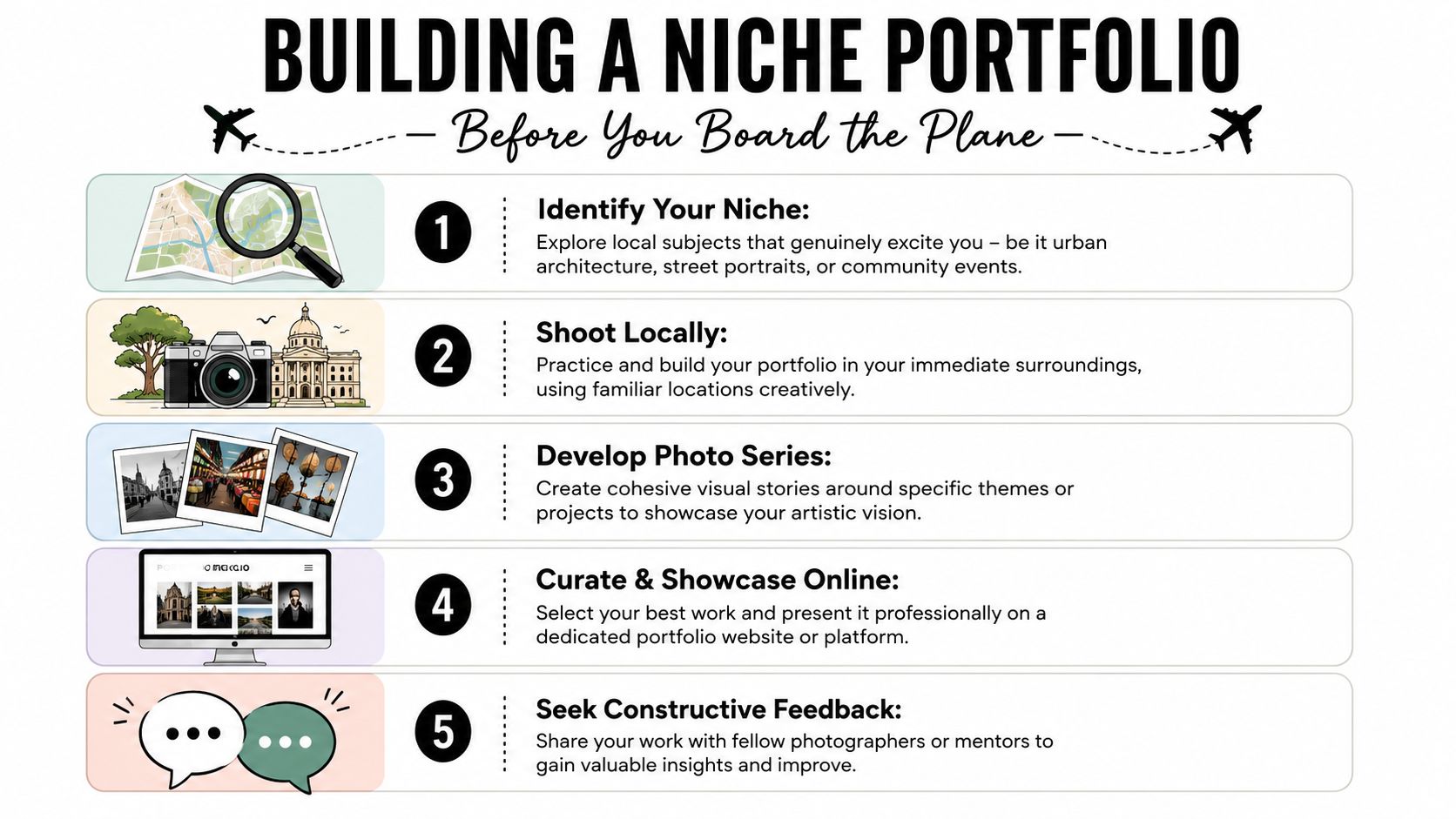
Building a Niche Portfolio Before You Board the Plane
Most aspiring travel photographers make the same portfolio mistake. They upload every decent image they've ever taken and call it a brand.
That doesn't work. Clients don't hire “someone who likes photography.” They hire the person who already looks like the answer to a specific need. Expert guidance in this field consistently points to building a portfolio around a clear niche and using direct outreach, rather than waiting for clients to find you. It also warns against over-investing in gear before revenue exists, as noted in this freelance photographer guide from Format.
Build a niche before you build a destination list
You do not need to be in Morocco, Japan, or Patagonia to create travel-style work. You need consistency.
Strong beginner niches for a travel-minded photographer include:
- Boutique hospitality: Rooms, breakfast scenes, check-in moments, details, neighborhood atmosphere
- Outdoor lifestyle: Trails, camps, surf towns, movement, gear-in-use
- Cultural storytelling: Local makers, food vendors, workshops, community spaces
- Urban destination content: Architecture, cafés, public spaces, street texture, local character
Pick one. Then build for that one.
A messy portfolio forces the client to guess what you do. A focused portfolio lets them imagine hiring you.
Shoot local work that looks like commissioned work
Your town is enough. Your nearby train line is enough. The café down the street is enough. The point isn't glamour. The point is whether your images solve a commercial brief.
Create small self-assigned projects such as:
- A hotel-style series in a guesthouse, short-term rental, or stylish hostel common area
- A city guide edit featuring transit, coffee, storefronts, signage, and neighborhood rhythm
- A maker profile on a florist, ceramic artist, baker, or surf instructor
- A “48 hours here” story built entirely in one district
Use the same discipline you'd use on paid work. Ask for permission. Plan a shot list. Deliver a polished gallery. Write captions. Name files clearly.
A client doesn't need proof that you travel often. They need proof that you can produce consistent work in real conditions.
Your website should be simple and easy to scan
A portfolio site doesn't need to be clever. It needs to remove friction.
At minimum, include:
- A homepage with your niche stated clearly
- Two to four tight galleries
- An about page with your location flexibility
- A contact page with one obvious form or email
- A short services page
Skip the giant autobiography. Skip the twenty-category menu. Skip the moody quote on the homepage.
If you want to sharpen your visual direction, study practical travel photography techniques and then apply them to local assignments. That's how you create work with destination appeal before any big trip happens.
Direct outreach beats passive hope
When your portfolio starts to look coherent, reach out. Don't blast generic templates to hundreds of businesses. Send a short, relevant note to places that fit your style.
A useful message includes:
- Why you chose them
- What kind of work you make
- A direct portfolio link
- A simple idea for how you could help
That approach works better than posting endlessly and waiting for strangers to connect the dots.
How to Find Clients and Price Your Work Confidently
Getting good at photography feels hard until you try pricing. Then pricing feels harder.
The reason is simple. Pricing forces you to confront whether this is a hobby you occasionally monetize or a business that has to survive. That gap is where many talented photographers get stuck.
Data from ZipRecruiter's freelance photographer salary page shows the average annual salary is $130,079 as of May 2026, with top earners at $148,500 and the 25th percentile at $61,500. That range tells you something important. Skill matters, but business decisions shape income.

Start with reachable clients, not dream clients
New photographers waste months pitching national tourism boards and glossy magazines before they've completed a handful of clean, paid jobs. Start closer.
The fastest early clients are often:
- Local stays and hosts: Small hotels, guesthouses, hostels, and vacation rentals need images regularly.
- Tour operators and guides: Walking tours, food experiences, diving schools, yoga retreats, and surf camps all need usable content.
- Restaurants and cafés: Especially those in travel-heavy areas with active social channels.
- Remote content clients: Blogs, small brands, and creators who need photo editing, selects, metadata cleanup, or image libraries organized.
This is also where a travel-focused freelancer can begin getting paid to travel, even if the first steps are local and regional rather than international.
Calculate your minimum viable rate
One of the most practical pieces of guidance for new freelancers is to calculate a minimum viable rate using your real expenses and your real working time, as outlined in this Indeed guide to becoming a freelance photographer. Too many people charge for shoot hours only and forget everything around the shoot.
Your floor should include:
| Cost area | What belongs in it |
|---|---|
| Equipment | Camera wear, repairs, replacements, accessories |
| Software | Editing tools, gallery delivery, bookkeeping, storage |
| Travel | Transit, fuel, baggage fees, accommodation when needed |
| Admin | Email, proposals, invoicing, scheduling, calls |
| Post-production | Culling, editing, export, upload, revisions |
| Protection | Insurance, taxes, contingency buffer |
Now add the part many beginners ignore. Profit. If your quote only covers costs, one cancellation, delayed payment, or broken lens can wipe out the month.
Charge for the whole assignment, not just the hour your camera is in your hand.
A simple way to quote without panicking
You don't need a complicated formula on day one. You do need a repeatable structure.
Use this sequence:
- Estimate total time including planning, travel, shoot time, editing, and delivery.
- Add direct expenses specific to the job.
- Check your minimum viable rate so you know your floor.
- Assess usage and complexity. A small local social shoot isn't the same as a multi-location hospitality package.
- Present one clear quote, not a rambling list of doubts.
If the client budget is below your floor, you have three options. Reduce scope, change deliverables, or decline. Don't passively absorb the gap.
What works and what doesn't
What works
- Sending customized pitches with relevant portfolio samples
- Offering compact starter packages for first-time clients
- Following up politely when people go quiet
- Asking happy clients for referrals and repeat work
What doesn't
- Quoting from insecurity
- Matching the cheapest photographer you can find
- Saying yes to vague deliverables
- Treating every inquiry as if exposure will lead somewhere
The photographers who build stable income aren't always the most artistic. Often, they're the clearest.
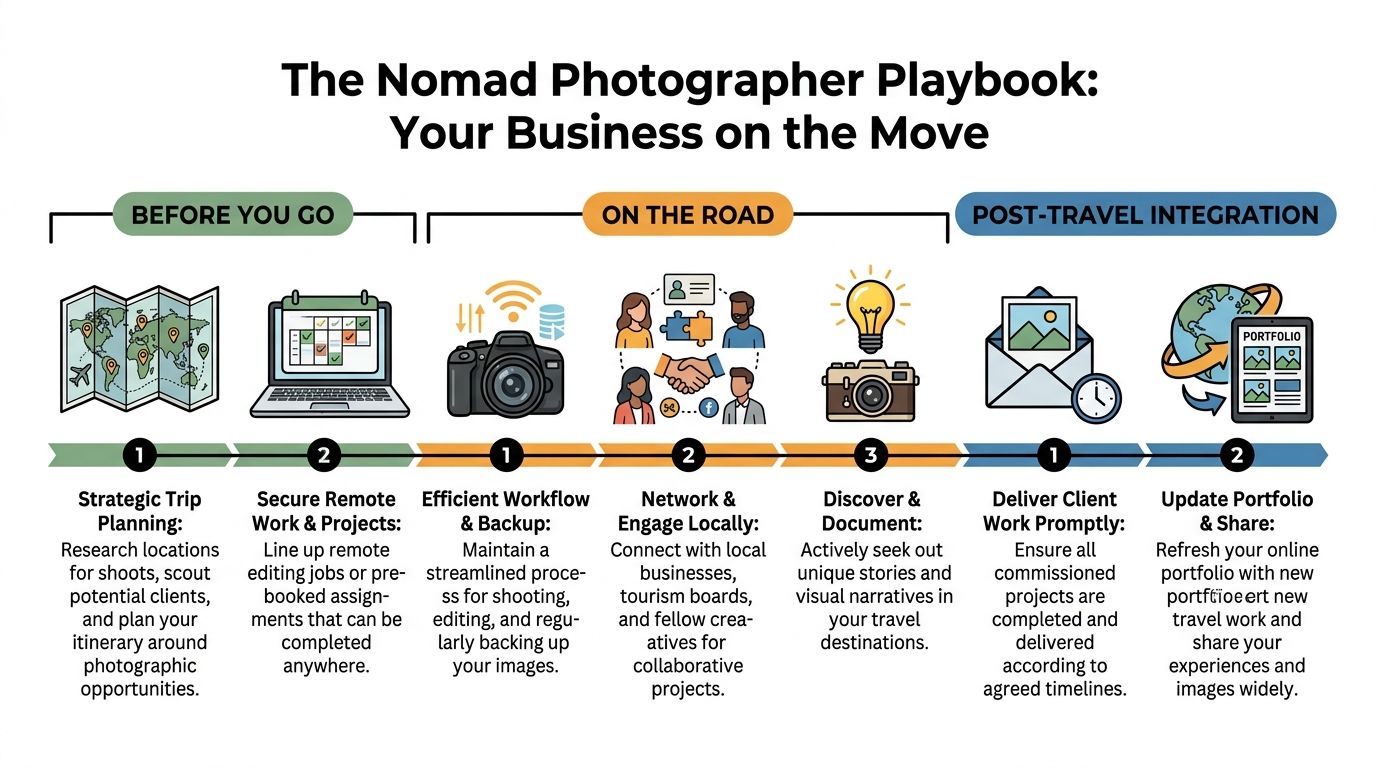
The Nomad Photographer Playbook Your Business on the Move
Travel photography becomes more viable when you stop thinking like a tourist and start thinking like an operator.
The biggest shift is understanding geographic arbitrage. Data from the 2024 Global Freelancer Survey by SAP shows 68% of remote freelancers in creative fields cite geographic arbitrage as their primary income booster. In plain language, that means living where your overhead is lower while selling work into stronger-paying markets.
That doesn't mean undercutting everyone. It means building breathing room.
Use geography strategically
A nomad photographer can combine several income streams:
- Client work in higher-paying markets
- Remote editing or retouching
- Local destination shoots while abroad
- Content packages for accommodations, retreats, and small travel brands
The advantage isn't magic. It's margin. If you can keep living costs controlled, you get more room to be selective, save for gear replacement, and survive slow months without dropping your standards.
For many people, researching the best countries for digital nomads is really a question about cost structure, visa fit, internet reliability, and how easily they can maintain client service from the road.
Build a mobile business that doesn't fall apart
Mobility rewards simple systems. Fancy workflows collapse when you're editing on a train, sending an invoice from an airport, or trying to upload finals from weak Wi-Fi.
Keep these pieces lean:
Contracts
Use a short agreement for every paid job, even small ones. It should cover deliverables, payment timing, rescheduling, cancellations, usage, and turnaround.
A simple contract protects both sides. It also signals professionalism fast.
Payments
Use payment tools your clients already trust and that work internationally. Test them before you leave home. Nothing makes you feel more amateur than finishing a job abroad and realizing the payment method doesn't work where you are.
File management
Back up in layers. Keep files on your working device, a portable backup, and a cloud option whenever connection allows. Cards fail. Bags get stolen. Laptops die.
Communication
Work from one professional email. Use a calendar link only if it simplifies booking. Keep proposal templates, licensing notes, and invoice language saved somewhere offline too.
If your business only works from your desk, it isn't built for travel yet.
Stay safe and stay useful
A travel career gets romanticized. In practice, the strongest nomad photographers are calm, organized, and boring in the best way.
They do things like:
- Carry less flashy gear in unfamiliar areas
- Scout locations in daylight
- Separate backups from the main camera bag
- Confirm logistics with clients in writing
- Know where they can work, edit, and recharge securely
They also keep earning while moving. That matters. A travel month with no invoices can feel adventurous for a week and stressful after that.
One hard-won lesson from life on the road is this: the travel itself won't stabilize your career. Your systems do.
Navigating the Legal Side of a Borderless Business
Many photographers assume they can sort out taxes, visas, and business rules later. That assumption causes expensive problems.
According to the 2025 International Taxation Report by the OECD, cross-border freelance income disputes rose by 45% in the last year, and 72% of new freelancers reported confusion over “tax home” definitions across borders. For a travel photographer, that's not background noise. It's a warning.
Tourist mindset, business risk
A camera doesn't turn every trip into work. The moment you start invoicing, shooting for a brand, or producing client deliverables across borders, legal questions show up.
Pay attention to these areas:
- Visa status: Some countries treat remote work, local paid shoots, and commercial production differently.
- Tax residency: The often-mentioned 183-day rule is only part of the picture. It doesn't replace country-specific tax rules or professional advice.
- Tax home: You need clarity on where your business base is.
- Insurance: General travel insurance may not cover paid professional equipment use.
- Permits and releases: Commercial work can trigger local permit requirements faster than many new freelancers expect.
Ask better questions before you travel
You don't need to become an international tax specialist. You do need to stop relying on vague internet comments.
Before taking paid work abroad, ask:
- Am I allowed to perform this type of work on my current visa?
- Where will this income likely be taxed?
- What makes this country consider me a tax resident?
- Does my insurance cover professional gear and liability?
- Do I need a local permit for this shoot?
Bring those questions to a qualified tax professional and, when needed, an immigration or business lawyer in the relevant country.
Borderless income still lives inside very real borders. Ignore that, and the paperwork catches up.
If you want a long career, treat compliance like part of the craft. It won't make your Instagram look exciting. It will keep your business open.
Travel Talk Today helps travelers build smarter, more affordable, and more meaningful adventures. If you're shaping a photography-driven life on the road and want practical guidance on destinations, budgeting, slow travel, and solo safety, explore Travel Talk Today.