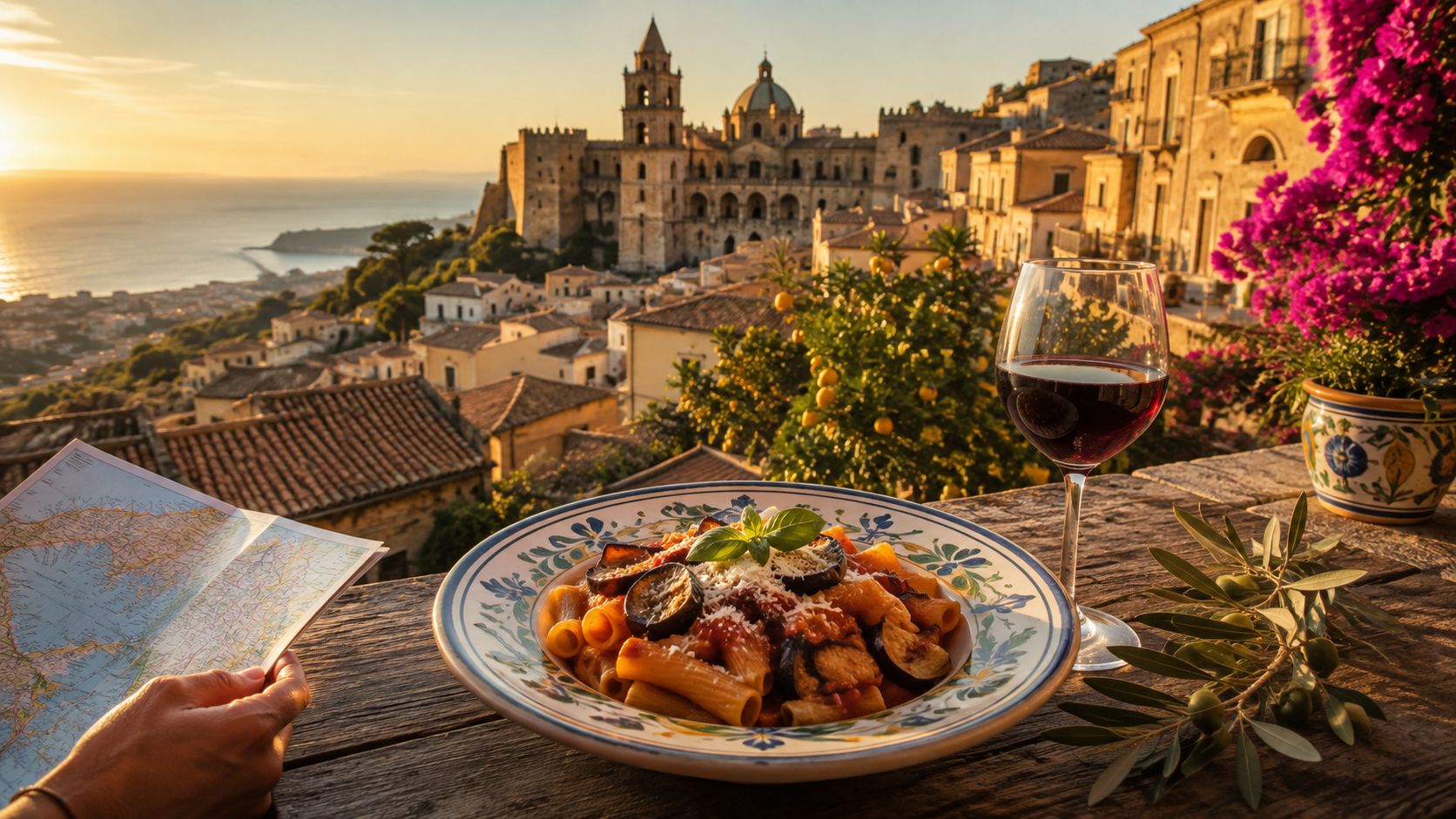
The fishmonger in Palermo slid a silver swordfish fillet onto brown paper, called after a customer in quick Sicilian, and then laughed when she answered in Italian with the same easy rhythm. A few streets away, church bells were already pulling people toward a procession, while scooters threaded through the market as if the whole city had agreed to share the road. That's the first lesson of Sicily Italy culture, it isn't a museum label, it's a daily negotiation between memory, speech, food, and faith.
Why Sicily Feels Like Nowhere Else in Italy
In Palermo's old market streets, the air can feel almost theatrical, with onions, citrus, grilled seafood, and incense all seeming to share the same hour. A vendor calls out in a rough sing-song, a grandmother answers in quick Sicilian, a child switches back to Italian without a second thought, and the street keeps moving. That is where Sicily Italy culture becomes visible in ordinary life, in the way speech, religion, food, and street habits sit side by side. Its distinct character has long been recognized by observers of the island's history and daily life Britannica.
You notice the difference before anyone explains it. In one neighborhood, laundry hangs between balconies above a bakery that smells of warm dough. In another, a church square fills slowly as people stop to talk before Mass, then drift toward a café for espresso and a pastry. On hot afternoons, shutters stay half-closed, and the pace of the day seems to shift with the light. Even transport has its own rhythm, with scooters, buses, and walkers all negotiating narrow streets that were never designed for modern traffic.
Sicily Italy culture lives in daily negotiation between memory, speech, food, and faith. A meal served near the coast may be simple and spare, while inland villages lean toward slower lunches, stronger dialect, and a sharper sense of local identity. Hospitality also changes from place to place. In one town, a visitor may be offered a seat immediately, in another, conversation comes first and the welcome arrives through the conversation itself. The island rewards travelers who pay attention to those small differences, because they reveal more than any single headline about Sicily ever could.
What stays with many visitors is the feeling that the island is never performing for them. A ceramic saint in a doorway, a market vendor with flour on his sleeves, and a family table set under a fan all belong to the same lived culture. That is the reason Sicily can feel so unlike anywhere else in Italy. The past is present, but it arrives through weather, work, speech, and the timing of an ordinary day. A closer way to see that everyday culture is through cultural immersion travel.
The Core Idea of Sicilian Culture
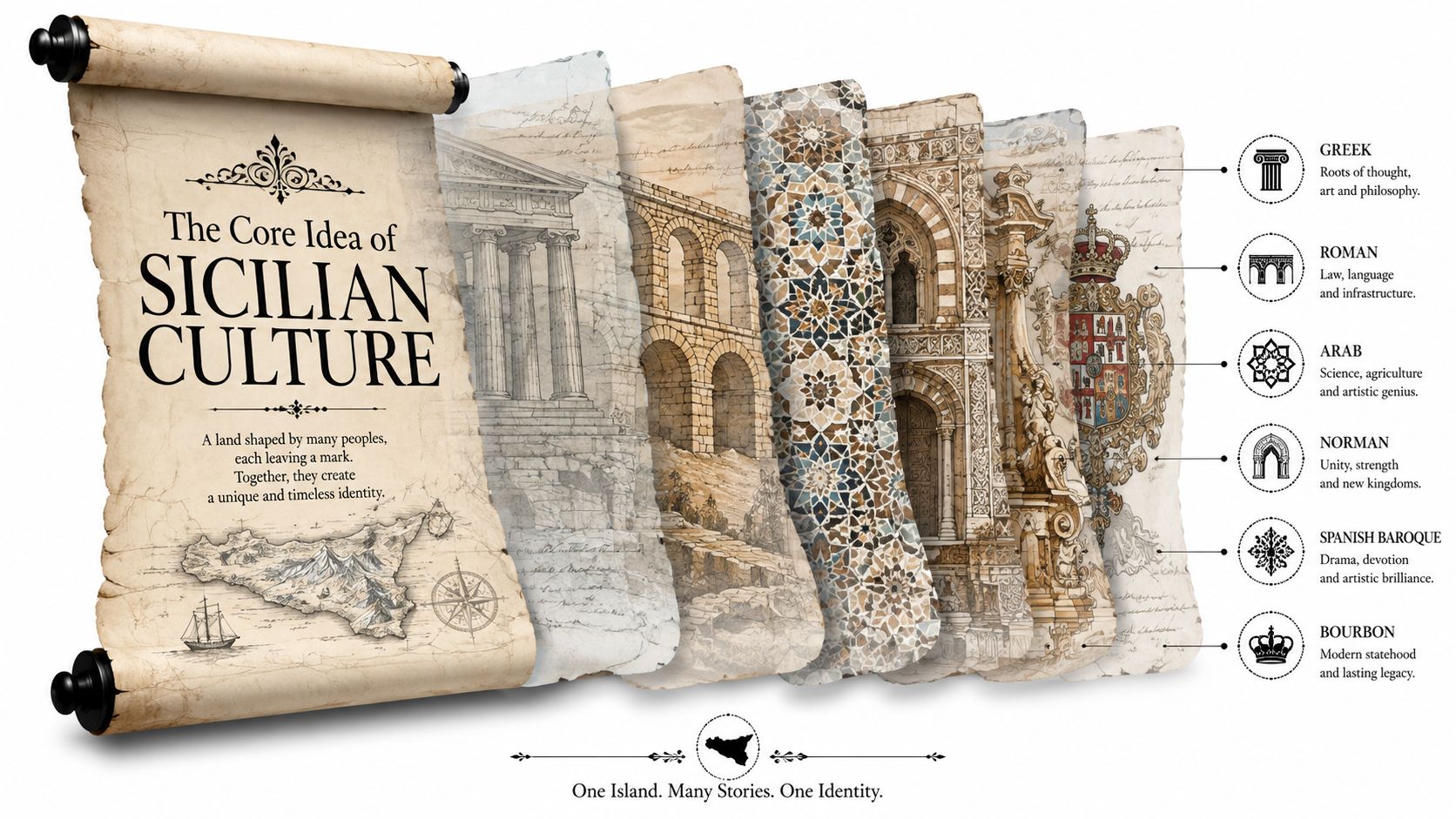
A visitor notices it first in small, ordinary scenes. A grandmother in a village square switches from Italian to Sicilian while calling to a nephew. A baker hands over warm bread and keeps talking about the weather, the olive harvest, and whose cousin married into which family. A church bell, a market stall, and a shaded table under a fan all feel part of the same social fabric. Sicilian culture is lived this way, in habits that carry memory without turning it into a museum display.
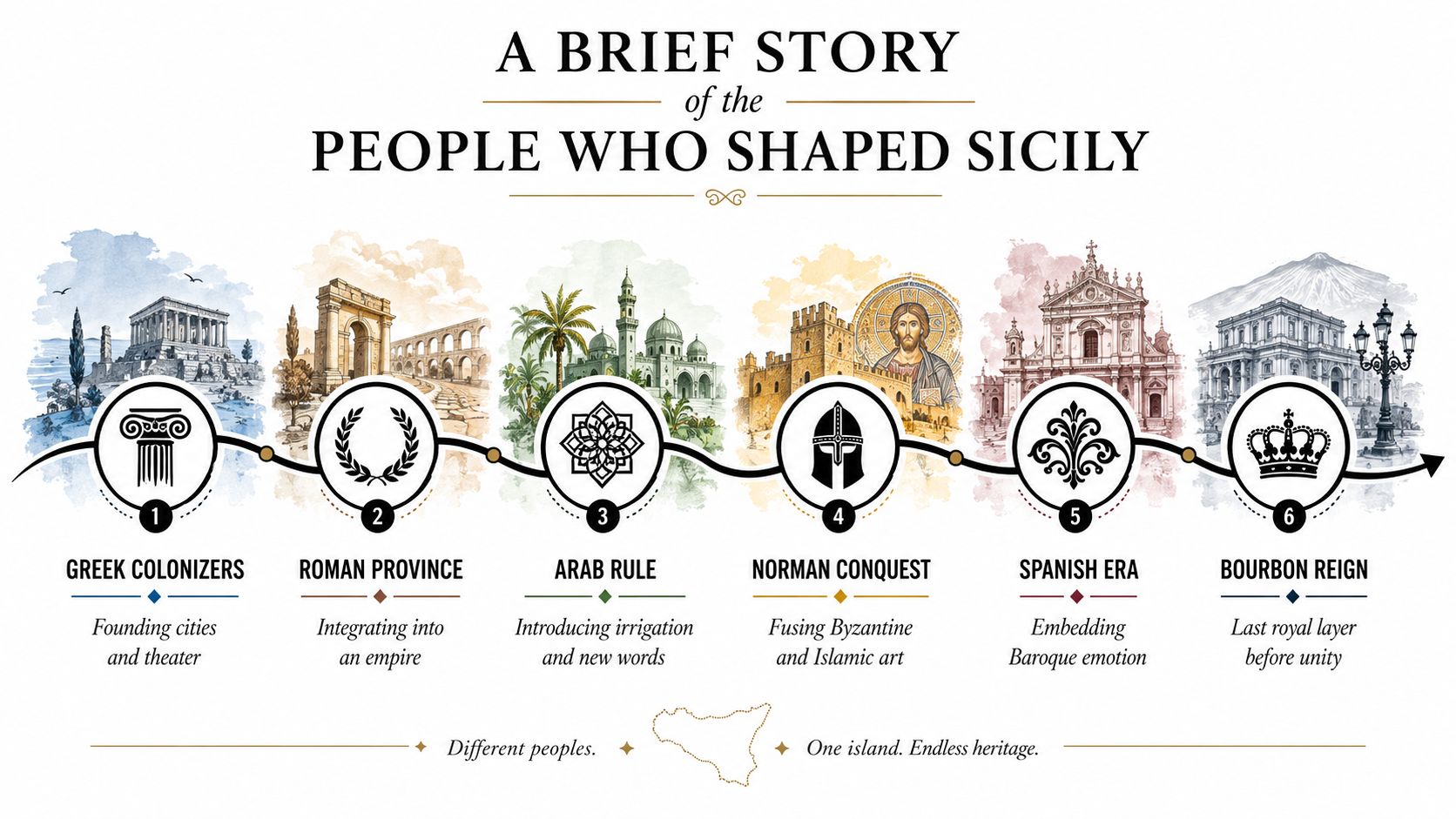
The island works like a palimpsest, an old page written over many times but never fully erased. Greek settlers founded major cities such as Syracuse, Catania, Selinunte, Agrigento, and Gela in the 8th century BCE, Rome later made Sicily its first province in the 3rd century BCE, and Arabic, Norman, Spanish, and Bourbon rule added further layers afterward Wikipedia. Those periods did not disappear. They remain visible in the shape of buildings, the logic of streets, the rhythm of cooking, the words people still use at home, and the way guests are received.
That is why a traveler can stand in one town and read several epochs at once. A church may carry Norman structure beneath later Baroque decoration. A dish can look familiar in Italian terms and still reflect ingredients or techniques that arrived through older Mediterranean exchange. Even conversation shifts with the setting. Many Sicilians move between standard Italian and Sicilian in daily life, and that bilingual habit gives each town its own voice Wikipedia.
Practical rule: Don't search for a single “authentic” Sicilian layer. The strongest moments usually come where layers meet.
For travelers who want more than quick sightseeing, cultural immersion travel suits Sicily especially well, because the island rewards time, conversation, and repeat encounters far more than rushed box-ticking. Understanding Sicily as a kitchen with many hands at work helps frame the journey ahead.
A Brief Story of the People Who Shaped Sicily
A woman in a village above the Ionian coast once pointed to the paving stones outside her door and said her street had always known how to welcome strangers. She meant more than manners. In Sicily, the old habit of receiving outsiders left traces in the layout of towns, in the way people linger in the piazza, and in the pride with which they speak of their quarter, their market, and their church. That sense of civic attachment goes back to the island's earliest settlers and still shows up in daily life now, especially in places like Syracuse and Catania, where local identity is spoken about as if it were part of the weather.
The island's history also runs through work. For centuries, Sicily was shaped by people who came to trade, farm, govern, pray, and leave their mark on stone and language. In practical terms, that means travelers keep seeing the same pattern from town to town, a cathedral beside a market, a hill road leading to a working port, a café table filled with people who have time to talk. The island has always been more than a beautiful backdrop, it has been a place of exchange, production, and movement across the Mediterranean.
The Arab and Norman turns
One of the clearest surviving layers came from the centuries of Arabic rule, followed by the Norman conquest. That sequence left a strong mark on language, agriculture, and building styles, and Britannica notes how those changes shaped the island's later identity Britannica. You feel it in the architecture first. A palace courtyard may frame light and shadow with Arabic restraint, while a cathedral nearby carries Norman mass and later ornament without ever feeling like a single, tidy style.
In town after town, that blend is visible without needing a museum label. A carved arch, a patterned courtyard, a street name people still use at home, these small details keep the older layers present in ordinary life. Later Spanish and Bourbon rule brought their own taste for ceremony, power, and display, and those habits still surface in processions, facades, and the way public space is staged for holidays and gathering.
For travelers who want to read those differences on the ground, the most useful guide to Sicilian towns is the town itself. Walk slowly, sit where people gather, and notice what stays in use. A stone doorway, a bakery queue, and the tone of conversation in the square usually reveal more than a neat summary ever can.
The story unfolds as a weave rather than a straight line.
How Sicily Varies Region by Region
Sicily isn't one cultural mood stretched across a map. Palermo can feel outward-looking and layered, while the east leans into older Greek memory, and the interior often carries a slower, more local rhythm. If you plan a trip by region instead of by island-wide cliché, the place opens up much faster. A useful starting point is to think in terms of what you want to hear at the table, not just what you want to photograph.
West, east, and interior
Palermo is the most obvious place to feel the Arab-Norman blend in daily life. Markets, church facades, and street food all sit close together, and the city's texture rewards walking rather than rushing. In the west, Trapani and Marsala carry stronger maritime and North African echoes, and that's where visitors often notice dishes like couscous as part of the local conversation.
The east feels different. Catania and Syracuse carry stronger Greek-rooted associations, and the terrain around them tends to frame that history more openly. In the southeast, Ragusa and Noto are associated with Spanish-Baroque atmosphere, while Enna and the interior towns can feel more withdrawn, with rituals and festivals tied to agricultural calendars and local memory. For readers who want to explore village culture at a gentler pace, a broader look at towns in Italy helps distinguish the kinds of places that reward lingering from the ones that only reward a quick stop towns in Italy.
| Region | Dominant influences | Signature food | Key festival |
|---|---|---|---|
| Palermo and the west | Arab-Norman, maritime, North African echoes | Couscous in western coastal areas | Local saint processions |
| Catania and Syracuse | Greek-rooted eastern identity, later layered influences | Pasta alla Norma in the Catania area | Saint Agatha in Catania |
| Ragusa and Noto | Spanish-Baroque southeast | Richer pastry and market-driven cooking | Religious and seasonal town celebrations |
| Enna and the interior | Rural, local, agricultural memory | Hearty inland dishes | Living Nativity in Enna |
| Marsala and Mazara del Vallo | Western coastal, Arab-influenced | Fish-forward coastal cooking | Harbor and saint festivals |
That table matters because Sicily's regions aren't just scenic categories. They shape the food you're offered, the accent you hear, and the pace at which people expect you to move. A traveler who wants the island's plural identity should choose a base with intention. Palermo, Catania, or a smaller town each leads you into a different version of the same island.
Food, Festivals, and Dialect as Everyday Culture
In Catania, a plate of pasta alla Norma can arrive looking simple, almost unassuming, until the first bite tells you how much history sits underneath it. The eggplant, the tomato, the salted cheese, and the way the dish is cooked speak to a kitchen shaped by exchange, trade, and local habit, then made fully Sicilian at the table. Street food carries the same memory. Fried panelle, arancini, and other quick bites keep that older taste for shared, practical food alive in markets and on corner streets, where cooking has always had to fit daily life as much as celebration.
What the calendar and the kitchen share
Festivals follow the same logic. A procession is part public ritual, part town memory, with saints carried through narrow streets, candles flickering at dusk, and families standing outside their doors to watch. In Catania, Saint Agatha still gathers the city around a shared story. In Enna, the Living Nativity turns winter into a local scene of faith and community. Visitors often come for the pageantry, then notice the deeper layer, the sense that each town is rehearsing its own belonging in front of the people who live there.
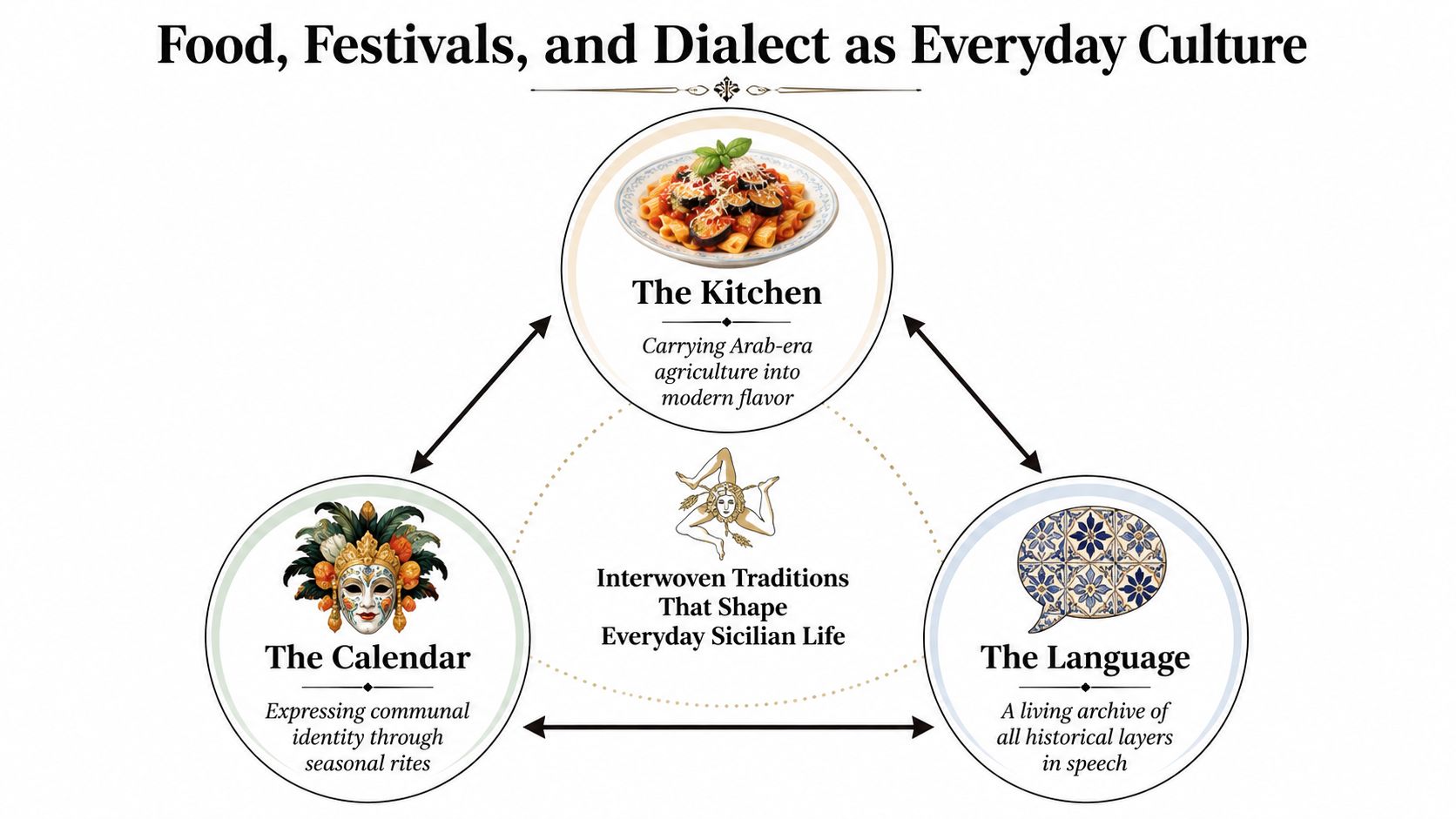
Language is the daily marker that ties those scenes together. Sicilians commonly move between Italian and Sicilian, and the island's speech still carries traces of long contact with Greek, Arabic, Norman, Catalan, Occitan, and Spanish Wikipedia. You hear that mix in the sound of greetings at a bar, in market banter, and in the way older speakers stretch or soften a word before handing it over to someone else. Even without understanding every phrase, the rhythm makes the island feel distinctly lived in.
A simple greeting can do more than a museum ticket. Learn a few local phrases, then listen for the rhythm before you speak again.
For travelers who want to see culture where it still meets work, family, and land, agritourism in Italy offers one of the clearest openings. In Sicily, that can mean a farm meal in the countryside, a vineyard lunch, or a kitchen where what is served depends on what was grown, preserved, or brought in that day. The best meal often says the most. It shows what people produce, what they borrow, and what they still claim as their own.
Etiquette, Sustainability, and Safety for Cultural Immersion
I once watched a shopkeeper in a small Sicilian town set down his coffee to explain the price of tomatoes, then pause to ask where the visitor was staying and whether they had eaten yet. That small exchange says a lot about local hospitality. Sicilian warmth tends to come with eye contact, conversation, and a clear sense that guests should arrive with patience, not hurry. The word sicilianità points to that local pride, a way of belonging that locals often describe through welcome and shared life rather than through outsider clichés about the island TandF Online.
How to move like a respectful guest
Start with the basics. Say hello before you ask for help, dress modestly in churches, and keep your voice low during religious processions. In restaurants, do not treat a family trattoria like a place to pass through. If you are invited to linger over another coffee or a final conversation, that is part of the visit.
Small choices shape how a trip feels on the ground. Stay longer in one city or town, then make shorter side trips instead of changing hotels every night. That approach fits Sicily well, because OECD research points to remoteness and weak internal and external transport connections as real limits on mobility across the island OECD. A slower plan is kinder to local rhythms, and it usually gives you more room to notice them.
Practical rule: If a village or hill town feels hard to reach, that difficulty is part of its character. Build the itinerary around the place instead of trying to force the place into a tight schedule.
Heat shapes the day too. Sicily's hottest months can reach around 35°C, while shoulder seasons are milder and usually less crowded OECD. If you are sensitive to high temperatures, putting culture-heavy walks in cooler months makes churches, markets, and neighborhood streets much easier to enjoy. The broader logic of slow travel in Italy fits here too, because Sicily rewards patient spending, local meals, and fewer jumps between towns.
Support family-run businesses, eat where locals linger, and ask before photographing people up close. Those choices are not symbolic. They decide where money goes, who can keep a shop open, and whether your visit feels like an exchange or a transaction. Safety and respect often begin the same way, by slowing down enough to notice the room you are in.
Two Culturally Rich Itineraries You Can Afford
A week in Sicily feels fuller when you stop trying to cover the whole island. One family may base itself in Palermo and spend its mornings under the chatter of market stalls, its afternoons in Arab-Norman churches, and its evenings walking back through streets that still smell of warm bread and fried street food. Another traveler may sleep in Catania, use the city as a fixed point, and let Syracuse, the slopes of Etna, or smaller inland towns add the next layer of history.
A slow base stay that doesn't feel hurried
For a seven-day stay, settle in Palermo or Catania and make short day trips into nearby villages and smaller towns. In Palermo, give one day to the markets, one to Arab-Norman sites, one to the coast, and another to neighborhood bakeries and churches where daily life keeps moving around you. In Catania, build your time around the city itself, then add Syracuse or inland towns for a second layer of history.
That kind of trip works because Sicily's transport realities do not always favor fast touring. Internal connections can make point-to-point cultural hopping frustrating, so one base often gives you a better trip than trying to cross too much ground. If you want the plan to feel bookable rather than aspirational, choose one hotel or apartment and treat everything else as an excursion.
A budget route that still feels layered
For a longer, budget-focused route, think in terms of Trapani, Palermo, Cefalù, and the Aeolian Islands. Regional trains and ferries let you stitch together a trip that changes mood without constantly changing your packing list. Trapani gives you the western coastal story, Palermo delivers the layered urban version, Cefalù adds a smaller seaside stop, and the islands offer a different pace altogether.
For travelers planning around weather and crowds, the shoulder seasons are the smartest window, especially if you want culture walks rather than heat-heavy sightseeing. If you are exploring in winter, a guide to Sicily in December can help you plan for calmer timing, shorter days, and the slower rhythm that suits cultural travel. The right trip here is less about maximizing mileage and more about choosing one cultural thread and following it carefully.
Your Sicily Culture Checklist and Where to Go Next
Carry three questions with you. What layer of Sicily am I standing in, what word am I hearing, and who does this place belong to when the visitors go home? If you ask those before each meal or town walk, you'll notice much more. Avoid stereotyping the island as only Greek, only Arab-Norman, or only mafia country, and don't rush past dialect, because that's often where the living culture reveals itself most clearly.
For deeper learning, look for books on Sicilian history, a basic Sicilian language primer, and documentary work that treats the island as a Mediterranean crossroads rather than a backdrop. Slow-travel guides also help, because Sicily rewards depth far more than checklist tourism. The best visits leave you wanting to return with more time, better listening, and a stronger sense of place.
Travel Talk Today offers practical, thoughtful travel guidance for people who want culture without the rush, and Sicily is exactly the kind of destination that rewards that mindset. If you're ready to plan a trip that balances local respect, smart timing, and real immersion, visit Travel Talk Today and start shaping a journey that feels as meaningful as it is memorable.