You're probably staring at two browser tabs right now. One has a dreamy beach town, mountain village, or wildlife reserve. The other has a volunteer listing that sounds promising, but also suspiciously vague. Meals included. Shared room. Meaningful impact. Flexible start dates. No clear explanation of what you'll do.
That tension is normal.
A lot of travelers reach a point where sightseeing stops feeling like enough. You still want the freedom of the road, but you also want a reason to stay longer, know people by name, and leave a place with more than photos. Volunteering can offer that. At its best, it creates a slower, more human way to travel. It puts you inside daily life instead of on the outside looking in.
It can also go wrong. Some placements are poorly organized. Some ask you to pay a lot for very little support. Some have ethical problems hidden behind beautiful branding. Others don't need the skills you bring, even if your intentions are good.
That's why learning how to find volunteer opportunities isn't just about browsing platforms. It's about matching your values, budget, safety needs, and actual skills to work that a community or organization needs. If you care about authentic travel experiences that go beyond sightseeing, that process matters as much as the destination.
The Journey to Meaningful Volunteering
The travelers who usually have the best volunteer experiences aren't the ones who click fastest. They're the ones who pause long enough to ask better questions.
I've met backpackers who arrived expecting cultural exchange and found themselves doing random chores with no local contact. I've also met travelers who spent weeks helping a small organization with website fixes, photography, English conversation, garden work, or logistics, and still talked about those experiences years later. The difference was rarely luck. It was fit.
Meaningful volunteering starts when you stop asking, “Where can I go for cheap?” and start asking, “Where can I be useful without becoming a burden?” That shift changes everything. It affects where you search, what offers you ignore, and how you judge whether a host is ethical.
What meaningful usually looks like
Good volunteer roles tend to share a few traits:
- Clear need: The host can explain the work plainly, not in vague feel-good language.
- Defined boundaries: You know the hours, days off, accommodation setup, and expected tasks before you arrive.
- Local relevance: The role supports work that already exists, instead of creating busywork for travelers.
- Basic professionalism: Someone answers questions directly and treats your time seriously.
The best placements don't make you feel rescued or heroic. They make you feel useful, accountable, and welcome.
Why the search deserves patience
A rushed search often leads to avoidable problems. Travelers overlook hidden costs, skip visa research, or apply to roles that sound noble but don't fit their background. Then they arrive underprepared, or disappointed, or both.
A thoughtful search gives you something better than a cheap stay. It gives you a role that fits the way you travel and the way you want to contribute. That's what turns volunteering from a travel hack into a genuine exchange.
Aligning Your Passion with a Purpose
Before you compare platforms or send messages, get specific about what you can offer. Good intentions matter, but they don't replace useful skills, emotional stamina, or practical limits.

A lot of travelers say they want to “give back,” but that phrase is too broad to guide a real search. You need a narrower answer. Do you want environmental fieldwork, community education, hostel support, farm work, animal care, admin help, design, social media, photography, language exchange, or technical support? Those are very different roles, and they suit different people.
If you want deeper cultural immersion through travel, choose settings where you'll interact with local staff, neighbors, or project participants. Some opportunities offer more community contact than others. A remote eco-lodge, for example, may provide natural beauty but limited local connection.
Start with your real inventory
Write down four things:
Skills you can already perform well
Think beyond job titles. Cooking for groups, managing bookings, editing photos, tutoring, repairing things, organizing schedules, translating, writing social posts, building spreadsheets, and handling guest communication all count.Causes you'll stay motivated for
You don't need to care about everything. It's better to care strongly about one area than vaguely about ten.Constraints you can't ignore
Time, budget, language ability, physical stamina, dietary needs, remote work obligations, and comfort with shared accommodation all shape the right fit.What kind of challenge you want
Some travelers want structure. Others want independence. Some want rural simplicity. Others need Wi-Fi, routine, and a clear supervisor.
Don't ignore the skills-to-impact mismatch
Many searches for volunteer opportunities fall apart because a lot of opportunities are built around generic labor, while many travelers have skills that could help more in communications, systems, strategy, or creative work.
Important reality: A significant challenge is the skills-to-impact mismatch. 68% of skilled professionals report that over 90% of advertised volunteer roles are for low-skill tasks. This leads 54% of these professionals to abandon volunteering due to an inability to contribute meaningfully, according to Points of Light's discussion of virtual volunteering opportunities.
If you're a designer, developer, marketer, teacher, grant writer, editor, photographer, accountant, or project manager, don't assume the best way to help is to do whatever listing appears first. Your strongest contribution may be behind a laptop or inside a planning meeting, not holding a shovel.
Ask yourself harder questions
A useful self-check looks like this:
- Would I still want this role if there were no free bed attached?
- Can I explain why this cause matters to me in two honest sentences?
- Do I want to be helpful, or do I mostly want a cheaper trip?
- Will my presence support local work, or replace paid local labor?
- Can I commit to the schedule the host needs?
If a role only makes sense when you strip away your real skills and practical limits, it probably isn't the right role.
When your “why” is clear, your search gets easier. You stop chasing every listing and start recognizing the ones that fit.
Discovering Opportunities Beyond the Obvious
Most travelers start with a platform. That's fine. Platforms are useful because they gather listings, reviews, and host profiles in one place. But they aren't the whole picture, and they aren't always where the best opportunities live.
The strongest searches combine two methods. First, use platforms to scan what exists. Then use networking and direct outreach to uncover roles that never make it onto a listing site.
How major platforms differ
Here's a practical way to compare common options.
| Platform | Annual Fee (approx.) | Primary Focus | Best For |
|---|---|---|---|
| Workaway | Paid membership required | Work exchange across hostels, farms, homes, projects | Travelers who want broad global variety |
| Worldpackers | Paid membership required | Travel volunteering with stronger host presentation and reviews | First-time volunteers who want a polished platform |
| WWOOF | Paid membership required in many countries | Organic farming and rural stays | Travelers specifically interested in farm life |
| HelpX | Paid membership required for full contact features | Informal work exchange, often small hosts | Flexible travelers comfortable with mixed listing quality |
| VolunteerMatch | Free browsing | Nonprofit and community volunteering | Travelers searching in the U.S. or remotely |
| Idealist | Free browsing | Mission-driven organizations and nonprofit roles | Skilled volunteers looking for cause-specific organizations |
The annual fee isn't the primary cost question. The bigger issue is fit. A hostel listing may be perfect if you're social, adaptable, and okay with guest-facing work. A farm stay may suit you better if you want routine and outdoor labor. A nonprofit role found through Idealist or direct outreach may be the better choice if you have professional skills to offer.
If your goal overlaps with teaching English abroad requirements and realities, be especially careful. Teaching roles involve ethics, expectations, and sometimes legal requirements that go far beyond casual work exchange.
Why connection often beats browsing
This part surprises many travelers, but it matches what I've seen on the road. Nearly 50% of formal volunteers in the U.S. were recruited through a personal invitation, which highlights how often volunteering happens through relationships rather than solitary searching, according to VolunteerHub's roundup of volunteer statistics.
That matters even if you're traveling internationally. People trust referrals. Small organizations often prefer someone introduced by a friend, former volunteer, community member, hostel owner, or local business owner over a stranger sending a generic application.
Where to find leads people miss
Some of the best opportunities come from less obvious places:
- Former hosts and volunteers: Ask who they'd recommend, and why.
- Local NGOs with weak websites: Many do solid work but aren't skilled at online recruiting.
- Community Facebook groups and LinkedIn: Useful for short-term projects, events, and skilled support.
- Hostels, cafés, coworking spaces, and language schools: Staff often know who needs help nearby.
- Religious and community centers: Even if you're not part of them, they often know local service networks.
A message that actually works
Direct outreach should be short, respectful, and specific. Don't send a dramatic life story. Send evidence that you read their site and understand what they do.
Try something like this:
Hello [Name],
I'll be in [place] from [dates] and I'm looking for a volunteer role that matches my background in [skill]. I saw that your organization works on [specific area]. I'd be glad to help with [relevant task], if that would be useful.I'm happy to share my CV, references, and availability. If you're not currently accepting volunteers, I'd also appreciate any suggestion of local groups doing similar work.
Best,
[Your Name]
That last sentence matters. Even if they can't host you, they may introduce you to someone who can.
What works and what doesn't
What works
- Personalized messages
- Flexible but honest availability
- Clear skills
- Asking for referrals when the answer is no
What doesn't
- Copy-paste emails
- Leading with “I want a cultural experience”
- Hiding your limitations
- Applying to every role that offers accommodation
The obvious listings are only the first layer. If you want meaningful work, treat the search like relationship-building, not online shopping.
How to Vet Programs and Secure Your Spot
Once a role looks promising, slow down. At this stage, many travelers either save themselves from a bad experience or talk themselves into one.
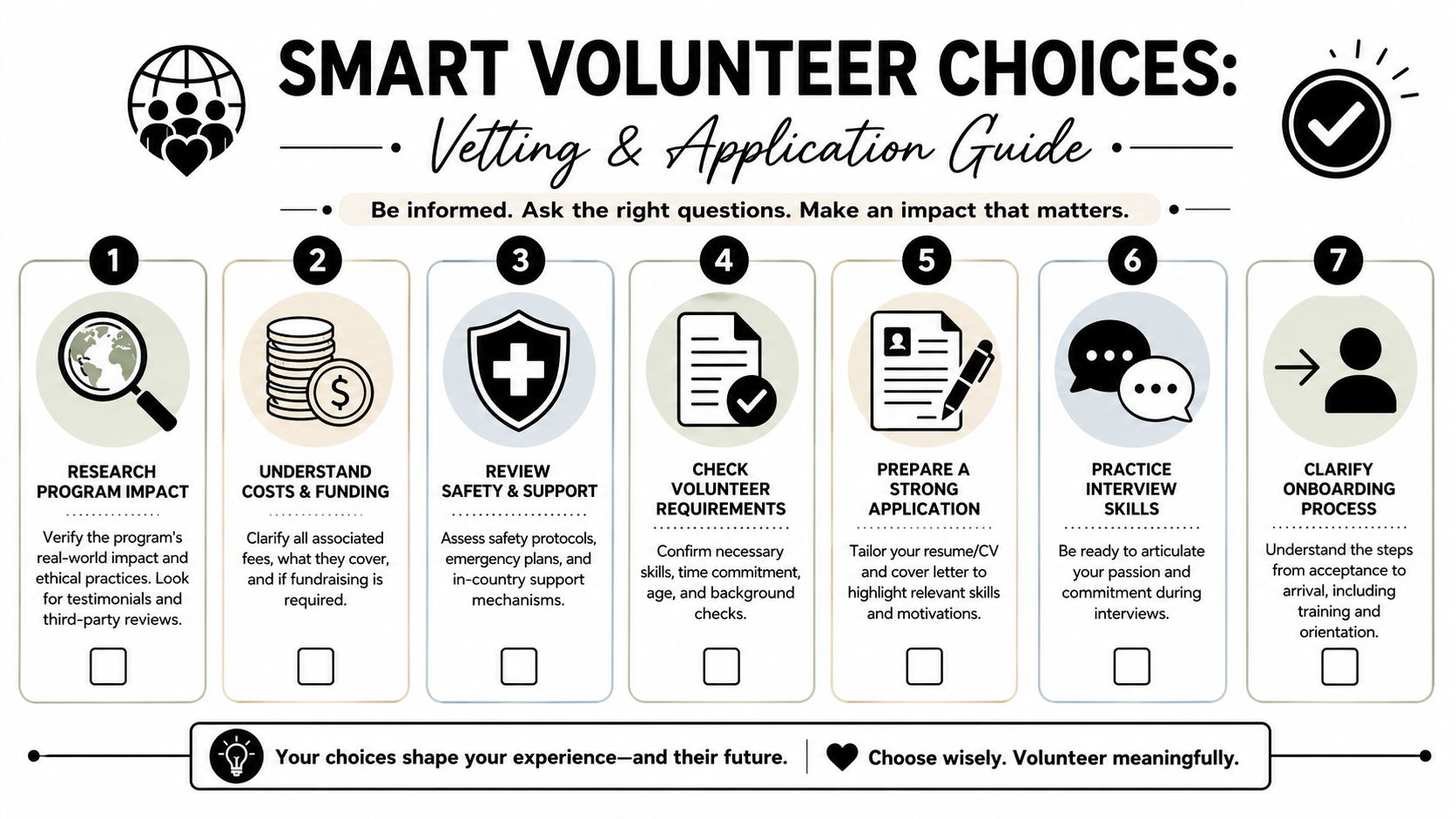
A strong application and a strong vetting process are really the same thing. When you ask smart questions, you learn whether the program is well-run. When you tailor your application around what they need, you show that you're not another impulsive traveler looking for a free bunk.
Check legitimacy before emotion takes over
Start with the basics. Can you identify who runs the program? Is there a registered organization, a named founder, or a team with visible roles? Do reviews describe actual tasks, or just sunsets and group dinners?
Then look for signs of ethical design:
- The role fills a defined need: They can explain why volunteers are useful.
- Locals remain central: Volunteers support work. They don't displace local employment.
- Children and vulnerable groups are protected: Access isn't casual or tourism-driven.
- The host welcomes questions: Defensive replies are a warning sign.
If a listing relies on emotional language but won't answer practical questions, move on.
Follow the money closely
Program fees aren't automatically bad. Some organizations need them to cover housing, food, transport, staff time, background checks, or training. The problem isn't the existence of a fee. The problem is vagueness.
Ask for a plain breakdown of what you're paying for. Also ask what is not included. Hidden costs often show up in airport transfers, local transport, weekend meals, mandatory insurance, visa runs, or training materials.
Practical rule: If a host can't explain costs in ordinary language, don't assume the details will improve after you arrive.
Read reviews with the same discipline. One glowing review means little if it only talks about scenery. A useful review mentions workload, supervision, sleeping arrangements, communication, and whether expectations matched reality.
Look for operational signs of a well-run program
Programs that treat volunteers well usually show it early. Clear emails, realistic onboarding, and direct answers are not small details. They're evidence of how the organization functions day to day.
A good sign is a structured communication process. Organizations that value volunteers tend to provide accurate training and segmented communication, and email is reported as effective by 80% of organizations for recruitment, as discussed in Galaxy Digital's volunteer retention guidance. In practice, that means a professional email exchange, clear next steps, and role-specific preparation often signal a host that has thought seriously about retention and support.
Questions worth asking in an interview
If a host offers a video call, use it. You're not just trying to impress them. You're checking whether you want to say yes.
Ask questions like these:
- What does a normal week look like?
- Who supervises volunteers on-site?
- What training happens before I begin?
- Which tasks are most urgent right now?
- What expenses should I expect beyond the listed fee?
- What happens if the role changes after arrival?
- How do you handle emergencies or safety concerns?
- Can you connect me with a recent volunteer?
If the answers stay fuzzy, that's information.
For broader context on comparing options, it's worth reviewing guides to the best volunteer abroad programs, then applying stricter standards than the marketing copy does.
Make your application useful, not sentimental
The strongest applications are specific. Hosts don't need a speech about wanting to change the world. They need to know whether you can show up, communicate well, and handle the role they described.
A solid application email usually includes:
- Relevant dates: Exact arrival and departure window
- Matching skills: The two or three abilities most related to the role
- Context: Why this organization, not volunteering in general
- Practical readiness: Language level, license, certifications, or experience if relevant
- Professional references: Especially for roles involving teaching, children, tech, media, or long stays
Here's a better pattern than the generic “I'd love to help in any way” message:
Hello [Name],
I'm available in [location] from [dates] and I'm interested in your volunteer opening because my background in [specific skill] seems relevant to the work you described. In my recent experience, I've handled [brief example].I'm comfortable with [relevant conditions], and I'd be glad to support [specific task]. I've attached my CV and can also share references.
If it helps, I'm available for a call to discuss expectations, accommodation, and onboarding.
Best,
[Your Name]
That tone works because it respects everyone's time. It also makes it easier for the host to picture where you fit.
Preparing for Your Volunteer Adventure
Getting accepted is only half the job. The other half is preparing well enough that you don't create avoidable stress for yourself or the host.
Travelers often focus on flights first. I'd put visas, insurance, and role logistics ahead of airfare. A cheap ticket doesn't help if you enter on the wrong status, arrive without the right documents, or discover your policy won't cover volunteer activities.
Treat visa rules as non-negotiable
This is one of the messiest areas in volunteer travel. Some countries allow certain unpaid activities on a tourist entry. Others don't. Some make distinctions between formal volunteering, work exchange, internships, and religious or charitable service. The wording matters.
Don't rely on hostel gossip or an old forum post. Ask the host what previous volunteers used, then verify it through the official immigration or consular source for your nationality and destination. If the host tells you to “just say tourism” when that's inaccurate, take that as a serious warning sign.
Bring printed and digital copies of:
- Passport and passport validity details
- Entry requirements
- Return or onward travel proof, if required
- Acceptance letter or host contact details
- Insurance documents
- Vaccination or health records, if relevant
Build a safety plan you can actually follow
Solo travelers, especially women, need more than generic advice. Know where you'll sleep on the first night, who's meeting you if anyone is, how you'll get from the station or airport, and what your backup accommodation is if things feel off.
A few practical habits matter:
- Share your plan: Send itinerary, host name, phone number, and address to someone you trust.
- Arrive in daylight if possible: First impressions are clearer when you're not tired and disoriented at night.
- Keep emergency cash separate: Don't store all your money in one place.
- Know your exit option: Save enough to leave early if the role turns out to be unsafe or misrepresented.
Leave room in your budget for walking away. That's not negativity. That's independence.
Choose insurance for the role you're actually doing
Not all travel insurance treats volunteering the same way. Read the activity terms. If you're doing farm work, construction-related tasks, motorbike riding, wildlife work, trekking, or anything physical, check whether those activities are included or excluded.
Look closely at:
- Medical coverage abroad
- Emergency evacuation
- Personal liability
- Lost or stolen gear
- Trip interruption
- Coverage for volunteer or unpaid work activities
If the wording is unclear, ask the insurer in writing. Keep that response.
Budget for the whole experience
Even low-cost placements have layers of spending around them. Program fees are only one category. You also need to think about transportation, visa costs, data or SIM cards, local transit, work clothing, toiletries, background checks, occasional meals outside the host arrangement, and a buffer for unexpected changes.
Use a simple budget with three columns:
| Category | Expected Cost | Notes |
|---|---|---|
| Fixed before departure | Flight, visa, insurance, platform membership | Paid regardless of how the placement goes |
| Weekly on the ground | Meals not included, transport, laundry, data | Easy to underestimate |
| Emergency reserve | Extra nights, transport out, clinic visit | Don't spend this casually |
Pack for usefulness, not fantasy
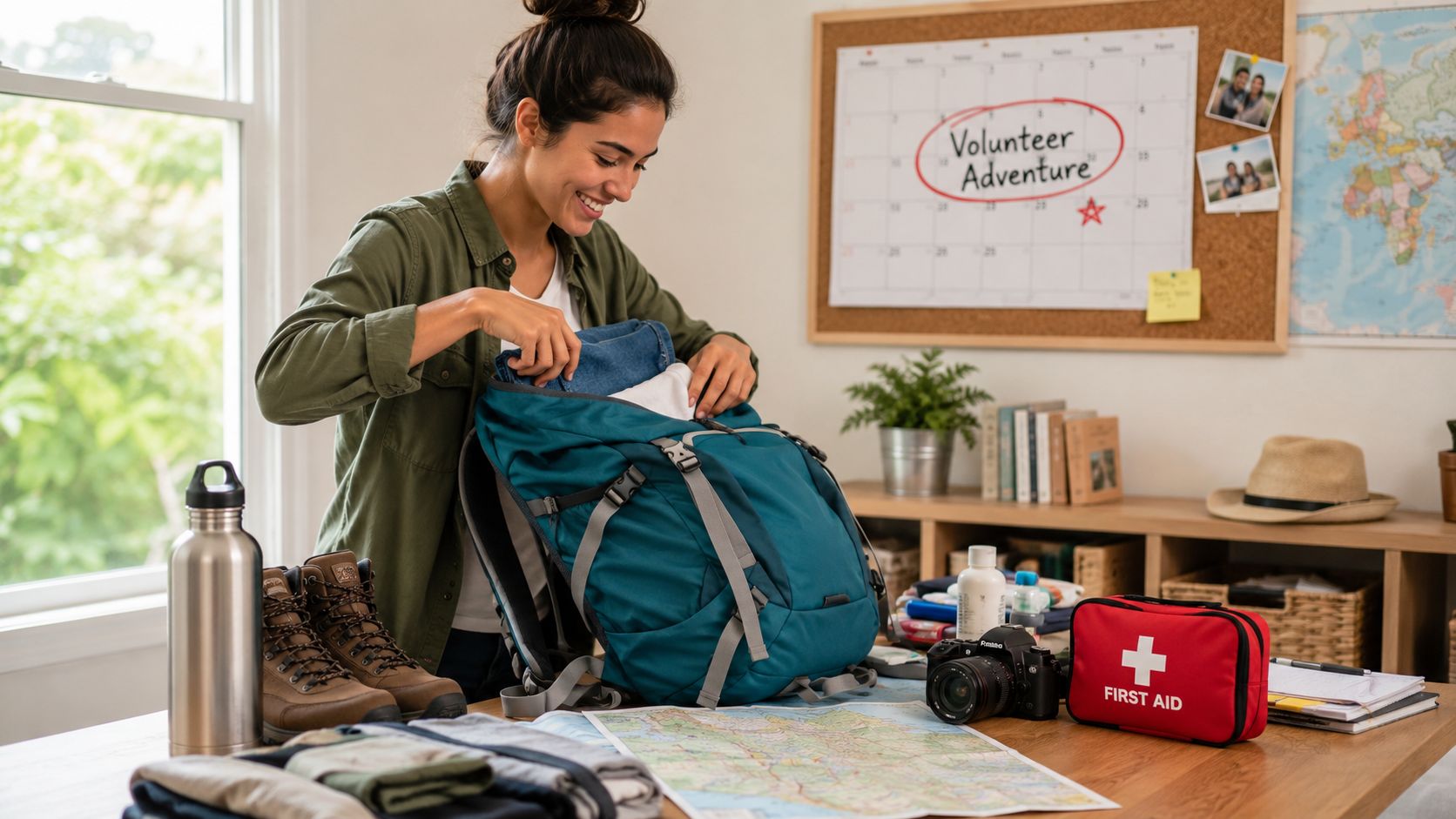
Pack for the actual role. A farm stay, city nonprofit, marine project, and hostel reception job require different gear. Ask the host for specifics and trust their answer over your travel aesthetic.
Bring what helps you work comfortably. That may include modest clothing, closed shoes, a headlamp, work gloves, a notebook, backup chargers, a water bottle, and copies of key documents. The goal is to arrive ready to participate, not to curate a mood board.
Making Your Impact Last
A volunteer trip matters most after the novelty wears off. That's when your habits count. Show up on time. Do the ordinary tasks well. Keep your promises small and realistic instead of dramatic and unsustainable.
Once you're on-site, pay attention to the culture of the place before trying to improve it. Listen more than you speak in the first few days. Ask how things are done and why. If you have strong professional skills, offer them with humility. A cleaner spreadsheet, better photos, or a more usable process can be valuable, but only if the team wants it and can maintain it after you leave.
Leave the place better, not dependent
The healthiest volunteer mindset is transfer, not heroics. Document what you do. Hand over files cleanly. Write instructions if you build something. Don't position yourself as indispensable.
A few habits help:
- Respect local leadership: Even when you think you see a faster solution.
- Write an honest review: Mention logistics, communication, and fit so future travelers can decide well.
- Stay in touch appropriately: Keep the relationship alive without centering yourself.
- Support the mission after departure: Sometimes the best follow-up is remote help, advocacy, or donating relevant tools.
If volunteering changes how you travel, keep that change. Carry it into the way you spend money, choose hosts, and move through other people's communities. That's where the deeper value lives, alongside sustainable tourism practices that reduce harm and increase local benefit.
The best volunteer experiences don't end at the airport. They sharpen your judgment, widen your circle, and make future travel more honest. Start carefully, choose well, and let the work teach you something.
If you want more grounded travel guidance like this, Travel Talk Today shares practical advice for travelers who want their trips to be affordable, thoughtful, and connected to local life.