You've probably had the same late-night thought a lot of future teachers have. You scroll job boards, watch apartment tours in Seoul or Madrid, and start imagining a life where your commute includes a new language, new food, and a classroom full of students who want to learn from you.
Then the requirements hit. Degree. TEFL. Visa. Background check. Health forms. Maybe proof of English level. Maybe notarized documents. It can feel less like a dream and more like a bureaucratic obstacle course.
It's still doable.
Your Dream of Teaching Abroad Starts Here
A lot of people assume teaching abroad is only for recent graduates with perfect timing, plenty of savings, and a suitcase already half-packed. That's not how it looks in real life. More often, it starts with someone at a kitchen table, trying to figure out whether the dream is practical enough to take seriously.

That's why it helps to begin with the big picture. The opportunity is real. One TEFL industry source says 1.5 billion people are learning English worldwide and projects the English language learning market will reach $69.62 billion by 2029 (TEFL Academy English teaching statistics). That scale is why schools, language centers, and government programs keep hiring qualified teachers.
For budget-minded travelers, this matters. A dream with no demand behind it is risky. A dream tied to a large global market is something you can plan for.
If you've been browsing stories about getting paid to travel, teaching English is one of the most realistic paths because it sits at the crossroads of work, travel, and cultural immersion. It isn't effortless, but it is structured. And structure is good news when money is tight.
Practical rule: Don't ask, “Can I do everything at once?” Ask, “What's the first requirement I can knock out this month?”
Most readers get stuck because they try to solve the whole move in one sitting. A better approach is simpler. First, learn the baseline qualifications. Then match them to countries. Then price out your documents and timeline. Once you do that, the wall of teach English abroad requirements starts looking more like a checklist.
The Two Pillars of Qualification Degree and TEFL
You find a job post in a city you can almost picture already. The salary looks workable. The photos look real. Then the requirements list stops you cold: degree, TEFL, documents.
That moment feels bigger than it is.
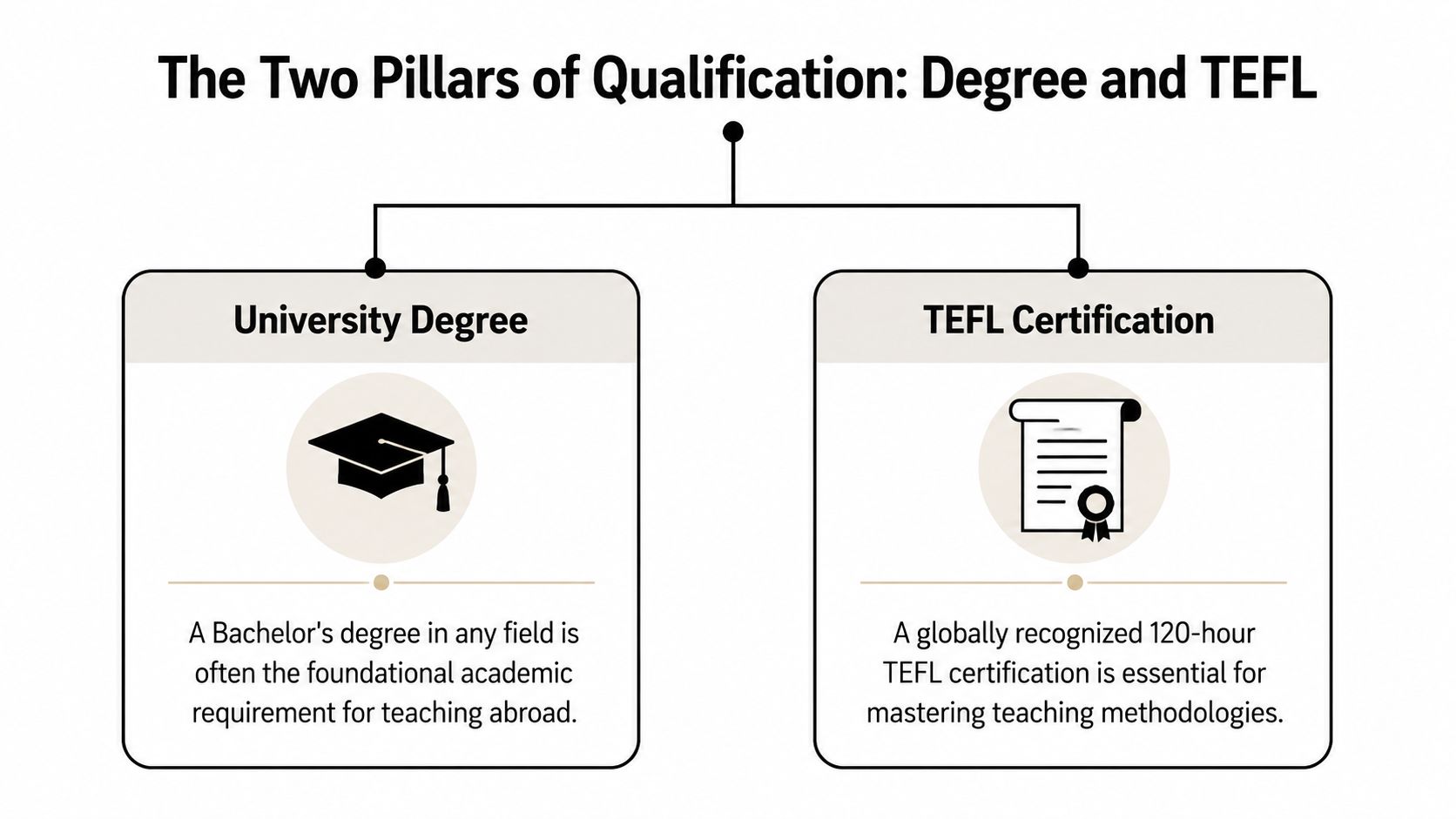
For most first-time teachers, the foundation is simpler than the internet makes it sound. Schools and immigration offices usually start with two checks. Do you have a degree? Do you have recognized teacher training? If you understand those two pieces early, you can avoid wasting money on applications for jobs you cannot legally take yet.
Why the degree matters
A bachelor's degree works like an entry pass for many legal teaching jobs abroad. In plenty of countries, it is less about your ability to teach and more about meeting the minimum academic standard for a foreign work permit.
That clears up a common misunderstanding. A school may like your interview, your energy, and your work history. If the country requires a degree for visa approval, the school may still be unable to hire you legally.
For entry-level jobs, the subject of your degree often matters less than readers expect. English, history, biology, business. Many employers accept any bachelor's degree as long as it comes from a recognized institution. What matters most is whether that document helps you pass the government filter.
This matters for your budget too. If you do not have a degree, it is smarter to target countries and programs with different rules before you spend money on document notarization, rush shipping, or multiple applications.
Why TEFL matters
Your degree may help you qualify on paper. Your TEFL certificate shows that you have at least some classroom preparation.
TEFL, TESOL, and CELTA can confuse beginners because the names sound like separate worlds. In practice, they are different types of English teaching qualifications. The label matters less than the course quality, the number of training hours, and whether employers in your target country accept it.
A useful baseline is a 120-hour TEFL course. That is the benchmark many schools use for entry-level hiring, and it is often the safest minimum for applicants who want access to more jobs across multiple regions.
Cheap short courses can create an expensive delay. If a bargain course is too thin, unaccredited, or missing practical training, you may end up paying for a second course later. For a budget-conscious traveler, that is like buying a discount plane ticket with so many extra fees that it costs more than the standard fare.
The low-cost choice is only the smart choice if it still meets hiring and visa expectations.
What to look for in a TEFL course
A solid TEFL course should prepare you for real classes, not just give you a certificate file to upload. New teachers usually benefit most from training in lesson planning, classroom management, grammar explanation, and error correction.
Look for these signs before you pay:
- At least 120 hours: This is a practical baseline for broad job eligibility.
- Clear accreditation or recognition: The provider should explain who stands behind the course.
- Teaching practice or observed practicum: Real practice helps you feel less overwhelmed in your first classroom.
- Job support: Resume guidance and interview prep can save time and help you avoid poor-fit employers.
If money is tight, pause before choosing the absolute cheapest option. A course with no practicum, weak support, or unclear recognition can cost more in the long run if it limits where you can apply.
Some readers consider volunteering first to test whether teaching abroad feels right. That can be helpful for confidence and cultural experience, but it does not usually replace a recognized teaching qualification for paid jobs. If you are comparing routes, this guide to best volunteer abroad programs for meaningful travel experience can help you see where volunteering fits and where it does not.
The bottom line on qualification
For many aspiring teachers, these two pillars set the direction of the whole plan. The degree helps satisfy legal hiring rules in many countries. The TEFL certificate helps show schools you are prepared to step into a classroom.
Once you know which pillar you already have, the process gets less intimidating. You can build your plan in the right order, protect your budget, and focus on options that are within reach.
Decoding Visas and Work Permits Around the World
Many people think the school decides everything. In reality, the visa often decides first.
A useful way to think about work permits is as a matching game. You bring your passport, your degree, your TEFL certificate, and your documents. The country decides whether that profile fits its legal hiring rules. If it does, an employer can usually move forward. If it doesn't, enthusiasm won't fix it.
Sponsorship is the normal route
For most legal teaching jobs abroad, the employer sponsors your work visa or supports the permit process. That sponsorship usually depends on you submitting the exact documents immigration wants, in the exact format required.
Verified guidance for this article notes that a bachelor's degree acts as a mandatory technical filter for visa processing in over 150 countries, and that immigration authorities in markets such as the UAE, China, and Japan require a four-year degree for work permits regardless of teaching experience.
That's why some teachers can get interviews but still can't get hired legally.
Teaching English abroad requirements by region
| Region | Degree Requirement | TEFL Requirement | Visa Competition |
|---|---|---|---|
| Asia | Often strict in regulated markets | Commonly expects a recognized 120-hour certificate | Usually high in established programs |
| Europe | Varies widely by country and citizenship status | Often expected for entry-level language teaching | Can be competitive, especially where visas are limited |
| Latin America | More flexible in some markets | TEFL is often the practical credential schools want to see | Mixed, often more relationship-driven |
| Middle East | Commonly strict for legal work permits | Recognized TEFL or stronger teaching credentials may be expected | High, with heavier document scrutiny |
How readers usually get this wrong
The mistake isn't just choosing a country you like. It's choosing one that doesn't match your paperwork profile.
If you have a degree and recognized TEFL, you can usually target more regulated markets. If your profile is less conventional, you may need to look at countries with more flexible entry routes or different school types. That's similar to how remote workers compare destinations based on fit, paperwork, and lifestyle rather than looks alone in lists of digital nomad destinations.
Treat each country like a separate application system. “Teaching abroad” is one dream, but it breaks into many legal pathways.
Before you fall in love with one destination, check four things: visa sponsorship, degree rules, TEFL expectations, and document legalization. That order saves time, money, and frustration.
Clearing the Official Hurdles Background and Health Checks
This part feels intimidating because it sounds more serious than it usually is. In practice, it's paperwork with deadlines.
Schools and immigration offices often want proof that you can work with students safely and live in the country lawfully. That usually means some version of a criminal record check and some version of a health clearance.
What a background check usually involves
The exact document depends on your home country. Some applicants need a national-level police certificate. Others need a federal document. Then, depending on the destination, you may need notarization, legalization, translation, or an apostille so the document is valid abroad.
A calm way to handle it is to work in this order:
- Confirm the exact document name: Don't guess. Use the wording your employer or visa office gives you.
- Check validity dates: Some countries only accept recently issued documents.
- Ask whether legalization is required: Apostille and notarization are not interchangeable everywhere.
- Keep digital and paper copies: You'll often need both.
Health clearance is usually routine
Some countries ask for a simple doctor's note. Others want a more formal medical check before the visa is issued or after arrival. This doesn't usually mean anyone expects perfect health. It means the system wants standard medical clearance for incoming workers.
It also helps to plan for everyday wellbeing once you arrive. New climate, new food, and a different routine can wear you down faster than people expect, so practical habits matter just as much as paperwork. A basic guide to staying healthy while traveling can help you think beyond the visa stage.
Keep one folder for originals, one folder for scans, and one running checklist with issue dates. That simple system prevents most document panic.
If this stage stresses you out, remember what it is. It's not a test of whether you belong abroad. It's administration. Slow, fussy, sometimes annoying administration, but still manageable.
Beyond Paperwork Language Experience and Nationality
At this point, a lot of strong candidates talk themselves out of applying.
They assume they can't teach because English isn't their first language. Or because they've never had a formal classroom before. Or because their passport doesn't fit the image most online advice seems to have in mind.

Non-native speakers are not automatically excluded
The primary question usually isn't “native or non-native?” It's “What does this country, visa office, or employer require?”
Verified guidance notes that for non-native speakers, requirements often change. Applicants may need to show native-level proficiency with a standardized test such as IELTS or TOEFL, while some countries accept candidates with TEFL or TESOL credentials and, in some cases, no degree at all (Go Overseas guide to teaching English abroad requirements).
That's a much more useful framework than the old myth that only passport holders from a narrow set of countries can teach.
What matters if English isn't your first language
Employers usually care about a practical mix of factors:
- Your fluency: Can you teach clearly, confidently, and accurately?
- Your credentials: Do you have the training and paperwork the role demands?
- Your professionalism: Can you handle interviews, planning, and classroom communication?
- Your target market: Some countries are more flexible than others.
In fact, non-native teachers often bring strengths schools value. They've usually learned English consciously, understand learner struggles firsthand, and can model what successful language acquisition looks like.
If you're a fluent non-native speaker, don't spend all your energy asking whether you're “allowed” to apply. Spend it building the strongest file you can.
Do you need experience first
For many entry-level language center roles, prior classroom experience isn't the first hurdle. Training, reliability, and legal eligibility matter more. That's good news for career changers, recent graduates, and travelers starting from scratch.
What does help is any experience that shows you can communicate and manage people well. Tutoring, coaching, youth work, mentoring, customer-facing jobs, and training roles all strengthen your application because they show you can explain, adapt, and stay calm with people.
And if your bigger goal is meaningful immersion, not just a stamp in your passport, teaching can be one of the richest forms of cultural immersion travel. You're not just passing through. You're participating in daily life.
Your Teach Abroad Timeline and Budget Blueprint
You find a job post in a country you have been dreaming about for months. The salary looks workable. The city seems affordable. Then the important questions start. How long will this take, and how much money do I need before I ever step on a plane?
That is the point where a dream needs a calendar.
The people who reach departure day without draining their savings usually do one thing well. They break the process into stages and pay for each stage in the right order. Teaching abroad works a lot like planning a long train trip. If you buy the wrong ticket first, or leave too little time between connections, the whole journey gets more expensive.
Stage one research and TEFL enrollment
Start with country fit before you start spending. A low-cost path for one person can be a poor fit for someone else, depending on degree status, passport, and savings.
Look at three things together:
- Where your qualifications are accepted
- What school type you want
- What it will cost to get from application to arrival
Then price your TEFL course as part of the move, not as a separate side purchase. As noted earlier, many schools expect both a degree and recognized TEFL training, so this cost belongs near the top of your budget plan.
Your first-stage budget usually includes:
- TEFL tuition
- Passport renewal if needed
- Resume updates and document scans
- A small savings habit for later visa and flight costs
This stage can be slower than people expect. That is normal. Good research saves money because it helps you avoid paying for training or paperwork that does not match your target country.
Stage two document gathering
Momentum matters at this stage. Once your TEFL is in progress, begin collecting the paperwork that tends to slow applicants down later.
Focus on the items that often create delays:
- Degree documents: Keep digital copies ready and check whether notarization, apostille, or legalization may be required.
- Police check: Apply early enough that it stays valid through hiring and visa processing.
- Passport validity: Many countries want plenty of time left before expiration.
- Reference letters: Ask while former managers or professors still remember your work clearly.
A lot of first-time applicants wait for a job offer before handling any of this. Sometimes that works. For a budget-conscious teacher, early preparation is often cheaper because rush fees, express mailing, and last-minute appointments can add up fast.
Stage three job search and interviews
Once your paperwork is underway, begin applying. Schools often move faster than applicants expect, especially when hiring for upcoming terms.
Keep your application materials simple and clean. Tailor your resume to teaching roles. Prepare a short introduction video if requested. Practice answering practical questions such as why you chose that country, how you would support beginners, and how soon you could relocate.
This part of the process usually costs less than the earlier stages, but it is not free. Set aside money for:
- Document certification or mailing
- Reliable internet or basic interview tech
- A possible housing deposit if an offer arrives quickly
Treat this as your transition phase. You are no longer just preparing. You are getting ready to say yes to a real offer.
Stage four visa processing and departure savings
This stage surprises many new teachers. A school may guide you through the visa process, but you still may need cash for fees, translations, medical appointments, transport to consulates, flights, and your first few weeks abroad before the first paycheck lands.
That is why your budget needs a buffer, not just a target.
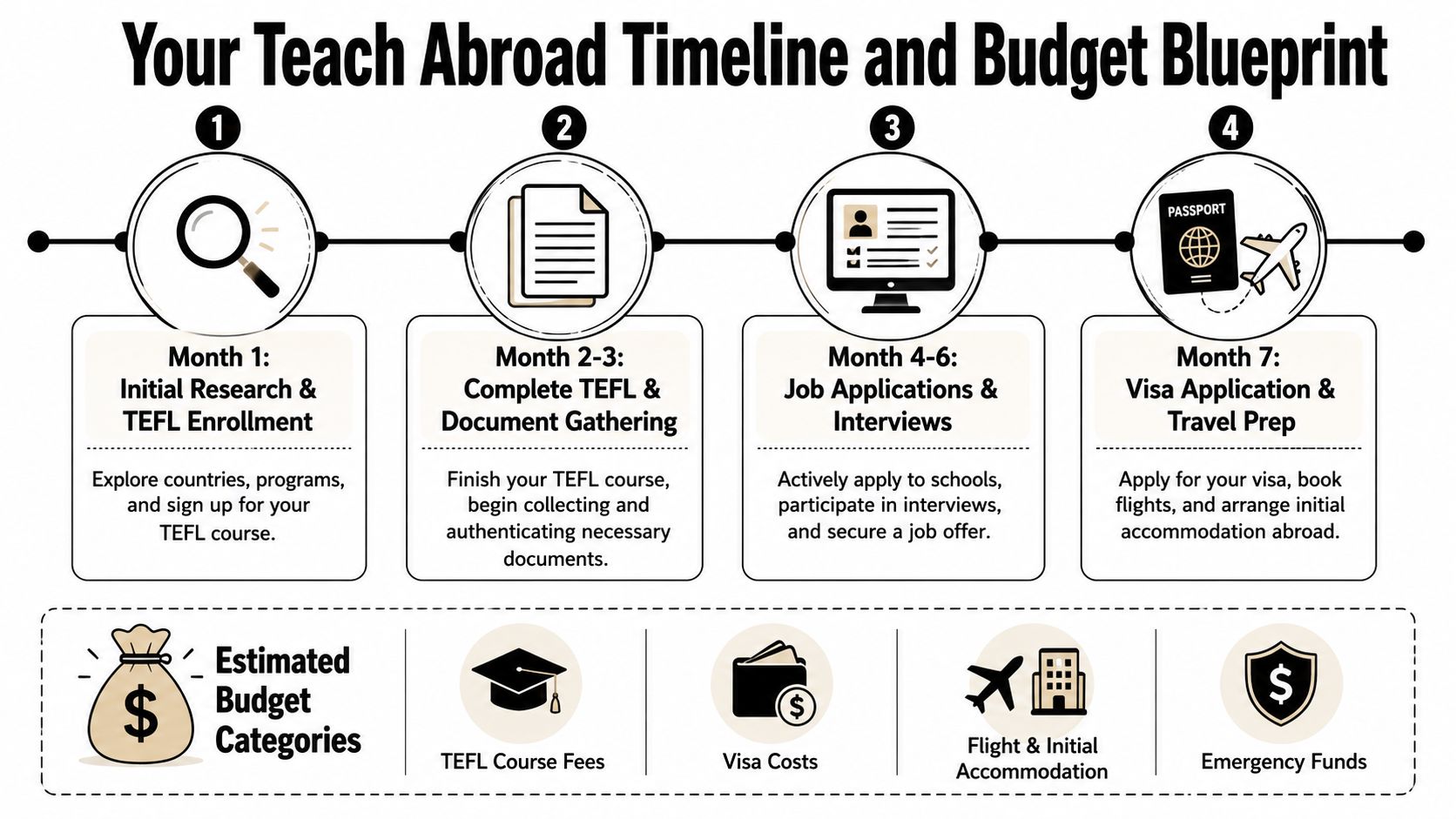
A workable starter budget usually includes four categories:
| Budget category | What to expect |
|---|---|
| TEFL course fees | One of the main upfront costs |
| Visa costs | Fees depend on the country and document route |
| Flight and initial accommodation | Often paid before income starts |
| Emergency funds | A cushion for delays, deposits, and surprise admin costs |
Budget for the departure you hope for, but save for the departure that gets delayed. Paperwork often moves slower than your ideal timeline.
For many first-time teachers, a practical timeline looks like this:
- Months 1 to 3: Research countries, compare costs, enroll in TEFL, and start saving.
- Month 4: Gather documents and prepare your application materials.
- Months 5 to 6: Interview, review contracts, and begin visa steps.
- Month 7 onward: Finalize flights, housing plans, and departure logistics.
Some people move faster. Some need longer. The point is not speed. The point is sequence.
When each task has a month and each cost has a category, teaching abroad starts to feel less like a financial leap and more like a plan you can afford.
Your Journey is Possible Your Next Steps
By this point, the teach English abroad requirements probably look different than they did at the start. They're still real. There's still paperwork. There's still cost. But it's no longer a fog of vague demands.
It's a set of known gates.
That matters, especially if you're budget-conscious. Clear requirements let you plan. You can choose countries that fit your qualifications. You can save in stages instead of all at once. You can avoid wasting money on low-value courses or rushed documents. And you can target jobs that support a simpler, more affordable life abroad, especially if they include help with housing or a location where daily costs are easier to manage.
Teaching abroad isn't only for people with a large savings account. It's often a better fit for patient planners than impulsive spenders.
Keep your first moves simple:
- Verify your degree status: Check whether your degree level and documents are likely to meet the countries you're considering.
- Research accredited TEFL options: Prioritize recognized courses with at least the accepted baseline and practical teaching components.
- Build a starter fund: Create a savings target for training, paperwork, travel, and your first few weeks abroad.
You do not need to solve your entire future this week.
You just need to turn the dream into tasks, and the tasks into dates.
Frequently Asked Questions About Teaching Abroad
Am I too old to teach English abroad
Usually, no. Schools care more about legal eligibility, professionalism, and whether you can do the job than whether you match a backpacker stereotype. Older applicants often bring work maturity, stronger communication skills, and better classroom presence.
The better question is whether your target country has age-related visa rules. That varies, so always check the country first, not just the school.
Can I teach abroad without classroom experience
Often, yes. Many entry-level roles are designed for newly qualified teachers. What matters most is whether you can show solid training, good communication, and a professional attitude.
Your TEFL course matters a lot here because it can stand in for experience by giving employers evidence that you've learned classroom basics and, ideally, completed observed practice.
Can I teach abroad if English isn't my first language
Yes, in many cases. The path may look different, but it's still possible. Some employers and countries ask for proof of high English proficiency through tests such as IELTS or TOEFL, while others are more flexible depending on your qualifications and the role.
What strengthens your position is a strong application file: fluent English, recognized training, a polished interview, and realistic country targeting.
How much money should I save before I go
There isn't one universal number because costs depend on your TEFL provider, destination, visa process, and whether your job includes support such as airport pickup or housing help.
A sensible approach is to save for four separate buckets:
- Training money: So you can pay for a proper TEFL course without panic.
- Paperwork money: For background checks, document handling, and visa-related tasks.
- Travel money: For flights and early accommodation.
- Buffer money: For the gap before your first paycheck.
If your budget is tight, lower your risk by picking destinations with a lower cost of living, delaying departure until you have a stronger cushion, or targeting schools that offer practical support.
Should I apply from home or after I arrive
That depends on the region and the legal pathway.
Applying from home is often better if the country has a formal visa process tied to employer sponsorship. It gives you more clarity before you spend money on flights. Arriving first can make sense in places where in-person networking is common and the hiring culture is more informal, but it also raises your upfront costs and risk.
If you're on a tight budget, a confirmed job offer before departure is usually the calmer route.
Can couples or friends do this together
Yes, but it takes more planning. Each person usually needs to qualify in their own right unless one partner is joining under a dependent visa route. Housing, timing, and school placement also become more complex when you're trying to coordinate two jobs instead of one.
The easiest version is when both people are independently employable and flexible about exact city or school placement.
What's the biggest mistake new teachers make
They focus on destination aesthetics before legal fit and budget reality. A beautiful city won't help if you can't get the visa, can't afford the move, or end up paying twice for the wrong certificate.
The strongest applicants tend to be the calmest planners. They choose a legal route, budget realistically, and leave room for delays.
What should I do this week if I'm serious
Keep it boring and practical:
- Check whether your passport is valid.
- Make a shortlist of countries that match your qualifications.
- Compare TEFL courses based on hours, accreditation, and practicum.
- Start a dedicated savings pot for your move.
- Create one document folder on your laptop and one physical folder at home.
Small admin tasks don't feel glamorous, but they create momentum fast.
If you're planning a meaningful move abroad and want more practical ideas for affordable, thoughtful travel, Travel Talk Today is a helpful next stop. It's built for travelers who care about budget, cultural connection, and realistic planning, which makes it a strong companion when you're turning a teaching dream into an actual departure date.