This is it. The moment it all becomes real. Planning a solo trip always begins with that one exciting, slightly terrifying question: where in the world do I go?
This single choice is the first brushstroke on your blank canvas, setting the stage for everything that follows—your budget, your itinerary, and the kind of memories you’ll bring home. The goal isn't just to pick a place; it's to find a destination that makes your heart beat a little faster with anticipation, not anxiety.
Choosing Your First Solo Adventure
Dreaming about traveling the world on your own terms is the easy part. Actually pinning a location on the map? That can feel like a monumental task.
Forget the generic "top 10" lists for a second. The perfect destination for your first solo trip is where your personal passions, your comfort zone, and a dose of practicality all meet. This is less about finding the "best" place and more about finding the best place for you.
So, what lights you up? Do you imagine yourself getting lost in the electric, round-the-clock energy of a massive city like Tokyo or Berlin? Or does the idea of quiet reflection while hiking through the epic landscapes of Patagonia or the Scottish Highlands sound more like your speed? Maybe you're craving a deep cultural connection, picturing yourself wandering through ancient Roman ruins or learning to cook authentic pad thai in Chiang Mai.
There's no wrong answer. It's about honesty with yourself.
Match Your Vibe With a Destination Type
To help narrow things down, think about what kind of experience you’re really after. Most solo travelers fall into one of these general styles:
- The Social Butterfly: If your goal is to meet fellow travelers and make fast friends, stick to places with a well-worn "backpacker trail." Think Southeast Asia (Thailand, Vietnam) or Central America (Costa Rica, Guatemala). The built-in network of hostels and tours makes it incredibly easy to find your travel tribe.
- The Independent Urban Explorer: Love the idea of getting lost in a city's history and culture? Western European capitals are a fantastic starting point. Places like Lisbon, Madrid, or Prague are famous for their walkability, amazing public transportation, and solid tourism infrastructure. You’ll feel empowered, not overwhelmed.
- The Nature Seeker: If you're looking to unplug from the noise and reconnect with the great outdoors, focus on countries celebrated for their natural beauty. New Zealand's jaw-dropping landscapes or the Canadian Rockies offer endless trails for hiking, soul-searching, and pure adventure in seriously safe environments.
My best advice for your first time? Choose a destination that feels like a "soft landing." Pick a place known for being safe, friendly to tourists, and easy to get around. This builds incredible confidence and ensures you have a positive experience, leaving you hungry for your next adventure.
A Look at the Top Solo Travel Hotspots
While your personal interests are the most important factor, it’s also smart to see where other solo travelers are going. There’s a reason certain places become so popular—they simply do a great job of welcoming people traveling on their own.
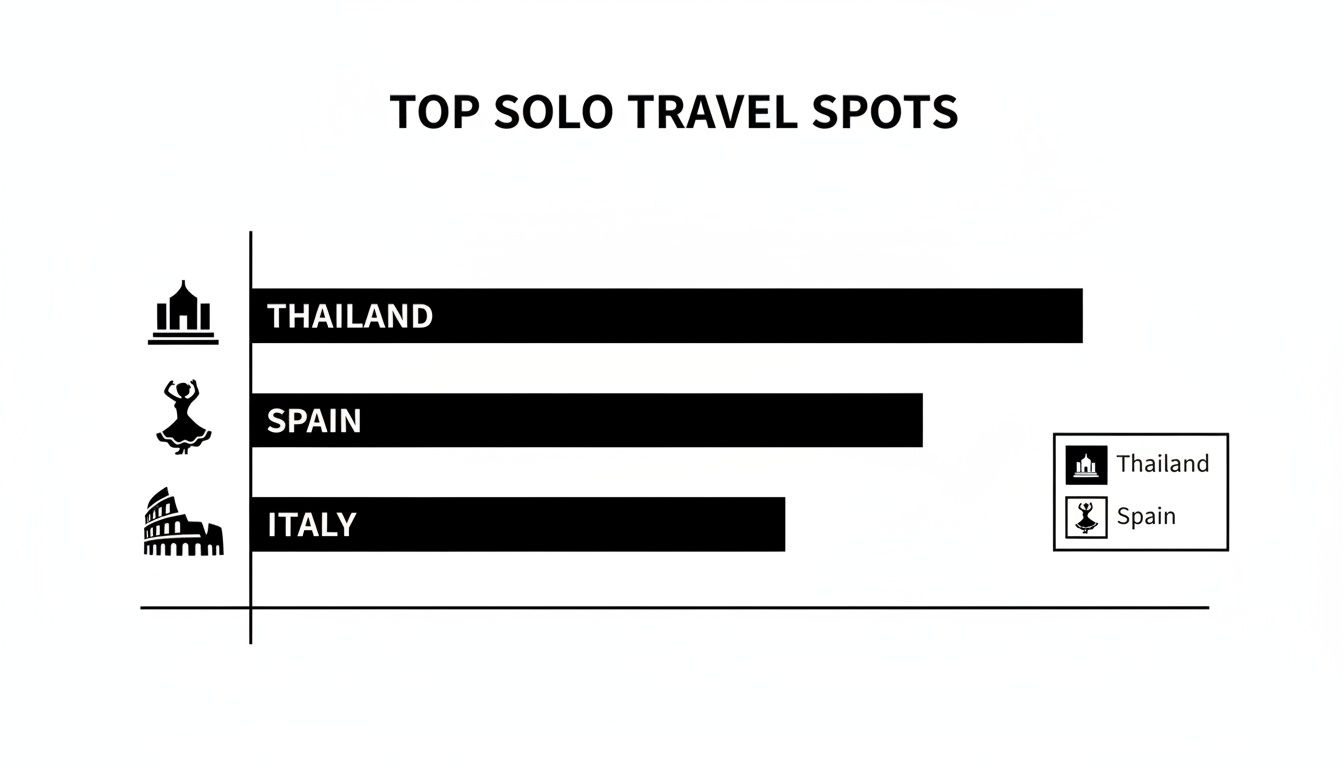
As you can see, places like Thailand, Spain, and Italy consistently top the charts. There's a powerful trend here: people are flocking to destinations that offer an amazing blend of culture, affordability, and a strong social scene. It's no surprise, especially when you consider that 53% of solo travelers are women. And once they go, they often get hooked—a whopping 63% plan to travel solo again!
For a first-timer, this data is gold. It points you toward places with proven track records.
Top Solo Travel Destinations Comparison
To help you visualize the options, I’ve put together this quick comparison table. It breaks down some of the most popular regions by what they’re best for, a realistic daily budget, and the general safety vibe you can expect.
| Region | Best For | Average Daily Budget (Hostel) | Safety Vibe |
|---|---|---|---|
| Southeast Asia | Social connections, vibrant culture, budget-friendly | $30 - $50 | Generally safe on the tourist trail; be mindful of common scams. |
| Western Europe | History, art, easy navigation, and city life | $60 - $90 | Very safe, with excellent infrastructure and low crime in tourist areas. |
| Central America | Adventure, nature, and learning Spanish | $40 - $60 | Varies by country; stick to well-traveled routes for a safer experience. |
| Oceania | Epic landscapes, outdoor adventure, and high safety | $70 - $100 | Extremely safe and friendly, but comes with a higher price tag. |
This table is just a starting point, of course, but it gives you a framework for matching your budget and travel style to a part of the world that will welcome you with open arms.
Once you’ve settled on a general region that feels right, you can start zeroing in on specific cities and towns. For some concrete inspiration, check out our guide on the best cities for solo travelers.
Remember, the goal is to pick a place that doesn't just look good on Instagram but also makes you feel capable and excited to step out into the world on your own.
Crafting an Itinerary That Breathes
This is where the real fun begins—dreaming up your day-to-day adventure. But let's get one thing straight: forget those rigid, color-coded spreadsheets that map out every single minute. A great solo itinerary isn’t a contract you sign in blood; it’s more like a hand-drawn map with a few key landmarks and a lot of enticing, unexplored space.
The idea is to build a supportive framework, not a cage. You want just enough structure to feel confident and prepared, but enough freedom to let the magic of solo travel find you. It’s a delicate dance between your must-see list and the beautiful, unplanned moments that truly make a trip your own.
Anchor Your Days With Key Experiences
Instead of trying to do it all, start by dropping a few anchors. For each place you visit, pick just one to three absolute "must-do" experiences. These are your non-negotiables—the very reasons you chose this destination.
It might be witnessing the sunrise over Angkor Wat, tackling a specific alpine hike, or getting lost for a whole afternoon in the Louvre. By building your day around these core moments, you give your travels a natural rhythm without feeling rushed.
This way, you’re guaranteed to hit the highlights that matter most to you, leaving the rest of your time wide open for pure, unadulterated discovery. It’s the difference between feeling accomplished and just feeling busy.
Embrace the Art of Activity Clustering
Here’s a simple trick that will completely change how you move through a city: activity clustering. All this means is grouping your plans by neighborhood. It sounds obvious, but it has a massive impact on your energy levels and your wallet.
Let’s say you’re in Rome. A rookie mistake is to crisscross the city all day, running from one major sight to the next. The clustered approach looks totally different.
- Day 1: Immerse yourself in Ancient Rome. You’d hit the Colosseum, the Roman Forum, and Palatine Hill, since they are all conveniently located right next to each other.
- Day 2: Make it a Vatican City day. Give yourself plenty of time for St. Peter's Basilica and the sprawling Vatican Museums without feeling rushed.
- Day 3: Wander the historic center. This is your day for tossing a coin in the Trevi Fountain, people-watching on the Spanish Steps, and marveling at the Pantheon.
This strategy slashes your travel time and costs. More importantly, it lets you really sink into the unique vibe of each district, rather than just seeing the city through a bus window.
My most memorable solo trip moments have rarely come from the big-ticket items I planned. They came from the detours—stumbling upon a hidden courtyard cafe because I decided to walk instead of taking the metro, or discovering a local artisan market just around the corner from a famous landmark. Leave space for these happy accidents.
Build in Time for Nothing at All
If I could give you only one piece of advice on how to plan a solo trip, it would be this: schedule empty space. I mean it. Block out entire afternoons—or even a full day—with absolutely zero plans.
This "do-nothing" time isn't empty; it's full of potential. It’s your official permission to be gloriously spontaneous.
- Wander down a fascinating alleyway just to see where it goes.
- Spend two hours browsing a tiny bookstore you stumbled upon.
- Grab a coffee, find a park bench, and just watch the city live its life.
- Say "yes" when a new friend from your hostel invites you on a last-minute adventure.
These are the moments that separate a tourist from a traveler. You shift from checking things off a list to simply experiencing a place. If you're looking for ways to make the most of a short window of freedom, our guide to weekend getaway ideas offers some great inspiration.
When you create an itinerary that can breathe, you give yourself the gift of a journey that feels both intentional and beautifully free. That’s the secret recipe for an adventure you’ll never forget.
Mastering Your Solo Travel Budget
Let’s be honest: money can feel like the biggest hurdle to traveling solo. But I want you to reframe that thinking. Your budget isn't a cage; it's the key that unlocks the door to your adventure. Creating one is the moment your dream trip starts to feel real—a tangible plan you can actually bring to life.
This isn’t about being stingy. It’s about being smart. A well-planned budget gives you the freedom to spend, guilt-free, on the experiences that truly matter to you. Maybe that's a world-class cooking class in Thailand, getting scuba certified in the Red Sea, or splurging on that one incredible meal you know you’ll be talking about for years.
And there’s never been a better time to go it alone. The solo travel industry is absolutely booming. Valued at USD 482.34 billion in 2024, it’s set to skyrocket to an incredible USD 1.07 trillion by 2030. For us, that means more options, better deals, and a travel world that's finally catering to our needs. Hotels are dropping those dreaded single supplements, and new apps make it easier than ever to manage money on the go. You can see more data on these exciting trends over at Solo Traveler World.
Building Your Budget Framework
Forget confusing spreadsheets and complicated formulas. I've always found it easiest to think of a travel budget like a pie with four main slices. The exact percentages will shift based on your trip, but this is a solid starting point I’ve used for years.
- Flights & Major Transport (30-40%): This is usually the first big-ticket item. It covers your flight to get there and back, plus any major travel within the country, like long-haul trains.
- Accommodation (25-35%): Your home away from home. This slice covers your hostels, guesthouses, or hotels for the entire trip.
- Food & Drink (15-25%): The fuel for your adventure! From market snacks and grocery runs to that celebratory dinner, it all adds up here.
- Activities & Everything Else (10-20%): I call this the "fun fund." It’s for museum tickets, tours, souvenirs, and a little extra for those unexpected gems you discover along the way.
Once you see your money broken down like this, it becomes so much clearer where you can save and where you want to splurge. For an even more detailed breakdown, our guide on travel budget categories that can save you money is a fantastic resource.
Smart Strategies to Make Your Money Go Further
Budgeting isn’t about limiting your trip; it’s about extending it. By being savvy with your spending, you can travel for longer and dive deeper into your destination.
One of the most powerful moves you can make is timing your trip right. By traveling during the shoulder seasons (like April-May or September-October in Europe), you can watch flight prices fall by 30-50% and find amazing places to stay for as little as $40 per night. That simple decision alone can free up hundreds, even thousands, of dollars.
A smart budget is your permission slip to say "yes" to the things that matter. It's not about what you can't do; it's about making sure you can do what you came for.
Thriving on a Budget Without Sacrificing Experience
Here's the secret: traveling on a budget often leads to the most authentic and unforgettable experiences. It pushes you to get creative, connect with people, and see a place from a different angle.
Embrace the Hostel Kitchen: This is my number one tip, hands down. It's not just about saving money on dinner. It's about gathering with new friends from all over the world, sharing a bottle of cheap wine, and cooking a meal together. It’s a classic backpacker ritual where you trade stories and get the best tips for your next stop.
Master Public Transportation: Forget the overpriced tourist taxis. There’s a certain pride that comes from figuring out a new city’s metro or bus system. It’s a small adventure in itself, makes you feel like a local, and the savings are massive.
Seek Out Free Experiences: Every city is overflowing with incredible things to do that won't cost you a penny.
- Join a free walking tour: An absolute must for your first day to get oriented and learn the city's history.
- Explore local parks and markets: This is where you’ll feel the true pulse of a place and see daily life unfold.
- Find free museum days: Many world-class institutions offer free admission on certain days or evenings—a little research goes a long way.
- Politely Deflect Unwanted Attention: Learn a few simple but firm phrases in the local language to end a conversation. A straightforward "no, thank you" and turning to walk away is often all it takes.
- Use the "Friend" Technique: If you're feeling uncomfortable, mentioning that you're on your way to meet a friend (even a fictional one) works wonders. I've been known to end a voice memo to myself by saying something like, "Hey, I’m just around the corner, see you in two minutes!"
- Share Your Location: Technology is your best friend here. Before you head out, especially at night, share your live location on an app like WhatsApp with a trusted friend or family member back home. It's a tiny action that brings a huge amount of peace of mind to everyone.
- Tops: Stick to 4-5 versatile shirts in mostly neutral colors, plus one or two with a pop of color or a fun pattern.
- Bottoms: Two or three reliable options are all you need. I usually take a pair of comfortable travel pants, dark-wash jeans, and either shorts or a skirt depending on the weather.
- Layers: A lightweight fleece or cardigan and a waterproof, packable jacket are non-negotiable. They’ll save you when the weather inevitably changes.
- Shoes: This is where people overpack! Limit yourself to three pairs: your most comfortable walking shoes, a nicer pair for evenings out, and flip-flops for the beach or hostel showers.
- Passport and Visas: Double-check that your passport is valid for at least six months after your planned return date. Some countries are incredibly strict about this.
- Digital and Physical Copies: Make two photocopies of your passport, visas, driver's license, and credit cards. I keep one set buried in my main bag (separate from the originals) and leave the other set with a trusted person back home.
- Cloud Backups: This is a game-changer. Snap photos of all your important documents and upload them to a secure cloud service like Google Drive or Dropbox. If you lose everything, you'll still have access.
- Notify Your Banks: Give your bank and credit card companies a quick call to let them know your travel dates and destinations. This simple step prevents them from freezing your account when they see a transaction from another continent.
- Local Emergency Numbers: Look up the equivalent of 911 for police, fire, and ambulance services in your destination country.
- Embassy/Consulate Information: Jot down the address and phone number for your country's nearest embassy.
- Insurance Details: Have your policy number and the 24/7 assistance phone number ready to go.
- Bank Contact Info: You'll want the right number to call immediately to cancel a lost or stolen card.
When you start adopting these habits, you’ll realize your budget isn't just a financial tool. It’s a roadmap to a richer, more connected travel experience.
Traveling Safely and Confidently on Your Own
Let's get one thing out of the way: safety. It's the question I get asked most often about traveling alone, but it shouldn't be a source of fear. Instead, think of it as your secret weapon for a fantastic trip. Weaving smart safety practices into your planning from day one isn't about building a list of worries; it's about building a foundation of confidence so you can truly relax and immerse yourself in the adventure.
Solo travel is booming for a reason. An estimated 50% of Americans are planning solo trips in 2024, and that number tells a story of empowerment. It’s no coincidence that destinations with stellar safety records—like Japan, Iceland, and Australia—are consistently at the top of so many wish lists. You can see more fascinating solo travel trends and statistics on Condor Ferries.
Situational Awareness Is Your Superpower
Your greatest safety asset is your own intuition, made even sharper by being aware of your surroundings. Before you even pack your bags, spend some time researching the local culture of your destination, especially when it comes to social norms and how people dress. This isn’t about changing who you are; it’s about showing respect and moving through a new place with ease.
Once you land, make a point of being present. Instead of staring down at Google Maps while walking, pop into a cafe to figure out your route. Walk with a sense of purpose, even if you’re just aimlessly exploring. This small shift in how you carry yourself projects confidence and makes you a much less appealing target for scams or unwanted attention.
Your gut feeling is your personal security system, and it's rarely wrong. If a situation feels off or a conversation takes a weird turn, trust that instinct. Don't hesitate—just leave. You don't owe anyone an explanation or an apology for prioritizing your safety.
Special Considerations for Solo Female Travelers
For women exploring the world on their own, safety can feel like a more complex issue. And while the vast majority of people you'll meet are wonderful, being proactive is the key to navigating any situation with confidence.
Getting comfortable with these habits makes all the difference. For a more in-depth look, check out our dedicated guide on safe solo travel for women.
Practical Tips for Protecting Your Valuables
A big part of feeling secure is knowing your essentials are safe. Losing a passport or wallet can throw a wrench in your plans, but a few simple habits can drastically lower that risk.
Divide and conquer. Never, ever keep all your cash and cards in one place. I always stash an emergency credit card and some cash in a totally separate spot from my main wallet—maybe in a hidden pocket in my backpack or locked up in my room.
Create digital backups. Before your trip, snap photos of your passport, visas, and both sides of your credit cards. Save them to a secure cloud service like Google Drive or Dropbox. If the worst happens and you lose the physical copies, having these backups will make the replacement process so much smoother.
Secure your bag. On a bus or train, I always loop a strap from my backpack around my leg. In a cafe, I'll clip it to the leg of my chair. It’s a simple deterrent. While anti-theft bags are a great investment, even a small, cheap padlock on your main zipper sends a clear message to would-be pickpockets.
Ultimately, staying safe on a solo trip is about being prepared, not paranoid. By making these strategies a natural part of your travel routine, you’re building a foundation of confidence that frees you up to embrace the spontaneity, freedom, and pure joy of seeing the world on your own terms.
Your Final Pre-Trip Logistics Checklist
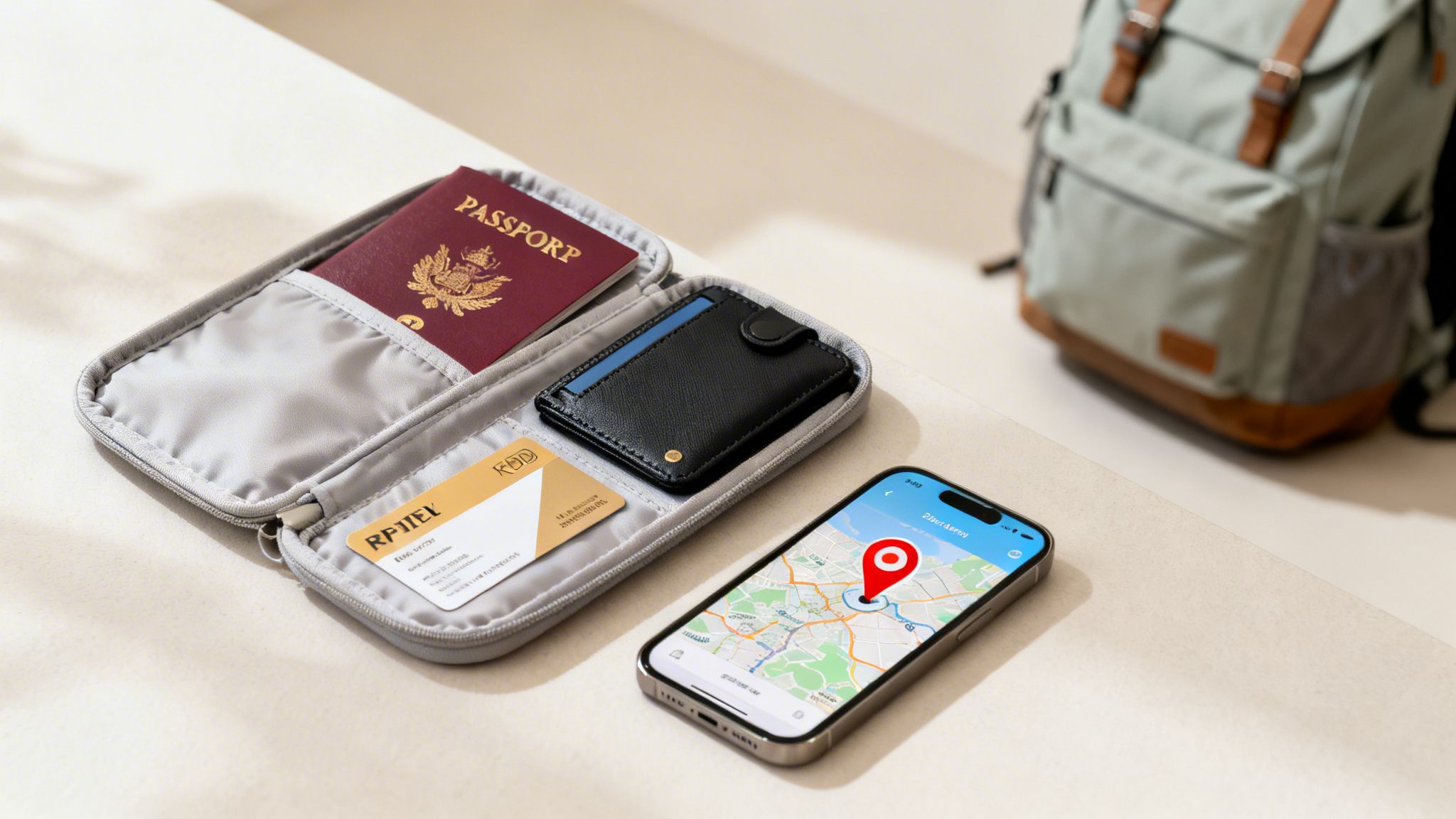
The butterflies are probably kicking in by now. Your destination is picked, the itinerary is starting to feel real, and your budget is set. It’s time to lock in the last few details—the small but critical tasks that turn a plan into an adventure and let you walk out the door feeling cool, calm, and completely prepared.
One of the biggest questions I get is about bookings: should you schedule everything in advance or leave it all to chance? Honestly, the sweet spot is somewhere in the middle. If you’re heading out for two weeks or less, booking your main accommodations beforehand is a great idea. It gives your trip a solid backbone and removes the “where will I sleep tonight?” stress.
For longer journeys, I’ve found a more flexible strategy works best. Book your first couple of nights in any new city. This gives you a safe place to land, drop your bags, and get your bearings after a long travel day. From there, you can explore neighborhoods and decide where to go next, leaving you free to follow a new friend’s recommendation or take an unexpected detour.
Navigating Visas and Insurance
As your route firms up, it’s time to handle the absolute must-dos: visas, vaccinations, and insurance. The first stop should always be your home country's official government travel site. Check its page for your destination to get the definitive word on entry requirements, visa rules, and any health precautions you need to take.
And please, whatever you do, don't skip travel insurance. It’s the single most important thing you’ll buy for your trip, acting as your safety net for everything from a lost bag to a medical emergency. I always look for a policy with solid medical coverage and emergency evacuation—just in case.
My personal rule is simple: If you can't afford travel insurance, you can't afford to travel. It's what gives you the confidence to be adventurous without being reckless.
The Art of Packing Light
Packing for a solo trip is less about what you can fit in a bag and more about what you can live without. Trust me, your journey will be ten times better if you aren't dragging a massive, heavy suitcase over cobblestone streets. The secret is building a capsule wardrobe where almost every piece of clothing works together.
Here’s a simple framework that I’ve used for trips to all sorts of climates:
Beyond your clothes, a few gadgets have earned a permanent spot in my bag. A portable power bank is an absolute lifesaver for keeping your phone—your map, camera, and lifeline—charged. A universal travel adapter is just as crucial. One little thing I never leave without is a small, extendable padlock; it’s perfect for securing a hostel locker or even locking your bag to a chair leg at a busy café.
Your Final Document Checklist
Before you head for the airport, do one last sweep of your documents. This is your final check to make sure everything is in order, a core part of any good travel planning checklist.
You've done the work. You've prepared for the what-ifs. Now it's time to take a deep breath, trust your planning, and get ready for the incredible journey you've created for yourself. Adventure is waiting.
Frequently Asked Questions About Planning a Solo Trip
Thinking about heading out on your own for the first time? It's totally normal to have a million questions swirling around in your head. But trust me, once you have a few answers, that flutter of nerves starts to feel a lot more like excitement. Let's tackle some of the biggest questions that come up.
How Do I Deal With Feeling Lonely?
This is the big one, isn't it? It’s the number one fear I hear from first-time solo travelers, but what many of us discover is that it’s rarely the problem we build it up to be. There’s a huge difference between being alone and being lonely. Traveling solo gives you the incredible gift of solitude, but you're only ever truly alone when you choose to be.
The trick is to be a little proactive. Social hostels are absolute goldmines for meeting interesting people. My go-to move is to sign up for the free walking tour on my first day in a new city. You can also try a group cooking class or just grab a drink in the common area. You'd be amazed at how easily conversations spark up when everyone's in the same boat.
And even on those days when you just want to curl up and be by yourself, you're never truly disconnected. Schedule a quick video call with your family to show them the amazing view from your balcony or send a flood of photos to your friends' group chat. Those little check-ins can completely change your mood.
A great tip I learned is to have "anchor points" for social interaction. Even something as simple as becoming a temporary regular at a local coffee shop gives you a sense of community and a friendly face to say hello to each morning.
Is It Easy to Make Friends on the Road?
Honestly? It's surprisingly easy. When you’re traveling by yourself, you naturally give off a more open and approachable vibe. Other travelers—and there are tons of other solos out there—are in the exact same position and just as eager to connect. It creates this kind of unspoken camaraderie.
Group activities are your best friend here. Think about joining a day tour to a nearby volcano or a multi-day trek through the mountains. You’re spending hours with the same small group, and friendships just naturally form over those shared "wow" moments. I’ve made friends for life on everything from a shaky boat trip in Thailand to a pasta-making class in Rome.
Sometimes, all it takes is a simple, open gesture. Ask someone for directions, compliment their backpack, or ask where they got that incredible-looking pastry. The smallest interaction can easily turn into a dinner invitation or a new buddy to explore with for the day.
What Should I Do in an Emergency?
A little bit of prep work is the best cure for panic. Before you even pack your bags, create a small "emergency info" document. Save it on your phone, but also in a cloud service like Google Drive or Dropbox just in case you lose your phone.
Here’s what you should include:
On top of that, always share your itinerary with a trusted person back home. An app like Life360 or even the simple location-sharing feature on WhatsApp can bring a ton of peace of mind to both you and your loved ones.
What Kind of Accommodation Is Best for a Solo Traveler?
The "best" place to stay really boils down to your personality and what you’re looking for on your trip. Each option offers a completely different experience.
| Accommodation Type | Best For... | Social Vibe |
|---|---|---|
| Hostels | Meeting other travelers, sticking to a budget, and finding social events. | Very High |
| Guesthouses/B&Bs | A cozier, more local feel, often with fantastic insider tips from the host. | Moderate |
| Private Room (Airbnb) | Independence and feeling like a local, with your own space to retreat to. | Low to Moderate |
| Hotels | Comfort, total privacy, and helpful amenities like a 24/7 front desk. | Low |
My personal strategy is often to mix and match. I might start a trip in a fun, social hostel to meet people and get my bearings, then treat myself to a private room for a few nights in the middle of the trip just to recharge. Always, always read recent reviews from other solo travelers—they’ll give you the real scoop on which places feel welcoming and secure.
Ready to turn your solo travel dreams into a reality? At Travel Talk Today, we provide the tools, tips, and inspiration you need to design an adventure that's all your own. Start planning your journey at https://www.packlight-journeys.com.