You’re probably in one of two moods right now. You’re in Key West, sunburnt in the best way, staring at a map and wondering whether Islamorada is just a quick transfer. Or you’re trying to build a Keys itinerary that doesn’t waste money, doesn’t feel rushed, and still leaves room for the kind of small moments that make a trip stick.
That’s the right instinct. The key west to islamorada run is short enough to be practical and scenic enough to deserve its own plan. Done badly, it’s just a move between beds. Done well, it becomes one of the best stretches of the trip, especially for solo travelers, photographers, and anyone trying to travel the Keys without burning cash on convenience.
From Railroad Dreams to an Epic Road Trip
A lot of travelers leave Key West thinking of Islamorada as the next pin on the map. That misses the point. This route only starts as logistics. Once you’re moving north, the bridges, open water, old infrastructure, and mile markers turn it into a story.
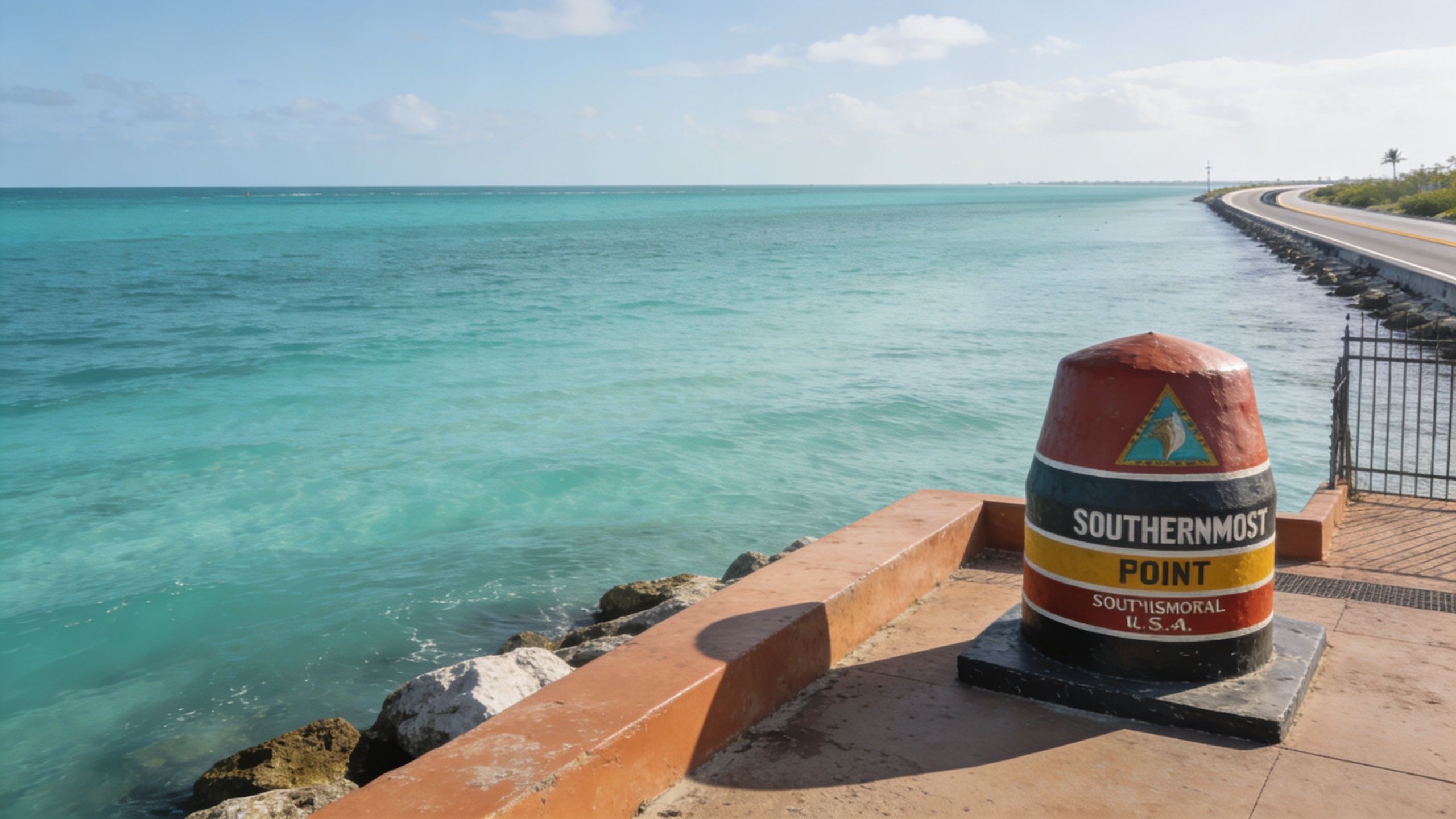
If you’ve already done the longer Miami to Key West drive, this middle stretch feels different. It’s leaner, quieter, and more intimate. There’s less “arrival” energy and more room to notice what’s around you.
Why this road matters
The Overseas Highway wasn’t built out of nowhere. The Overseas Highway originated from Henry Flagler's Overseas Railroad, completed in 1912. After the devastating 1935 Labor Day Hurricane destroyed the rail line in Islamorada, the state purchased the right-of-way for $640,000, opening the highway in 1938 and forever changing travel in the Keys, according to Islamorada’s historical overview.
That history changes how the drive feels. You’re not just crossing bridges for views. You’re moving over a route shaped by ambition, storm damage, and reinvention.
Practical rule: The more you treat this road as part of the destination, the less likely you are to rush it and miss what makes the Keys different from anywhere else in Florida.
The route rewards slow attention
Key West has noise, movement, and momentum. Islamorada has a different rhythm. The transition between them is the reward.
For budget travelers, that matters because the route itself gives you value. You don’t need expensive tours to feel like you’re seeing something special. A careful drive, a few smart stops, and enough time to get out of the car does a lot of the heavy lifting.
For solo travelers, this stretch works well because it’s simple to travel and easy to break into manageable pieces. You can leave after breakfast, stop when a view earns the stop, and reach Islamorada without needing a full expedition mindset.
What works on this route
- Leave room for pauses. The best parts aren’t always headline attractions.
- Use mile markers as your mental map. They make the drive less abstract.
- Treat Islamorada as more than a pass-through. It works well as a deliberate stop, not just a waypoint.
- Stay flexible. Weather, traffic, and your own energy level matter more here than a rigid minute-by-minute schedule.
The mistake most travelers make is trying to “complete” the route. The better approach is to experience it.
Your Key West to Islamorada Transit Options at a Glance
The smartest way to choose transport isn’t asking what’s fastest. It’s asking what kind of day you want. Some travelers want freedom. Some want to spend less mental energy. Some just want to get there without renting a car.
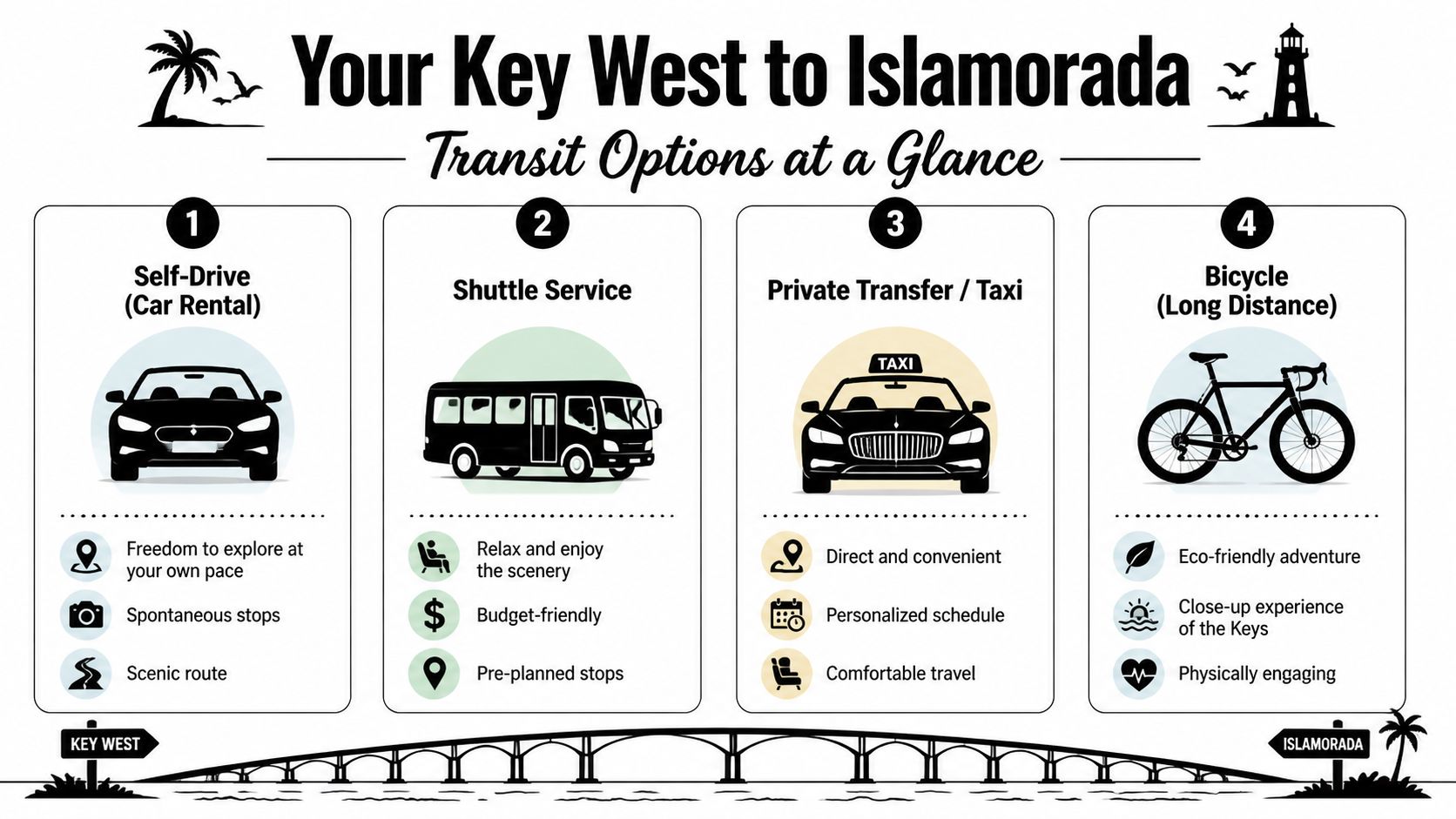
Key West to Islamorada transport comparison
| Transport Method | Estimated Time | Estimated Cost | Best For |
|---|---|---|---|
| Self-drive | About 1 hour 49 minutes in optimal conditions | Fuel costs vary by vehicle and rental setup | Travelers who want flexibility and stops |
| Shuttle or bus | Around 2 hours for the route discussed in available bus info | FlixBus tickets start at $20.48 | Budget travelers who don’t want to drive |
| Private transfer or taxi | Varies by provider and traffic | Usually the least budget-friendly option | Travelers prioritizing convenience |
| Boat or charter | Under 5 hours on a planing hull at 30 knots | Varies widely by vessel and charter setup | Travelers turning transit into an experience |
| Bicycle | Travel time depends on fitness, weather, and route planning | Low direct transport cost, high effort | Experienced endurance riders |
How each option feels in real life
Driving is the best fit for travelers who want control. If you want to stop for photos, eat when you feel like it, or turn the transfer into half a day, a car wins easily.
Bus or shuttle options are the best value play if your goal is simple movement. FlixBus offers tickets from Key West to Islamorada starting at $20.48, and current route information shows 3 daily departures between 10:00 am and 5:00 pm, but the same listing notes that seasonal and time-of-day pricing variations remain largely undocumented on that route, based on the current FlixBus route page. That uncertainty cuts both ways. You may find a decent fare, but you shouldn’t assume there’s a perfect booking formula.
Private transfer makes sense when you’re splitting the fare, carrying a lot of gear, or arriving on a schedule that doesn’t match bus times. It solves hassle, not budget.
Boat charter is the wildcard. It can be memorable, but it’s only sensible if the water journey is the point.
If your goal is authentic travel on a budget, the winning choice is usually either self-drive with planned stops or a bus plus an overnight in Islamorada.
Best choice by traveler type
- Solo budget traveler: Bus if you want the cheapest clean transfer. Drive if you can share costs.
- Photographer: Self-drive. You need the freedom to pull over selectively.
- Low-stress traveler: Shuttle or private transfer.
- Adventure-first traveler: Boat, but only if you’re comfortable with marine logistics or booking through a reputable operator.
What doesn’t work well is choosing a method that clashes with your travel style. Renting a car just to hurry through defeats the point. Booking the cheapest seat but hating fixed schedules doesn’t save much in the end.
Mastering the Overseas Highway Drive
The drive is straightforward, but it punishes casual mistakes. Most problems on this route are predictable. A rushed start, low fuel, distraction on bridges, or assuming “it’s only 80 miles” means nothing can go wrong.
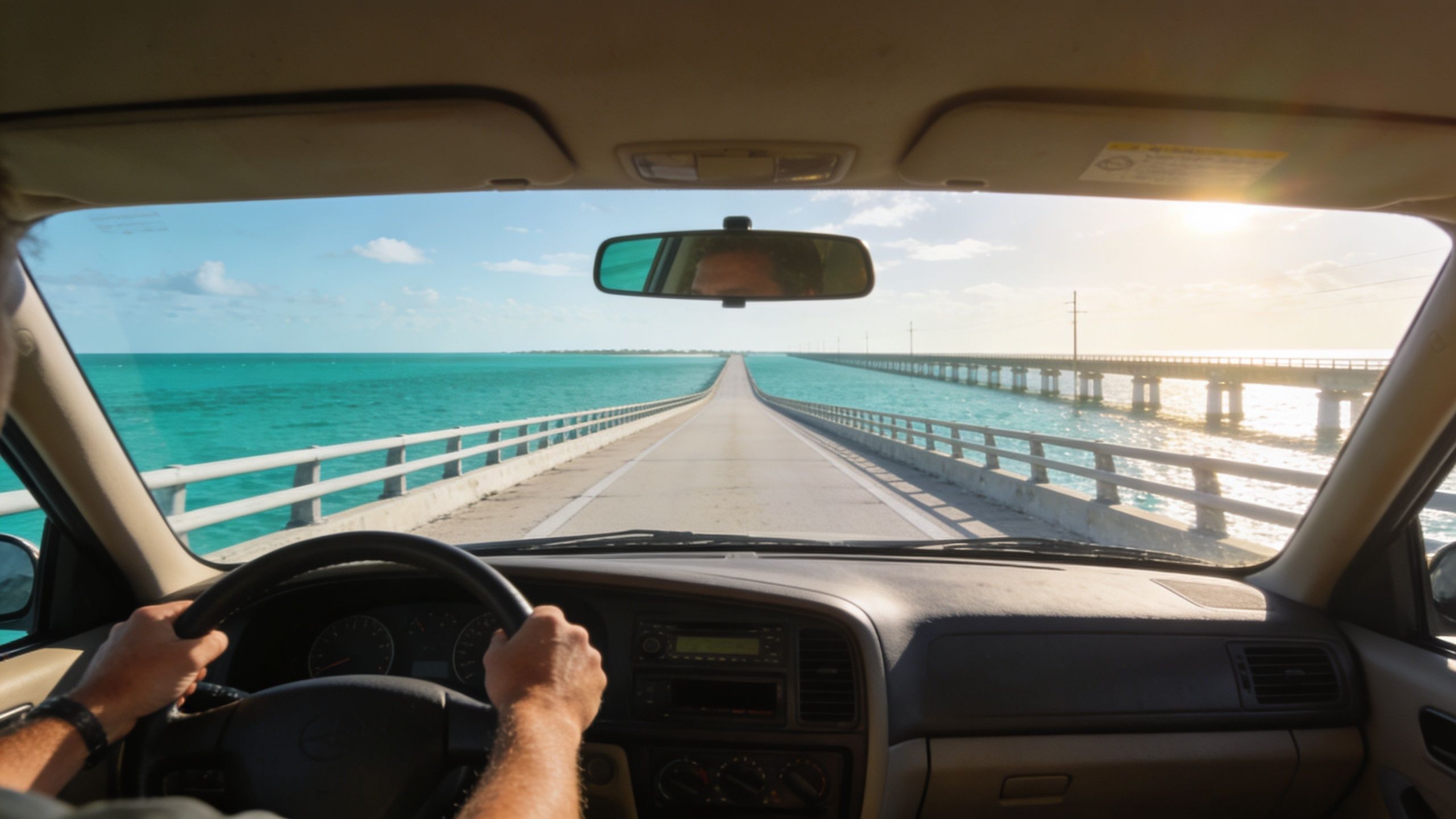
The baseline you should plan around
Driving from Key West to Islamorada covers 81.1 road miles and takes about 1 hour 49 minutes in optimal conditions, according to Rome2Rio’s route breakdown. The same route guidance notes that bridge traffic can add 40-minute backups, and that Big Pine Key has 25 mph deer crossing zones at MM 30, in a region that sees over 200 annual wildlife collisions Keys-wide.
That’s the actual planning number. Not the fantasy version where you’re somehow floating through the Keys with no brake lights in front of you.
My practical driving playbook
Before you leave Key West, do three things:
- Check traffic and weather. Use the FL511 app and weather radar before you turn the key.
- Start with enough fuel. Don’t gamble on filling later.
- Make the car bridge-ready. Tire pressure and brakes matter more on a route with repeated bridge crossings.
Rome2Rio’s route guidance also recommends checking tire pressure in the 32 to 35 psi range, preparing for 42 bridges including the 7-Mile Bridge, and keeping an eye on rainy-season squalls, which are common enough to deserve respect. It also estimates €13-19 in fuel for a standard sedan under the assumptions listed on the route page.
For broader cost control once you’re on the road, these road trip money-saving tips that actually work pair well with the Keys, especially if you’re stretching a multi-stop Florida trip.
Key points to watch on the route
- Leaving Key West: Don’t rush the first segment. Settling into the drive matters.
- Sugarloaf Key around MM 20: Stay alert for cyclists and roadside movement.
- Big Pine Key around MM 30: Slow down and respect the deer zones.
- 7-Mile Bridge area: Patience beats aggression every time.
- Approaching Islamorada: Ease off early and let the pace change.
The driver who saves the most stress on this route isn’t the fastest one. It’s the one who expects delays and builds around them.
What works and what doesn’t
What works is leaving with snacks, water, a half-decent playlist, and no unrealistic arrival target. Waze can help with live conditions, and route guidance on Rome2Rio notes it can help avoid slower tourist convoys.
What doesn’t work is assuming there will always be a convenient station, a safe shoulder, or a quick workaround. The Keys are linear. If traffic clogs, you often wait it out.
That’s why this drive rewards calm more than speed.
Exploring Hassle-Free Shuttles and Charters
Not everyone should drive this route. If you’re tired, traveling solo and don’t feel like managing a rental, or want to watch the water instead of the lane lines, non-driving options can be the better move.
When the bus makes sense
Bus travel works best when your goals are simple. You want one seat, one bag strategy, and no parking decisions. For many budget travelers, that’s enough.
The catch is that route information is incomplete in one important area. Current route listings show available service and a starting fare, but they don’t clearly explain whether certain days or times reliably produce lower prices. That means the usual “always book this exact window” advice would be guesswork here, and guesswork isn’t useful.
A practical approach is to compare a few departures, book once your dates are fixed, and avoid building a tightly timed onward connection on the same day if you can help it.
Boat charter is different from “taking a boat”
A charter from Key West to Islamorada is not public transport with sea spray. It’s a marine trip that needs proper planning.
Traveling by boat from Key West to Islamorada covers 60 nautical miles. A planing hull at 30 knots can make the trip in under 5 hours, but requires careful navigation of shoals and channels, with a recommended minimum draft of 4 feet, according to Savvy Navvy’s route guide.
That same route guidance gets specific fast. It references Chart 11451, a float plan with the USCG, route segments near shoals and channels, and docking in Islamorada at Lorelei Marina. In other words, this is only “hassle-free” if you’re booking a competent operator or you already know what you’re doing on the water.
Which option wins for solo and budget travelers
A shuttle or bus is the practical winner when:
- You don’t want rental costs
- You’d rather arrive rested
- You’re traveling light
- You plan to use Islamorada as a stop rather than a day of roadside exploration
A charter can make sense when the ride itself is the experience you’re buying. It’s not the low-cost default.
If you’re comparing providers, schedules, navigation tools, and live conditions, a solid set of travel apps for route planning and logistics helps more than generic travel forums do.
Worth knowing: Water travel in the Keys looks effortless from shore. In practice, shallow areas, channels, and changing conditions make local knowledge valuable.
What doesn’t work well
Trying to use a boat transfer as a casual budget substitute for road travel usually doesn’t work. Neither does booking the cheapest ground option if your actual priority is freedom to stop and explore.
The right choice is the one that matches your energy level and your reason for going.
Transform Your Trip with These Must-See Stops
The best key west to islamorada day isn’t built around trying to collect as many named attractions as possible. It’s built around a few stops that each give you a different side of the Keys. One for natural beauty, one for local flavor, one for a reset.
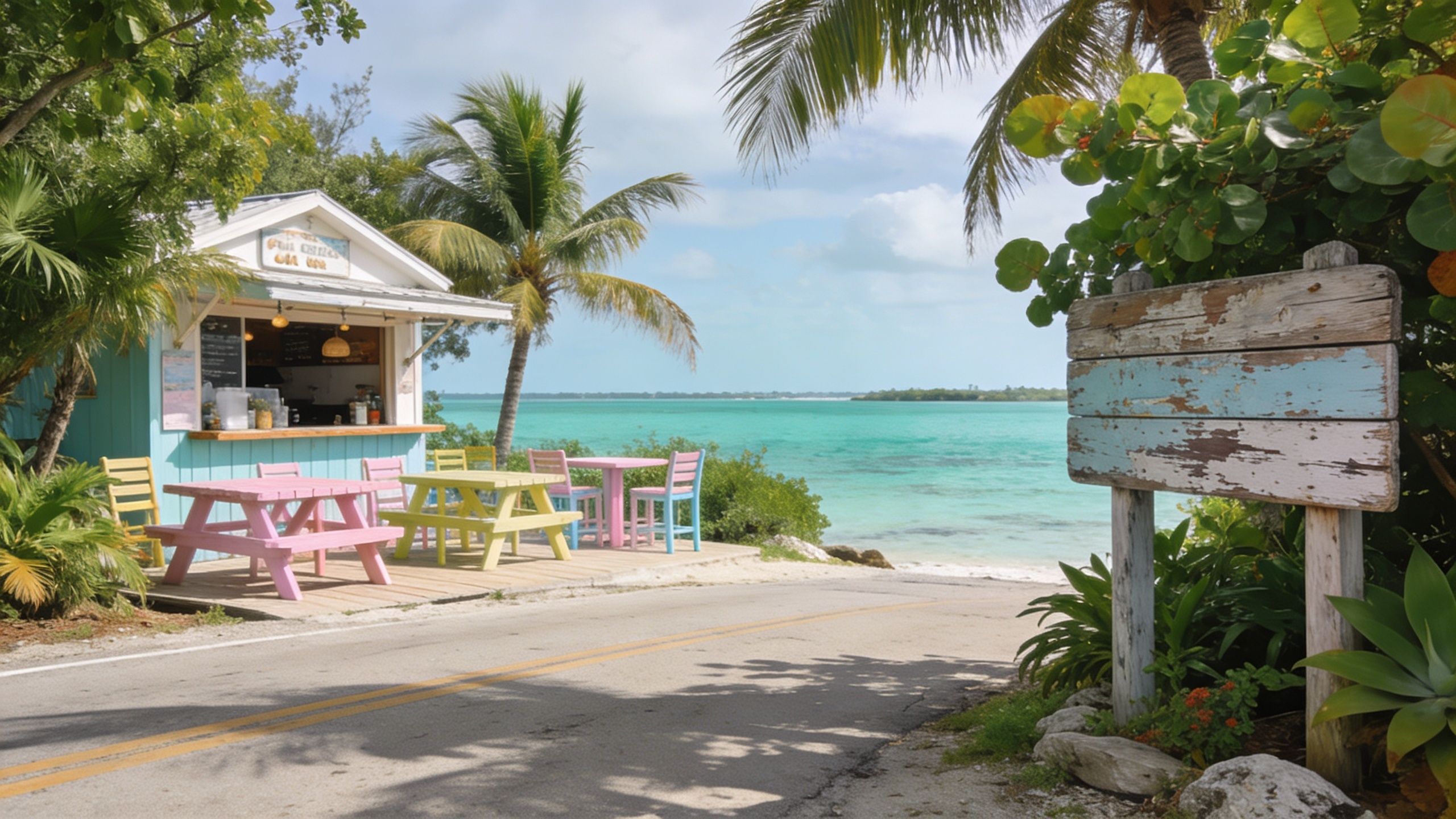
A useful way to think about it is this. Big attractions are easy to find. Memorable stops are the ones that fit your pace.
Stops that work for solo travelers and photographers
Bahia Honda area is worth your time if you want open views, water color, and a break from the car that doesn’t feel manufactured. It’s one of the easiest places on the route to reconnect with why you came to the Keys in the first place.
Big Pine Key is better approached gently than aggressively. This isn’t a place to speed through. Slow roads and a more residential feel make it a good mental reset after Key West.
Islamorada itself deserves to be treated as a real stop, not just “where the room is.” The available travel commentary around this route notes that many guides over-focus on big-ticket attractions and overlook what shorter or more thoughtful stopovers can offer. That’s exactly why Islamorada works so well for independent travelers.
The smart stop strategy
Most guides focus on major attractions, but its charm is often found in smaller stops. With the drive taking under two hours, a strategic stopover in Islamorada or a hidden gem en route offers a chance for authentic cultural immersion that most box-ticking tourists miss, as noted in this travel reflection on Islamorada and Key West.
That tracks with real experience on this route. The drive is short enough that one meaningful stop changes the entire feel of the day.
If you want ideas before you leave Key West, this guide to things to do in Key West helps you decide what to do there before shifting into road-trip mode.
How to choose stops without wasting time
- Choose by mood, not hype. Need a quiet photo stop? Prioritize scenery over shopping.
- Stop where getting out feels easy. If parking or crowds look chaotic, keep moving.
- Eat somewhere with a local feel. The Keys reward simple meals with a view.
- Don’t overload the route. Two or three stops are usually enough for this stretch.
A good Keys stop should lower your pulse, not turn into another queue.
What authentic looks like here
It often looks small. A roadside pull-off with water on both sides. A meal where nobody is rushing you. A walk where you hear more wind than conversation.
That’s especially useful for solo travelers. The route doesn’t need to be “busy” to feel worthwhile. In fact, the quieter intervals often become the part you remember best.
Crafting Your Perfect Itinerary and Travel Plan
You don’t need a complicated schedule for this route. You need one that matches your energy, budget, and tolerance for friction.
The efficient day-tripper
This works best if you’re staying in Key West and want Islamorada as a focused outing.
- Leave Key West with a simple morning plan. Earlier is usually calmer.
- Drive straight through your first segment. Don’t stop too soon just because you can.
- Pick one main stop en route. Give it enough time to feel real.
- Spend your core hours in Islamorada. Eat, walk, and keep the pace loose.
- Return with margin. Never plan your evening around a perfect drive back.
This itinerary works because it limits decision fatigue. You get movement, scenery, and a destination without turning the day into a checklist.
The slow traveler
This is the stronger plan if you’re moving one way and want the road to matter.
Start in Key West, leave enough room for a scenic pause, and treat lunch or an afternoon break as part of the journey instead of a side task. Reach Islamorada with enough daylight left to settle in, walk around, and avoid the “arrive, shower, sleep” trap.
The route is short enough that you can travel slowly without feeling inefficient.
Timing that usually works better
If you have flexibility, avoid the mindset of squeezing this trip into the hottest, busiest middle of the day. Earlier departures tend to feel easier. They also give you more room if road conditions shift or a stop turns out to be better than expected.
For preparation, this travel planning checklist is useful for making sure the small stuff is handled before you leave, especially if the Key West to Islamorada segment is part of a larger Florida trip.
Final planning mindset
The best version of this journey is rarely the most packed one. It’s the one with enough structure to keep costs under control and enough freedom to let the Keys do what they do well.
Don’t just get from Key West to Islamorada. Build a day that gives the route space to surprise you.
Frequently Asked Questions
Is key west to islamorada doable as a day trip?
Yes. The drive is short enough that a day trip is realistic, especially if you keep your stop count selective. It gets much better when you plan one or two meaningful pauses instead of trying to see everything.
Is it worth renting a car just for this route?
It depends on what you want. If your goal is flexibility, photo stops, and control over timing, a car is worth it. If you only need transport and want to spend less mental energy, a bus or shuttle can be the smarter choice.
Is the drive stressful for solo travelers?
Usually not, as long as you prepare for it properly. The route is linear and easy to follow. The main issues are bridge traffic, weather, wildlife zones, and not leaving enough buffer.
Can you do key west to islamorada without driving?
Yes. Bus service exists, and private transfers are also an option. Some travelers also arrange charters by water, though that’s more of an experience choice than a simple transport fix.
Is boating between Key West and Islamorada practical?
It can be, but it’s not casual transit. The route involves channels, shoals, and proper marine planning. If you’re not experienced, treat it as a booked charter experience rather than a DIY shortcut.
Should you stay overnight in Islamorada?
If your budget and itinerary allow it, yes. Islamorada works well as a reset point between busier parts of the Keys. It gives you time to enjoy the route instead of compressing everything into one rushed transfer.
Travel well, spend carefully, and make the road part of the memory. If you want more practical, thoughtful trip ideas, Travel Talk Today is a strong place to keep planning smarter adventures.