Your South American Adventure Starts Here
You've probably done the same thing most travelers do at the start of planning South America. You open a map, pin Machu Picchu, Patagonia, Rio, maybe the Galapagos, then realize the continent is too big for a neat, obvious route. One week turns into three browser tabs, then thirty. Suddenly the hard part isn't deciding whether South America is worth it. It's figuring out how to shape a trip that feels rich instead of rushed.
That's where most advice falls short. A lot of South America travel itineraries either try to cover everything or assume you have months to roam from Colombia to Patagonia by bus. In reality, many travelers are balancing limited time, a fixed budget, nervous first-day energy, and a strong desire to do this well. They want epic scenery, yes, but they also want plans that hold up when buses run late, altitude hits hard, or a destination looks better on paper than on the ground.
The good news is that South America rewards focused planning. It's one of the best places in the world for combining big-ticket highlights with slower, more personal travel. A route can include ancient stone cities, glacial lakes, jungle rivers, street murals, overnight buses, vineyard lunches, community homestays, and long conversations in market stalls. The trick is choosing the right rhythm.
Below are 10 strong routes I'd recommend. Some are classic for a reason. Some work best for first-timers. Others are better if you want fewer crowds, more cultural texture, or a more sustainable footprint. Each one includes the trade-offs that matter, plus practical notes on timing, safety, budgeting, and what tends to work better in real life than it does in travel fantasy.
1. The Classic Peru & Bolivia Circuit (14-21 days)
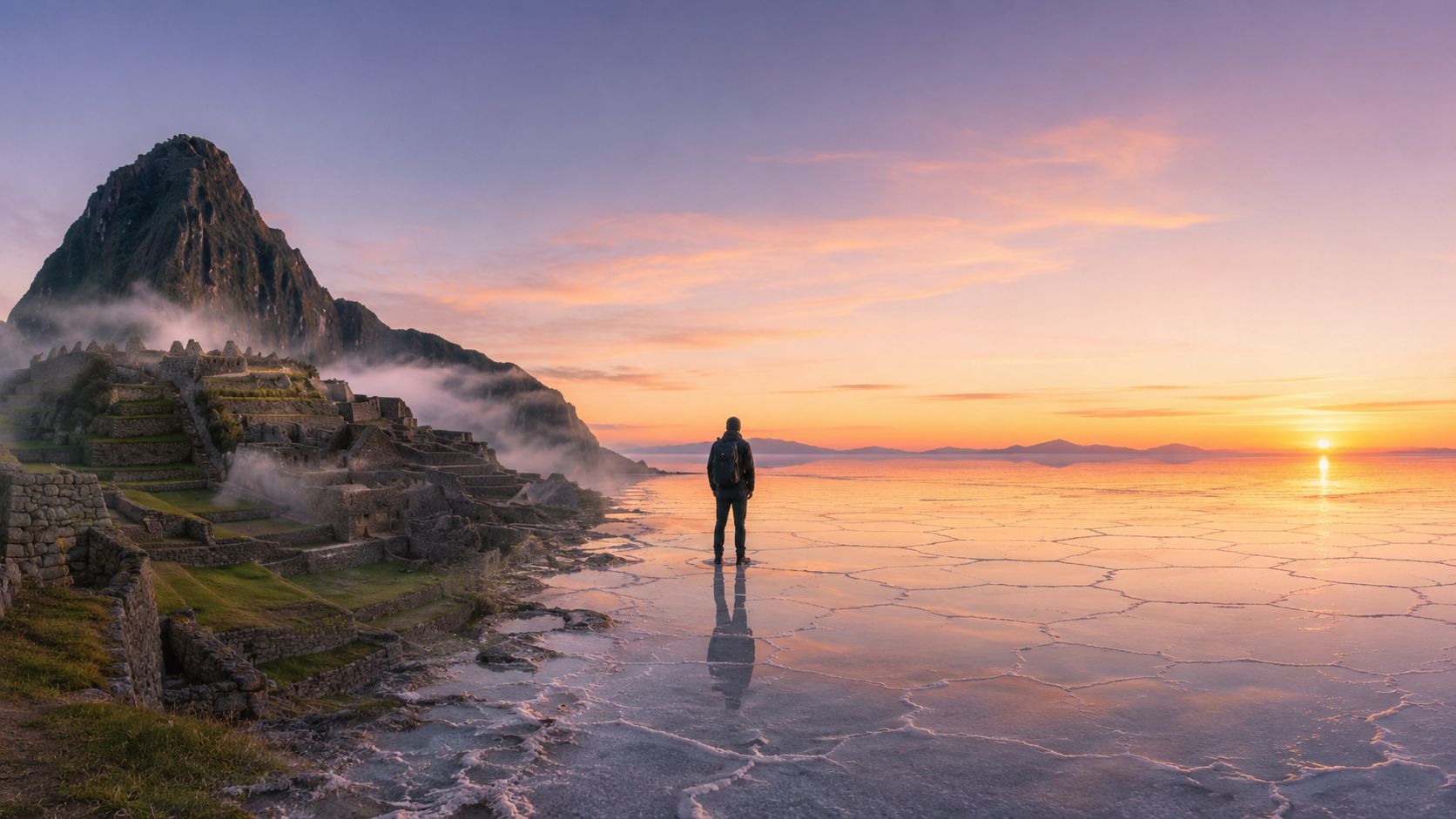
You land in Cusco, feel the altitude on the walk to your hostel, and realize this route rewards restraint more than speed. Done well, it threads together Inca history, living highland culture, lake crossings, chaotic capital energy, and the stark white silence of Uyuni without turning the trip into a blur.
The classic arc is Lima, Cusco, Machu Picchu, Puno or Copacabana, La Paz, then Salar de Uyuni. It remains popular because the pieces fit together overland, prices are still manageable for independent travelers, and the contrast between stops is strong enough to keep two to three weeks feeling full. If you want a wider planning framework before locking in transport, this guide on how to plan a backpacking trip helps with the bigger route logic.
Start slower than your itinerary wants to.
What works best on this route
For 14 to 21 days, the smartest version gives Cusco a real acclimatization buffer, uses Lake Titicaca as a transition instead of a rushed checkbox, and saves Uyuni for the end. The salt flats hit harder after crowded plazas, old stonework, and busy bus stations. That contrast is part of why this route works so well.
A practical pacing framework looks like this:
- Lima: Keep it short unless food is a priority. One or two nights is enough for many travelers.
- Cusco and Sacred Valley: Give this block several days. You need time for altitude, ruins, and at least one slow day.
- Machu Picchu: Book entry and train or trek plans early if your dates are fixed.
- Lake Titicaca: Use it to break the journey south. Copacabana often feels calmer than Puno.
- La Paz: Worth a pause for logistics, markets, and recovering before the Uyuni leg.
- Salar de Uyuni: Finish here if possible. The visual payoff is bigger at the end of the circuit.
Practical rule: If you are changing cities every day, you are spending too much of this trip in transit.
Budget matters here, and so does where you spend. Backpackers can keep costs moderate by using long-distance buses, dorms, market lunches, and local set-menu dinners. Mid-range travelers usually get the biggest quality jump by paying more for private rooms, a better Uyuni operator, and a train connection that saves time around Machu Picchu. I would cut one stop before I would cut quality on the salt flats tour. The cheapest Uyuni trip is often where comfort, food quality, vehicle condition, and guide standards slip first.
Solo travelers generally find this route approachable, but there are trade-offs. Cusco feels easy to settle into. La Paz requires more street awareness, especially around bus terminals, nightlife zones, and unlicensed taxis. Overnight buses save money, though I only use reputable companies on this corridor and keep valuables on me, never in the hold if I can avoid it.
Sustainability choices are straightforward here if you make them early. Stay longer in fewer places. Choose locally run guesthouses and community-based experiences in the Sacred Valley or around the lake rather than stacking day tours from big agencies. On the Uyuni segment, ask operators about group size, waste handling, and whether they pay local drivers and cooks fairly. A lower footprint on this route usually lines up with a better trip anyway.
One hidden-gem adjustment I often recommend is swapping some time in Puno for Copacabana or adding a Sacred Valley base like Ollantaytambo instead of sleeping every night in Cusco. Both changes make the route feel less transactional and more lived-in, which is usually the difference between a trip that looks good on paper and one that feels good on the ground.
2. The Patagonia Adventure Trail (10-14 days)
Patagonia doesn't reward speed, but it can reward focus. If you only have 10 to 14 days, don't try to “do Patagonia.” Choose a tight arc through southern Chile and Argentina and let the scenery do the work.
The mood here is completely different from the Andean cultural circuits further north. Days revolve around wind, trail conditions, ferry schedules, and whether the clouds lift long enough to reveal the granite towers you came for. If you're building a wider overland trip later, this primer on how to plan a backpacking trip helps with the bigger logistics mindset.

A strong route runs through Chilean Patagonia and Argentine Patagonia, then finishes in Buenos Aires for contrast. Give the cities less time than the trailheads. That's the common mistake. Travelers often overestimate what they'll feel in transit hubs and underestimate how much an extra weather day can save a hiking trip.
Timing and cost reality
Patagonia is one of the pricier corners of the continent. For a one-month route centered on Chile, Brazil, and Argentina, backpackers should expect roughly $1,200 to $1,800 USD total, while mid-range travelers should budget $2,000 to $3,000 USD, with Chile the most expensive and Argentina often offering better value, according to Backpacking Bella's one-month South America route. Even if you're only spending part of your trip here, that price hierarchy matters.
Shoulder season is usually the sweet spot. You'll often get more breathing room, lower pressure on accommodation, and a better chance at enjoying the scenery without peak-season crowding.
What works:
- Flexible hiking days: Keep at least one spare day for weather.
- Longer stays in one base: El Chaltén and Puerto Varas reward lingering.
- Mixing buses and short flights carefully: Patagonia distances can eat your trip if you romanticize every overland leg.
What doesn't:
- Daily hotel changes: Constant movement makes the route feel like logistics, not wilderness.
- Assuming every viewpoint is guaranteed: Some days the mountains stay hidden. That's part of Patagonia.
3. The Colombia Cultural Deep-Dive (14-21 days)
Colombia is the itinerary I recommend when someone says, “I want a trip that feels alive.” The draw isn't only scenery. It's the energy of neighborhoods, music, coffee regions, mountain towns, and the way each stop feels socially textured rather than purely scenic.
A lot of travelers under-allocate time here. That's a mistake. In one long-form overland plan, Colombia gets 34 days within a 154-day trip, which shows how quickly this country can expand once you start moving beyond headline stops, according to Mili Mundo's South America itinerary.
Where the route comes alive
Medellín, Bogotá, the Coffee Triangle, and the Caribbean side form a smart backbone. I like starting with Medellín because many first-timers settle in faster there. The weather is gentler, the city rhythm is more approachable, and organized neighborhood walks add context quickly.
For travelers who care more about connection than sightseeing volume, Colombia pairs especially well with intentional cultural immersion travel. That means coffee fincas, language exchanges, local food markets, and neighborhoods where you spend long enough to recognize faces.
A good two-to-three-week version often looks like this in practice:
- Medellín for urban context: Street art, social history, and a soft landing.
- Coffee region for slower travel: Plantation stays and small-town pacing.
- Bogotá for museums and food: Best done with some structure.
- Santa Marta or the Caribbean edge: Useful if you want heat, coast, or access to trekking.
Colombia rewards travelers who stay curious and move with local rhythms instead of trying to “complete” the country.
For solo women, this route works better when arrivals happen in daylight and transport between major points is kept simple. I'd also avoid forcing too many remote side trips into a short schedule. Colombia opens up beautifully when you have time, but a compact itinerary should stay disciplined.
4. The Amazon Basin Immersion (7-14 days)
The Amazon asks for a different mindset. Don't treat it like a day trip attached to a larger itinerary. The jungle works when you let it slow you down, sharpen your attention, and reset what you think travel is supposed to feel like.
A short stay can still be meaningful, but only if you choose depth over variety. A river lodge, a community-based stay, or a guided wildlife route can all work. What doesn't work is rushing in for a single night and expecting the forest to reveal itself on command.

Choosing the right Amazon gateway
For travelers chasing South America's “Big Five” experiences, the Amazon is one of the essential pieces, and the shortest workable version of that broader dream still needs at least 5 to 6 weeks overall, with Amazon options often routed through Iquitos in Peru or Coca in Ecuador, according to Chimu Adventures' guide to South America's Big Five.
That matters because it shows the jungle isn't a throwaway add-on. It takes effort to reach and deserves room to breathe.
I'd think about the Amazon like this:
- Ecuadorian access: Easier for travelers who want fewer logistical hurdles.
- Peruvian access: Strong value and good fit for a wider Peru route.
- Brazilian access: Better if the rainforest is your central focus, not a side chapter.
Sustainability and safety notes
This is the itinerary where your choices matter most. Pick operators who employ local guides, keep group sizes reasonable, and treat wildlife observation as observation, not performance. If an experience sounds built around handling animals, forcing sightings, or staging contact with communities, skip it.
Pack light colors, long sleeves, and patience. Bring insurance with evacuation coverage if you're going remote, and ask blunt questions before booking: who guides the trip, who owns the lodge, where waste goes, and how community visits are handled. The best Amazon experiences feel quieter, more respectful, and less polished than mainstream tourism. That's usually a good sign.
5. The Buenos Aires & Wine Country Escape (10-14 days)
You arrive in Buenos Aires after an overnight flight, drop your bag, order a medialuna and coffee, and realize this itinerary runs on a different rhythm. Late dinners, long walks, bookstore afternoons, and one very good bottle of Malbec fit better here than a rushed country-counting trip.
This is one of the smartest South America travel itineraries for travelers who want pleasure without constant friction. It works especially well for first-time visitors, couples, solo travelers who like city comfort, and anyone who wants a clear framework: a few nights in Buenos Aires, a focused wine-country stay, and enough slack in the plan to enjoy both.
How to split the time well
Buenos Aires deserves at least four nights. Five is better if you enjoy neighborhoods, food, and museums more than checklist sightseeing. Base yourself by temperament, not by vague ideas about what is "central." Palermo works well for restaurants and nightlife, Recoleta suits travelers who want calmer streets and classic architecture, and San Telmo gives you more old-city character. If you want help choosing, this guide to the best neighborhoods in Buenos Aires is a useful place to start.
Then choose one wine region.
Mendoza is the practical pick. It has better tourist infrastructure, easier winery logistics, and plenty of accommodation at different price points. Salta is the stronger choice for travelers who have already done the classic Argentina route or want high-altitude vineyards, dramatic desert scenery, and a trip that feels less polished and more regional.
I would structure 10 to 14 days like this:
- Days 1 to 5: Buenos Aires for neighborhoods, markets, cafés, and one slower cultural day
- Days 6 to 9 or 10: Mendoza or Salta, with no more than one major tasting circuit per day
- Final 1 to 3 days: Return to Buenos Aires for shopping, a steakhouse or natural wine bar, and a buffer in case of flight changes
That last buffer is not wasted time. Argentina rewards slower pacing, and domestic flight disruptions do happen.
Budget reality and trade-offs
This route is rarely the cheapest option on the continent. Argentina can still offer good value once you are on the ground, but food, boutique hotels, winery transport, and domestic flights can push costs up fast. For broad planning context on Argentina travel costs and timing, Anywhere's Argentina travel guide is a more relevant benchmark than a generic continent-wide roundup.
A practical daily budget usually breaks down like this:
- Budget: Hostel or simple guesthouse, public transport, limited tastings, casual meals
- Mid-range: Well-located hotel or stylish guesthouse, a guided winery day, strong restaurant scene
- Higher spend: Boutique stays, private driver in wine country, top-end tastings, tasting-menu dinners
The key trade-off is easy to miss. Spending more on accommodation in Buenos Aires often matters less than spending more on transport in wine country. A private or small-group winery day is usually worth the money because distances add up, drinking and driving is off the table, and the better vineyards are often inconvenient without a car.
Solo safety and smart logistics
Buenos Aires is one of the easier large cities in South America for solo travelers, but easy does not mean careless. Use rideshare apps at night, keep your phone off café tables near the street, and avoid arriving in a new neighborhood with luggage after midnight if you can help it.
Wine country is comfortable for solo travel too, especially in Mendoza, where hostels, bike rental shops, and organized tasting tours make it easy to meet people. Salta feels less set up for spontaneous backpacker logistics, which can be a plus if you want a quieter trip and are happy to pre-book more of it.
One practical mistake ruins a lot of wine itineraries. People try to squeeze in too many wineries. Two good visits and a long lunch beat four rushed tastings every time.
Hidden gem alternatives and better choices
If Mendoza feels too obvious, look at Luján de Cuyo versus the Uco Valley rather than treating the whole region as one thing. Luján is easier from the city and works well for shorter stays. The Uco Valley is more scenic and often gives you a stronger sense of space, but distances are longer and costs can climb.
If you choose Salta, pair it with Cafayate and give the road journey proper time. The scenery is part of the appeal. So are the Torrontés wines, which give this route a very different personality from the heavier Mendoza reds that dominate postcards and exports.
For a lower-impact version of this itinerary, stay longer in one base instead of changing hotels repeatedly, book winery visits with producers who discuss water use and land management openly, and prioritize local restaurants over imported luxury experiences designed to feel interchangeable. Argentina does high-end travel well, but the trip is stronger when it still feels rooted in place.
A city-and-wine route can sound softer than Patagonia or Peru. In practice, it is one of the best-designed trips in South America if you care about food, pace, and getting the details right.
6. The Ecuador Diversity Loop (7-10 days)
Land in Quito in the morning, drink coffee with volcano views by lunch, and by the next day you can be in a cloud forest, an Indigenous market town, or at the edge of the Amazon. Few countries reward a short trip this well.
That is Ecuador's real advantage. It gives you range without forcing you into constant airport days or punishing overland hauls. For travelers building South America travel itineraries around one week or a little more, it is one of the easiest places to create a trip that feels full rather than rushed.
Best use of a short window
The mistake here is trying to prove how much you can fit in. Ecuador looks small on a map, but mountain roads are slow, weather shifts fast, and altitude can flatten your first two days if you arrive ambitious.
Use Quito as your anchor and build a loop with two, or at most three, supporting stops. Otavalo works well if you want textiles, market culture, and easy access to highland scenery. Mindo is the smarter pick if your priority is birdlife, waterfalls, and a softer climate after Quito's altitude. For an Amazon sampler, Tena is usually a more realistic short-trip choice than going too deep into the basin.
A practical 7 to 10-day version usually looks like this:
- Days 1 to 3: Quito. Historic center, food, museums, and time to adjust to the altitude.
- Days 4 to 5: Otavalo or nearby highlands. Best for markets, weaving traditions, lakes, and mountain villages.
- Days 4 to 6 alternative: Mindo. Better for nature, hiking, chocolate, and a lower-stress pace.
- Final 2 to 4 days: Tena, Cotopaxi area, or one coast base. Pick one. More than that turns the route into transit management.
This is a trip that gets stronger when you cut one stop.
What this itinerary is actually good at
Ecuador suits travelers who want contrast without heavy planning friction, but the route changes depending on what matters most.
- On a tighter budget: Mainland Ecuador is one of the more forgiving Andean countries for bus travel, simple guesthouses, and set lunches.
- For solo travelers: It is easier to join day tours from Quito and Mindo than in many larger South American countries, which helps if you want flexibility without feeling isolated.
- For photographers and hikers: Light, altitude, and ecosystems shift fast, so you can get very different images within a single week.
- For more thoughtful travel: Community-run lodges, local guides, and small-scale food producers are easier to find here than in routes built around marquee attractions alone.
The Galapagos is the obvious temptation. On a 7 to 10-day mainland loop, I would usually leave it out. The islands deserve their own budget, their own pace, and their own planning logic. Trying to bolt them onto a short Ecuador circuit often leaves both experiences thinner than they should be.
Budget, safety, and better choices
For a mainland loop, budget travelers can keep costs moderate with buses, basic private rooms or dorms, and market lunches. Mid-range travelers get good value here, especially in Quito and Mindo, where small hotels and guided day trips are often reasonably priced for what you receive. Costs rise quickly once you add private transfers, remote lodges, or last-minute domestic flights.
Solo safety is generally manageable with standard city awareness. In Quito, choose your neighborhood carefully, use registered taxis or ride apps at night, and avoid carrying your full cash supply on market days. On buses, keep valuables on your body rather than in overhead storage. The risks are usually mundane, not dramatic.
For a lower-impact version of this itinerary, stay longer in fewer places, choose rail or bus over short flights where practical, and look for operators connected to local conservation or community projects. Ecuador's Ministry of Tourism also highlights community tourism options across the mainland, which can be a useful starting point when comparing operators and regions on the official Ecuador travel site.
A hidden-gem alternative I recommend often is swapping Otavalo for Cotacachi and nearby villages if you want the northern highlands without the busiest market energy. Another good trade-off is choosing the quieter cloud forest around Nanegalito or Mashpi-access areas if Mindo feels too popular on weekends. Ecuador works best when you stop treating every famous place as mandatory and start building around one question: culture, wildlife, mountains, or rest. Pick two, and the loop becomes much stronger.
7. The Chile North to South Journey (14-21 days)
Chile is long enough to punish vague planning. It's one of the easiest countries in South America to travel independently, but only if you accept that you can't sensibly string together desert, capital, lakes, and Patagonia without making hard cuts.
The reward for getting it right is huge. Few routes offer this much visual contrast inside one country. You move from Mars-like desert plains to vineyard country, then into forests, volcanoes, fjords, and cold southern light.
Segment it or it falls apart
For a practical long route, I'd treat Chile as separate mini-journeys linked by strategic flights or overnight buses. In a 154-day overland itinerary across seven countries, Chile only gets 5 days, which is a useful warning about how easily this country gets compressed when travelers try to cover too much ground in a larger continental trip, according to 185 Jours' South America backpacking itinerary.
That doesn't mean Chile deserves less time. It means you need to choose.
A strong 14 to 21-day version usually prioritizes:
- Atacama: For desert scenery, astronomy, and otherworldly terrain.
- Central Chile: Often brief, but useful for food, wine, and urban reset.
- Lake District: A softer, greener chapter with road-trip appeal.
- Patagonia: If it fits the season and the budget.
Smart trade-offs
Chile tends to reward self-directed travelers. Car rental can make sense in the Atacama or Lake District if you're sharing costs and want flexibility. In cities, public transport is usually easier than driving.
I wouldn't try to force the whole country into one unbroken overland line. Chile looks tidy on a map and travels long in real life. If you only have two weeks, choose north and center, or center and south. The mistake is thinking “seeing more of Chile” always means “having a better Chile trip.” Usually it means spending more time in terminals.
8. The Venezuela (Historic) & Caribbean Route (Variable)
This one belongs in a planning conversation with care. Venezuela has historically been part of ambitious northern South America routes, especially for travelers drawn to Caribbean islands, Andean scenery, and less conventional overland arcs. Right now, though, this is better treated as a future-facing itinerary than an active recommendation.
That distinction matters. Responsible trip design isn't just about what looks exciting on a map. It's also about timing, safety, infrastructure, and whether your presence helps or complicates local realities.
How to think about it now
If you're mapping long-term travel goals, keep this route in a separate folder marked “watch and reassess.” Follow official advisories, visa policies, and healthcare access closely before you make any commitments. Conditions can change, and this is not a region to plan from nostalgia or old blog posts.
For travelers who want a similar blend of Caribbean atmosphere and mountain access now, nearby alternatives make more sense:
- Northern Colombia: Better for Caribbean coast energy with established travel infrastructure.
- Ecuador: Better for Andes depth with manageable logistics.
- Trinidad and Tobago: Better if island culture is your immediate priority.
This route is still worth understanding historically because it shows how broad South America's travel imagination can be. Just don't confuse future interest with present readiness.
9. The Peru to Bolivia to Brazil Loop (21-30 days)
You wake up in Cusco in a fleece, cross Bolivia under a hard blue sky, and finish the month eating grilled fish in Brazil in a T-shirt at night. Few South America routes change this much without feeling stitched together. Done well, it gives you altitude, desert, big city energy, and either Atlantic coast or Amazon humidity in one trip.
The route works because the transition is logical. Starting high in Peru gives you time to acclimatize before Bolivia, and finishing in Brazil usually feels like a release rather than another physical hurdle. If you are piecing together flights, border crossings, and rest days across three countries, these trip planning tips for multi-stop travel can help you choose where to spend time instead of trying to fit everything in.
How to shape the loop
The best version is selective. Peru carries the history and mountain scenery. Bolivia adds raw high-altitude drama and lower costs. Brazil changes the mood completely, but it also changes the budget.
A balanced loop often looks like this:
- Peru: Lima arrival, Cusco, Sacred Valley, and optionally Puno if Lake Titicaca is part of the overland route.
- Bolivia: Copacabana or La Paz, then Uyuni if you want the salt flats, or Sucre if you want a calmer cultural stop.
- Brazil: Rio if this is your first visit, Paraty for a slower coast finish, Florianópolis for beaches with structure, or Manaus if you want the trip to end in the Amazon rather than on the Atlantic.
The hidden gem choice here is easy. If Rio feels too obvious or too expensive for the final stretch, Paraty is often the smarter finish. You still get colonial architecture, water access, and strong food, but with less logistical friction and a smaller daily spend.
Budget, pace, and where costs jump
Peru and Bolivia usually let you stretch your money. Brazil usually does not. A detailed solo travel report from eight months in South America reflects a pattern many long-term travelers recognize. Brazil tends to cost more than Peru and Bolivia for the same level of comfort, especially once domestic flights, beach towns, and nightlife enter the picture.
For planning purposes, I would frame it like this:
- Budget travelers: Peru and Bolivia can stay manageable with buses, simple guesthouses, and menu del día lunches. Brazil is where you need stricter choices on nightlife, flights, and beachfront stays.
- Mid-range travelers: This route is comfortable if you save your nicer hotels or splurge meals for Brazil and keep Peru and Bolivia more modest.
- Time-rich travelers: Extra days matter more than extra destinations. Cutting one stop often improves the whole month.
Rest days matter on this loop because altitude, night buses, and border days stack up fast. Put one reset day in Cusco or the Sacred Valley, another in La Paz or Sucre, and one more when you reach Brazil.
Solo safety and practical trade-offs
This route is solo-friendly, but not uniformly easy. Peru is straightforward in established hubs. Bolivia rewards patience more than spontaneity, especially when transport changes at the last minute. Brazil is the place to tighten your city habits. Use registered taxis or ride apps where available, stay alert with phones in big urban areas, and choose accommodation in neighborhoods you would still feel comfortable walking through after dinner.
There is also a real trade-off between overland romance and trip efficiency. Buses between Peru and Bolivia can add atmosphere and save money. Crossing into Brazil often makes more sense by air unless you are intentionally building an Amazon route.
Sustainable choices that improve the trip
This loop can be done with a lighter footprint without making it harder. Stay longer in fewer places. Choose locally run lodgings in Peru and Bolivia where your spending stays in town. In Brazil, avoid building the final leg around multiple short domestic flights if one base can give you the coast or rainforest experience you want. Uyuni also deserves restraint. Pick operators that explain waste handling, driver rotation, and accommodation standards instead of choosing only on price.
This is one of the strongest South America itineraries for travelers who want range without chaos. Treat it as a designed route, not a country-counting exercise, and the month will feel full rather than rushed.
10. The Hidden Gems Colombia-Ecuador-Peru Triangle (14-21 days)
This is the route for travelers who've realized famous doesn't always mean memorable. The triangle linking less-visited parts of Colombia, Ecuador, and Peru can be one of the richest journeys on the continent, but it asks more from you. More Spanish. More flexibility. More patience when transport is messy and recommendations come from people rather than apps.
The reward is texture. You get places where tourism hasn't flattened local rhythm, where arrival still feels like arrival, and where a homestay, market, or shared van ride can become the center of the trip.
Why this route fills a real gap
One neglected problem in South America planning is the “Two-Week Reality Gap.” Many itineraries are built for months on the road, while a large share of first-time travelers try to make the continent work in under 15 days, according to P Simon My Way's discussion of South America route planning. That's exactly why hidden-gem routes matter. They can deliver depth without pretending you'll see half the continent in two weeks.
A strong version might briefly touch a major access city, then move quickly into secondary regions where the pace changes. Southern Ecuador is especially good for this. So are Colombia's quieter coastal or inland areas and Peru's less-publicized Andean towns.
What makes it work
This style of trip succeeds when you accept a few rules:
- Keep the route narrow: Don't add famous detours just because they're famous.
- Use local advice daily: Conditions change fast in less-touristed areas.
- Build in slack: Delays are part of the experience.
- Travel respectfully: Small places notice traveler behavior more sharply than major hubs.
Go lighter on bookings and heavier on curiosity.
For solo travelers, especially women, this route can still work, but confidence matters. I'd lean toward private rooms, daytime arrivals, and accommodation with strong local reputation rather than the cheapest option on the map. Hidden gems are best enjoyed when the trip still feels grounded, not risky for the sake of authenticity.
Top 10 South America Travel Itineraries Comparison
| Itinerary | Implementation Complexity 🔄 | Resource Requirements ⚡ | Expected Outcomes 📊 | Ideal Use Cases 💡 | Key Advantages ⭐ |
|---|---|---|---|---|---|
| The Classic Peru & Bolivia Circuit (14–21 days) | Medium, well‑established routes; altitude planning needed | Moderate, $50–80/day; buses/trains/flights readily available | High cultural & iconic-site exposure; some crowding | First‑time South America travelers; budget backpackers; solo travelers | UNESCO sites, strong hostel networks, affordable options |
| The Patagonia Adventure Trail (10–14 days) | Medium‑High, remote parks, weather and gear logistics | High, $60–100+/day plus expensive international/domestic flights | Exceptional landscape and photography opportunities; variable weather | Hikers, outdoor photographers, adventure couples | World‑class trekking, fewer crowds, camping and guide options |
| The Colombia Cultural Deep‑Dive (14–21 days) | Medium, urban + rural mix; safety awareness advisable | Low‑Moderate, $30–55/day; excellent public transport | Deep cultural immersion, coffee/arts, biodiversity at value | Cultural travelers, coffee enthusiasts, solo female travelers | Affordable, vibrant cities, strong transport and community tours |
| The Amazon Basin Immersion (7–14 days) | High, remote access, health/guide dependence | Variable, $50–150/day; long transfers, vaccines and insurance needed | Intense biodiversity encounters and indigenous cultural exchange | Nature lovers, eco‑tourists, wildlife photographers | Unique wildlife sightings, meaningful community tourism |
| The Buenos Aires & Wine Country Escape (10–14 days) | Low‑Medium, urban logistics simple; vineyard bookings useful | Moderate, $55–100/day; domestic flights accessible | Culinary and wine‑focused experiences in comfortable settings | Foodies, wine enthusiasts, first‑time visitors to region | Excellent infrastructure, great wine value, safe walkable cities |
| The Ecuador Diversity Loop (7–10 days) | Medium, compact but frequent transfers; altitude manageable | Low, $25–50/day; efficient buses and short travel times | Maximum geographic diversity in short time; photography friendly | Time‑limited travelers, photographers, families | Compressed variety, affordable, strong community homestays |
| The Chile North to South Journey (14–21 days) | High, very long distances, multi‑modal transport planning | High, $65–120/day incl. domestic flights; long travel times | Broad ecosystem coverage from desert to Patagonia; road‑trip ready | Road‑trippers, landscape photographers, multi‑week travelers | Reliable infrastructure, self‑guided feasible, diverse scenes |
| The Venezuela (Historic) & Caribbean Route (Variable) | Very High / Not recommended, security/humanitarian constraints | Unreliable / N/A, infrastructure and services currently limited | Historically unique sites; presently inadvisable for general tourism | Researchers, journalists, long‑term planners monitoring recovery | Exceptional natural wonders historically; use for future planning |
| The Peru → Bolivia → Brazil Loop (21–30 days) | High, multi‑country visas, border logistics, altitude changes | Moderate‑High, $45–75/day; extended time and varied transport | Comprehensive regional immersion across ecosystems and cultures | Gap‑year/sabbatical travelers, extended photographers | Deep diversity, economies of scale, extended homestay opportunities |
| Hidden Gems Colombia‑Ecuador‑Peru Triangle (14–21 days) | High, remote routes, limited infrastructure, Spanish helpful | Low, $25–45/day but slower travel and local logistics | Authentic cultural interactions, few tourists, logistical flexibility | Experienced backpackers, language learners, researchers | Authentic experiences, direct community benefit, lower costs |
Designing Your Own South American Story
The best South America travel itineraries aren't the ones that cover the most ground. They're the ones that match your time, energy, budget, and curiosity. That's the difference between a trip that feels cinematic on Instagram and a trip that works when you're carrying your backpack through a bus terminal, deciding whether to push on or stay one more night.
Start with rhythm, not landmarks. Ask yourself whether you want movement or depth. Some travelers come alive with constant scenery changes. Others need three or four nights in one place before a destination starts to mean anything. South America can support both styles, but it punishes mixed intentions. A route that tries to be both a slow cultural immersion trip and a highlight-hunting sprint usually turns into a tiring compromise.
The strongest itineraries usually have one clear spine. Maybe that's altitude and archaeology in Peru and Bolivia. Maybe it's Patagonia and wilderness. Maybe it's food and neighborhoods in Argentina, or cultural immersion in Colombia and Ecuador. Once that spine is set, every extra stop should earn its place. If a destination only makes sense because it looks famous on a map, cut it.
Budget matters, but not just in the obvious way. It shapes pace. In cheaper regions, you can often recover from a bad planning decision by staying longer, changing buses, or booking a better room for a night. In pricier regions like parts of Chile, Argentina, and Brazil, mistakes cost more. That doesn't mean avoiding them. It means planning those legs with more care and accepting that you may need to see less to enjoy more.
Safety planning should be built into the itinerary, not added as an afterthought. That means looking at arrival times, overnight transport choices, neighborhood selection, and how much mental bandwidth you'll still have by the second or third week. Solo travelers, especially women, usually benefit from slightly simpler routing and fewer “just figure it out on arrival” segments. Confidence grows from good structure.
Sustainability also gets easier when the route is cleaner. Fewer frantic transfers usually means fewer wasteful decisions, fewer rushed bookings with questionable operators, and more time to choose local guides, community stays, and businesses that keep money in the destination. Slow travel isn't always about staying for months. Sometimes it's just about not treating every place like a checkbox.
A good South America trip should leave room for the unexpected. A market town you didn't research. A bus conversation that changes your next stop. A storm that keeps you in one village long enough to finally notice the place instead of just passing through it. Those moments don't happen when every hour is preloaded.
If you're planning now, choose one itinerary from this list that feels immediately right. Then sharpen it. Cut one stop. Add one recovery day. Think through how you'll arrive, where you'll sleep, and what kind of memories you want. The continent is vast, but your trip doesn't need to be. It just needs to be intentional.
South America rarely gives travelers the exact experience they imagined. It usually gives something messier, richer, and more personal. That's often the better story.
If you want practical help turning these ideas into a route you can afford and enjoy, explore Travel Talk Today for thoughtful guides on budgeting, cultural immersion, slow travel, hidden gems, and safer solo planning across South America and beyond.