You're probably in Thailand right now, or about to land, scrolling tattoo photos between hostel bookings and night market plans. You want more than a random souvenir. You want a tattoo that still means something when the trip is over.
That's exactly why getting a tattoo in Thailand deserves a little more thought than walking into the first shop with a neon sign. Thailand offers two very different tattoo worlds. One is Sak Yant, a sacred tradition tied to ritual, blessing, and spiritual meaning. The other is the modern studio scene, where talented artists create custom work in every style from fine line to heavy blackwork.
Both can be great. Both can also go badly if you rush it.
I'll be blunt. If you want a sacred tattoo because it “looks cool,” stop and slow down. If you want a modern tattoo but you're tempted by the cheapest place near the beach, stop and slow down there too. The right tattoo in Thailand should fit your reason, your budget, your risk tolerance, and your respect for local culture.
The Dream of a Thai Tattoo
A lot of travelers hit the same moment. Maybe it happens after a few days in Bangkok, when everything feels louder, stranger, and more alive than back home. Maybe it happens in Chiang Mai after a temple visit, or on an island when you decide this trip changed you and you want proof on your skin.
That urge makes sense. Tattoos have moved far beyond niche subculture. The global tattoo market was valued at USD 2.43 billion in 2025, is projected to reach USD 2.66 billion in 2026, and is forecast to grow to USD 5.99 billion by 2034, a projected 10.67% CAGR from 2026 to 2034, according to Fortune Business Insights' tattoo market outlook. Thailand stands out inside that growth because it offers something many other destinations don't. You can choose between ritual-based sacred tattooing and polished contemporary studio work.
That's why this decision matters. You're not just choosing a design. You're choosing an experience, and those experiences aren't interchangeable.
Two very different reasons to get inked
Some travelers want a tattoo that marks a chapter of life. They care about the design, the artist, and the memory. A modern studio tattoo fits that goal perfectly.
Others feel pulled toward something older and more symbolic. They don't just want art. They want ritual, blessing, and a connection to Thai tradition. That's where Sak Yant enters the conversation.
A tattoo from Thailand can be a meaningful travel memory. It shouldn't be a rushed dare you explain away later.
If your trip is already pushing you toward more intentional travel, read this guide the same way you'd approach cultural immersion travel. Get curious first. Spend money second.
My advice before you do anything
Before you message an artist or an Ajarn, ask yourself one question: Do you want spiritual commitment, or do you want great artwork?
There's no shame in either answer. The mistake is pretending they're the same thing.
The Soul of Thai Ink Sak Yant and Sacred Meanings
Sak Yant isn't a Thai version of a trendy flash tattoo. It comes from a much older Southeast Asian tradition rooted in Buddhist and animist beliefs. Tattoo history tied to Thailand traces back to the Khmer Empire, and these tattoos were historically linked to status, military rank, protection, and magical power, as described in this guide to Thai tattoo history and Sak Yant tradition. In present-day Thailand, that sacred link still matters, especially in temple-based ritual settings and through blessings given by monks or Ajarns. Wat Bang Phra remains the most widely recognized temple associated with the tradition.
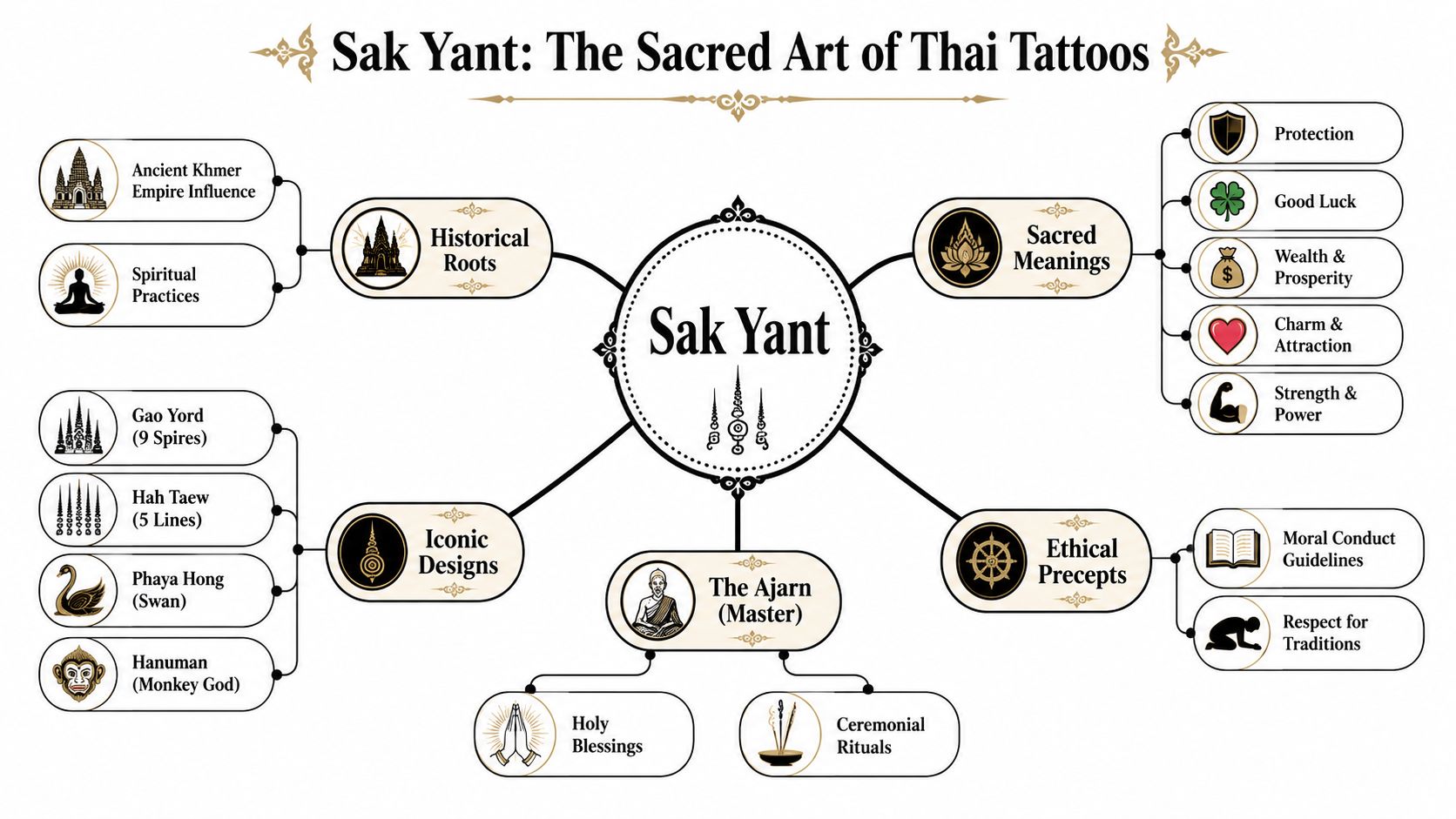
What Sak Yant actually means
Think of Sak Yant less like ordering a design from a menu and more like entering a symbolic practice. The image matters, but so do the script, the blessing, the ritual, and the intention behind it.
A lot of Western travelers fixate on the visual side. That's backward. In a sacred context, the tattoo isn't only decoration. It can be treated as protection, discipline, or a spiritual obligation.
Here's the simplest way to understand it:
- Sacred first: The spiritual meaning comes before aesthetics.
- Ritual matters: Who applies it matters, and the blessing matters.
- Conduct matters: Some traditions attach rules, mantras, or expectations to the tattoo.
- Context matters: A temple or Ajarn setting isn't the same as a studio appointment.
Why respect matters more than style
People often get sloppy. They see a famous design online, they book it like any other tattoo, and they never ask whether they want what comes with it.
If you feel drawn to Sak Yant, spend time learning from people who prioritize authentic travel experiences, not just photo ops. You don't need to become an expert in Thai spirituality overnight. You do need to show basic humility.
Practical rule: Don't request a sacred tattoo the way you'd order a beach souvenir. Ask what it means, who gives it, and what it asks of you afterward.
When a Sak Yant is the right choice
A Sak Yant makes sense if you're comfortable with these realities:
- You may not control every design detail
- The blessing is part of the experience, not an optional extra
- You're willing to treat it with seriousness afterward
- You're drawn to the cultural and spiritual meaning, not just the look
If that doesn't sound like you, skip it. Respectfully. A modern Thai studio can still give you beautiful work without crossing into a tradition you don't intend to honor.
Choosing Your Path Studio Artist or Sak Yant Master
This is a pivotal fork in the road. Don't overcomplicate it. Choose based on what you want to carry home.
The experience compared
A Sak Yant master or Ajarn offers ritual, symbolism, and a traditional process. A studio artist offers design control, collaborative planning, and a standard modern tattoo appointment.
Sak Yant is typically applied by hand, often with a sharpened bamboo stick or metal rod, not an electric machine. Travel accounts describing the method note that many people report faster healing and less trauma than machine tattooing, though that claim is anecdotal rather than clinically proven, as discussed in this Sak Yant technique and healing overview.
Quick comparison
| Factor | Sak Yant | Modern studio tattoo |
|---|---|---|
| Main purpose | Ritual, blessing, symbolism | Art, self-expression, customization |
| Application | Hand-poke with bamboo or metal rod | Electric machine |
| Design control | Often limited or guided by master | High |
| Healing expectations | Some travelers report faster healing | Familiar modern tattoo aftercare path |
| Commitment level | Can include spiritual or behavioral obligations | Personal and aesthetic only |
My honest recommendation
Choose Sak Yant if you want the ritual as much as the tattoo.
Choose a studio artist if you care most about the artwork, exact placement, line quality, portfolio fit, and having a detailed consultation.
That sounds obvious, but travelers still confuse the two all the time. They want a sacred tattoo with full custom control, or they want a clean studio experience but book a ritual setting they don't understand. That mismatch creates disappointment.
For solo travelers, keep it practical
If you're traveling alone, especially if you're a woman, remove all romantic nonsense from the decision. Ask:
- Will I feel physically safe in this setting?
- Can I communicate clearly with the artist or Ajarn?
- Am I comfortable with the privacy, dress expectations, and environment?
- Do I have support afterward if I feel unwell or overwhelmed?
For broader planning, the safety mindset in solo female travel in Thailand applies here too. Meet in established locations. Tell someone where you're going. Don't book a remote appointment because an influencer made it look mystical.
If your gut tightens when you arrive, leave. A meaningful tattoo never requires you to ignore your instincts.
The best path for budget travelers
If your budget is tight, a studio tattoo is often easier to compare and plan because you can discuss style, size, and pricing upfront. A sacred tattoo may be less straightforward because the meaning and setting matter as much as the money.
Cheap should never be your main filter. For a tattoo in Thailand, the right question isn't “What's the cheapest option?” It's “What can I afford without cutting safety or respect?”
Your Non-Negotiable Guide to Hygiene and Safety
I don't care how talented the artist seems or how spiritual the setting feels. Hygiene is not optional. If a place gets weird, vague, defensive, or sloppy when you ask about cleanliness, walk out.
A lot of travelers get timid here because they don't want to seem rude. Forget that. You're about to let someone break your skin. Ask direct questions and watch what happens next.
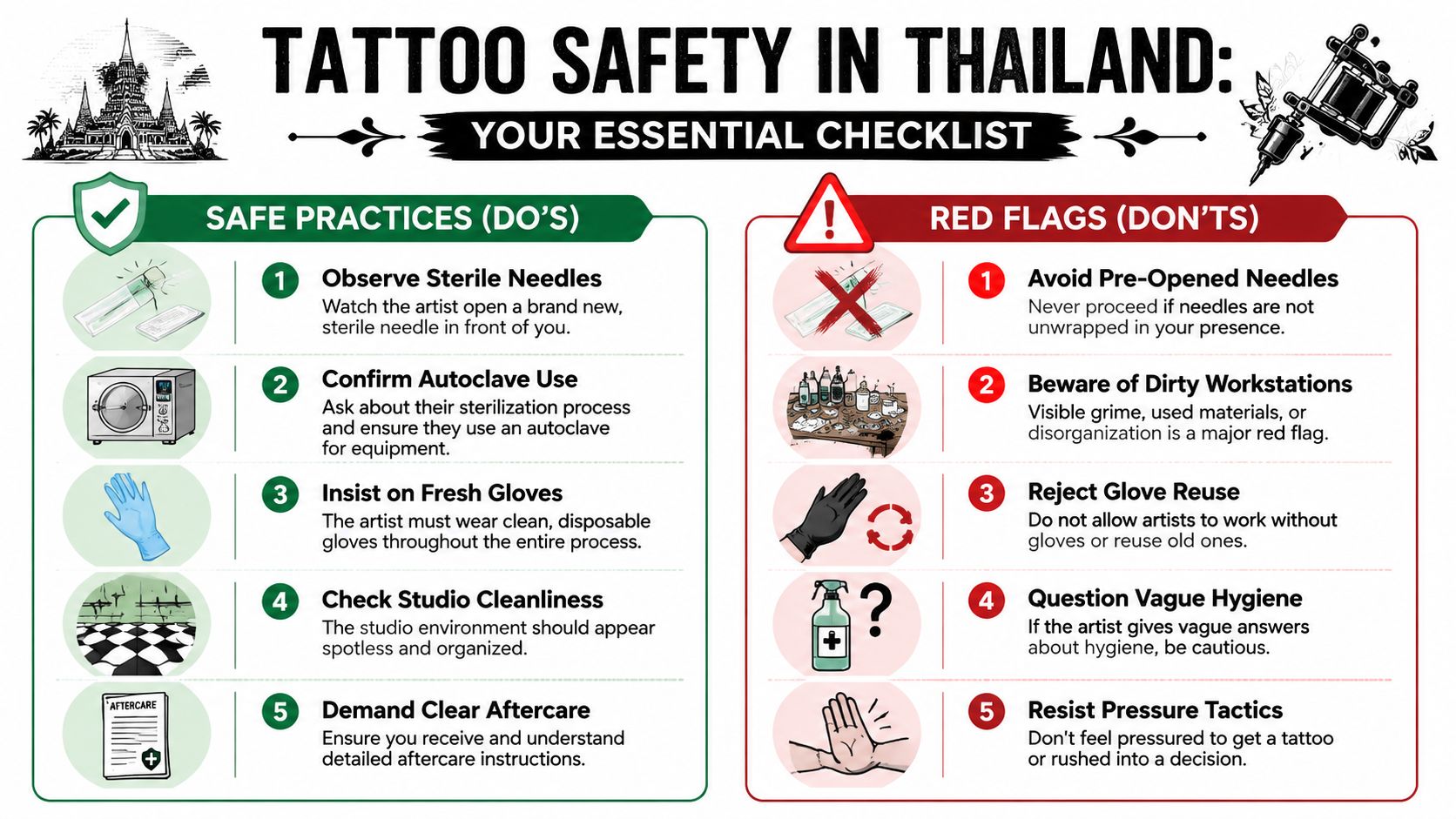
What you need to see with your own eyes
Don't settle for promises. Look for observable behavior.
- Fresh needle opening: The artist should open a new sterile needle in front of you.
- Clean gloves: They should use fresh disposable gloves and change them when needed.
- Orderly workspace: Surfaces should look clean and organized, not chaotic.
- Clear process: The artist should explain aftercare, not mumble through it.
- Professional communication: You should be able to ask questions without getting brushed off.
Red flags that mean leave now
At this point, you stop being polite and start protecting yourself.
- Pre-opened tools: If anything looks reused or already unwrapped, leave.
- Dirty station: Ink stains happen. Filth is different.
- Vague answers: If they dodge hygiene questions, they're telling you enough.
- Pressure tactics: Anyone rushing you into a tattoo is not acting in your interest.
- Bad energy: Sloppy, intoxicated, distracted, hostile. None of that gets better once the needle starts.
Don't let a low price talk you into a high-risk decision.
Budget travel doesn't excuse bad standards
Backpackers sometimes normalize sketchy conditions because they're trying to stretch money. That's foolish. The cheapest tattoo can become the most expensive problem on your trip if healing goes wrong.
This is also where planning tools help. You don't need expensive gear. You need enough time, enough money, and enough margin in your itinerary to choose carefully. If you're trying to squeeze a tattoo between a boat transfer and a full moon party, your plan is bad.
For general trip planning and recovery-minded prep, how to stay healthy while traveling is a useful mindset. Build your tattoo day like you'd build a health day, not a party day.
Thailand's Tattoo Hotspots Where to Get Inked
Location changes the whole experience. Not because one city is “best” for everyone, but because each place has a different rhythm, different client mix, and different tattoo culture.
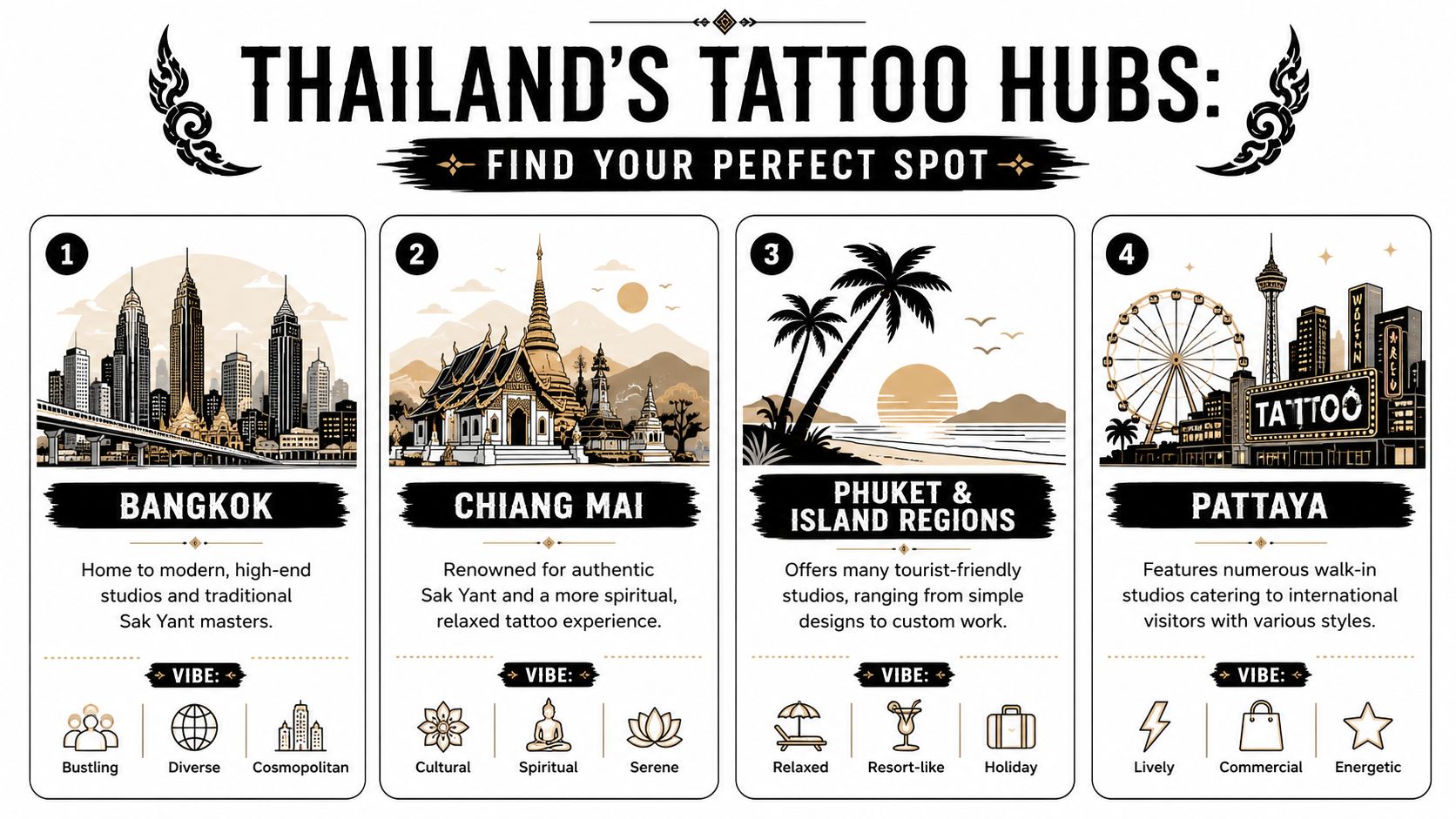
Bangkok for range and serious studio work
Bangkok is where I'd send travelers who want options. You'll find modern studios, custom artists, and access to traditional practitioners too. The city suits people who want to compare portfolios carefully and book with intention.
If your tattoo is large, style-specific, or technically demanding, Bangkok makes sense. You have more room to be selective.
Chiang Mai for culture and a slower pace
Chiang Mai is a strong fit if you want a more reflective experience. The city attracts travelers looking for tradition, creativity, and a calmer pace than Bangkok.
That makes it especially appealing for people considering Sak Yant, or for travelers who want a modern studio tattoo without the intensity of the capital. The city's broader appeal also fits naturally with some of the best places to travel in Southeast Asia, especially if you like combining culture with a slower route.
Phuket and island areas for convenience, with extra caution
Phuket and the islands make tattoos feel dangerously easy. You're on holiday, studios are visible, and tourist traffic keeps the whole thing moving.
That convenience has a downside. You need to vet more carefully. Some places are perfectly fine. Some clearly target impulsive walk-ins who haven't thought beyond tonight's story.
Pattaya for access and volume
Pattaya has plenty of walk-in studios serving international visitors. That means access is easy and styles vary. It also means quality varies.
If you're in Pattaya, don't choose based on who can start immediately. Choose based on cleanliness, communication, and portfolio fit.
My city-by-city rule
Use this simple filter:
- Bangkok: go for high-choice studio hunting or a planned appointment
- Chiang Mai: go for a more grounded, culturally rich tattoo trip
- Phuket and islands: only if you're disciplined enough not to book impulsively
- Pattaya: fine for access, but vet hard
The city shouldn't choose your tattoo. Your tattoo goal should choose the city.
Aftercare in the Tropics and Cultural Etiquette
Healing a tattoo in Thailand is different from healing one back home in cool, dry weather. Heat, humidity, sweat, beach plans, long transit days, and shared hostel spaces all make aftercare harder. That doesn't mean you shouldn't get tattooed here. It means you need to behave like someone who wants the tattoo to heal well.
A more nuanced point often gets missed with sacred tattoos too. Sak Yant can come with behavioral obligations or rules, and solo travelers also need to think carefully about dress, cultural sensitivity, and aftercare in humid climates, as noted in this discussion of Sak Yant obligations and traveler considerations.
Tropical aftercare that actually works
Your first job is boring consistency.
- Keep it clean: Follow the artist's aftercare instructions exactly.
- Stay out of dirty water: Don't treat a fresh tattoo like a beach accessory.
- Wear loose clothing: Tight, sweaty fabric rubbing on fresh ink is asking for trouble.
- Avoid all-day sun exposure: Fresh tattoos and strong tropical sun are a bad pairing.
- Plan slow days: Don't get tattooed right before a long bus ride, trek, or boat day.
Temple and public-space etiquette
Thailand is not one single social setting. What feels normal in a beach town may feel disrespectful at a temple or in a more conservative space.
Use common sense:
- Cover tattoos in temples
- Dress modestly in sacred settings
- Don't treat a Sak Yant like a party conversation piece
- Ask before photographing practitioners or ritual spaces
- Keep your body language respectful
Sacred tattoos carry meaning beyond the image. If you choose one, act like you know that.
If you're a solo female traveler
Think through logistics before the appointment, not during it.
Choose a setting where communication is easy. Wear practical clothing that still respects the environment you're entering. Have aftercare supplies ready. If the tattoo placement requires more exposure than you're comfortable with, say so and reconsider. You don't owe anyone access to your body because they're the artist or the spiritual authority.
A good practitioner will respect clear boundaries. If they don't, leave.
Your Final Checklist and Cost Guide
You are in Chiang Mai or Bangkok, you found an artist you like, and your finger is hovering over the booking button. Stop for two minutes and run a hard filter first. Thailand is a great place to get tattooed, but only if the tattoo fits your budget, your travel plans, and the kind of experience you want.
That matters even more if you are choosing between a studio piece and Sak Yant. One is usually about design, technique, and artist fit. The other also carries ritual, etiquette, and personal responsibility. Treat them differently.
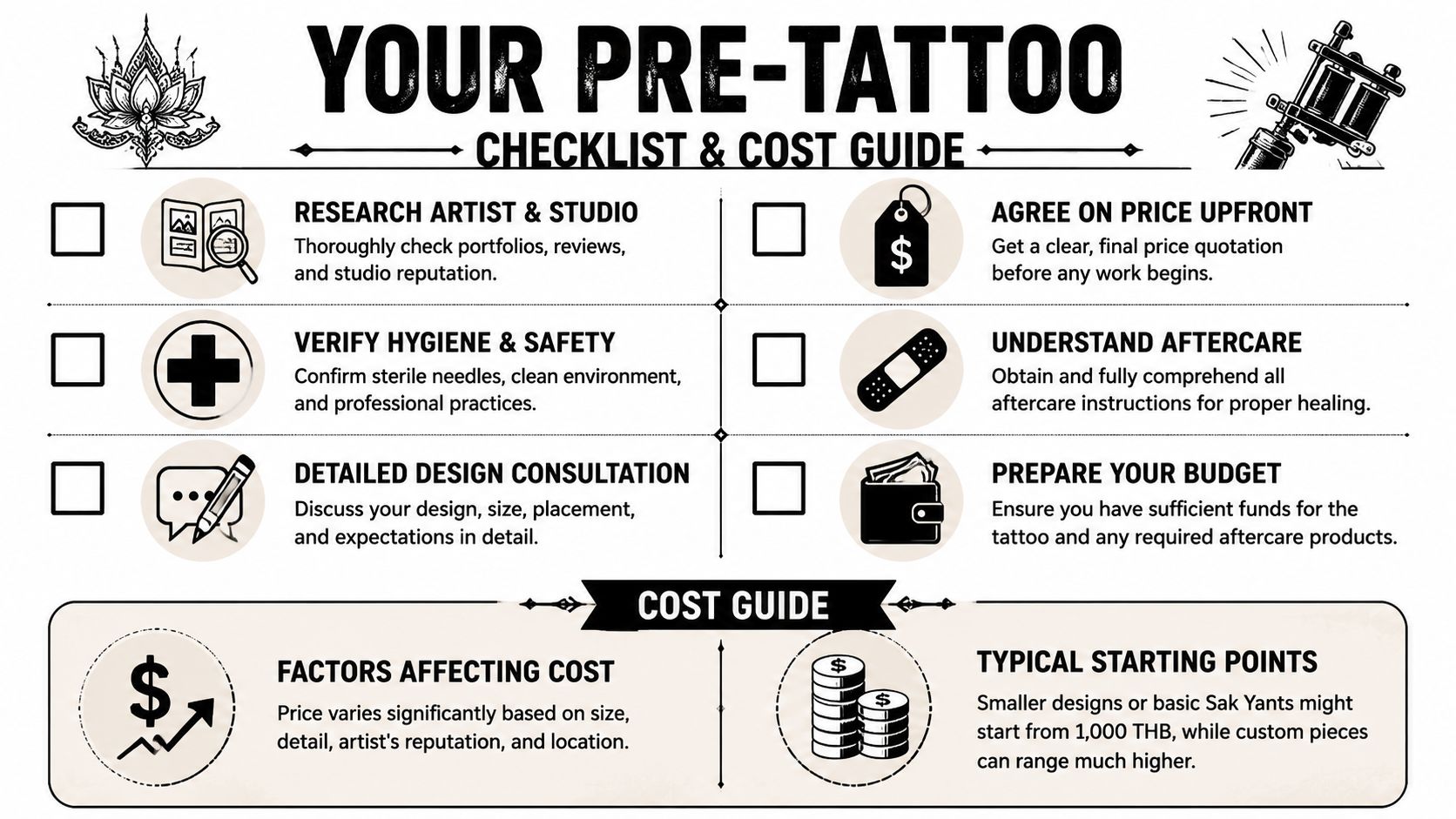
Final pre-booking checklist
- Reason check: Do I want sacred meaning, strong custom artwork, or just a travel memory I may regret in a week?
- Path check: Am I booking a modern studio tattoo, or am I choosing Sak Yant with full respect for the ritual side of it?
- Research check: Have I looked closely at healed work, reviews, communication, and the practitioner's reputation?
- Safety check: Are fresh needles, gloves, clean surfaces, and a professional setup clearly part of the process?
- Comfort check: Would I still feel okay walking into this appointment alone?
- Timing check: Do I have enough quiet days after the session, or am I squeezing this between boats, buses, and beach time?
- Money check: Can I afford the tattoo, deposit, transport, food, aftercare supplies, and a safer backup option if something feels off?
If one of those answers is weak, wait. A rushed tattoo is expensive even when the sticker price looks cheap.
Cost guide
Tattoo prices in Thailand vary widely. Size, placement, detail, city, artist demand, and whether you are booking a studio artist or an Ajarn all affect the final number.
A practical baseline is simple. Small tattoos or basic Sak Yants may start around 1,000 THB. Larger custom work can climb fast, especially in well-known studios or with artists whose books fill early. Ask for the full price before you commit. Ask whether the quote includes touch-ups, design time, or ritual offerings if you are pursuing Sak Yant.
My advice is straightforward:
- Very tight budget: Get something small from a reputable artist, or wait until you can afford better work.
- Solo traveler on a fixed budget: Keep cash aside for transport, food, and aftercare so you do not choose a cheaper setup out of pressure.
- Custom studio tattoo: Confirm price, placement, size, and style before the appointment.
- Sak Yant: Do not shop for the lowest number. Judge the setting, the respect shown, and whether you understand what you are agreeing to receive.
Travel Talk Today publishes practical trip planning content that can help you structure your Thailand itinerary so you are not trying to heal a new tattoo during a chaotic travel stretch.
Choose slowly. Spend carefully. Respect the culture if you go the Sak Yant route. That is how you come home with a tattoo that still feels right years later.
If you're planning a Thailand trip and want travel advice that balances budget, safety, and cultural respect, check out Travel Talk Today . It's a useful resource for building a smarter itinerary around experiences like this, especially if you want more than a rushed checklist holiday.