You’re probably in a familiar spot. You want more trips, more places, and more variety, but your budget keeps dragging you back to the same calculations: flight prices, lodging costs, peak season surcharges, and the sinking feeling that “someday” travel keeps getting more expensive.
That’s where a timeshare exchange program starts to sound tempting. The pitch is simple enough. Own access to one vacation stay, then swap it for another somewhere else. In theory, one home base becomes a passport to a much bigger travel map. For a traveler trying to stretch every pound, dollar, or saved-up annual leave day, that promise has real pull.
But this world gets confusing fast. You’ll hear about weeks, points, deposits, banking, trading power, resort affiliations, and exchange fees. Some travelers treat it like a smart long-game move. Others feel trapped by costs, limited availability, or a style of travel that looks flexible in marketing but feels rigid in practice.
That tension matters if you care about value, independence, and travel that feels meaningful, not just convenient. A budget traveler doesn’t need another glossy promise. You need a straight answer about how the system works, what it costs, and whether it fits how you travel.
If you’ve been exploring budget-friendly vacation ideas for stretching your travel fund, this is one of the more complicated options on the table. It can open doors, but only if you understand the rules before you step through them.
Introduction Your Gateway to a Bigger World
You spot a tempting travel idea while planning next year. One ownership. Many destinations. For a solo traveler trying to stretch savings without giving up variety, that can sound like a clever shortcut.
The appeal is easy to understand. Traditional timeshares have long carried the image of returning to the same resort at the same time every year. Exchange programs changed that image by adding a swap system. Owners could use one purchase as a base, then request stays in other places through a larger network. What looked like a fixed holiday started to resemble a members-only booking system with strict rules, fees, and availability limits.
That distinction matters.
For Travel Talk Today readers, the question is bigger than whether exchanging can get you more destination options. The better test is whether it supports the kind of travel you want. Budget-conscious travelers care about total cost, not just the sales pitch. Solo travelers care about flexibility and whether resort inventory matches one-person trips. Sustainable travelers often care less about collecting properties and more about staying longer, traveling more intentionally, and putting money into places that feel connected to local life.
A timeshare exchange program can help with some of that. It can also cut against it.
It helps to picture the system like airline miles crossed with a vacation apartment network. You prepay your way into a club, then learn its rules to get the best value back out. Travelers who enjoy planning ahead, comparing dates, and working within a system may find that appealing. Travelers who book on instinct, prefer small guesthouses, or chase the cheapest route each season may find the structure expensive and restrictive.
If you have been browsing budget-friendly vacation ideas that help stretch your travel fund, this option sits in a very different category from budget airlines, hostels, or off-season deals. It is less about finding a bargain in the moment and more about committing early, then trying to use that commitment wisely.
That is why timeshare exchanges deserve a closer look. They are not automatically a smart travel hack, and they are not automatically a trap either. They are a system. Like any system, they reward a certain kind of traveler and frustrate another.
What Is a Timeshare Exchange Program Anyway
A timeshare exchange program is the system that lets an owner trade the vacation time they already have for a different stay inside a larger network. Instead of using the same resort every year, you place your week or points into an exchange pool and request something else from the inventory other members have deposited.

For a traveler, that can sound a bit abstract. Here is the plain-English version. You already paid for access to one slice of vacation real estate. The exchange program is the middle layer that may let you swap that slice for a different destination, different season, or different type of resort without buying a second ownership.
Say you own a week at a beach resort, but this year you want a mountain town, a European city stay, or a quieter shoulder-season base for a longer solo trip. You deposit what you own, then search or request what the network can offer in return. If the value lines up under the program rules, you can make the exchange.
That is the appeal. More variety from the same ownership.
What the exchange company actually does
The exchange company runs the clearinghouse. It collects deposited weeks or points from members, organizes them into bookable inventory, and sets the rules for who can get what. In practice, it works less like a casual swap between two travelers and more like store credit inside a private travel club.
A simple way to follow the flow:
- You own vacation access: usually a fixed week, floating week, or points package.
- You deposit that value: your usage goes into the exchange system.
- You request another stay: you search available inventory or place an ongoing request.
- You confirm the exchange: if your deposit carries enough value for that stay, you can book it.
You are usually not trading directly with another owner. You are trading through a managed pool with its own pricing logic and membership rules.
Where travelers get tripped up
The word "exchange" makes many first-time readers picture a one-to-one trade. That is rarely how it works. Your week or points become a kind of internal currency, and the exchange company decides how much buying power that currency has.
That detail matters a lot for Travel Talk Today readers. Budget travelers need to ask whether the exchange saves money after membership fees, annual dues, and booking charges. Solo travelers need to ask whether the inventory fits one-person trips, or if the best availability is tied to larger units and family resort calendars. Sustainable travelers should ask a different question too. Does this system help you stay longer and travel with intention, or does it keep nudging you toward resort-centered trips that feel detached from local life?
That is why a timeshare exchange program should be viewed less like a cheap booking trick and more like a closed travel economy. If you already understand the trade-offs of points and loyalty systems, the logic will feel familiar, much like comparing airline miles with travel rewards credit card programs built around transfer partners and redemption rules. The better question is whether that economy fits the way you travel, not the way a sales brochure says you might.
How Exchanges Really Work Points vs Weeks
A timeshare exchange program runs on one question: how much vacation buying power do you have?
That buying power shifts. It depends on the type of ownership you hold, the dates attached to it, the resort, the unit size, and how early you act. Two owners can both belong to the same exchange network and still have very different results.
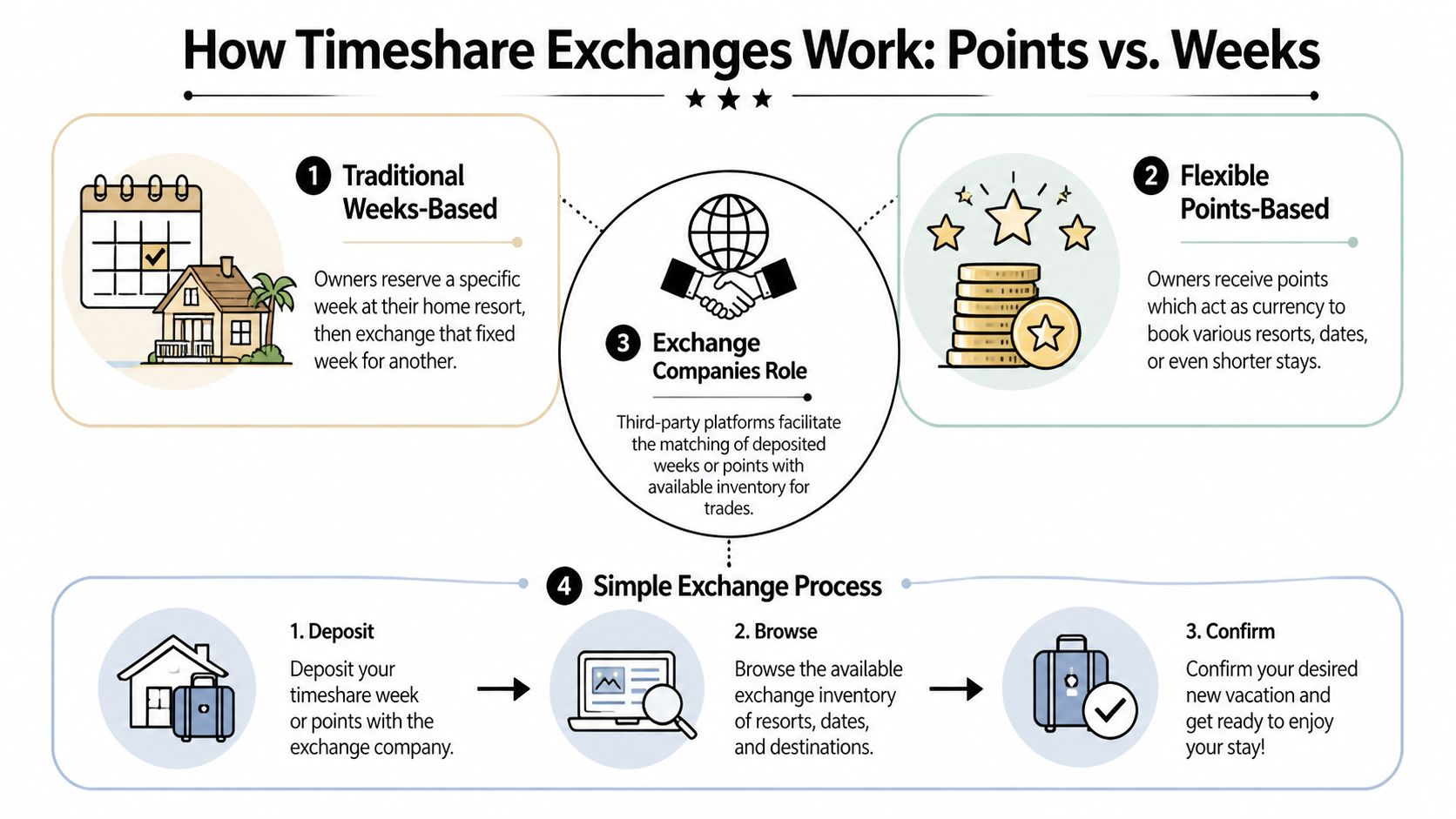
Weeks-based ownership
In a weeks-based system, your exchange value starts with a specific stay. You own a set week, or a seasonal band of weeks, at your home resort, and that stay becomes the asset you deposit into the exchange pool.
A strong week usually means peak season, a larger unit, and a resort other travelers actively want. A weaker week usually means shoulder season, a smaller unit, or a location with less demand. The network may still accept both, but they will not pull the same options.
Many first-time owners get frustrated. “I joined the network” sounds like “I can book anything in the network.” In practice, it works more like arriving at a busy market with a certain budget. You can shop in the same place as everyone else, but what you leave with depends on what your deposit is worth that day.
For a solo traveler, this can create an awkward mismatch. A one-bedroom in a family resort during school holidays may carry more exchange weight than a smaller, simpler stay that better fits one person and a lighter footprint.
Points-based ownership
In a points-based system, your ownership is converted into points that you spend across the network. The appeal is flexibility. You may be able to choose different arrival dates, unit sizes, trip lengths, or seasons, depending on the rules of your club and exchange company.
That sounds more modern because it often is. Many travelers no longer plan one fixed annual holiday. They take a long weekend, then a week, then maybe a shoulder-season workcation.
Still, points are not magic. A points balance can feel generous for an off-peak studio and surprisingly thin for a ski week, a beach holiday, or a larger unit. If you travel on a tight budget, the trap is assuming points always stretch farther than they do in real booking conditions.
Trading power is the part that decides your options
According to RedWeek’s explanation of exchange options and trading power, exchange systems use trading power to estimate how much value a deposited week or points package carries inside the network. That value is shaped by season, location, unit size, resort reputation, and supply versus demand.
A few examples make the concept easier to see:
- Stronger trading power: a larger unit during peak winter at a popular ski resort
- Weaker trading power: a smaller unit in an off-peak season at a mid-market property
- Brand effect: a well-known resort brand may hold more exchange weight than a lesser-known one
- Timing effect: an earlier deposit can improve what the system lets you request
RedWeek also notes that depositing far ahead can improve your odds because exchange systems tend to favor owners who give the network more time to work with the inventory.
Why the difference matters in real travel planning
Weeks owners usually plan from the asset outward. You start with the week you own, then ask what it can get you elsewhere.
Points owners plan from the trip backward. You start with the trip you want, then check whether your points balance can cover it.
That sounds subtle, but it changes behavior. Weeks can suit travelers who like one main holiday and are comfortable planning early. Points can suit travelers who split trips across the year, chase shoulder-season value, or want shorter stays. For Travel Talk Today readers, that second pattern may sound better on paper than it looks in practice. Many exchange networks still reward resort-style, longer, and family-oriented travel more than low-impact solo trips built around public transit, slow stays, and local guesthouses.
Here’s the practical comparison:
| System | Best for | Main trade-off |
|---|---|---|
| Weeks-based | Travelers planning one main holiday each year | Your exchange reach depends heavily on how desirable your owned week is |
| Points-based | Travelers who want more choice in dates and trip length | It is easy to spend points inefficiently on high-demand stays |
| Hybrid use through exchange companies | Owners trying to widen their options beyond one home resort | More moving parts, more rules, and more chances to misjudge value |
If you already use travel rewards credit cards to stretch lodging and flight budgets, the logic will feel familiar. The headline balance matters less than how and when you redeem it.
For budget-conscious, solo, and sustainable travelers, that is the critical factor. A points or weeks system only works well if it helps you take the kinds of trips you already value, not just the trips the resort network is built to promote.
Decoding the Fees and Contracts
The most important question for a budget traveler isn’t “Can I exchange?” It’s “What will the exchange cost me once the glossy brochure disappears?”
That’s where many people lose the plot. They focus on the fantasy destination and ignore the fee ladder underneath it.
The fees that matter most
Major networks charge both a membership fee and a transaction fee. The clearest hard numbers available here come from RCI. According to this breakdown of timeshare exchange company fees, RCI’s 1-year membership is £136, with exchange fees of £145 for domestic online, £169 for international online, and £179 for international offline. A guest certificate costs £37, which can bring a single trade to roughly £300 to £400.
That range matters. For a budget traveler, £300 to £400 is not a side note. It can be the difference between “good value” and “I could have booked independently and kept full flexibility.”
A simple cost worksheet
The challenge with the required table is that the assigned heading asks for USD, while the verified figures are primarily in pounds for RCI and a qualitative dollar range for Interval owner reports. To stay accurate, I’m keeping the figures qualitative where conversion would require inventing numbers.
| Fee Type | Typical Cost Range (USD) | Description |
|---|---|---|
| Annual membership | Qualitatively, owner reports place some programs around the low hundreds of USD | Paid each year to stay in the exchange network |
| Exchange fee | Qualitatively, owner reports place many exchanges in the low to mid hundreds of USD | Charged each time you confirm a trade |
| Guest certificate | Varies by network | Lets someone else use your confirmed reservation |
| Banking or extension fee | Varies by network | Charged when you defer usage or preserve value for later |
For readers who want the clearest specific benchmark, stick with the RCI figures above because they’re directly stated in the verified data.
Why contracts matter more than the headline fee
A timeshare exchange program isn’t a one-click booking platform. It’s a rules-based membership system layered on top of ownership. That means the true cost isn’t only the exchange fee. It includes how often you travel, whether you need flexibility, whether you bank time, and whether your requests succeed often enough to justify staying enrolled.
Here’s the practical lens I’d use before signing anything:
- Run a real comparison: Compare the exchange fee against what you usually pay for independent lodging in the kinds of destinations you typically visit.
- Check how often you travel: If you won’t use the network consistently, the annual fee becomes dead weight.
- Ask about restrictions: Booking windows, inventory visibility, guest rules, and banking rules affect value as much as the base fee.
- Look at your travel style: If you pivot plans often, fixed systems can get expensive emotionally even before they get expensive financially.
Budget test: If the annual fee plus exchange fee would make you hesitate before every booking, the program probably doesn’t fit your travel habits.
Travel protection matters here too. If a trip changes or falls through, the difference between a flexible reservation and a rigid exchange rule can feel huge. It’s worth understanding how travel insurance comparisons can help protect prepaid trip costs before you lock yourself into any structured vacation system.
Comparing the Major Exchange Players
You are planning a low-key week away. One network shows pages of options in many destinations. Another shows fewer choices, but the resorts look more consistent and polished. On the surface, both promise "more travel." In practice, they serve different kinds of travelers.
RCI and Interval International
The two names you will hear most often are RCI and Interval International. They have been around for decades, and each has a different personality.
RCI often suits travelers who want range
RCI is usually the broadest marketplace. That matters if your main goal is getting into more destinations, trying different regions, or improving your odds when your dates are somewhat flexible.
For a solo traveler, that range can be helpful, but it comes with a catch. A large network can still skew toward bigger family-style resorts, larger units, and destinations built around car-based vacation habits. So the question is not only "How many resorts are there?" It is "How many fit the way I travel?"
If you travel light, keep costs tight, and care more about access than atmosphere, RCI can feel like the warehouse store version of exchange. You get lots of aisles. You still need to check whether the item on the shelf is right for you.
Interval International often appeals to travelers who care more about the stay itself
Interval International tends to attract travelers who put more weight on resort quality, brand familiarity, and a more consistent on-property experience.
That can be appealing if your trip is about slowing down and staying put rather than using the resort as a base camp. For a value-conscious traveler, though, "nicer" only matters if you will use what makes it nicer. A polished pool complex or full-service resort setting may add little value if you plan to spend your days walking cities, taking trains, or exploring local food spots.
For travelers trying to make each trip line up with a broader travel planning checklist for flexible, realistic trip choices, this distinction matters more than marketing language suggests.
Smaller exchange companies and alternatives
Independent exchange companies can appeal to travelers who dislike giant systems and want something that feels more personal or more specialized. Some focus on certain regions or owner communities. Some may be easier to deal with on a human level.
But smaller does not automatically mean better for a budget traveler.
A niche network can work well if it overlaps with how you already travel. If it concentrates on drivable beach resorts, and you prefer rail-friendly cities, off-season nature trips, or lower-impact stays in less tourist-heavy areas, the inventory may not help much. Friendly service cannot fix a poor fit.
Which network fits a Travel Talk Today reader
For this audience, the better question is not "Who is biggest?" It is "Who helps me travel well, without pushing me into wasteful or overpriced habits?"
A few patterns stand out:
- Budget-conscious travelers usually get the most value from a network with enough inventory to compare options, but only if annual costs and exchange fees do not erase the lodging savings.
- Solo travelers should look closely at unit size, occupancy rules, and whether the exchange mainly favors larger resort stays that feel oversized for one person.
- Sustainable travelers should ask whether the network nudges them toward high-consumption resort travel or supports the kinds of trips they prefer, such as shoulder-season stays, longer visits, and destinations where local spending matters more than resort amenities.
More inventory helps. Better alignment helps more.
That is the part many comparisons skip. An exchange network is not just a booking tool. It subtly shapes the kind of traveler you become. If a program keeps steering you toward oversized resorts, fixed-date habits, and trips you would not have chosen on your own, the "value" may be weaker than it first appears.
A Practical Guide to Your First Exchange
Your first exchange usually feels harder than it should. Not because the system is impossible, but because it rewards travelers who think a few moves ahead.
Start with the value of what you own
Before searching dream destinations, figure out what you’re depositing. A peak-season week in a strong location gives you more advantage than an off-season week in a lower-demand one. If you don’t know the relative strength of your ownership, every search result will feel random.
Treat this stage like checking the spending power of a travel card before trying to redeem points for a holiday weekend flight. The tool only makes sense once you understand its value.
Deposit early and stay flexible
Early deposits matter in exchange systems. If your network favors long-lead planning, waiting too long can weaken your options before you even begin searching.
Flexibility matters just as much. Travelers who insist on one exact week, one exact destination, and one exact unit type usually have the roughest experience. Those who widen the search to nearby dates or similar destinations tend to fare better.
The best first exchange is rarely your most ambitious dream booking. It’s the booking that teaches you how the system behaves.
A workable first-exchange checklist
Use this approach to keep the process grounded:
Confirm your membership status
Make sure your account is active and your ownership is eligible for exchange.Deposit before you browse obsessively
Many travelers waste time searching without understanding what their deposit can support.Build a short list, not a single fantasy booking
Pick a few destinations or date ranges that you’d enjoy.Use ongoing search tools if your network offers them
That can save you from manually checking inventory over and over.Read the booking rules before confirmation
Check guest certificate rules, cancellation terms, and any date limits tied to banked value.Save every confirmation detail
You don’t want to hunt for reservation terms later.
Red flags worth noticing
A first exchange can go sideways when travelers ignore warning signs:
- You can’t get clear fee details in writing
- The inventory you want never seems to appear
- The sales pitch talks more about dreams than booking rules
- You feel pressured to upgrade before using what you already have
- The contract language feels too dense to explain plainly
That last point matters. If a company can’t explain the user experience in simple language, assume the complexity will show up later when you’re the one paying.
For travelers who love systems, structure, and annual planning, this process can feel satisfying. If you prefer winging it, use a travel planning checklist that keeps bookings, dates, and backup options organized before you commit to any exchange request.
Is an Exchange Program Right for Your Travel Style
An honest look reveals that a timeshare exchange program can be clever, but clever isn’t the same as right for everyone. The best fit depends less on the brochure and more on how you move through the world.

For budget-conscious travelers
There’s a major information gap here. One verified source explicitly points out that the key break-even question is often left unanswered: when does an exchange membership cover its cost versus booking independently? The article discussing pros and cons of timeshare exchange programs notes that marketing often emphasizes savings and perks without a transparent comparison against ordinary hotel or vacation rental bookings.
That’s the heart of the issue.
If you’re highly organized, use the program regularly, and target exchanges that would otherwise be costly, the numbers may work in your favor. But if you only travel occasionally, prefer budget guesthouses, or change plans frequently, the membership and trade fees can eat away at the value fast.
A budget traveler’s reality check
Ask yourself:
Do I want resort inventory?
If your style is hostels, apartments, or neighborhood stays, this may solve the wrong problem.Will I use it enough?
A fee-based system needs repeat use to feel worthwhile.Am I okay with planning far ahead?
Last-minute flexibility is usually not where this model shines.
For solo travelers
Solo travelers often care about three things: flexibility, safety, and not paying for more space than they need.
Timeshare resorts can offer predictability, which some solo travelers appreciate. You know the property standards will usually feel more structured than a random booking on the open market. But many timeshare stays are designed around couples, families, or full-week vacations. That can make the format feel oversized for a solo city-hopper or someone building a trip one stop at a time.
The bigger issue is rhythm. Solo travel often evolves on the road. You meet people, change plans, stay longer, leave sooner. Exchange systems tend to reward a steadier style.
For backpackers and highly flexible travelers
This is usually the weakest fit.
Backpackers often optimize for low cost, route freedom, and short booking windows. A timeshare exchange program asks for the opposite mindset. It leans on advance planning, fixed inventory, and a willingness to work inside a closed system. That can feel less like freedom and more like carrying a heavy suitcase into a trip that should have been done with a backpack.
That doesn’t mean no backpacker could ever use one. It means the system’s strengths and the backpacker’s instincts often pull in different directions.
If you define value as maximum freedom per pound spent, a timeshare exchange program may feel too structured.
For sustainable and slow travelers
This is the most overlooked angle, and maybe the most important for thoughtful travelers. One verified source highlights a major missing conversation: the sustainability and authentic travel paradox. The discussion around exchange programs often focuses on convenience and destination access while ignoring whether frequent resort-to-resort travel encourages shallow, extraction-style tourism rather than local connection. That concern is outlined in this discussion of the sustainability gap in timeshare exchange coverage.
A resort exchange can absolutely deliver comfort. What it doesn’t automatically deliver is meaningful engagement with place.
If your idea of a good trip includes local food markets, neighborhood walks, longer stays, public transport, and relationships with a destination beyond the pool deck, then the resort model may only work if you use it intentionally. You’d need to treat the resort as a base, not the whole experience.
That’s where slow travel principles can help you choose depth over constant movement. The exchange itself isn’t necessarily shallow. But it can nudge travelers toward convenience-first habits unless they push back on that pattern.
A simple verdict by travel type
| Travel style | Likely fit | Why |
|---|---|---|
| Budget planner | Maybe | Works better if you travel regularly and plan ahead |
| Solo traveler | Mixed | Safety and structure may help, but flexibility can suffer |
| Backpacker | Usually weak | The system often clashes with spontaneous, low-cost travel |
| Slow and sustainable traveler | Mixed | Can work if used as a base for deeper travel, not resort-hopping |
The right question isn’t “Is this a good travel product?” It’s “Does this support the kind of traveler I want to be?”
Conclusion Your Passport to Savvy Travel Choices
A timeshare exchange program can look like a travel hack, and for some people it is. It can turn one owned stay into access to a much wider world. It can reward early planning, strategic thinking, and a preference for resort-based travel. For travelers who like systems and use them well, that structure can feel satisfying.
But the same structure can feel restrictive if your travel life runs on spontaneity, low-cost independent stays, and changing plans on the fly. That’s why the smartest way to judge a timeshare exchange program isn’t by the sales promise. It’s by four practical tests.
The four tests that matter
Value test
Do you understand the exchange strength of what you own?Cost test
Have you added up membership fees, exchange fees, and the friction costs of limited flexibility?Fit test
Does the network’s style match your destinations and your pace of travel?Philosophy test
Will this help you travel in a way that feels richer, more grounded, and more aligned with your values?
Those questions matter more than any glossy image of a perfect beach week.
The best travel tool is the one you’ll use well, not the one that sounds impressive in theory.
If you’re budget-conscious, the hidden cost-benefit gap deserves your full attention. If you travel solo, think hard about flexibility. If you care about sustainability, ask whether the program supports deeper engagement with a place or just makes it easier to collect resort stays.
There isn’t a universal yes or no here. There’s only a better-informed decision. And that’s good news, because informed travelers make better trips. They spend with intention, choose systems that support their real habits, and build journeys that feel rewarding long after checkout.
A timeshare exchange program might open up your dream vacation. It might also complicate a travel style that was already working. Your job isn’t to be dazzled by access. It’s to decide whether that access serves the way you want to see the world.
If you want more practical, thoughtful guidance on affordable trips, smarter planning, and travel that feels meaningful, explore Travel Talk Today. It’s a strong resource for travelers who want to protect their budget, travel with purpose, and make choices that lead to better journeys, not just more bookings.