Forget what you’ve heard about a single “magic” day to book flights. The real secret to unlocking incredible savings isn’t a trick; it’s about understanding the rhythm of airfare pricing.
Airlines don’t just set a price and leave it. Fares ebb and flow based on demand, season, and how close you are to your travel date. Think of it like a dance—sometimes prices are high, sometimes they dip low. Learning the steps to this dance is what turns a hopeful traveler into a savvy one who consistently scores great deals.
This guide will teach you that rhythm. We’re going to move beyond the myths and give you a clear, actionable playbook for finding the best prices, every time.
The Goldilocks Window: Not Too Early, Not Too Late
There's a sweet spot for booking flights, and it's what I call the "Goldilocks Window." Book too early, and you'll often pay a premium because airlines haven't released their more affordable seat blocks yet. Wait too long, and you're at the mercy of last-minute price hikes aimed at desperate travelers.
The goal is to book when prices are just right. This window is that perfect moment when supply and demand hit a sweet spot, and airlines offer their most competitive fares to fill seats.
Nailing this window is the cornerstone of smart travel planning. It’s not about luck; it’s about timing. For domestic flights, this is typically 1 to 2 months out. For international trips, you'll want to give yourself more runway—usually 3 to 5 months in advance.
To make this even clearer, here’s a quick-glance table to help you pinpoint those sweet spots.
Flight Booking Goldilocks Windows at a Glance
Think of this table as your starting point—a reliable cheat sheet for when to start your search in earnest.
What You'll Learn in This Guide
Getting the timing right is just the beginning. We're going to break down everything you need to become a flight-booking pro. Here’s what’s ahead:
- Booking Windows by Trip Type: We'll dive deeper into specific timelines for domestic, short-haul, and long-haul international flights.
- The Best Days to Fly and Book: Uncover the simple day-of-the-week tweaks that can save you hundreds.
- Navigating Peak Season: Learn the strategies for booking around holidays and summer vacation without getting gouged.
- The Right Tools for the Job: I’ll show you how to set up price alerts and use flight trackers to have the deals come to you.
Ready to put these strategies into action? Get even more insider tips with these 10 game-changing budget travel hacks. Let’s get started.
Decoding the Booking Window
Timing your flight purchase is everything. I like to think of it like picking a perfectly ripe avocado: book too early, and the price is still hard and unappealing. Book too late, and you’re left with the mushy, overpriced leftovers. The real magic is catching that perfect moment of ripeness when the cost is just right.
That prime time is what we call the "Goldilocks window"—that sweet spot where airlines have released enough seats to keep prices competitive, but the last-minute rush hasn't sent them soaring. Hitting this window is often the single biggest factor in scoring an affordable getaway versus a trip that breaks the bank.
But here’s the thing: this window shifts depending on where you're going. A quick weekend trip has a totally different timeline than that bucket-list international adventure.
Domestic and Short-Haul Flights
For trips within your own country or to nearby spots, you don’t need to plan a year out. In fact, booking too far in advance for these shorter flights will almost always cost you more. The sweet spot is much closer to your departure date.
A good rule of thumb is to start seriously tracking prices around three months out. The best time to actually book is usually between one and two months before you plan to fly. This is when prices tend to bottom out before they start their inevitable climb.
International and Long-Haul Adventures
Planning a big trip across the globe? That requires a completely different strategy. For international flights, booking late is a rookie mistake that can lead to some serious sticker shock.
You'll want to start your search much, much earlier. The ideal booking window for long-haul international flights typically opens up around three to five months in advance. This gives you plenty of time to watch the fare trends, set up price alerts, and pounce when you see a good deal. If you're planning a multi-stop journey, our guide on how to plan a backpacking trip can help you map it all out.
This timeline gives you a great visual for how flight prices ebb and flow.
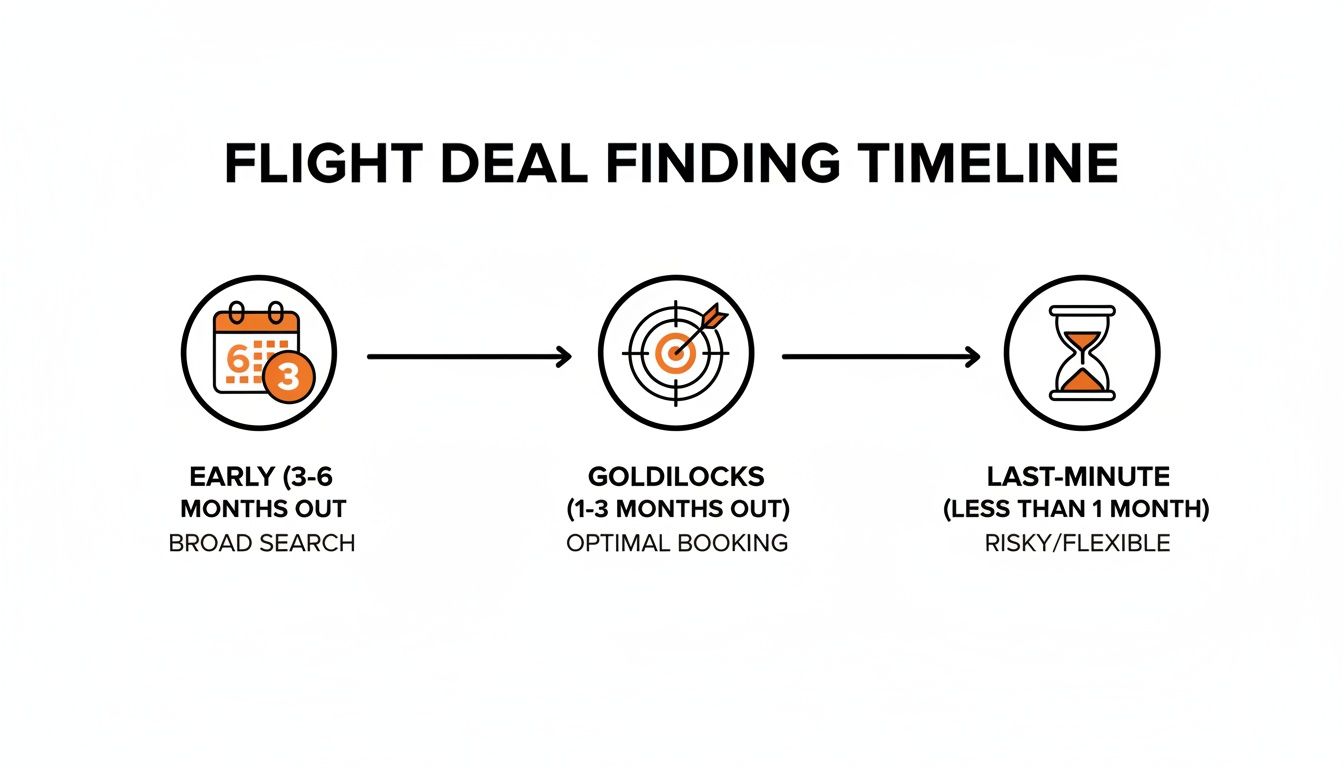
As you can see, that "Goldilocks" phase is where you want to be. It’s not too early, not too late—it’s just right.
Navigating Holiday and Peak Season Travel
So, what about those high-stakes travel times like summer vacation or the winter holidays? These periods play by their own set of rules. When everyone is trying to fly at the same time, the standard booking windows get thrown out.
For peak travel, you absolutely have to book earlier than you normally would.
- Summer Holidays (June-August): Start looking in late winter. You should aim to have your flights booked by late April or early May to lock in the best prices and seat selection.
- Thanksgiving: This one’s a little counterintuitive. The sweet spot often falls between 24 and 59 days out. Whatever you do, don't wait past Halloween.
- Christmas and New Year's: This is the big one. The best deals are typically found between 32 and 73 days in advance. That means you should be buying your tickets from mid-October to mid-November, at the latest.
Holiday travel demands a proactive game plan. By booking within these specific windows, you give yourself the best shot at a reasonable fare before the last-minute panic sends prices through the roof.
Remember, the advance booking window is your most powerful tool. Airlines use dynamic pricing, which means prices are constantly changing based on demand. Book too early, and they haven't started discounting seats yet. Book too late, and you’re competing with everyone else for the last few spots. The key is to find that happy medium.
Mastering Your Booking Day and Time
Once you’ve figured out when you should be looking, the next trick is knowing the best day and time to actually click "buy." For years, we all heard the same travel myth: Tuesday is the golden day for flight deals. While that used to be a decent rule of thumb, the game has completely changed.
The old logic was pretty simple. Airlines would launch their new fares on Monday nights, and by Tuesday morning, competitors would scramble to match them, creating a sweet spot for deals. But today, with lightning-fast pricing algorithms and totally different travel patterns (thanks, 2020), that predictable weekly rhythm is a thing of the past. Holding out for Tuesday isn't just outdated—it could mean you miss a better price that popped up over the weekend.
In a surprising twist, a new champion has emerged in the quest for the cheapest day to book. For domestic flights, Fridays now often have the biggest savings, completely flipping that old Tuesday myth on its head. This is mostly because business travel isn't what it used to be. With corporate travelers often flying home earlier in the week, airlines are getting more aggressive with their pricing to fill those leisure seats leading into the weekend. You can dig deeper into this shift over at NerdWallet's guide on the best days to book your next flight.
This means timing your purchase for the end of the workweek could be your secret weapon for a cheaper getaway.
Aligning Your Booking Day with Savings
Knowing this new dynamic gives you a real strategic advantage. While Friday often takes the top spot for domestic deals, other days still offer plenty of value. The most important thing is to avoid the one day that consistently costs more: Sunday.
Think about it—most people plan their trips over the weekend, so booking activity skyrockets on Sundays. Airlines see this spike in demand and their algorithms react instantly, pushing prices up. Just by shifting your purchase day away from Sunday, you can often dodge those weekend price hikes.
Here’s a quick look at the new hierarchy for booking days:
- Best Days: Friday often leads the pack for domestic flights, with Thursday right behind.
- Good Days: Tuesday and Wednesday are still solid, reliable days to find competitive fares.
- Most Expensive Day: Sunday is almost always the priciest day to book a flight, thanks to that high weekend demand.
It's like this: While everyone else is finalizing their vacation plans on a Sunday afternoon and driving prices up, you can be quietly searching on a Friday, snagging a deal they’ll never even see.
Does the Time of Day Matter?
So, what about the exact time you book? While the day of the week makes a bigger difference, the time can still play a small part. There’s no single magic hour, but some people swear by searching late at night or very early in the morning.
The reason is that airline pricing systems are constantly churning. During these off-peak hours, when fewer people are online, you might just stumble upon a temporary price drop before the system corrects it. It's not a foolproof strategy, but it’s definitely worth a shot if you're a night owl or an early riser.
Set an alarm for 5 a.m. or do one last check before bed—you might be surprised by what you find when the digital skies are a little quieter. In the end, combining the right booking window with the right day is what gives you the ultimate edge.
Capitalizing on the Midweek Travel Advantage
Knowing the best day to book your flight is only one piece of the puzzle. The real magic happens when you pair that with the best days to actually fly. Think of the travel week like a mountain range: the weekends are the sky-high, expensive peaks, while the middle of the week represents the beautiful, affordable valleys. Your goal is to chart your course straight through those valleys.
Flying on a Tuesday, Wednesday, or Thursday almost always unlocks the lowest fares and, frankly, a much more pleasant travel experience. While the rest of the world is wrestling with Friday afternoon and Sunday evening airport crowds, you’ll be breezing through security and finding your seat on a less-packed plane. This isn't just a clever hack; it's a fundamental shift in how you approach travel, one that puts both your wallet and your peace of mind first.

The logic behind this midweek sweet spot is pure supply and demand. Business travelers are usually out the door on Mondays and heading home by Friday, while weekend vacationers create a huge surge from Friday to Sunday. This leaves a quiet lull right in the middle of the week when airlines have empty seats they need to fill—and they’ll drop prices to do it.
The Financial Power of Midweek Flights
We’re not talking about saving a few bucks here. The impact of choosing a midweek flight can be massive. Simply shifting your departure or return by a day or two can easily save you hundreds of dollars, particularly on international routes. For example, recent insights on flight booking data show that flying domestically on a Tuesday can save you around 14% compared to a Sunday flight. For international trips, Thursday often comes out on top with potential savings of up to 15%.
Let's put that into perspective:
- The Weekend Warrior: Flies Friday to Sunday for a quick domestic getaway. Cost: $450.
- The Midweek Maverick: Flies Tuesday to Thursday to the very same spot. Cost: $320.
That's an extra $130 in your pocket. That’s enough for a fantastic meal out, a couple of museum tickets, or another night's stay. This strategy becomes even more powerful when you're visiting one of the world's top cheap places to travel abroad, making your budget stretch that much further.
Think of it this way: every dollar you save on the flight is a dollar you can spend on an authentic experience at your destination. Choosing a Wednesday flight over a Sunday one is a direct investment in your adventure.
The Holiday Exception: The Ultimate Flexibility Play
For those with ultimate flexibility, there’s an even more powerful move: flying on the actual holiday. The days leading up to Christmas or Thanksgiving are some of the most expensive and chaotic travel days of the year. But on the holiday itself? Prices plummet.
Why? Because almost nobody wants to spend Christmas morning or Thanksgiving Day in an airport. If your plans allow for it, you can snag an unbelievable deal. You’ll arrive at a blissfully quiet airport, ready to kick off the celebration while everyone else is still recovering from their travel nightmare. It's the ultimate power move for anyone who values savings and serenity over rigid tradition. From now on, make midweek travel a core part of your planning.
Using Technology to Find the Best Fares
Knowing when to book is a game-changer, but you don’t have to go it alone. The secret weapon in every smart traveler's toolkit? Technology. Forget spending hours manually refreshing airline websites—it’s time to let flight search engines and alert systems do the heavy lifting for you. This is how you stop hoping for a good price and start ensuring you never miss one.
Think of it like fishing. You could sit by the water all day, waiting for a bite. Or, you could set up a few lines with bells that ring the second you get a nibble. Flight alerts are those bells. They notify you the moment a price drops into your sweet spot, giving you the chance to reel in the deal before it swims away. It’s all about working smarter, not harder.
Let's dive into how you can use tools like Google Flights and Skyscanner to automate your search and finally book with total confidence.

Set Up Your Digital Watchdogs
The single most powerful tool at your disposal is the price alert. It takes all the emotion and guesswork out of the equation. Instead of feeling that frantic pressure to book right now, you can simply tell the system what you want and let the deals come to you.
Here’s a simple way to get started:
Pick Your Platform: I’m a huge fan of Google Flights for its clean interface and incredibly useful price history data. Skyscanner is another go-to, especially for its flexibility—the “Everywhere” search feature is brilliant for a spontaneous adventure.
Enter Your Ideal Trip: Be specific. Plug in your departure and arrival cities and your target travel dates. If you can be flexible, play around with the date grid or price graph. You’ll be amazed at how shifting your trip by a day or two can slash the cost.
Activate Price Tracking: Look for a button that says "Track prices" or "Get price alerts." Once you click it, the platform becomes your personal flight detective, sending you an email the moment the fare for your route makes a significant move.
Pro tip: Set up multiple alerts for different dates or nearby airports. This casts a wider net and dramatically increases your chances of snagging a bargain. Your search just went from a stressful chore to an effortless waiting game where you hold all the cards.
Read the Tea Leaves of Price History
Beyond alerts, the real magic lies in price history graphs. This data is your crystal ball, showing you whether today’s price is a true steal or just… average. These charts often include a colored bar that tells you what’s considered a low, typical, or high price for that specific route. If the current fare is sitting comfortably in the green "low" zone, that's a powerful signal to book.
By watching these trends, you'll start to see patterns. Do prices for your dream trip to Rome typically dip six weeks out? Do they spike as the departure date gets closer? This historical context gives you the confidence to know precisely when to pull the trigger.
Many platforms are now even adding AI-powered predictions, analyzing mountains of data to forecast if prices are likely to go up or down. They’ll sometimes give you a straight-up "buy now" or "wait" recommendation. While they aren't foolproof, they add another fantastic layer of insight to your decision.
Essential Flight Booking Tools Comparison
Each tool offers its own unique strengths. Here’s a quick breakdown to help you pick the right one for your next trip.
Ultimately, there's no single "best" tool—the smart move is to use them in combination. Start broad with Skyscanner, then zero in on specific dates with Google Flights, and double-check with Momondo before you book.
By combining automated alerts with historical data, you're no longer just a passenger—you’re an empowered traveler making truly savvy booking decisions. For more strategies on stretching your travel budget, check out our complete guide on how to find cheap flights.
Advanced Strategies for the Savvy Traveler
Okay, so you've nailed the basics of booking windows and know that flying mid-week is the way to go. Now, let's level up. True travel pros know that the absolute best deals aren't found by following the crowd—they're discovered by those willing to think a little differently and embrace the journey. This is where we move from just finding a cheap flight to crafting a smarter, more rewarding travel experience.
Think of it this way: standard booking advice is like following the main highway on a map. These advanced strategies? They’re the scenic backroads and clever shortcuts that lead to incredible discoveries and serious savings.
Embrace the Power of Flexibility
If there's one golden rule in finding cheap flights, it's this: rigid plans are your enemy. The more wiggle room you have, the more money you'll save. It's that simple. One of the most powerful moves you can make is to consider alternate airports. Big, famous hubs are convenient, sure, but that convenience often comes with a hefty price tag.
For example, everyone wants to fly into London Heathrow (LHR). But what if you looked at flights into Gatwick (LGW) or even Stansted (STN)? A quick train or bus ride could easily save you hundreds of dollars on the airfare. This works everywhere. Think Providence (PVD) instead of Boston (BOS), or Long Beach (LGB) instead of Los Angeles (LAX).
Flexibility isn't about compromise; it's about unlocking value. By expanding your search to include nearby airports, you dramatically increase your pool of potential deals, giving you the upper hand against airline pricing.
Another game-changer is learning to love the layover. Instead of seeing a connection as a hassle, reframe it as a mini-trip. Some airlines even offer free or cheap stopover programs, letting you explore a city like Reykjavik or Istanbul for a day or two at no extra flight cost. It’s a brilliant way to see two places for the price of one.
The Art of Indirect Routing and Slow Travel
Sometimes, the straightest line between two points is also the most expensive. Indirect routing—booking a flight with a stop or two—can slash the cost of your ticket, especially on long-haul international journeys. Yes, it adds some travel time, but the savings can be massive.
This mindset dovetails beautifully with the whole philosophy of slow travel. Instead of a frantic rush from one landmark to the next, slow travel is about sinking into a place and really connecting with it. The money you save on an indirect flight could fund an entire extra week abroad, letting you live less like a tourist and more like a local.
Plus, taking a more thoughtful approach to your route has a nice side effect: it's often better for the planet. Opting for fewer direct long-haul flights can help reduce your carbon footprint, making your travels a little more sustainable.
The High-Risk, High-Reward Game
Feeling spontaneous? For travelers who can pack a bag at a moment's notice, the world of last-minute deals and flash sales is a thrilling—and incredibly cheap—way to fly. This isn't for planners, but the payoff can be huge.
Last-Minute Deals: Airlines get desperate to fill empty seats in the final days before takeoff. This is perfect if you’re open to going anywhere. Just be ready to book and go.
Flash Sales: Every so often, airlines drop fares to unbelievably low prices for just a few hours. To catch them, you have to be in the know. Follow your favorite airlines on social media and sign up for their newsletters.
These tactics are the complete opposite of booking in the "Goldilocks window." They're all about spontaneity and quick decisions. But if you can pounce when the opportunity strikes, you could snag a ticket for a fraction of its normal price. And to make every dollar count, pair these booking hacks with the right financial tools. Discovering how the best credit cards for travel rewards can help you turn everyday spending into your next great adventure is a strategy in itself.
Clearing the Air: Your Biggest Flight Booking Questions
Even with the best game plan, booking a flight can feel like trying to hit a moving target. Let's tackle some of the biggest questions and myths that can trip up even seasoned travelers. Getting these right is the final step to booking with total confidence.
Think of this as your pre-flight checklist. Running through these points ensures you’re not leaving money on the table or falling for old travel tales.
Should I Use a VPN to Book Flights?
You’ve probably heard this one: use a VPN (Virtual Private Network) to trick airline websites into thinking you’re in another country, unlocking cheaper local fares. The theory makes sense, and every once in a while, it might work.
But honestly, the golden age of this hack is mostly behind us. Airline pricing is now so incredibly sophisticated that the small wins you might get from a VPN are nothing compared to the massive savings from booking in the right window or flying on a Tuesday. Give it a shot if you’re curious, but don’t expect it to be a silver bullet.
Will Clearing My Cookies or Going Incognito Save Me Money?
This is the myth that just won’t quit. The story goes that airlines use cookies to track your searches and hike up the price every time you return to their site. It feels true, but there’s simply no hard evidence to back it up.
Flight prices are constantly in motion because of complex, real-time dynamic pricing. It’s all about supply and demand, not your browser history.
So, while clearing your cookies won’t do any harm, your time is far better spent setting up price alerts and tweaking your travel dates. That’s where the real power is.
What’s the Deal with Error Fares?
An error fare is the white whale of travel deals—a glitch in the system that spits out an absurdly cheap ticket. Think of a $1,200 flight to Tokyo accidentally listed for $120. They’re incredibly rare, completely unpredictable, and finding one is a matter of pure, dumb luck.
If you ever spot one, here’s what you do:
- Book it. Now. Don’t think, don’t hesitate, don’t even pack your imaginary bags yet. These mistakes are often fixed in minutes.
- Hold off on everything else. Don’t book your hotel or rental car until the airline sends you a confirmed e-ticket. There’s a chance they might cancel the ticket, though thankfully this happens less often these days.
You can't build a travel strategy around error fares, but knowing what to do if you strike gold means you won't miss out. For everything else, stick with the tried-and-true methods that give you control.
At Travel Talk Today, we believe the best journeys are both meaningful and affordable. Our guides are designed to help you explore the world with confidence and purpose. Start planning your next adventure at https://www.packlight-journeys.com.