How to Find Cheap Flights: how to find cheap flights with simple tips
If I could give you just one piece of advice for finding cheaper flights, it would be this: learn to love flexibility. Being able to shift your travel dates by even a day or two, or considering an airport a little further out, isn't just a minor tweak—it's the single most powerful key to unlocking massive savings.
Tools like Google Flights and Skyscanner are built for this kind of thinking. They'll literally show you the cheapest days to fly across an entire month, rewarding your open-mindedness with deals you’d never find otherwise.
The Art of Finding Cheap Flights Starts Here

Picture this: you're stepping off the plane into a city you've always dreamed of, buzzing with excitement and the quiet satisfaction of knowing you got there for a fraction of the typical cost. Finding a great flight deal isn't about luck. It’s a skill, and this guide is your playbook.
I want to take you beyond the generic "clear your cookies" advice. We're going to dive into the proven strategies that seasoned travelers and I use to turn the dreaded booking process into the first thrilling part of the adventure itself. Let's make those dream destinations feel closer than ever.
To kick things off, here’s a quick-reference table summarizing the core strategies we'll be covering. Think of it as your cheat sheet for booking smarter.
Your Quick Guide to Finding Cheap Flights
A summary of core strategies for securing the best flight deals at a glance, giving you a head start.
This table is just the beginning. Now, let’s get into the details that truly make a difference.
Master Your Flight-Finding Toolkit
The first real step is knowing your tools and what they’re good for. Don't just stick to one site; you need a multi-pronged approach to see what’s really out there.
Your Search Engine Command Center: Think of sites like Google Flights, Skyscanner, and Momondo as your starting point. They pull in fares from hundreds of airlines and travel sites, giving you that crucial bird's-eye view of the market. I always start here.
Your Automated Price Scouts: Don't wear yourself out checking prices three times a day. Set up fare alerts for the routes you want. These systems work 24/7, sending you an email or notification the second a deal pops up. It's like having a personal deal-finding assistant.
Your Secret Weapon—Loyalty Programs: Seriously, don’t sleep on this. Signing up for airline loyalty programs costs you nothing but can lead to huge savings down the road. Every flight you take can earn miles that eventually turn into a free ticket. It's a no-brainer.
The goal here is to empower you to travel more, not just spend less. Mastering these tools is the foundation, and we've got even more game-changing budget travel hacks to build on that.
Traveler's Insight: The best deal isn't always the lowest number. A slightly more expensive flight that avoids a 4 AM departure or an overnight layover can be worth its weight in gold.
Strategic Timing Is Everything
Of all the factors, timing is king. I can't stress this enough. Booking on the right day of the week can easily cut your airfare by 20-30%. It’s not an old wives' tale; the data backs it up.
Tuesdays and Wednesdays are almost always the cheapest days to fly, while weekends see prices soar. For domestic flights in the US, for example, you can see fares drop by as much as 15% mid-week compared to a Friday. That's a real saving that adds up, especially for a family. Want to see the trends for yourself? You can discover more insights about airfare trends and get a feel for the rhythm of the market.
Unlocking Deals by Staying Flexible
If there's one secret weapon in the arsenal of a savvy traveler, it’s flexibility. Being locked into rigid travel plans is the quickest way to overpay for flights. The moment you give yourself a little wiggle room—on your dates, your destination, or even your airport—you open up a world of savings you probably didn't know existed.
Think of it this way: airlines set prices using complex algorithms that jack up the cost when demand is high. When you search for a very specific flight, like a Friday departure to Paris in the middle of July, you're competing with everyone else and paying a premium for it. But when you tell a search engine you're open to options, you're essentially giving it permission to hunt for the quiet spots, the low-demand pockets where the incredible deals are hiding.
Let the Deal Choose Your Destination
One of the most powerful and, frankly, fun ways to find cheap flights is using the "Explore" or "Everywhere" feature on sites like Google Flights and Skyscanner. Instead of telling the tool where you want to go, you just tell it where you're flying from and let it show you the cheapest destinations on the planet.
This completely flips the script on how most people plan a trip. It’s less about picking a place and then hunting for a flight, and more about letting an amazing deal inspire your next adventure. This is exactly how those spontaneous, unforgettable trips happen.
Let’s run through a quick example. Say you're based in Chicago and have a free week in October. You're itching for a European escape but aren't tied to one specific city.
Here’s how you'd set it up:
- Origin: Pop in your home airport (e.g., Chicago O'Hare - ORD).
- Destination: Instead of a city, just type "Europe" or even leave it blank to see a world map of deals.
- Dates: Choose flexible timing, like "One week in October."
The search engine will instantly show you a map dotted with prices. You might discover a round-trip ticket to Barcelona is only $450, while that flight to Paris you were first considering is closer to $800. All of a sudden, those Spanish tapas and Gaudí architecture start looking very appealing.
Here’s what that kind of search looks like on Google Flights—a map full of possibilities.
This visual approach lets you compare dozens of potential trips in seconds, without having to run a bunch of separate searches.
Use the Calendar View to Pinpoint the Cheapest Days
Even if you have your heart set on a specific destination, being flexible with your travel dates is still your best friend. Flying on a Tuesday or Wednesday can easily be 20-30% cheaper than the same exact flight on a Friday.
Almost every flight search engine has a calendar or price graph view. Make this your go-to tool. It lays out the fares for an entire month, taking all the guesswork out of finding the cheapest days to fly. It’s a simple click that can literally save you hundreds.
My Two Cents: When you stumble upon a killer fare—especially a mistake fare or a flash sale—don't wait. The best deals can vanish in hours, sometimes even minutes. Book it first. You can always use the 24-hour cancellation rule (for flights to or from the U.S.) to sort out the finer details later.
For a deeper look into the strategy behind when to pull the trigger on a purchase, check out our complete guide on the cheapest time to book flights.
The "Open-Jaw" Trick: A True Game-Changer
Ready for a more advanced move? Meet the open-jaw ticket. This is where you fly into one city and fly home from a completely different one. For instance, flying from New York into Rome, traveling across Italy by train for two weeks, and then flying home from Venice.
This strategy is brilliant for multi-destination trips for two huge reasons:
- It Saves Time and Money: You don't have to waste a day and the cost of a train ticket or another flight just to backtrack to your arrival city.
- It Makes Your Trip Better: Your journey becomes a fluid, one-way adventure. You get to see and do more without constantly looking over your shoulder at a return flight from where you started.
Booking an open-jaw ticket is surprisingly easy. On any major flight search site, just look for the "multi-city" option instead of the standard "round trip." You'll often find the price is about the same as a regular ticket, and sometimes it's even cheaper. For anyone hoping to build a smarter, more efficient itinerary, this is an absolute must-know technique.
Let Technology Do the Heavy Lifting for You
Forget spending hours every day manually searching for flights. That’s a surefire way to get frustrated and, worse, miss out on a great deal. The real secret to consistently snagging low fares is to let technology be your 24/7 deal scout. When you set up a smart system of automated alerts, you can lean back and let the perfect price find its way to you.
Imagine waking up to an email letting you know that flight to Paris just dropped by $200. That’s not luck; it's a strategy. This is how you stop chasing deals and start letting the deals come to you.
Set Up Your Digital Deal Finders
Your first move is to get some fare alerts running on a few key platforms. I use a few different ones because each has its own little quirks and strengths, and combining them gives you the best coverage. Think of it as having a team of experts working for you around the clock, for free.
Here are the essential tools I never plan a trip without:
- Google Flights: This is my workhorse for tracking specific routes. Its tracking is incredibly powerful and reliable. You can set an alert for a precise trip (say, New York to Lisbon from May 10-17) or keep an eye on prices for a general route over several months.
- Kayak: Kayak has a great price alert feature, but its secret weapon is the ability to track fares from your home airport to "anywhere." This is a game-changer when you're flexible and just want to jump on an incredible deal, no matter the destination.
- Hopper: This app brings a bit of forecasting into the mix. Hopper’s AI analyzes massive amounts of historical data to predict whether you should buy now or wait for a likely price drop. It’s like having a crystal ball for airfare.
Setting these up couldn't be easier. After you run a search, just look for a button that says something like “Track prices” or “Create alert.” A few clicks, and you've put some seriously powerful algorithms to work for you.
This simple visual breaks down how a flexible, tech-assisted search works, moving from your dates to your destination and finally your route.
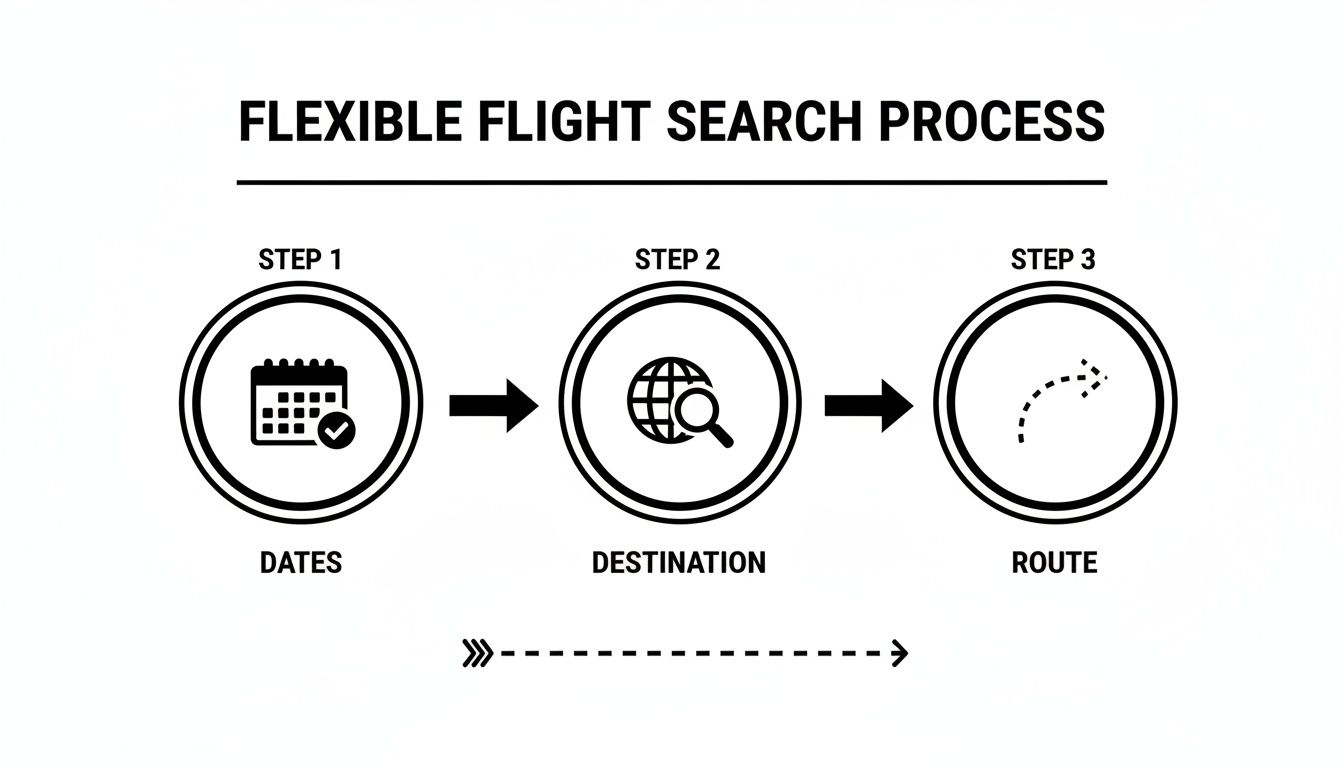
The big takeaway here is that by staying open-minded at each stage, you exponentially increase your odds of finding a jaw-droppingly good deal.
Go Beyond Basic Alerts to Find the Hidden Gems
Just tracking a single route with fixed dates is only scratching the surface. To really master automated deal-finding, you have to think a little more creatively. A fantastic deal might be hiding just a day or an airport away, and the right alerts will help you uncover it.
Try incorporating these pro-level strategies into your alert setup:
- Track Multiple Date Windows: Don't just set an alert for one specific week. If you have some wiggle room, create a few different alerts. For a September trip, I’ll often track the first, second, and third weeks separately to see which one bottoms out.
- Always Include Nearby Airports: Before you hit "create alert," make sure you've ticked the box to include nearby airports. A flight into Oakland (OAK) could easily be $150 cheaper than flying into San Francisco (SFO), and your alert will catch it for you.
- Monitor Specific Airlines: If you're loyal to a particular airline or know a budget carrier flies the route you want, set up an alert just for them. Sometimes the best prices don't show up in the big, broad searches.
By layering these alerts, you create a wide net that’s far more likely to catch an exceptional fare than a single, rigid search ever could.
A Pro Tip: When an alert for a fantastic price hits your inbox—especially a potential mistake fare—you need to act fast. The truly amazing deals can disappear in a matter of hours. Just remember the 24-hour rule: for flights touching the U.S., you can usually cancel for a full refund within 24 hours of booking. This gives you a risk-free window to lock in the price and finalize your plans.
Tap into the Insider Communities
While the big search engines are incredible, some of the most mind-blowing deals are found by communities of dedicated travel hackers. These services specialize in unearthing mistake fares and unadvertised sales that automated systems often miss.
Joining one of these is like unlocking a secret level of the flight-finding game. Two of the best in the business are Going (formerly Scott's Cheap Flights) and Secret Flying. Their teams manually scour the web for deals and blast them out to members—we're talking $350 round-trips to Japan or $400 flights to Italy.
Many of these services have paid premium options, but even their free newsletters are a goldmine. For more ways to build smart savings into your travel plans, check out our other travel tips. Getting on these email lists is one of the easiest things you can do to make sure you never miss another once-in-a-lifetime fare.
Think Beyond the Obvious Airport
Here’s a secret that separates casual travelers from savvy globetrotters: the most convenient airport is almost never the cheapest. If you want to unlock serious savings, you have to get creative with where your journey begins and ends.
Think of your destination not as a single dot on a map, but as a region with multiple doors. A little extra ground travel—which I often find is a fun part of the adventure itself—can easily put hundreds of dollars back into your travel fund.
The Power of the Second-Choice Airport
Big international hubs like San Francisco (SFO) or London Heathrow (LHR) are expensive for a reason: high demand and convenience. Airlines know people will pay a premium to land right in the heart of the action. But just on the outskirts of most major cities, you'll find smaller airports serviced by budget-friendly airlines, and that's where the magic happens.
For instance, I've seen flights into Oakland (OAK) that were $150 cheaper than identical ones landing just across the bay at SFO. In Europe, choosing London Gatwick (LGW) or Stansted (STN) over Heathrow can be the difference between a spontaneous weekend trip and one you have to save up for.
Reframe your mindset. An hour-long train ride from a secondary airport isn't an inconvenience. It’s a hundred dollars (or more) that you just earned back to spend on great food, a cool tour, or a nicer hotel.
This is incredibly easy to put into practice. Whenever you're searching on a site like Google Flights or Skyscanner, just tick the box that says "include nearby airports." That one click does all the heavy lifting for you.
Major Hub vs. Alternative Airport Savings
Let's see what this looks like in the real world. You’ll quickly find that the cost and time of a bus or train ticket are a tiny price to pay for the massive savings on your flight.
The table below breaks down a few popular examples.
As you can see, a little bit of flexibility goes a long, long way. This strategy is an absolute game-changer in places like Europe, where the train and bus networks are so efficient that hopping between cities and their airports is a breeze.
The 'Hacker Fare' Self-Connection Strategy
Alright, ready to level up? Let's talk about the "hacker fare," also known as a self-connection. This is where you book two completely separate one-way tickets to build your own itinerary, often for a fraction of the price. It's my go-to move for long-haul international flights.
Here’s a real-world scenario I've used before: You want to fly from New York to Athens. A standard ticket from a major airline might be running you $1,200. Ouch. But then you spot a killer deal from New York to London for $450. From London, you find a cheap one-way flight to Athens on a European budget airline like Ryanair or EasyJet for just $80.
Your new total? $530. That’s a whopping $670 in savings. You’ve just outsmarted the system by pairing a cheap transatlantic flight with an inexpensive regional one.
How to Self-Connect Without the Stress
This approach can save you a ton of money, but it’s not for the faint of heart. It requires smart planning because if your first flight is delayed and you miss your connection, the second airline has zero obligation to help you. You're on your own.
Here's my personal checklist for pulling this off smoothly:
- Leave a Giant Layover. This is the golden rule. I never book a self-connection with less than a four to five-hour layover. If you're flying through an airport known for delays, give yourself even more time. An overnight layover is the safest option and, hey, it’s a free mini-trip in another city!
- Travel with Carry-On Only. Trust me on this. Having to wait for your luggage, go through immigration, re-check your bag, and go back through security is the number one way to miss your connection. Stick to a carry-on and you can walk straight from one gate to the next.
- Check Your Visa Needs. If you're connecting in a different country (like the UK in our Athens example), double-check that you don't need a transit visa just to pass through.
- Confirm the Airport! This is a rookie mistake. Make absolutely sure your second flight leaves from the exact same airport you flew into. Cities like London, Bangkok, and New York have multiple airports, and a cross-city dash will destroy your layover and your budget.
Make Your Points Work for You & Find Those Hidden Gems
Imagine your weekly grocery run or that morning coffee habit paying for your next flight to Paris. It sounds like a travel fantasy, but it’s absolutely possible. This is the real power of travel loyalty programs. While the whole world of points and miles can feel a bit overwhelming at first, the core idea is beautifully simple: your everyday spending can be your ticket to seriously cheap travel.
Think of loyalty points as a separate travel currency. When you make a habit of collecting them, you’re essentially building a travel fund that can cover most, or sometimes all, of a flight's cost. Getting started is way easier than you think, and it shifts your mindset from a one-time hunt for a cheap flight to a sustainable, long-term strategy.
Turn Your Wallet into a Travel Engine
By far, the fastest way to rack up a ton of points is with a good travel rewards credit card. These cards are specifically designed to give you miles or points for every dollar you spend. Plus, they often come with massive sign-up bonuses that can be worth an entire round-trip international flight right off the bat.
Choosing the right card is what really matters, though. Don't just jump on the first offer you see. Your goal is to match the card to your actual travel habits.
- Airline-Specific Cards: If you’re loyal to a particular airline, like United or Delta, their co-branded cards are a no-brainer. They usually throw in awesome perks like free checked bags and priority boarding, which adds a ton of value beyond just the points.
- Flexible Rewards Cards: This is where the real magic happens. Cards that earn transferable points (think American Express Membership Rewards or Chase Ultimate Rewards) give you incredible freedom. You aren't tied to one airline. Instead, you can transfer your points to dozens of different airline partners, letting you shop around and book the absolute best deal you can find.
Once you have the card, the plan is simple: put your regular expenses on it—gas, groceries, bills—and always, always pay the balance in full each month. You’ll be earning points on stuff you were going to buy anyway, essentially funding your next trip for free. For a deep dive into the best options, you might want to check out our guide on the best credit cards for travel rewards.
The Thrill of the Hunt: Finding Mistake Fares
Now, let's talk about one of the most exciting secrets in the world of cheap travel: the elusive mistake fare. These are the travel world’s white whales—glitches caused by human error or a currency conversion hiccup that result in unbelievably low prices. I'm talking about deals like a $250 round-trip flight from New York to Rome or a $400 ticket to Southeast Asia.
These aren't sales; they're genuine mistakes, and they don't stick around. When a mistake fare pops up, it can vanish within hours, sometimes even minutes, once the airline figures it out. The key is knowing where to look and being ready to pounce.
The Golden Rule of Mistake Fares: Book first, ask questions later. Seriously. Don't waste time checking your schedule or calling a friend. Grab the ticket immediately. For flights touching the US, you can almost always use the 24-hour cancellation rule to get a full refund if you find out it won't work.
So, where do you find these hidden gems?
- Specialty Deal Sites: Websites like Secret Flying and the premium service Going (formerly Scott's Cheap Flights) have teams that do nothing but hunt for these glitches. Following them on social media or signing up for their newsletters is your best shot at getting real-time alerts.
- Travel Forums: Passionate travelers love to share their finds. Communities on Reddit (like the r/flights subreddit) or the FlyerTalk forums are often the very first places these deals get posted.
A Quick Word on Booking Mistake Fares
There’s a bit of unspoken etiquette here that helps everyone out. First and foremost, never, ever call the airline to confirm the price. That's like setting off a flare gun—you're just alerting them to the error, and they'll kill the deal for everyone.
Second, be mentally prepared for the slim chance of cancellation. While most airlines honor these fares to maintain goodwill, they aren't technically obligated to. It's smart to hold off on booking non-refundable hotels or tours until you have the final e-ticket confirmation in your inbox, which can sometimes take a day or two.
The rush of snagging a flight for 80% off is well worth the tiny risk and the need for a little patience. It's the ultimate win in the game of finding cheap flights.
Your Smart Pre-Booking Checklist

You’ve done the hard work—navigating calendars, exploring alternate airports, and finally finding a flight deal that feels like hitting the jackpot. Before you race to click that "confirm" button, just pause and take a breath. This final pre-booking check is what separates a smooth, affordable trip from one filled with unexpected costs and headaches.
It’s so tempting to book through the first site that shows you a low price, but where you book really matters. If a third-party site—often called an Online Travel Agency (OTA)—offers a price that seems too good to be true, it just might be.
Always, and I mean always, cross-reference that fare directly on the airline’s own website. If the prices are close, booking directly with the airline is almost always the smarter, safer choice. This gives you a direct line for support if there are cancellations or changes, and you get to skip playing telephone with a frustrating middleman.
Decoding the Budget Airline Bargain
Let's talk about those super-cheap flights you see from airlines like Spirit, Ryanair, or Frontier. Their headline prices can be jaw-droppingly low, but their entire business model is built on ancillary fees. These are the little add-ons that can quickly double your total cost if you aren't paying close attention.
Before locking anything in, your final check should be a thorough read of the fare rules. Keep a sharp eye out for these common "gotchas":
- Baggage Allowances: Is a carry-on bag actually included, or just a small personal item that has to fit under the seat? Checked bag fees can easily be $50–$70 each way, and they cost even more if you wait to pay at the airport.
- Seat Selection Fees: Need to sit with your family or friends? Budget fares often assign seats randomly at check-in. Paying to choose your own can add $10–$50 per person, per flight.
- Change and Cancellation Policies: These fares are notoriously inflexible. A simple name correction or date adjustment could end up costing more than the original ticket itself.
Before you commit, add up the real cost. That amazing $98 flight might suddenly become $250 after you add a carry-on and a checked bag. Understanding the total price is crucial for making smart choices about your travel budget, which is a key part of any trip's success.
This final check ensures your cheap flight is a genuinely great deal. Think of it as the last hurdle before you can celebrate locking in an incredible adventure without any nasty hidden surprises.
Now, you can book with total confidence, knowing you’ve made a truly savvy travel decision.
Your Top Questions About Finding Cheap Flights, Answered
When you're on the hunt for a great flight deal, a few key questions always seem to pop up. Let's tackle them head-on, so you can book smarter and keep more money in your pocket for the actual trip.
What's the Real "Sweet Spot" for Booking Flights?
This is the million-dollar question, isn't it? For flights within the country, you'll generally find the best prices 1 to 3 months before you plan to fly.
Heading overseas? Give yourself a bit more of a runway. Start looking seriously 2 to 8 months out. Jump the gun and book too early, and you might miss out on future sales. Wait too long, and you'll be competing with last-minute travelers when prices are at their peak.
Is a Round-Trip Ticket Always the Cheaper Option?
It used to be a no-brainer that round-trip was the way to go, but the game has changed. You absolutely have to price it out both ways now.
I've often found that booking two separate one-way tickets, sometimes on completely different airlines, can lead to incredible savings. This little trick, often called a "hacker fare," works especially well for international trips where you can pair a major airline for the long-haul flight with a local budget carrier for the final leg.
At Travel Talk Today, we believe amazing adventures shouldn't break the bank. We’re here to give you the practical advice and inspiration to see the world.