You're probably here because your phone has started to feel limiting.
It does fine for quick clips at the airport gate, a sunset from a rooftop bar, or that first wide shot when you step into a new city. Then the harder scenes show up. A night market glows with mixed light and your footage turns muddy. A walking vlog through narrow streets shakes just enough to feel amateur. You try to talk to camera on a windy ferry and realize the sound matters as much as the image.
That's usually the moment travelers start looking for the best video cameras for travel. Not because they suddenly want to become gear nerds, but because they want their footage to feel closer to what the trip felt like.
The right camera doesn't just make cleaner video. It changes what you're willing to film. You pull it out faster. You trust it in motion. You carry it all day without resenting it. And if you want to sharpen your eye as much as your kit, these travel photography techniques help just as much as any upgrade.
Your Next Adventure Deserves More Than a Phone
A lot of travel footage fails for a simple reason. The camera that was easiest to bring wasn't the camera that best matched the way the trip unfolded.
A phone is always with you, which is why it captures so much. But travel asks more from a camera than everyday life does. It asks for quick startup in the rain, usable handheld footage while walking, decent audio in noisy places, and enough battery confidence that you don't stop shooting halfway through the day because you're trying to preserve charge for maps and boarding passes.
That's why the search for the best video cameras for travel shouldn't start with specs. It should start with your travel style.
Start with the trip, not the camera
A solo backpacker moving through hostels has different needs than a couple documenting a road trip. A creator shooting short-form vertical clips needs a different workflow than someone building longer cinematic edits from a week in the mountains. A city traveler who films food, architecture, and walk-and-talk updates has almost nothing in common with someone who needs a rugged camera for boats, dust, and rough weather.
The best choice is the one that gets out of your way.
For some travelers, that means a tiny camera you can run one-handed while carrying a coffee and boarding pass. For others, it means an interchangeable-lens body that gives more control over look, audio, and low light. What doesn't work is buying a camera that looks impressive on paper but stays in the room because it's too heavy, too obvious, or too fiddly to use.
A travel camera earns its place in your bag every day. If it slows you down, you'll stop using it.
That's the lens for everything that follows. Not “Which camera is best?” but “Which camera helps you tell the story of this trip without turning the trip into a production?”
What Truly Matters in a Travel Video Camera
The camera market is crowded, but most buying mistakes come from ignoring a few practical questions. Before looking at brands or model names, judge any camera against the way you travel.

The eight things that matter most
- Size and weight matter more on day four than on day one. A camera can seem compact in a store and still feel annoying after a full day of trains, stairs, and walking tours.
- Stabilization decides whether your footage looks calm or distracting when you're moving.
- Battery life matters most when you can't top up easily between scenes.
- Low-light performance becomes obvious the moment the sun goes down and the best scenes begin.
- Audio quality separates memorable footage from clips you never use.
- Lens options affect flexibility, but they also affect bulk, cost, and how often you switch gear in risky places.
- Durability and security matter when your bag gets tossed around, your route changes fast, or you're filming in crowds.
- Cost isn't just the body price. It's the total system, including accessories, media, spare batteries, and peace of mind.
Stabilization is the most misunderstood feature
Many buyers get tripped up when comparing cameras by sensor size or resolution, only to discover later that their real problem was motion.
Many travel creators rely on gimbal-free handheld shooting, but most roundups don't test for real-world motion. Travelers increasingly want a single-device walk-and-talk solution for scenarios like walking tours, crowded streets, or solo filming where one-handed operation and instant setup matter most, which is an underserved angle in typical reviews, as discussed in this real-world take on travel shooting scenarios.
Practical rule: If you plan to narrate while walking, prioritize stabilization and one-handed usability before chasing the largest sensor.
Cobblestones, ferry decks, tuk-tuks, staircases, and uneven trails expose weak stabilization immediately. A camera can produce lovely static footage and still frustrate you in motion. That's why travel shooters often love devices built specifically around handheld movement, even if another camera wins on pure image quality.
Audio is part of the picture
Travelers obsess over sharpness and forget that viewers will forgive a slightly less cinematic image before they forgive bad sound.
If you record street food scenes, quick interviews, room tours, or direct-to-camera updates, you need a simple audio path. That might mean a reliable built-in mic for convenience, or a body with an easy mic input if you want cleaner voice capture. What doesn't work is buying a camera that forces a clumsy external setup every time you want decent sound.
Durability and security aren't boring details
A travel camera isn't living on a desk. It's going in and out of bags, riding buses, getting exposed to dust, and drawing attention in unfamiliar places.
Think about three questions:
- Can you pack it quickly? Slow packing gets gear damaged.
- Can you carry it discreetly? A larger setup changes how visible you are.
- Can you trust it in changing weather? That matters more than many buyers admit.
A compact system often wins not because it's “better” in a lab, but because it's easier to live with. And when a camera is easier to live with, you capture more useful footage. This kind of practical trip planning mindset matters for gear decisions too, not just flights and routes, which is why a solid travel planning checklist helps before you buy anything.
Cost means more than the sticker
It's easy to stretch for a more advanced body. The harder question is whether you want to build a full system around it.
A body with interchangeable lenses can open creative options, but it also invites more spending, more weight, and more decision fatigue. A fixed-lens or pocket device can be limiting in some scenes, but it can also be liberating on the road. The best travel camera is often the one that leaves enough room in your budget for the rest of the trip.
The Modern Travel Camera Types Explained
You are standing on a train platform at blue hour, backpack on, one hand on your luggage, the other trying to start recording before the doors close. That moment usually decides what kind of travel camera fits your trip. The right category is the one you can use fast, carry all day, and trust when the scene appears without warning.
Pocket gimbal cameras
Pocket gimbal cameras are built for motion and speed. They make the most sense for solo travelers who film themselves, shoot walk-and-talk clips, or need stable footage with one hand while managing a bag, ticket, or coffee in the other.
That is why they have become such a strong fit for travel. A device like the Osmo Pocket 3 solves a real problem. It gives you smooth footage and quick setup in a form that does not ask for a cage, a separate gimbal, or much thought before you hit record.
The limits are real too. You are committing to a fixed-lens tool with less room to adapt your look later. If your style depends on lens choice, stronger low-light performance, or a more cinematic image, you may outgrow this category faster than you expect. But for vertical video, fast clips for social, and low-friction daily shooting, pocket gimbals are hard to beat.
Action cameras
Action cameras belong on trips where the camera will get knocked around. Rain, surf, scooters, hiking poles, chest mounts, helmets, dust. They handle abuse better than almost any other option, and that changes what you are willing to film.
Their weakness shows up in quieter scenes.
Wide views and heavy processing can make every location feel a bit similar, especially if you are filming food, interviews, markets, or slower story moments. For many travelers, an action camera works best as a specialist camera or a second camera. It can be the main camera if the trip is built around movement first and image character second.
Compact mirrorless cameras
Compact mirrorless cameras are often the best middle ground. They suit travelers who care about image quality, want better audio options, and like the idea of growing their kit over time without jumping straight into a large professional setup.
This category gives you choices, which is both the benefit and the trap. A small body with a compact lens can still feel travel-friendly. Add a fast zoom, extra batteries, a mic, and a charger, and the kit changes quickly. I recommend this category to travelers who know they will use the extra control, not just admire it in the hotel room.
They are also the strongest fit for hybrid creators who need horizontal footage, vertical cutdowns, and good stills from the same camera.
Full-frame systems
Full-frame systems are for travelers who already know why they need one. They offer the most headroom for low light, lens selection, background separation, and demanding video work, but they ask for more from you every day you carry them.
That trade-off matters on the road. A larger body and larger lenses take more bag space, attract more attention, and slow down casual shooting. Security becomes part of the buying decision, not an afterthought. Full-frame can be worth it for commercial jobs, high-end travel films, or creators who prioritize image quality above pack weight. It is often too much camera for a flexible, everyday travel setup.
The simplest way to choose a category
Start with how you travel, not the brand name on the camera.
| Camera type | Best fit | Main strength | Main compromise |
|---|---|---|---|
| Pocket gimbal | Solo travel, walk-and-talk, quick vertical clips | Stable one-handed shooting | Fixed lens and less room to grow |
| Action camera | Adventure travel, water, rough conditions | Tough build and easy mounting | Less natural look for everyday scenes |
| Compact mirrorless | Hybrid creators and serious hobbyists | Strong balance of quality, size, and control | Kit can get bulky once lenses and audio are added |
| Full-frame system | Advanced filmmakers and paid work | Highest image quality ceiling | More weight, cost, and visibility |
If you are still deciding, base the choice on your shooting rhythm. A solo traveler posting frequent reels has different needs than a couple filming a polished trip recap, and both need different tools than someone crossing borders weekly with only a small daypack. The same practical mindset you use for routing, booking, and on-the-road workflow applies here too, which is why many creators also organize their trip around best travel apps for planning and daily travel logistics.
Top Picks by Traveler Profile and Budget
A camera choice gets real at 6 a.m. in a bus terminal, on a wet boat deck, or during a fast street scene when you have one free hand and ten seconds to hit record. The right pick is the one you will carry, trust, and use without slowing down the trip.
2026 Travel Video Camera Recommendations at a Glance
| Model | Best For | Sensor Size | Stabilization | Weight | Price Guide |
|---|---|---|---|---|---|
| DJI Osmo Pocket 3 | Solo travelers and walk-and-talk video | 1-inch | Built-in gimbal stabilization | Pocketable | Mid-range |
| Sony a6700 | Most travelers wanting one strong all-rounder | APS-C | In-body stabilization | Compact mirrorless | Roughly $1,000 to $1,500 |
| Panasonic LUMIX S5 II | Video-first travelers who prioritize capability | Full-frame | In-body stabilization | Larger full-frame system | Premium |
| Sony A7C II | Travelers wanting strong full-frame video in a smaller style body | Full-frame | In-body stabilization | Compact for full-frame | Premium |
| Canon EOS R50 V | Budget-minded creators making social and travel video | APS-C | Camera-based video stabilization options | Compact mirrorless | Budget-friendly |
| Canon EOS R5 II | High-end travel filmmakers | Full-frame | In-body stabilization | Pro body | $3,000+ |
The backpacker and solo traveler
DJI Osmo Pocket 3 makes the most sense for travelers who shoot alone, film themselves often, and care more about getting the shot than building a kit. One-handed operation matters on travel days. So does fast startup. So does footage that already looks stable when you are walking through stations, old towns, food markets, and uneven streets.
It also fits a real travel habit. Pocketable gear gets used. Larger gear often stays in the bag until the “important” part of the day, and that usually means you miss the candid moments that make a trip film feel lived-in.
If you want more control and room to grow, choose the Sony a6700. It is the safer long-term buy for travelers who want interchangeable lenses, better subject separation, and stronger hybrid performance for both photos and video. The cost is obvious once you travel with it for a week. Extra lenses, batteries, a mic, and a small tripod turn a compact body into a real kit.
For anyone traveling with a small pack, especially on longer routes, honest packing matters as much as camera choice. These backpacking tips for beginners that help you keep weight and visibility under control apply to camera gear too.
The aspiring filmmaker
Choose the Panasonic LUMIX S5 II if the trip is built around filming, not just documenting. It gives serious video creators the tools to shape footage in post, work with better lenses, and push image quality further than smaller, simpler cameras usually allow.
The trade-off is not subtle. Full-frame kits ask more from your shoulders, your bag, your battery pouch, and your attention. They also attract more notice in crowded places, which matters if you prefer to stay discreet on the road.
That is why the Sony a6700 remains the better recommendation for many travelers, even when the bigger camera can produce a richer result. In practice, a lighter APS-C setup often wins because it keeps the camera in your hand longer and cuts down the friction between seeing a scene and filming it.
The Sony A7C II sits in the middle. It gives full-frame image quality in a smaller body, which is appealing for travelers who want better low-light performance without jumping to a bulkier pro-style body. It still becomes a larger system once you choose lenses, so the body size only solves part of the problem.
The social media creator
Short-form travel creators need a camera that fits the posting rhythm. Vertical clips, quick self-framing, fast file transfer, and reliable stabilization matter more here than chasing the most cinematic spec sheet.
The Canon EOS R50 V is a smart budget pick for that kind of work. It suits creators who are building skill, want better quality than a phone, and need a body that feels video-first without pushing them into premium pricing. It is a practical choice for reels, shorts, simple travel vlogs, and lightweight editing workflows.
The DJI Osmo Pocket 3 is still hard to beat if speed is the priority. It works especially well for solo travelers shooting cafes, transit clips, room tours, quick food coverage, and to-camera updates throughout the day. Vertical workflow is simpler when the camera is already built around fast, casual capture instead of a larger interchangeable-lens setup.
Posting consistently is its own production challenge. The best tool for that job is often the one that removes setup time, keeps the footage stable, and makes self-shooting less awkward.
Quick buying advice by profile
- Choose the Osmo Pocket 3 if your priority is one-handed filming, smooth walking footage, and low-effort solo shooting.
- Choose the Sony a6700 if you want the strongest balance of size, quality, lens choice, and long-term flexibility.
- Choose the Panasonic LUMIX S5 II if filmmaking is the main purpose of the trip and you accept a larger, more visible kit.
- Choose the Sony A7C II if you want compact full-frame performance and can keep the lens setup disciplined.
- Choose the Canon EOS R50 V if you make social-first travel content on a tighter budget and want a straightforward step up from a phone.
Buy for your travel style, not your idealized future setup. The best travel camera is the one that matches how you move, how often you shoot, and how much kit you are willing to protect every day.
Beyond the Specs Advanced Video Features Demystified
You feel the difference in advanced video features long before you can define them. It shows up when a sunset keeps its color in the grade, when market lights do not break apart into ugly bands, or when a walking shot still looks clean after you crop it for vertical.

Advanced features matter most once your trip involves a clear shooting plan. If you post same-day clips from your phone and want the lightest possible workflow, many of these tools will sit unused. If you cut proper travel films, mix horizontal and vertical edits, or shoot solo in changing light, a few of them can save a shot.
4K at higher frame rates
Higher frame rates help with motion. Fast street scenes, boats, trains, surf, and handheld walking shots often look better when you can slow them down in editing.
There is a cost. Many cameras crop the image, reduce autofocus performance, or lose low-light quality at their highest frame rates. Some also generate bigger files than many travelers want to manage on the road. Buy this feature if you know you will use slow motion often, not because 60fps or 120fps sounds more professional on a spec sheet.
For solo creators, higher frame rates also give more flexibility for reframing. A quick clip shot for YouTube can become a cleaner vertical cut for Reels or Shorts without feeling quite as rushed.
Log profiles and 10-bit color
These features matter in post, not in the moment you hit record.
Log gives you more room to shape contrast and color later. Ten-bit color holds together better when you push skies, sunsets, neon, skin tones, or mixed indoor lighting. If you edit travel footage from bright afternoons into shadowy restaurants on the same timeline, that extra grading room is useful.
The trade-off is time. Log footage usually needs color work before it looks finished, and 10-bit files can be heavier on older laptops. Travelers with a simple kit and a fast turnaround may be better off with a standard profile that looks good straight out of camera.
Oversampled video and detail
Oversampled 4K starts with a higher-resolution readout, then scales it down to 4K. The result is often cleaner fine detail, fewer jagged edges, and a more polished image in architecture, natural settings, and textured street scenes.
It is a nice feature, not a magic fix. Good light, stable handling, and strong composition still matter more. But if you care about footage that can survive cropping for vertical delivery or small reframes in editing, cleaner source video gives you more options.
That matters on travel days when you only get one chance at the shot.
The advanced features most travelers should care about
Use a simple filter before paying more.
| Feature | Matters most if you... | Less important if you... |
|---|---|---|
| Higher frame rates | Shoot movement-heavy scenes and use slow motion in edits | Mostly film talking clips or quick documentary coverage |
| Log and 10-bit | Color grade seriously or shoot difficult light often | Want footage that looks finished with minimal editing |
| Oversampled 4K | Reframe, crop, or mix horizontal and vertical delivery | Post mainly to social and rarely inspect fine detail |
| Pro video tools | Build polished travel films and accept a slower workflow | Prioritize speed, battery life, and low-effort shooting |
A good travel camera does not need every advanced tool. It needs the right ones for your workflow, your bag, and your patience at the end of a long day.
If your trip is built around mobility, keep those trade-offs in mind alongside the rest of your backpacking essentials checklist. The camera should serve the trip, not run it.
Essential Packing and Safety Tips for Your Gear
Buying the camera is the easy part. Bringing it home safely with usable footage is what separates a smooth trip from a painful lesson.
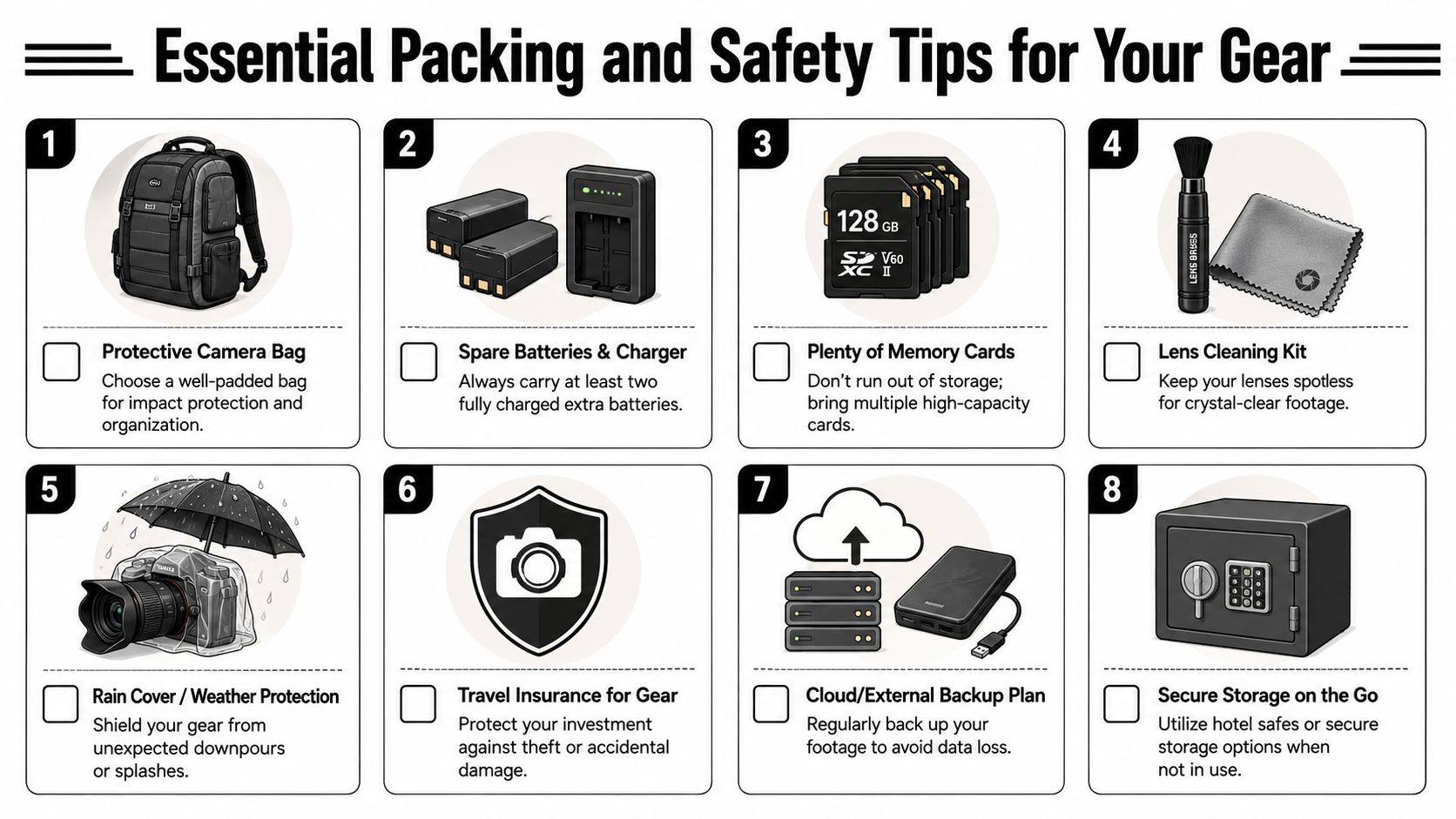
Pack for speed, not just protection
A beautiful padded insert doesn't help if it takes too long to access your camera. Good travel packing lets you grab the camera quickly, stow it quickly, and avoid setting it down in bad places.
Use a bag that protects gear but doesn't scream “expensive camera inside.” In crowded cities, understated bags are often safer than camera-branded ones. The less attention your setup draws, the better.
Build a simple field routine
Most gear problems come from inconsistency. Create a repeatable habit every day.
- Check batteries early before leaving your room, not when the light gets good.
- Rotate memory cards carefully so exposed footage isn't all on one card forever.
- Clean the lens often because travel dust, fingerprints, and sea spray ruin more clips than people think.
- Back up footage regularly whenever your trip allows it.
Think about theft, weather, and backups as one system
Security isn't one trick. It's a chain of small habits.
Keep your camera put away when it doesn't need to be visible. Don't leave gear loose in hostel dorms. In transit, separate your most important footage from the main camera bag whenever possible. If the bag disappears, you still want your trip.
A camera can be replaced. The footage usually can't.
Weather matters too. Even if your body isn't built for rough conditions, a simple protective routine helps. Wipe down gear after damp days. Don't swap lenses in blowing dust. Let cold gear adjust before exposing it to warm humid air.
A strong gear checklist makes this much easier, especially for longer trips where one missing item compounds over time. This backpacking essentials checklist is a useful companion when you're building a travel kit that has to stay light and dependable.
Conclusion Your Story Is Waiting to Be Told
You land in a new city before sunrise, shoot one-handed on the walk from the station, grab a few vertical clips for social, then switch to a wider scene as the street wakes up. That kind of travel day decides what the right camera is more than any spec sheet does.
The best travel video camera is the one that fits your pace, your budget, and the way you work on the road. For some travelers, that means a small camera they can keep in hand all day without drawing attention. For others, it means paying more for better low-light footage, stronger autofocus, or lenses that give their trip a more cinematic look. Good options exist across a wide price range, as noted earlier. The core question is simpler. Will you carry it, trust it, and use it often enough to come home with a story instead of a bag full of gear?
That decision-first approach matters. A solo traveler filming one-handed has different needs than a couple shooting destination films together. Someone publishing vertical video every day needs a faster workflow than someone cutting one polished recap after the trip. And if security is a constant concern, a smaller, less conspicuous setup often beats a larger system, even if the bigger camera wins on pure image quality.
A few practical starting points
Keep these in mind when the scene changes faster than you can dig through menus.
Bright beach day
Use a standard frame rate and keep ISO low. Watch reflective highlights on water and sand, because they blow out fast.Low-light street food scene
Open the lens up, stay steady, and place your subject near usable light. If autofocus starts to hunt, simplify the shot and let the action come to you.Walk-and-talk vlog
Use stabilization that still looks natural. Keep your framing consistent, and check audio before you start walking into wind, traffic, or crowds.Sunrise
Slow the whole process down. Lock the frame, protect the sky first, and decide how much shadow detail you want instead of chasing a perfectly bright image.
One rule holds up across every budget and travel style.
Choose the camera that keeps you present enough to notice what matters.
The musician in the underpass. The cook working over steam at first light. The quiet moment on a ferry deck before anyone else is awake. Those are the clips people remember. The camera only matters because it helps you catch them with less friction and more intention.
If you want more grounded travel advice that balances creativity, budget, and practical decision-making, Travel Talk Today is worth bookmarking. It's built for travelers who want memorable trips, smarter planning, and gear choices that support the journey instead of weighing it down.