The cheapest time to book hotels globally is typically 8 to 14 days before arrival, when travelers saved an average of 23% compared with booking four or more months ahead. January is the cheapest month to stay, and Sunday check-ins can reduce the rate further.
That answer sounds simple, but hotel pricing doesn't follow one universal calendar. A domestic city break, a European summer holiday, a resort stay, and a cross-border backpacking route each have different demand patterns. The most reliable strategy combines booking lead time, check-in day, seasonality, destination type, and flexibility rather than relying on a single “book early” rule.
A major Tripadvisor hotel-booking analysis illustrates why market context matters. For U.S. summer hotels, the cheapest booking period was within two months of travel, but the saving at the lowest point was only 7%. In Europe, booking summer accommodation 3 to 5 months ahead produced savings of 22% versus the most expensive booking period. The same question therefore has different answers on opposite sides of the Atlantic.
The Core Timing Window Most Travelers Miss
The 2026 Hotels.com Hotel Price Index identifies 8 to 14 days before arrival as its strongest booking window, with travelers saving an average of 23% compared with booking four or more months ahead, according to the Hotels.com Hotel Price Index release. The same dataset ranked January as the cheapest month for hotel stays and found that Sunday check-ins provided a further 15% saving compared with Friday starts.
Those figures describe a benchmark, not a universal deadline. They are most useful when combined with destination type, trip purpose, and stay length. A flexible domestic city break may benefit from monitoring late availability, while a resort stay or multi-night trip may require earlier booking to protect room choice and location.
Read the window as a pricing signal
Hotels adjust rates as forecasts change. If rooms remain unsold, managers may lower prices to improve occupancy. If demand accelerates, they can raise rates or remove cheaper room categories. The late-booking window therefore works best in markets with ample inventory and travelers willing to accept another hotel, neighborhood, or room type.
| Lead Time | Average Nightly Rate Index | Savings vs. 120+ Days |
|---|---|---|
| 120+ days | 100 | Baseline |
| 8–14 days | 77 | 23% average saving |
| January stay | Not stated | Cheapest month in the index |
The table reflects the available Hotels.com comparison, not a universal rate card. Destination, property, room type, cancellation terms, check-in day, and seasonal demand can all change the result. A short stay also gives a traveler more flexibility to switch properties than a longer itinerary with several linked nights.
A useful comparison is the cheapest time to book flights. Hotel rooms can sometimes be discounted close to arrival when they remain unsold, whereas an airline seat loses its value once the flight departs. Flexible hotel shoppers therefore have more reason to monitor rates rather than automatically paying far ahead.
Practical rule: Start watching early, then treat the final two weeks as an active pricing window. Use it most confidently for flexible trips, and weigh the risk of limited choice for peak dates, special events, and longer stays.
The timing decision depends on whether the destination has spare inventory. Where it does not, a late discount can disappear before arrival.
Why Last-Minute Bookings Often Beat Early Planning
A vacant room loses its selling opportunity once the night passes. Hotels therefore adjust prices as arrival approaches, particularly when available rooms outnumber expected demand. This makes late booking a pricing strategy, not merely a gamble.
Revenue managers track booking pace, local demand, competitor rates, and occupancy forecasts. Weak signals may prompt lower rates or promotions, while faster-than-expected bookings can remove those offers. Hotel pricing is therefore responsive to demand, not governed by a fixed calendar.
The advantage of waiting
Early reservations buy certainty, room choice, and often better cancellation terms. They can also include a premium because the hotel has limited evidence about how quickly inventory will sell. As the stay nears, the property can hold its rate, raise it, or reduce it based on actual booking activity.
The 8 to 14-day pattern fits this supply-and-demand logic. When comparable rooms remain unsold, hotels have more reason to attract short-lead shoppers. Travelers who can compare several properties may benefit from that repricing window.
The trade-off is choice. A low late rate may be nonrefundable, exclude the preferred room type, or apply only to a less convenient neighborhood. Flexibility is the condition that makes waiting workable. Without it, a cheaper rate can create costs through a longer commute, an unsuitable room, or stricter terms.
A guide to last-minute travel deals can help travelers monitor opportunities, but hotel timing still depends on the destination's available supply and demand.
When waiting becomes risky
Late booking becomes less attractive when demand is concentrated or inventory is thin. Event weeks, holidays, single-property destinations, and resort markets can sell their lower-priced rooms well before arrival. Someone tied to one hotel has far less flexibility than a traveler choosing among several properties.
Use three questions before delaying:
- Inventory: Can you switch neighborhoods or properties if the price stays high?
- Dates: Can you move the stay by a night or change the check-in day?
- Room needs: Do you require a specific bed type, view, accessibility feature, or cancellation policy?
If most answers are no, book once the rate fits the budget. If most answers are yes, monitor prices and set a point at which the remaining flexibility is no longer worth the risk.
The strongest approach combines both timelines. Research hotels early, identify acceptable alternatives, and watch rates near arrival only when the trip can absorb a change. Last-minute booking works best as a controlled option for flexible, shorter stays, not as a universal rule for every market or itinerary.
Regional Booking Windows That Break the Global Rule
A single booking window obscures the variable that most affects hotel prices: where the room is located. The Tripadvisor analysis of hotel timing found a modest summer timing advantage in the U.S., but a much larger benefit from booking European hotels earlier. Travelers should therefore treat domestic and international stays as separate timing problems.
A market-by-market view
For many U.S. urban and mid-sized markets, 8 to 14 days is a practical starting range. Sunday check-ins also performed strongly in the Hotels.com dataset, while Friday starts were the most expensive U.S. option in that release. This pattern fits trips with flexible hotel choice, especially short city stays.
European summer bookings require more lead time. The Tripadvisor analysis identified 3 to 5 months ahead as the strongest window for European hotels, with a 22% saving compared with the priciest period. A popular summer route should not rely on a final-fortnight strategy because that approach can work in some U.S. cities.
International markets vary further by destination and itinerary. The KAYAK analysis of hotel-booking timing distinguishes domestic from international check-in patterns. Its comparison identifies Sunday as the cheapest U.S. check-in day and Tuesday as the cheapest international check-in day.
| Region or Market | Optimal Lead Time | Best Check-In Day | Notes |
|---|---|---|---|
| U.S. city stays | 8–14 days as a starting point | Sunday | Flexible urban inventory can support late monitoring |
| European summer hotels | 3–5 months | Varies by destination | Early planning mattered more in the Tripadvisor analysis |
| International stays | Market-specific | Tuesday in the KAYAK comparison | Do not apply a U.S. pattern automatically |
| Resort destinations | Earlier monitoring is prudent | Depends on season | Limited inventory can weaken last-minute discounts |
These are decision ranges, not guarantees. Stay length changes the calculation as well. A short city break may offer several comparable rooms, while a longer stay requires consecutive nights that can disappear from the cheapest inventory. A cross-border itinerary may also combine different pricing systems, so one booking rule cannot govern the entire route.
Travelers planning Italy should combine timing research with seasonal guidance, including this guide to the cheapest time to visit Italy. The practical conclusion is direct: market type determines how much risk you can take by waiting, while check-in day and stay length refine that decision.
Seasonality and Event Exceptions That Override Timing Logic
The cheapest time to book hotels depends on the difference between low demand and concentrated demand. January's position as the cheapest month in the 2026 Hotels.com index reflects a broad seasonal pattern, but it doesn't mean every January destination is inexpensive. A major event can overwhelm the normal month-level effect.
Peak periods often invert the late-booking curve. During a highly sought-after summer week in Europe, Christmas in New York, or cherry blossom season in Tokyo, travelers compete for a finite set of rooms. Hotels may raise rates as demand becomes clearer, and cheaper inventory can disappear well before arrival.
Use the calendar before using the booking window
Check three calendars before deciding to wait:
- Public holidays: Local and international holidays can change demand across several nights.
- Major events: Festivals, sporting events, conventions, and religious gatherings can compress availability.
- School breaks: Family demand can affect resorts and large city attractions even when business travel is quiet.
The same logic applies to events such as SXSW, Oktoberfest, Hajj, and Carnival. These periods can create sharp, destination-wide competition, so a short-lead strategy that works for an ordinary weekday may fail completely. The Albuquerque International Balloon Fiesta guide is a useful reminder to examine event dates before treating a destination as a normal city break.
Match the season to the risk
Shoulder periods usually give flexible travelers more room to monitor prices. With less concentrated demand, hotels have more reason to compete for bookings, and travelers can often shift dates or neighborhoods. Peak periods demand the opposite behavior. Secure a cancellable room when the rate is acceptable, then continue checking only if the terms allow a penalty-free change.
| Season or Event | Optimal Booking Window | Rate Increase vs. Off-Peak |
|---|---|---|
| January stays | Near the 8–14-day window when inventory permits | Not stated |
| European summer | 3–5 months ahead | Europe offered 22% savings at the best period versus the priciest period |
| Major festivals and conventions | Earlier than the normal market window | Not stated |
| Shoulder-season city stays | Flexible monitoring closer to arrival | Not stated |
Don't confuse a lower booking price with a lower total trip cost. A late discount is worthless if it forces an expensive alternative location, a longer transfer, or an unsuitable cancellation policy. The event calendar is the override switch that should be checked before any last-minute experiment.
Real-World Booking Scenarios for Budget and Solo Travelers
Timing becomes easier when applied to a real traveler rather than an abstract “average guest.” The key question is always the same: what can this traveler change if the price doesn't move?
A backpacker on a Southeast Asia loop may have the greatest flexibility. Instead of reserving every bed far ahead, they can monitor hostel availability, compare neighborhoods, and adjust the route when rates or reviews make one stop less attractive. The trade-off is obvious: flexibility can reduce price pressure, but it can also mean fewer choices at popular properties.
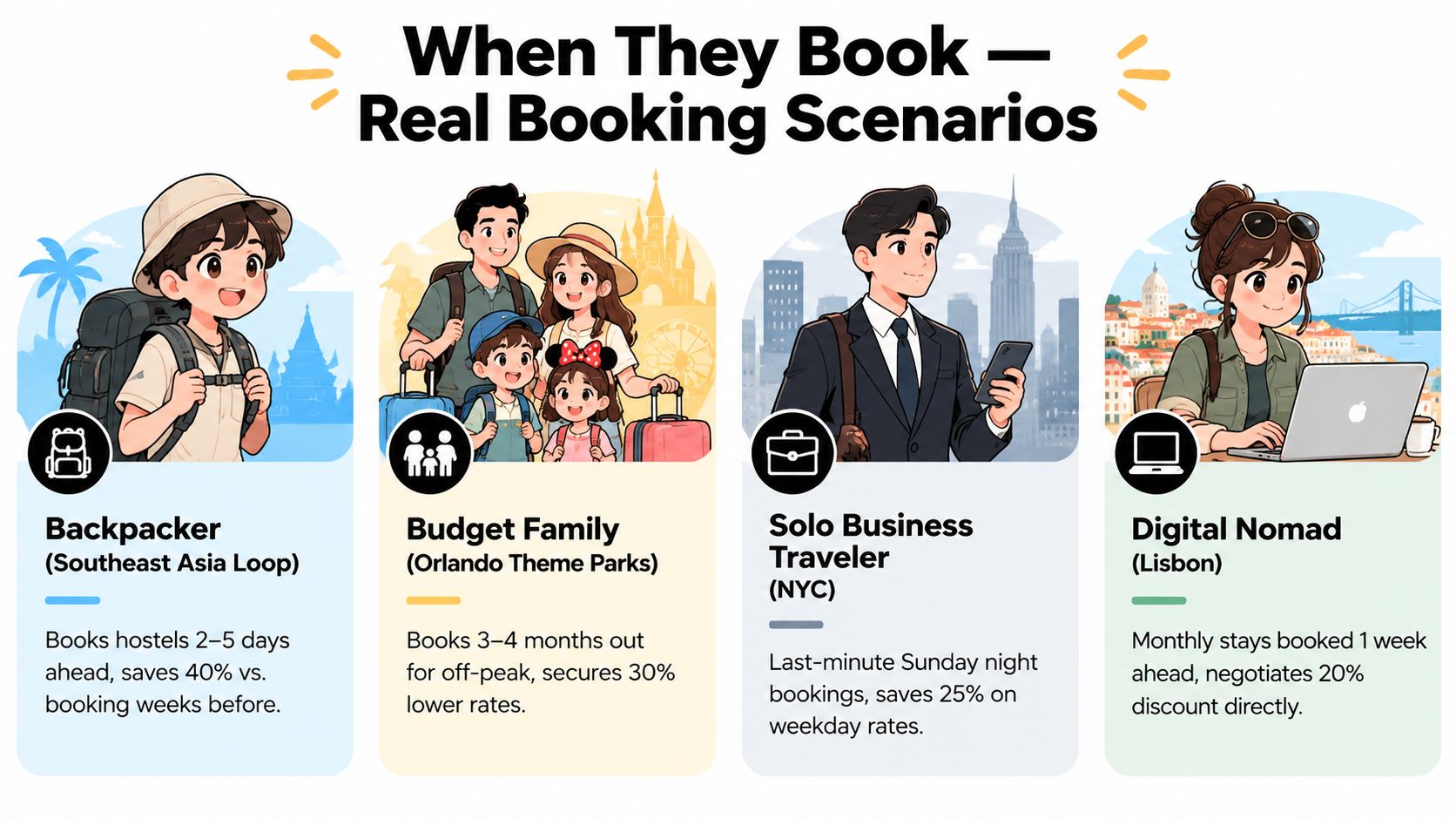
Four different decision profiles
A solo traveler planning a long weekend in Lisbon can build a more controlled experiment. Set alerts for the desired dates, compare weekday arrivals with weekend arrivals, and define an acceptable rate before searching. If the trip is fixed, the traveler should prioritize cancellation flexibility over a theoretical future discount.
A budget traveler driving through U.S. national-park gateways faces a different problem. Independent motels may have limited inventory, and a road trip often requires several linked stops. Booking each night around the broader two-week benchmark can work in ordinary demand periods, but the route should preserve backup properties because one sold-out gateway can disrupt the entire plan.
A remote worker staying for a month should stop thinking in nightly terms. Ask properties about extended-stay or monthly pricing, compare the total with a sequence of nightly reservations, and confirm internet quality, workspace, cleaning terms, and cancellation conditions. A longer stay can reduce turnover for the property, but the final rate depends on the accommodation and negotiation.
| Traveler Profile | Main Advantage | Main Risk |
|---|---|---|
| Backpacker | Flexible route and property choice | Reduced availability at popular hostels |
| Solo city traveler | Can shift arrival and neighborhood | A fixed weekend may remove flexibility |
| Road tripper | Can compare multiple independent properties | One unavailable stop can affect the route |
| Remote worker | Can request a stay-based rate | Nightly comparisons may hide different terms |
These scenarios reveal why a single “best time” answer fails. Short stays reward date flexibility, multi-stop trips reward early route protection, and long stays reward changing the pricing unit altogether.
Tools and Alerts That Lock In the Lowest Rates
Price tracking produces useful decisions only when each tool has a defined role. Too many platforms create noise, while relying on one booking site can hide a lower refundable rate or an offer available directly from the property. The goal is to compare like with like, then monitor the specific room and terms you would book.
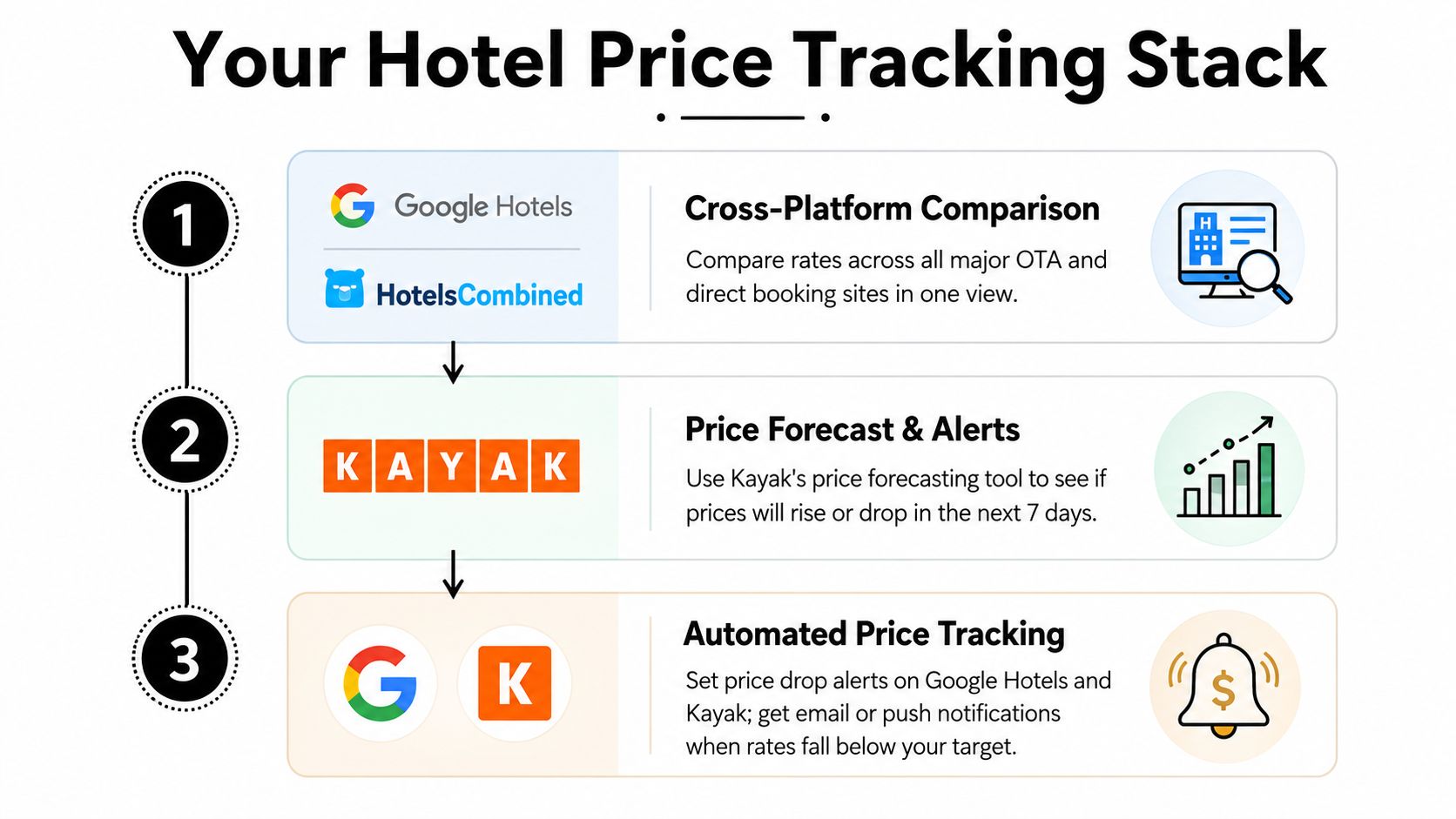
Begin with Google Hotels and HotelsCombined to establish the visible range. Record the property, room category, cancellation deadline, taxes, and check-in date alongside the price. After that first pass, keep a short list of acceptable options so alerts remain readable. Travelers comparing several booking tools can also review this guide to travel apps for comparing and monitoring hotel rates.
Build a simple tracking stack
KAYAK's price forecasting tool can indicate whether a rate may rise or fall, but a forecast should not outweigh fixed dates or signs of limited inventory. Set alerts for the exact destination and stay dates, then compare each notification with the hotel's direct website.
Use the tools in sequence:
- Compare first: Use Google Hotels and HotelsCombined to establish the available range.
- Forecast second: Check KAYAK's outlook before deciding whether waiting is reasonable.
- Alert third: Create notifications for the exact room type and cancellation policy you would accept.
- Verify last: Recheck the property's direct rate, loyalty offer, taxes, and included benefits.
Hopper's price freeze can hold a rate for a fee. Compare that fee with the possible saving, cancellation terms, and likelihood that your itinerary will change. Booking.com and Agoda support date-specific monitoring, while chain-hotel watchlists help loyalty members compare member rates with public offers.
Browser extensions such as Honey and Capital One Shopping may surface promotions, but use them as prompts to verify the final checkout total. Regional websites can show different offers. Check currency conversion, taxes, payment conditions, room details, and cancellation rules before booking through another market.
A refundable reservation can provide temporary protection while you continue monitoring. Book only when the cancellation deadline is clear, retain the confirmation, and recheck the rate before that deadline. If the price drops, cancel and rebook after confirming that the replacement has the same room and terms.
Travel Talk Today publishes travel-planning content on budgeting, booking timing, and practical trip decisions. Its wider resources are available through Travel Talk Today.
Your Booking Timing Checklist for 2026
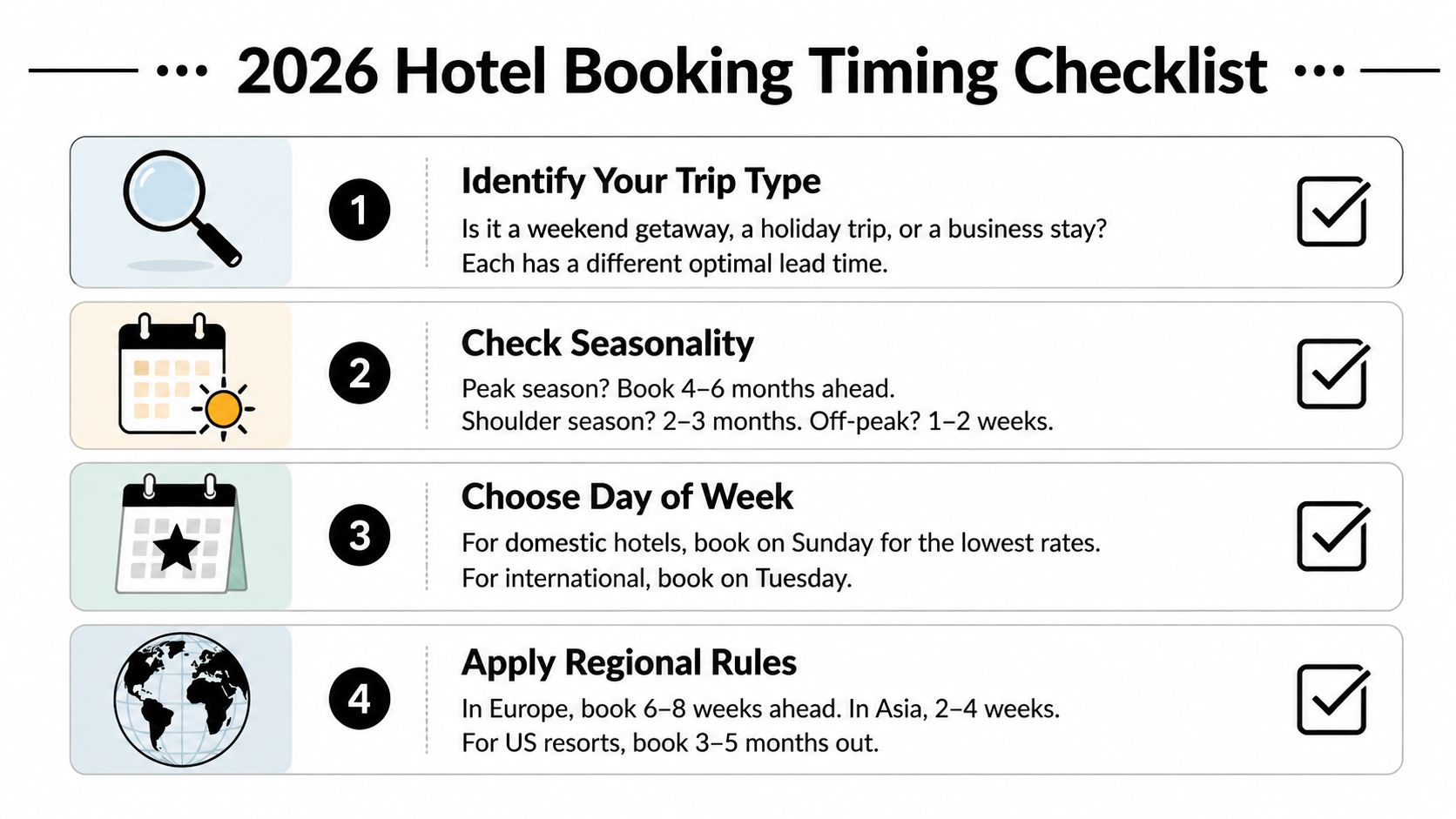
Use the booking window as a decision framework, not a prediction machine. The 2026 Hotels.com Hotel Price Index places the strongest value close to arrival and identifies Sunday nights as the best-value stay pattern, while the KAYAK comparison separates U.S. and international check-in-day recommendations. Those findings are useful starting points, but the trip's demand profile decides how much weight they deserve.
Four checks before you commit
First, classify the trip. A flexible domestic city stay can tolerate later monitoring. A fixed international itinerary, a resort, a holiday trip, or a multi-room booking needs more protection because acceptable alternatives may disappear.
Second, identify the market window. For an ordinary U.S. hotel, begin by watching the 8 to 14-day range. For European summer accommodation, use the 3 to 5-month pattern identified in the Tripadvisor analysis. For international travel, compare local demand and check-in-day behavior instead of copying a domestic assumption.
Third, inspect seasonality and events. January is the cheapest stay month in the Hotels.com index, but a festival or convention can override that broad pattern. Search the destination's event calendar before you postpone a booking, especially when your dates are fixed.
Fourth, set a rate ceiling. Decide the highest acceptable total price, including taxes, fees, breakfast, transport, and cancellation value. An apparently cheaper nonrefundable room may be the worse choice if your plans remain uncertain.
Before payment, audit the details:
- Cancellation: Confirm the exact deadline and time zone.
- Room: Check bed type, occupancy, location, and included facilities.
- Rate: Compare refundable, nonrefundable, member, and direct-property offers.
- Timing: Recheck the rate after an alert and before a cancellable booking expires.
Final decision rule: Wait when your dates, property, and room type are flexible. Lock in when demand is concentrated or the current refundable rate already fits your ceiling.
Use Travel Talk Today for practical, data-backed guidance on hotel timing, destination planning, and affordable travel decisions. Visit Travel Talk Today to compare smarter booking strategies and turn your next trip into a more flexible, better-planned journey.