January through March is consistently the cheapest time to visit Italy, with round-trip fares from major U.S. hubs averaging $420–$510, roughly 38% below summer rates. If you're chasing the lowest possible trip cost, start with the winter low season, then compare late November through early December and selected shoulder-season weeks.
That answer sounds simple until you decide what kind of Italy you want. A quiet Rome museum break, a Tuscan countryside stay, and an Amalfi Coast beach holiday respond to seasonality in very different ways. The cheapest airfare can become a poor bargain if ferries run infrequently, coastal businesses close, or the weather prevents you from enjoying the experience you planned.
The useful question, then, isn't only “When is Italy cheapest?” It's “When is Italy cheapest for my destination and travel style?” The pricing evidence points clearly toward winter for city-focused trips, while late spring and early fall can offer a stronger balance for coastal and rural itineraries.
Why Timing Is Your Biggest Budget Lever in Italy
A traveler planning a two-week Italy trip often starts by comparing hotels, restaurant prices, and train passes. Those choices matter, but the calendar usually deserves attention first. A 2026 monitoring dataset found that round-trip fares from major U.S. hubs to Rome or Milan averaged about $420–$510 from mid-January through mid-March, roughly 38% below summer rates according to fare monitoring summarized by Wildly.
That difference changes the shape of a trip. A lower flight cost can leave more room for a longer stay, better-connected accommodation, or an experience you'd otherwise cut. It also gives solo travelers and backpackers more flexibility because the savings arrive before they've made smaller daily spending decisions.
Practical rule: Compare travel dates before comparing neighborhoods. A cheaper month can influence the entire budget more than a modest reduction in nightly spending.
Why the winter gap appears
The winter low season follows a predictable demand pattern. The Christmas and New Year rush has ended, spring-break travel hasn't yet built momentum, and many travelers avoid Italy because daylight is shorter and temperatures are cooler. Airlines and hotels then have more reason to price competitively during weaker booking periods.
The same logic explains why late November through early December can work well, provided you avoid the holiday surge that follows. Prices don't fall randomly. They soften when fewer people compete for the same seats, rooms, and reservations.
The booking decision that comes first
Suppose your priority is Rome's ancient sites, Florence's galleries, and Milan's urban culture. Winter may allow you to pursue that itinerary while spending less on the largest fixed cost, the flight. Resources such as this guide to the best time to book flights can help you turn the seasonal pattern into an actual search plan.
The most important conclusion is easy to miss: timing doesn't merely reduce the cost of an Italy trip. It determines how much trip you can afford. Start with the month, then build the route around what remains open and enjoyable.
The Cheapest Months to Visit Italy
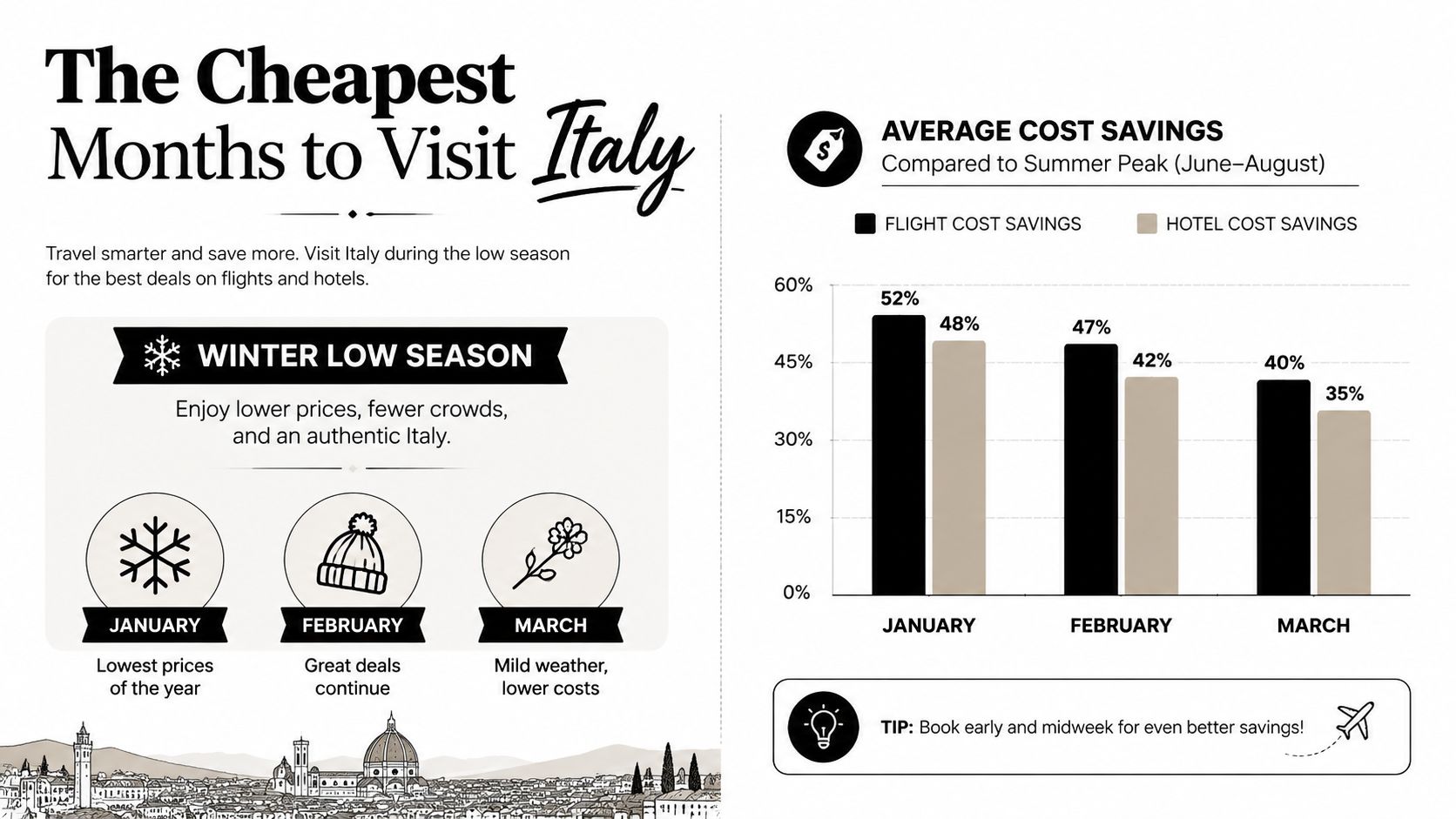
Italy's most reliable low-cost period is January through March, with February frequently emerging as the least expensive month. A second opportunity usually appears from late November through early December, before holiday demand lifts prices. Both periods benefit from weaker demand after the festive season and before spring travel accelerates.
One airfare study identified July as the most expensive month to fly to Italy. February and November ranked among the least expensive, with average round-trip fares around $500 as reported in The Points Guy's airfare analysis. The same fare comparison placed September at about $419, versus August at $655, a difference of roughly 36%. These figures come from the cited airfare comparison, so the lower September fare represents a shoulder-season opportunity rather than a winter price.
How each low-cost window behaves
January usually sees the sharpest post-holiday decline in demand. It suits travelers focused on museums, historic centers, cafés, and indoor cultural attractions, rather than beach conditions.
February often delivers the strongest value, but date selection matters. Venice Carnival can create a concentrated demand spike, meaning the cheapest February itinerary may fall outside the event period.
March remains part of the winter value period, although prices may respond to rising spring interest. It works as a transition month for travelers seeking lower costs without the deepest winter conditions.
Late November and early December can also reward flexible travelers. The savings depend on avoiding the holiday build-up and major events, so a city break's exact dates matter more than the month label alone.
The wider seasonal pattern
Summer demand remains heavily concentrated. Almost 40% of all trips in 2024 occurred in July and August, while the remaining 60% fell across the rest of the year in the seasonality analysis published by Springer Nature. That concentration helps explain why winter flights and rooms become more affordable. Suppliers still have capacity to fill, while fewer travelers compete for it.
For broader international airfare context, compare Italy's pattern with the cheapest months to fly internationally. The practical choice is straightforward: choose winter for the lowest overall prices, but check Carnival, school holidays, and pre-holiday demand before booking.
How Costs Shift Across Italy's Regions and Cities
Italy is not one travel market. A museum-focused winter trip to Rome can reduce costs without weakening the itinerary, while an Amalfi Coast holiday may save on accommodation but lose value if ferries, beach restaurants, and coastal services operate less often.
Independent budget guidance identifies January through March and late November through early December as the lowest-cost periods overall. It also places May and September among the value sweet spots, with prices potentially 25–40% below peak levels while major sights remain open and conditions suit destinations such as Tuscany, Rome, and the Amalfi Coast as outlined by 10 Million World.
City breaks and coastal itineraries side by side
| Destination | Low Season (Jan-Mar) | Shoulder Season (Apr-May, Sep-Oct) | Peak Season (Jun-Aug) |
|---|---|---|---|
| Rome and Florence | Strongest savings for museums, churches, and urban sightseeing | Balanced conditions and value | Highest demand and heavier competition |
| Milan | Good fit for galleries, shopping, and city culture | Comfortable compromise for city exploration | More expensive during summer demand |
| Venice | Can be affordable outside Carnival dates | Often combines open attractions with milder conditions | Peak crowds and pricing pressure |
| Tuscany | Lower rates, but countryside plans may require flexibility | May and September suit rural stays and cultural trips | Highest pressure on popular accommodation |
| Amalfi Coast | Lowest prices, but seasonal closures and limited transport can reduce value | May and September offer a stronger experience-to-cost balance | Best beach conditions, but highest demand |
| Cinque Terre and coastal towns | Quiet, with some operations reduced or closed | More services and usable outdoor conditions | Fullest operation, busiest demand |
The comparison exposes the main budgeting error: the cheapest room isn't always the cheapest complete trip. A coastal itinerary may require alternative transport, fewer open restaurants, or a shorter list of tours. Those constraints can narrow the initial saving.
Match the month to the destination
Winter suits a museum-heavy route through Rome, Florence, Milan, or Venice, provided event dates are checked before booking. May or September fit trips that depend on open coastal services, countryside access, outdoor dining, and usable walking conditions. Airfare may not undercut January, yet the broader itinerary can deliver better value.
For route planning, compare the best cities to visit in Italy and prioritize destinations that remain rewarding in the chosen season. Destination type should decide the month, not the other way around.
What Actually Drives Italy's Travel Prices
Flights usually create the clearest seasonal swing, but they aren't the only moving part. Italy's total trip cost combines airfare, accommodation, transport, and activities, and each category reacts to demand differently.
Flights and hotels respond directly to demand
Airlines can discount seats during weak travel periods because an empty seat earns nothing once the aircraft departs. That's why winter fares often undercut summer pricing, while late June through August attracts stronger competition for limited seats. The fare evidence discussed earlier shows how selecting the month can alter the budget before you've paid for lodging or activities.
Hotels use a similar principle, especially in heavily visited cities. Properties in Rome, Venice, and Florence can charge more when visitors compete for rooms, then adjust rates when occupancy becomes harder to maintain. Flexible travelers should compare the total nightly cost, cancellation rules, and location rather than treating the lowest displayed rate as the only measure of value.
The lowest airfare helps only when the rest of the itinerary supports the reason you're traveling.
Transport has a different pattern
Mainland trains and buses generally offer more consistent service across the year, although route choice still affects the final price. Ferries are more complicated. Services to islands and coastal destinations can run on reduced winter schedules, which may limit departure choices and create higher costs per available seat even when overall demand is lower.
That creates a common planning trap. A traveler sees an inexpensive winter flight to Naples, then discovers that the ferry timetable doesn't align with the intended island route. The fare was cheap, but the itinerary now needs extra nights, a different transfer, or a more expensive alternative.
Tours and seasonal access
Guided city tours and indoor cultural experiences can be easier to organize outside the busiest period. Some operators may offer more flexible arrangements when demand is softer. Outdoor providers face a different reality. Boat excursions, coastal hikes, and open-air dining may operate less frequently or close during the quietest months.
Use a component-by-component test:
- Airfare: Compare winter, late-fall, and shoulder-season dates first.
- Accommodation: Check cancellation terms and whether the property operates year-round.
- Transport: Confirm ferry schedules before committing to islands or remote coasts.
- Activities: Verify opening dates for tours that depend on weather or seasonal demand.
This approach prevents a low headline price from hiding the operational costs of an off-season itinerary.
Italian Holidays and Events That Spike Prices
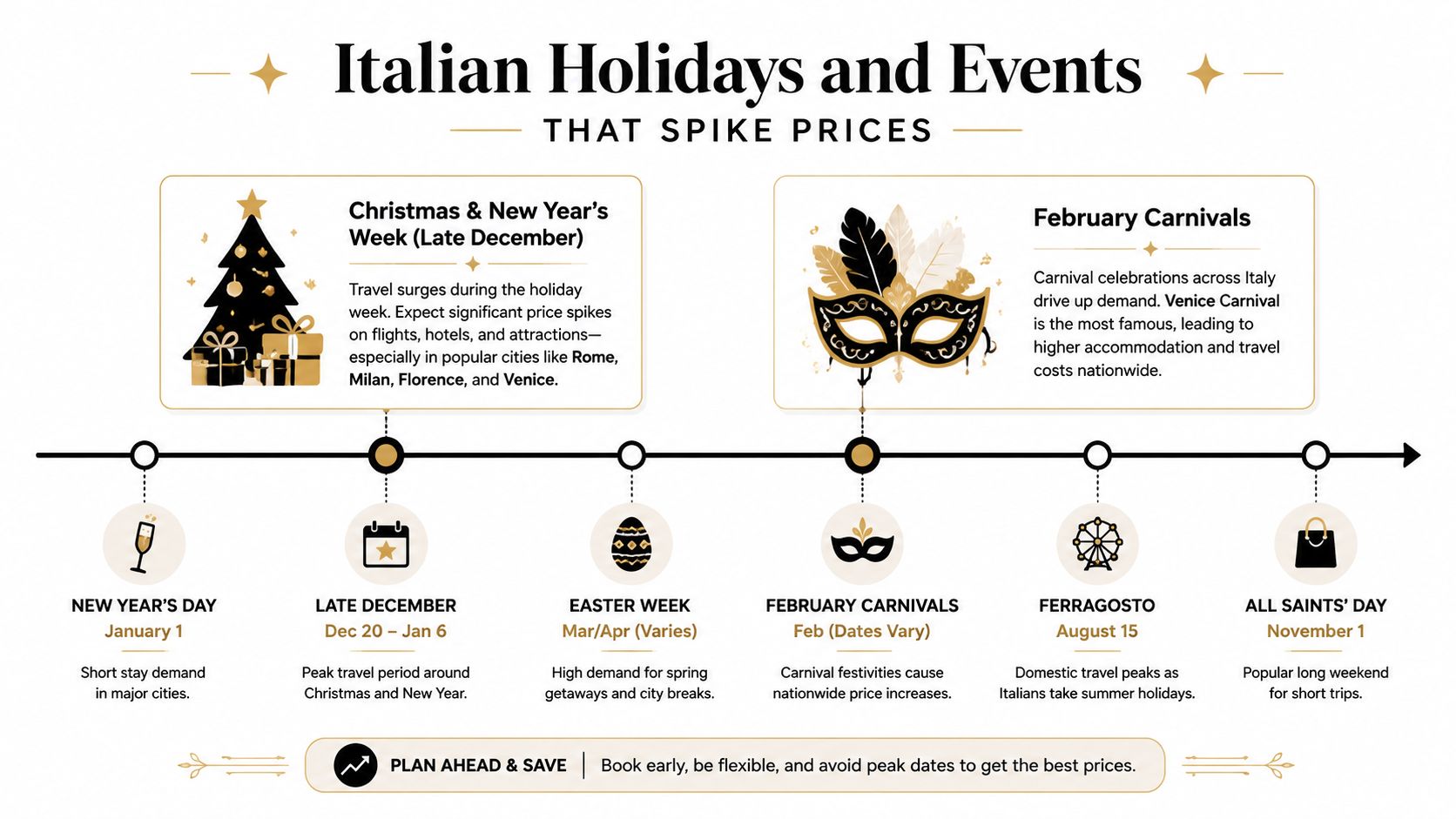
A cheap month can contain expensive dates. Travelers who search only by month may find a surprisingly high fare because a holiday or festival has concentrated demand around a narrow period.
The calendar begins with Christmas and New Year's week in late December, when Rome, Milan, and Venice attract festive travel. Epiphany on January 6 can create another brief increase in domestic movement. January remains a low-season choice overall, but those dates don't behave like an ordinary winter week.
Events that can overturn the monthly average
February requires particular caution in Venice. Carnival transforms the city's demand profile, so a traveler who assumes every February date is cheap may book during one of the most pressured periods of the month.
Easter week produces a broader national effect. Religious sites, major cities, and popular routes can all become more competitive as domestic and international travelers move through the country. The exact dates change, so check the calendar before treating late winter or early spring as automatically inexpensive.
August tells a different story. Ferragosto on August 16 sits inside Italy's already expensive summer period, when many residents travel toward the coast. Hotels and ferries can reach their strongest annual pricing pressure as cities empty and coastal destinations fill.
Local festivals matter too
September and October bring local sagre, or food festivals, that can temporarily raise accommodation demand in smaller towns. These events can be a wonderful reason to visit, but budget travelers should confirm room availability before choosing a village as a base.
The broader demand structure explains why these spikes matter. Almost 40% of Italy's trips in 2024 were concentrated in July and August, while 60% occurred during the rest of the year in the Springer Nature tourism-demand analysis. That concentration creates deep winter discounts, but individual events can temporarily reverse them.
Before booking, cross-check:
- National holidays: Review Christmas, Epiphany, Easter, and Ferragosto.
- Destination events: Check Venice Carnival and local festivals.
- School calendars: Look for regional or international holiday periods.
- Transport demand: Confirm whether ferries or trains face event-related pressure.
Weighing Price Savings Against the Italian Experience
Winter discounts involve practical tradeoffs. January through March usually means cooler weather, shorter daylight, and a higher chance of rain. Late November can be particularly changeable. A cheap fare cannot compensate for a coastal itinerary built around warm water, long afternoons, or restaurants that operate only during the busier season.
Coastal towns and resort areas often reduce services during the quiet season. Some hotels, restaurants, boat operators, and outdoor guides may close until spring. Mountain routes can also become harder to reach because of winter conditions. Seasonal closures can remove the experiences that motivated the trip.

When winter improves the trip
For museum-heavy city breaks, winter can improve the experience. Rome, Florence, Milan, and Venice offer museums, churches, architecture, food, and neighborhood walks that do not depend on beach weather. Fewer visitors may make it easier to enter major cultural sites, find a table, and explore without arranging every hour around crowd avoidance.
The season also changes the pace of a trip. Cooler days suit longer café stops, indoor meals, and slower routes through historic districts. Travelers exchange bright summer evenings for a quieter version of Italy focused on art, food, and local routines. This makes winter a stronger fit for an urban itinerary than for a coast-first holiday.
When shoulder season wins
Late spring and early fall suit travelers combining cities with countryside or coast. May and September generally offer more usable outdoor conditions than winter while remaining below peak-season pricing, consistent with the 25–40% shoulder-season savings noted earlier in the tourism-demand analysis and the seasonal planning guide referenced above.
Use the trip's purpose to choose the season:
- Choose winter when museums, monuments, cafés, and urban neighborhoods are the priority.
- Choose May or September when outdoor access, coastal services, and rural scenery matter.
- Choose summer when warm-water beach time and full seasonal operation justify the higher cost.
A guide to slow travel in Italy supports an itinerary built around depth rather than a long checklist. The strongest value comes from matching the destination type to the season, not selecting the lowest fare.
Smart Booking Strategies for Budget-Conscious Travelers
Finding the cheapest window is only the first decision. You still need a process that protects the fare, tests the full route, and prevents a low flight price from creating expensive complications later.
Build your search around flexibility
Start by searching a date grid rather than one fixed departure. For a winter city break, compare January, February, and March first, then examine late November and early December. Set fare alerts for both departure and return routes so you'll notice meaningful changes without repeatedly searching manually.
Consider alternate airports, but calculate the complete journey. A lower fare into Treviso instead of Venice, or Bari instead of Rome, may stop being economical after ground transportation, extra travel time, and additional accommodation are included.
Protect the booking
For hotels, prioritize free cancellation when the rate difference is reasonable. That gives you a chance to recheck prices and rebook if a better option appears. Confirm that the property remains open during your dates, especially in smaller coastal towns and island destinations.
Use a simple worksheet with four columns:
- Transport: Flight, train, airport transfer, and ferry costs.
- Accommodation: Nightly rate, cancellation terms, and location.
- Access: Opening dates for tours, museums, ferries, and restaurants.
- Purpose: The experiences your chosen month must support.
Island trips deserve special scrutiny. Reduced winter ferry service can force longer waits or alternative transfers, so check schedules before paying for a nonrefundable room. The cheapest flight is useful only if the complete route still works.

Choose your value objective
Decide which of three outcomes matters most:
- Maximum savings: Select the winter low season, focus on cities, and accept cooler conditions.
- Balanced value: Compare May and September for a mix of open services, comfortable exploration, and lower demand than summer.
- Best experience: Choose the season that protects your main activity, even if the fare is higher.
Off-season tours can also offer a more personal format when operators have fewer bookings. Compare group size, cancellation policies, and what remains available rather than assuming every discount represents equal quality.
For more practical airfare tactics, use these cheap flight hacks, then compare the final door-to-door cost. A booking is successful when it saves money without forcing you to redesign the trip around restrictions you discovered too late.
Travel Talk Today offers practical, data-backed guidance for planning affordable trips, from seasonal flight strategy to slow travel and destination budgeting. Visit Travel Talk Today to refine your Italy itinerary, compare timing options, and turn a lower fare into a more meaningful journey.