You open a hotel search, find a room that looks perfect, and feel that small rush of victory. Good location. Decent reviews. Price looks manageable. Then you hit checkout and watch the total climb with taxes, fees, and booking junk that somehow never showed up in the first search result.
That sting is familiar because almost every traveler learns it once.
I did too. Not with some luxury resort. With a plain, forgettable room that looked cheap, felt average, and still managed to cost more than a better option I'd ignored because the headline rate looked higher. That's the moment you stop treating hotel booking like shopping and start treating it like strategy.
Cheap hotels aren't about luck. They're about seeing the whole board. Timing matters. Search tools matter. Neighborhood choice matters. But the habit that saves the most regret is simpler than people think: never compare base rates alone. Compare the final, all-in price every single time.
Once you do that, the game changes. You stop getting lured by fake bargains. You stop paying extra for mediocre stays. You start spotting where genuine value sits, even when it doesn't shout the loudest in search results.
The Art of the Deal Not Just the Destination
It is often believed that hotels are overpriced because travel is expensive. That's only half true. A lot of the pain comes from paying too much for the wrong room.
A mediocre hotel can ruin your mood faster than a delayed train. You arrive tired, the room is smaller than the photos, the walls are thin, and the “great deal” turns out to have cost more than the better place down the street once taxes hit. You don't just lose money. You lose momentum.
That's why learning how to book cheap hotels matters so much. It isn't about being cheap for the sake of it. It's about protecting your trip.
Cheap isn't the lowest number
The rookie mistake is chasing the absolute lowest advertised rate. That number is often bait. Smart travelers look for value, not just a smaller number on the first screen.
That means asking better questions:
- What's the final total? The room rate alone doesn't tell you what you'll pay.
- What are you giving up? A cheaper room far outside the center can cost more once you add transit, time, and hassle.
- What's flexible? Dates, neighborhoods, and booking channels often matter more than star rating.
The best hotel deal is the one that stays cheap after checkout, after transit, and after you actually sleep there.
I've learned that a “budget” hotel can become expensive in all the wrong ways. Bad location. Surprise fees. Noisy street. Awkward check-in. Meanwhile, a slightly different choice can give you a better stay for less money overall.
Think like a deal hunter, not a shopper
The travelers who consistently find good rates don't book the first acceptable option. They compare, zoom out, and pressure-test the total cost.
A useful mindset shift is to treat every listing as unfinished information. The price you see first is not the answer. It's the opening move.
Here's what works better:
| Habit | What it leads to |
|---|---|
| Booking from the first search page | Fast decisions, weak comparisons |
| Comparing only base rates | Hidden surprises at checkout |
| Checking total cost across channels | Cleaner, more reliable savings |
| Looking one neighborhood over | Better value without sacrificing the trip |
This is the art of the deal. You're not trying to “win” the cheapest room on the internet. You're trying to book a stay that makes your trip easier, calmer, and lighter on your wallet.
Mastering the Calendar for Hotel Savings
If you want cheaper hotels, stop guessing and start using the calendar like a lever.
Timing changes hotel prices more than most travelers realize. Hotels don't price rooms based on fairness. They price around demand. If a city is filling up, rates rise. If hotels need heads in beds, prices soften. Once you understand that, you stop following recycled advice like “book on a Tuesday” and start looking for patterns that actually matter.
According to KAYAK hotel search data, January is the cheapest time to book a domestic hotel room in the United States, while Saturday is the most cost-effective booking day for international stays. The same data says November has the lowest average prices for stays within the United States, and Thursday offers the best rates for international breaks.

What those patterns actually mean
Those numbers matter because they reflect hotel behavior, not travel folklore.
Domestic hotel prices in the U.S. often dip when fewer people are taking leisure trips, and November can be especially attractive outside peak holiday surges and big event windows. International pricing behaves differently. Booking and travel patterns vary by region, and that's why blanket rules usually fail.
The useful takeaway isn't that one day magically reveals every cheap room. It's that calendar timing creates price pockets, and you can find them if you stay flexible.
The flexibility that pays off
You don't always need to change your whole trip. Sometimes moving your stay slightly is enough.
A better way to search looks like this:
- Shift your stay before changing hotels: Move check-in or check-out by a day and compare the final total again.
- Test shoulder periods: The week just before or after a busier stretch often gives you a calmer city and better hotel options.
- Watch local demand spikes: Conferences, festivals, and sports weekends can distort prices even when the broader season looks quiet.
Practical rule: If your dates are fixed, be flexible on neighborhood. If your neighborhood is fixed, be flexible on dates.
There's also a difference between booking timing and stay timing. People mix these up all the time. A cheap month to travel isn't always the same as the best moment to hit “book.” The KAYAK data helps because it separates those patterns instead of treating them as one thing.
Stop following generic booking myths
Some hotel advice survives because it sounds tidy, not because it works. “Always book on Tuesday.” “Always book as early as possible.” “Always wait until the last minute.” None of those rules hold up in every market.
What does work is checking rates across a small date range and reading the calendar like a pricing map. That gives you more control than any single booking superstition.
If your trip is coming up fast, it's worth browsing these last-minute travel deal sources as a backup strategy. Just don't confuse last-minute luck with a repeatable system. Last-minute deals can appear, but flexibility still does the heavy lifting.
A simple calendar test before you book
Run this quick test before committing:
- Search your exact dates.
- Search one day earlier.
- Search one day later.
- Search the same stay in a nearby week if your plans allow.
- Compare the final price, not the teaser rate.
That's how you stop booking blindly. The calendar won't solve every trip, but it will save you from paying peak prices on dates that only looked convenient because you never tested the alternatives.
Your Digital Toolkit for Finding Low Prices
Once your dates are in decent shape, the next win comes from using the right tools in the right order.
Most travelers waste money because they search in a straight line. They open one OTA, sort by lowest price, skim photos, and book. That approach is fast, but it leaves too much unseen. Better rates sit on direct hotel sites, in Google Hotels results, and sometimes under a different listing for the exact same property.
The search process needs to be layered.

Start with Google Hotels
If you only change one habit, make it this one. Use Google Hotels as your first comparison screen.
As explained in this hotel booking strategy video, travelers can reduce hotel costs by prioritizing Google Hotels over relying only on OTAs like Expedia, because it lets you compare the hotel's direct price against third-party listings in one place. It also makes it easier to stack cashback options. The same source notes that reverse image searching Airbnb listings can uncover identical properties on cheaper platforms, potentially saving over $100 per booking.
That's powerful because it cuts through one of the biggest problems in hotel search: fragmented pricing.
My baseline workflow
This is the workflow I trust when I want the best shot at a low price without wasting half my day:
Search the hotel on Google Hotels first.
This gives you a clean view of direct and third-party pricing.Open the hotel's own site in a second tab.
Sometimes direct booking wins on price. Sometimes it loses on headline price but includes better terms.Check cancellation terms before judging the rate.
A slightly higher flexible booking can be the smarter move if your plans may change.Use the map, not just the list view.
Neighborhood bargains appear when using the map.Take screenshots if you're comparing several options.
Hotel search gets messy fast. A screenshot keeps the details straight.
OTAs are useful, but don't trust them blindly
Booking platforms are convenient. They're good for discovery, reviews, and quick comparisons. But they're also designed to move you toward a booking before you've pressure-tested the details.
Here's the trade-off:
| Tool | Good for | Watch out for |
|---|---|---|
| Google Hotels | Broad comparison and direct-vs-OTA view | You still need to verify booking terms |
| OTA sites | Fast browsing and review volume | Headline rates can distract from total value |
| Hotel direct site | Better control, sometimes better perks | Interface can be clunky |
| Map search | Spotting location value | Easy to overlook transport friction |
Don't fall in love with a listing before you've checked where it's sold, how it's priced, and what happens if plans change.
Use filters like a grown-up, not like a gambler
Travelers either use no filters or too many. Both mistakes cost money.
A smarter filter setup looks like this:
- Price range: Keep it wide enough to catch nearby value.
- Review threshold: Use it to remove obvious problem properties.
- Location or map area: Focus on where you'll spend time.
- Amenities that matter: Wi-Fi, breakfast, air conditioning, private bathroom. Skip vanity filters you don't care about.
I also like to open the map and zoom one ring outside the main tourist center. That's often where the sensible deals live. Not the dirt-cheap listings with suspicious photos. The solid ones that don't need flashy marketing.
If you want a broader mobile toolkit for planning and comparing travel options, these travel apps are worth knowing.
The Airbnb reverse image trick
This one is underused because it sounds nerdy, but it works well enough to deserve a permanent place in your routine.
If you find an Airbnb you like, save one or two listing photos and run a reverse image search. Sometimes that same apartment appears on another platform under a different name or with a lower rate. The source above specifically calls out this tactic, and it's one of those methods that feels almost unfair the first time it works.
The point isn't to outsmart the internet with hacks. It's to stop assuming the first platform you found is the cheapest place to book.
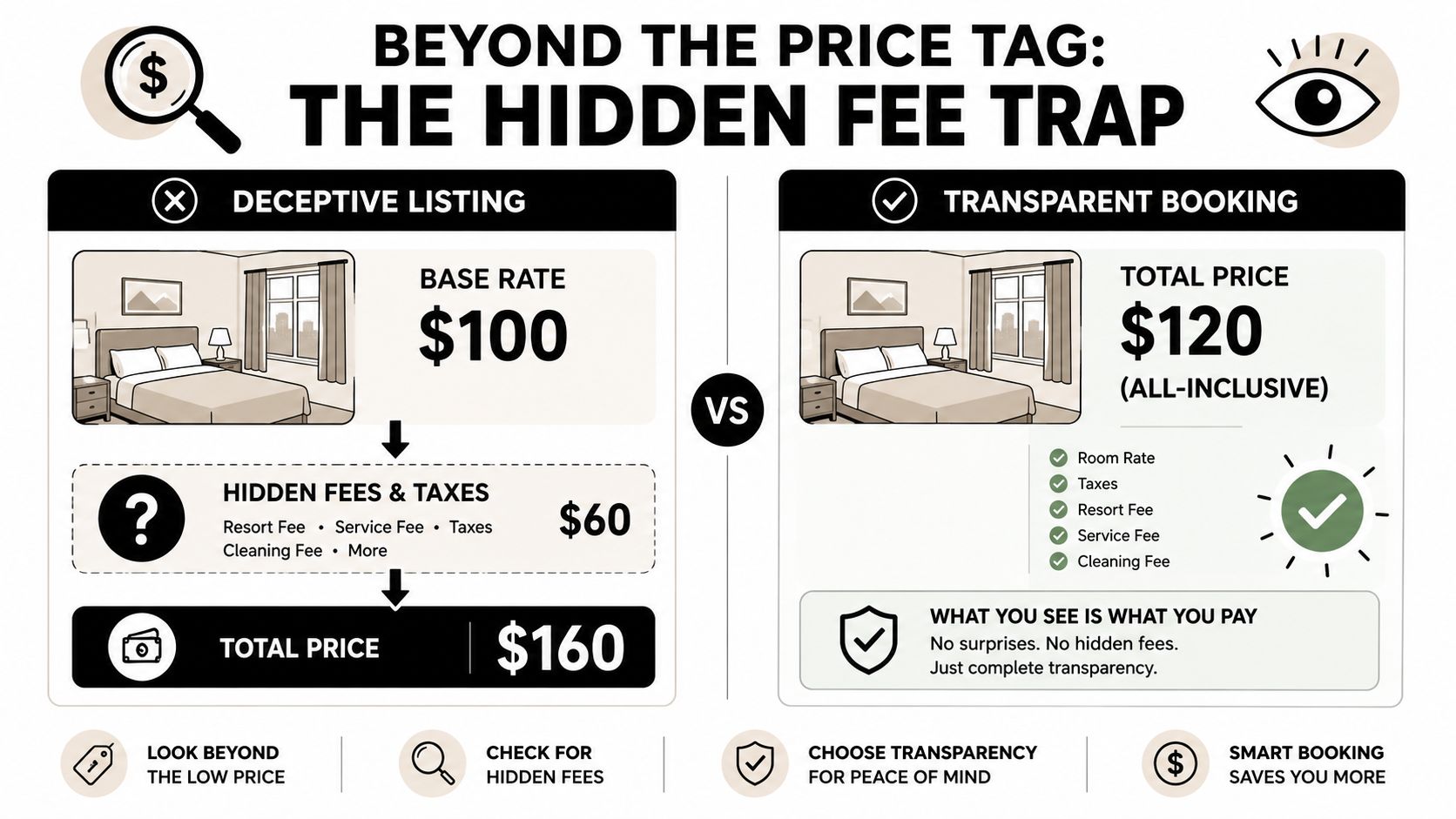
Beyond the Price Tag The Hidden Fee Trap
This is the part most hotel guides skip, and it's where a lot of “cheap” bookings stop being cheap.
The Tax Display Gap is what happens when a booking site shows you a low base rate up front, then reveals the total cost near checkout. Travelers fixate on the first number because it feels like the true price. It isn't.
According to this discussion of booking platform pricing and tax-inclusive filters, most booking sites hide taxes until checkout, causing travelers to misjudge costs by 15–25%. The same source notes that Google Travel now lets users filter for price including taxes and sort from lowest to highest, which can expose up to $40 differences on the same room. It also reports that a 2024 analysis found 68% of users canceled bookings after discovering hidden taxes.
Why the cheapest listing often isn't the cheapest stay
Two hotels can look nearly identical in search. One advertises a lower base rate, so it rises to the top of the list and steals your attention. By checkout, the “cheaper” room can cost more than the option you skipped.
That's not a rare edge case. It's a normal trap.
The practical fix is simple: sort and compare by total price whenever the platform allows it. If you don't see that option, click through to checkout and compare the final number before deciding anything.
Build one non-negotiable booking habit
I'd make this your hard rule:
- Check the all-in price before you compare properties
- Recheck the final total on the payment screen
- Treat hidden fees as part of the hotel's real price, because they are
- Be skeptical of the lowest base rate unless the seller is reputable
A room with a slightly higher sticker price can be the better deal if the total is cleaner, the terms are clearer, and the seller is reliable.
Cheap starts at the search result. Value shows up at the final total.
What to watch for at the last step
Even when you've done the search well, the last booking screen can still trip you.
Look for:
| What you see first | What you need to confirm |
|---|---|
| Nightly room rate | Total with taxes |
| Promotional discount | Whether fees are still added later |
| Good ranking in search | Final checkout number |
| “Limited-time deal” language | Seller reputation and cancellation terms |
This habit matters even more in places where local taxes and service charges vary a lot. You don't need to memorize the different fees city by city. You just need to stop trusting the first number on the page.
If you're already comparing travel costs across a full trip, this rental review piece is a good reminder that transportation has similar pricing traps. The pattern is the same. Headline price grabs attention. Final price tells the truth.
Unlock Deeper Discounts and Extra Value
Once you stop getting fooled by teaser rates, you can start chasing the better question: not “what's cheapest?” but “what gives me the best trip for the money?”
That's where a lot of travelers level up. They realize the lowest room rate isn't always the strongest deal. A hotel in a smarter location, with easier transit and fewer hassles, can beat a rock-bottom listing that drains time and energy every day.

Shop one neighborhood beyond the obvious
This tactic works over and over. Don't search only in the postcard center.
According to Travala's overview of hotel room pricing around the world, mid-range hotels globally typically range between $100 and $180 per night, while budget travelers can still find options under $40 per night in various destinations by expanding searches into up-and-coming or residential neighborhoods just outside major tourist zones.
That matches what seasoned travelers learn in practice. The best-value hotel is often one short walk, one metro stop, or one neighborhood away from the obvious zone everyone else searches first.
Cheap room versus cheap trip
A room that saves money on paper can cost you in other ways.
Consider the trade-offs:
- Closer to transit: A slightly higher nightly rate can save friction every morning and night.
- Residential area: Often quieter, more local, and better priced than the tourist core.
- Included breakfast or stronger Wi-Fi: Not glamorous, but useful if they replace daily spending.
- Safer late-night return: Worth thinking about, especially if you'll be arriving after dark.
Budget travel gets smarter. You're not only cutting cost. You're cutting waste.
Ask for value, not just a discount
Calling the hotel directly doesn't always produce a lower rate, but it can still improve the booking.
What I'd ask for depends on the property. Sometimes a hotel won't lower the price. They may still offer a better room category, easier cancellation, breakfast, or a small perk that makes the direct booking more attractive.
A few worthwhile moves:
Ask whether the direct site includes anything extra
Even a modest extra can beat a slightly cheaper third-party booking.Mention a competing rate politely
Don't bluff. Have the comparison open.Join the loyalty program before booking
Even occasional travelers can access member pricing or small perks.
A good deal isn't just lower. It's cleaner, easier, and better aligned with how you actually travel.
Stack the boring advantages
The biggest savings don't always feel dramatic. They come from stacking small advantages that other travelers ignore.
That can mean:
- booking a hotel with breakfast when food nearby is overpriced
- choosing a quieter district so you sleep well
- staying where you can walk more and ride less
- using rewards strategically if you already spend on travel
If you're building that side of your travel setup, these travel rewards credit cards are worth a look. The goal isn't to force loyalty to one brand. It's to turn spending you already do into better travel choices later.
A cheap hotel should help the trip, not just shrink one line item in your budget.
Your Smart Booking Checklist
When you're ready to book, keep this tight checklist nearby. It prevents most expensive mistakes.
Before you compare hotels
- Test nearby dates: Even a small shift can change the total.
- Search the map, not only the list: Good-value stays often sit just outside the obvious center.
- Know your real priorities: Location, safety, cancellation terms, and sleep quality matter.
While you search
- Start with Google Hotels or another broad comparison tool: You want direct and third-party options visible at the same time.
- Open the hotel's own site too: Don't assume an OTA wins automatically.
- Use filters carefully: Keep only the amenities and review standards you need.
Before you click book
- Compare the final all-in price: This is the habit that saves the most regret.
- Check cancellation terms: Cheap and rigid can become expensive fast.
- Look at transit cost and convenience: A cheaper room far away may not stay cheap.
For extra value
- Try one adjacent neighborhood: That's often where better pricing lives.
- Join the hotel's loyalty program if it's free: Member pricing and small perks can tilt the decision.
- Ask for a match or perk politely if booking direct: Sometimes the answer is no. Sometimes it isn't.
If you're younger and booking your own stay for the first time, this guide to hotel age requirements can save you from booking a room you can't check into.
The short version is this: learning how to book cheap hotels isn't about becoming obsessive. It's about becoming deliberate. Compare the right things. Ignore teaser pricing. Pick value over hype. Do that consistently, and you'll travel more often without feeling like every booking came with a hidden penalty.
Travel better for less with Travel Talk Today , where practical budgeting, smarter timing, and thoughtful travel advice help you stretch every trip without flattening the experience.