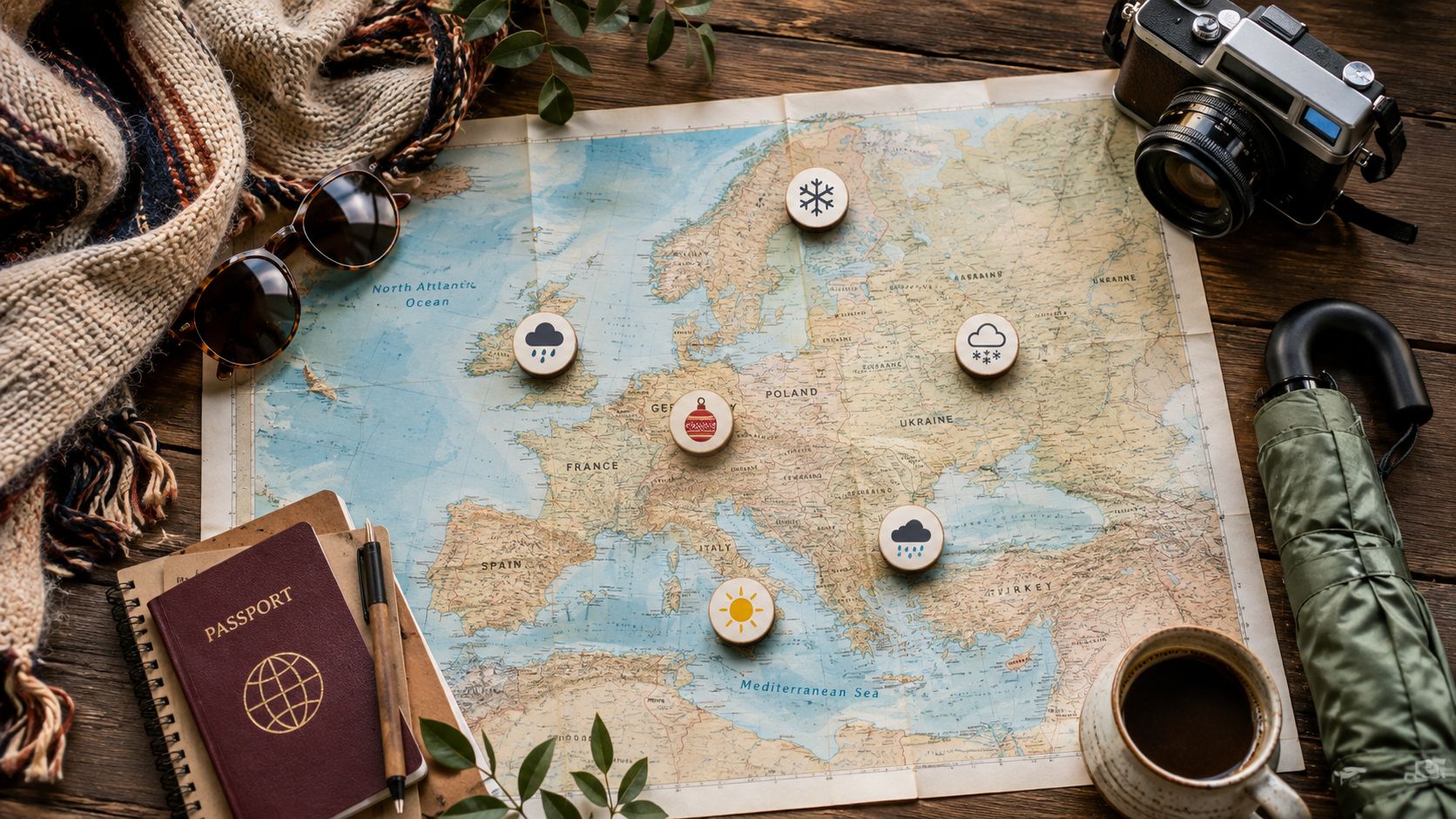
You've opened five weather apps for the same December itinerary and somehow found five different Europes. One forecast promises blue skies in Barcelona, another warns of rain, while a third shows snow near your next train connection. The confusion is understandable. “Europe in December weather” isn't one forecastable experience, because the continent shifts from mild Atlantic coastlines to frozen continental interiors and high mountain snowfields within a relatively short journey.
The practical solution is to stop choosing Europe first and weather second. Choose the climate you can enjoy, then build the route around it. This guide divides December into six useful climate zones, matches each one to a different travel preference, and takes an honest look at the month's biggest trap: December can be affordable before the holidays, but festive demand can erase the discount exactly when the atmosphere feels most tempting.
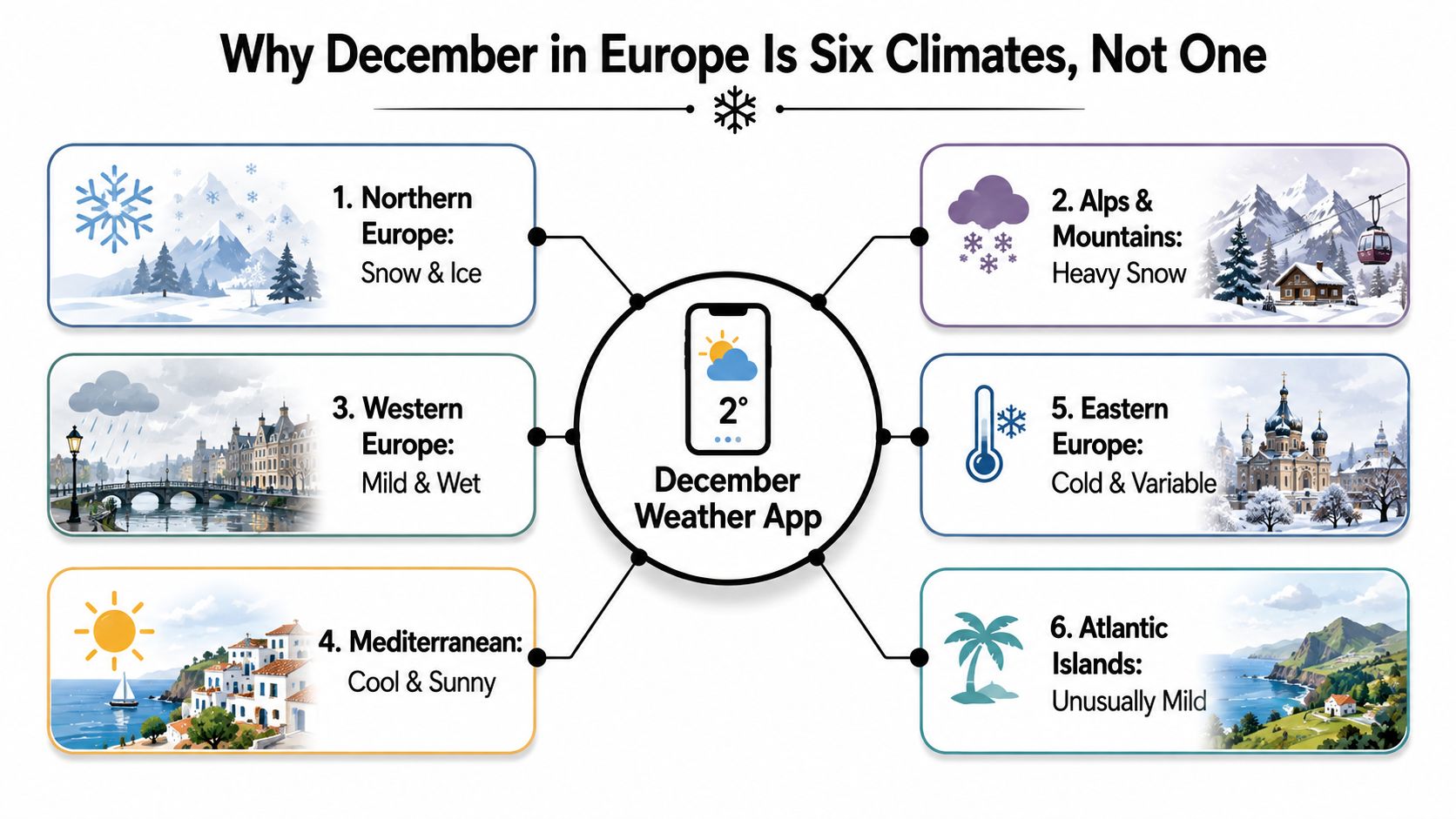
Why December in Europe Is Six Climates, Not One
A traveler flying from Athens to Berlin isn't just moving north. They're moving between maritime, Mediterranean, continental, mountain, and Nordic influences, each changing the temperature, precipitation, snow odds, and usable daylight. That's why a light jacket can work on a sunny southern terrace while the same trip requires insulated footwear and careful route planning farther east.
The six-zone approach makes planning easier:
- Northern Europe, where snow, ice, and very short days shape the itinerary.
- The Alps and mountain regions, where elevation matters more than the city's latitude.
- Western Europe, where winter often feels mild but wet.
- The Mediterranean, where cool evenings can accompany pleasant daytime sightseeing.
- Eastern Europe, where continental cold and rapid changes demand flexibility.
- Atlantic islands, where ocean influence often produces Europe's mildest December escapes.
Why nearby cities feel so different
The Atlantic moderates temperatures in western destinations, but it also supplies moisture. Inland cities lose that maritime buffer and can become colder, especially overnight. Mountains create another sharp dividing line, with elevation increasing the chance of snow and making roads, trails, and rail corridors more exposed to disruption.
The regional contrast is visible in long-term December normals. Athens averages 15°C highs and 9°C lows, while Barcelona averages 14°C and 6°C. Amsterdam and Brussels sit near 6°C and 2°C, Berlin near 4°C and 0°C, and Bucharest near 3°C and -3°C, according to European city December temperature normals. These figures aren't promises for your travel dates, but they're a useful baseline derived from long-term historical records.
Planning rule: Match your route to your tolerance for wet, cold, snow, and uncertainty. Don't pack for a continent-wide average that doesn't exist.
A mild island break, a market-focused central European trip, and a northern lights journey can all be excellent in December, but they require different footwear, budgets, and expectations. For more seasonal inspiration, compare this framework with winter destinations across Europe.
The December Temperature Map You Should Pack Against
Packing begins with the overnight low, not the daytime high. A city that reaches a pleasant afternoon temperature can still feel raw after sunset, particularly when rain, wind, or damp paving keeps you outside for hours.
The table below uses representative city normals to show the broad gradient. The figures come from long-term December city records, so treat them as planning anchors rather than a specific forecast.
| City | Region | Avg High | Avg Low | Typical Conditions |
|---|---|---|---|---|
| Athens | Mediterranean | 15°C | 9°C | Mild days, cool evenings, occasional rain |
| Barcelona | Mediterranean and western coast | 14°C | 6°C | Comfortable sightseeing temperatures, cooler after dark |
| Amsterdam | Western Europe | 6°C | 2°C | Chilly, damp, and often breezy |
| Brussels | Western Europe | 6°C | 2°C | Cool urban walking with wet-weather risk |
| Berlin | Central Europe | 4°C | 0°C | Near-freezing nights and cold daytime streets |
| Bucharest | Eastern Europe | 3°C | -3°C | Colder continental conditions, possible ice or snow |
Read the gradient before you choose clothing
Athens and Barcelona generally call for a flexible outer layer, a warm mid-layer, and shoes that can handle wet streets. You may be comfortable in a shell jacket over ordinary travel clothing during the day, but you'll still want a scarf or insulating layer for evening meals and late walks.
Amsterdam and Brussels need more attention to water resistance than dramatic insulation. A waterproof shell, quick-drying trousers, and shoes with dependable grip matter because damp cold can make a moderate temperature feel much harsher. Berlin and Bucharest move into a different category. Thermal underwear, a warm coat, gloves, and footwear with traction become sensible defaults rather than emergency extras.
The bigger issue is that “normal” doesn't mean stable. Copernicus recorded December 2022 at 0.89°C above the 1991–2020 European average, ranking it as Europe's eighth-warmest December since 1979. December 2019 was warmer still, while December 2021 was 0.21°C below that reference average and the coldest December since 2012, as documented in the Copernicus December 2022 climate bulletin.
That range explains why experienced December travelers pack systems, not outfits. A base layer handles cold mornings, a fleece or wool mid-layer adjusts comfort, and a waterproof shell protects against rain. You can remove one layer in Barcelona and add another in Bucharest without carrying a completely separate wardrobe.
If you're weighing a southern route, use this weather logic alongside practical seasonal guidance for choosing the best time to visit Croatia.
A December Day in Each European Region
Numbers explain the temperature gradient, but an itinerary reveals how it feels. December travel depends on what happens between breakfast, the first attraction, and the walk back to your accommodation.
North and mountain country
In Tromsø, morning darkness can make breakfast feel like the beginning of an evening. Snow and ice may govern the pace, while tours, buses, and waterfront walks require more planning than a summer city break. Wear insulated layers, waterproof boots, gloves, and a hat. Skip ordinary trainers, thin cotton socks, and the assumption that every outdoor activity can be improvised.
In the Alps, the valley town may look manageable from the station, but conditions can change quickly as you climb. A bright morning in Innsbruck or a Dolomite village can become a slippery afternoon on shaded paths. Wear a warm base layer, fleece, weatherproof jacket, and shoes with strong tread. Skip smooth soles, casual canvas footwear, and mountain routes you haven't checked locally.
Western and central Europe
Edinburgh offers the classic western winter compromise. You may get a clear, dramatic morning, then face wind and rain before lunch. Castle approaches, bridges, and exposed viewpoints can feel colder than the thermometer suggests. Wear a waterproof shell over warm layers and choose shoes that dry reasonably quickly. Skip a decorative wool coat without rain protection.
Berlin's December day often begins with a cold snap around the time you leave for the first museum. The city's indoor culture works beautifully in this season, but moving between galleries, cafés, and transit stops still exposes you to near-freezing streets. Wear thermal socks, a practical coat, and gloves you can remove easily indoors. Skip bulky luggage that makes train changes harder.
Prague and Vienna reward the same rhythm. Start outdoors while the light is useful, pause for a warm drink, then make museums, concerts, and restaurants the backbone of the evening. Wear layers that work in heated interiors, because a thick coat can become uncomfortable once you're inside. Skip packing only for photographs. A festive square is enjoyable for longer when your feet remain warm.
South and Mediterranean Europe
Athens often gives you a gentler winter walking day, with cool evenings rather than deep cold. The Acropolis, Plaka, and coastal viewpoints can be comfortable when the sky is clear, but wet stone and wind still deserve attention. Wear comfortable shoes, a light insulating layer, and a shell that fits in your daypack. Skip heavy snow gear unless your route includes mountains.
Málaga, Seville, or a sunny terrace in southern Spain can feel surprisingly warm in the afternoon, especially after a cool start. That contrast is exactly why flexible clothing beats a single heavy coat. Wear a removable sweater, breathable trousers, and walking shoes with grip. Skip assuming that “mild” means warm at night or dry every day.
Lisbon's Alfama adds another practical complication. Rain rolling over steep, polished streets changes the experience more than a small temperature shift does. Wear waterproof footwear and carry a compact shell. Skip smooth soles and long, untested hill routes after dark.
Daylight, Snow, and the Packing System That Ties Them Together
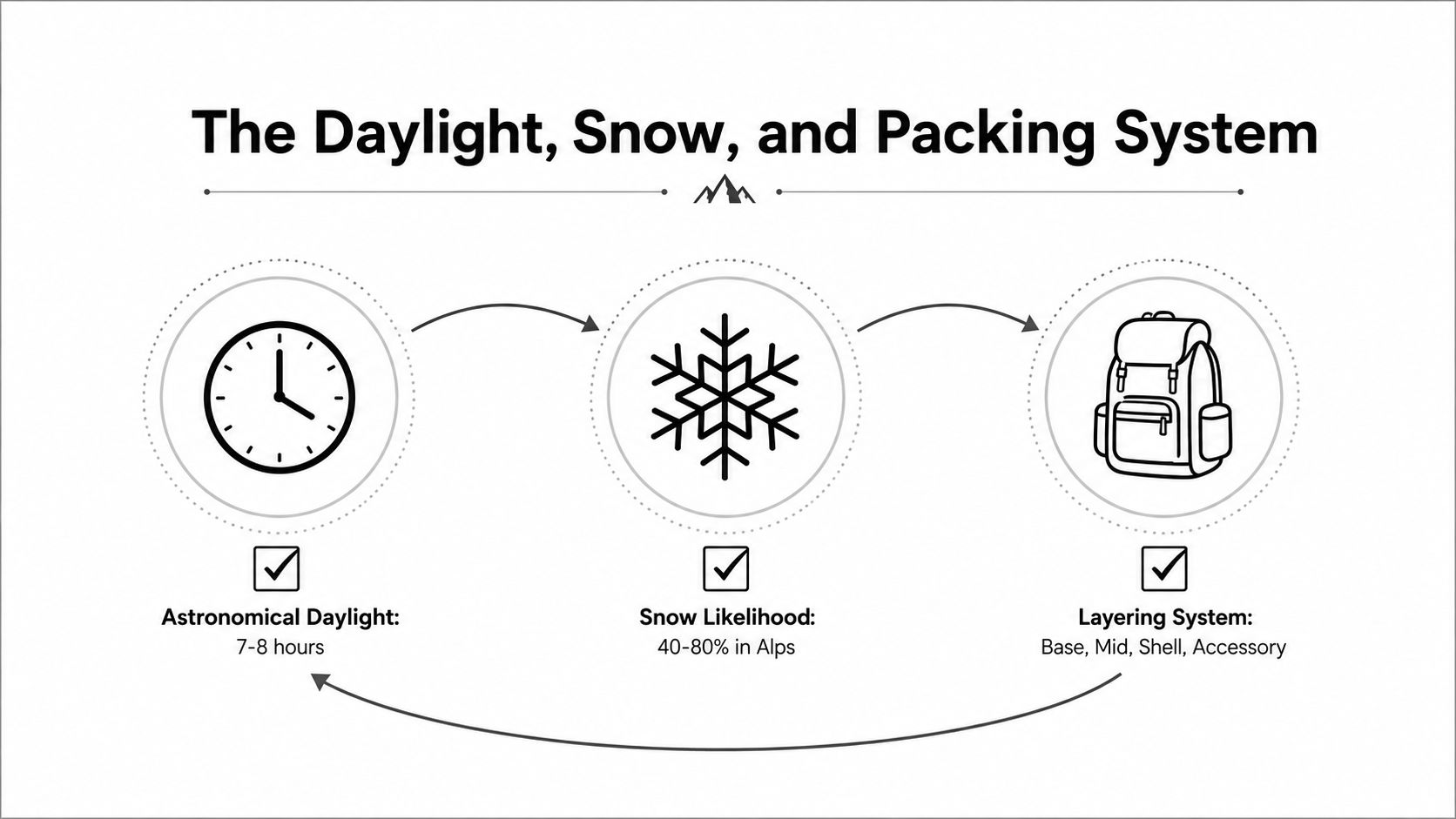
December packing works best when you treat light, surface conditions, and clothing as one problem. Shorter days reduce the time available for outdoor sightseeing. Snow and ice slow walking and transport. Wet weather can turn a comfortable temperature into a miserable one, particularly when you're waiting outside or standing at a market.
In northern and central Europe, sunset can arrive before 4 p.m. in cities such as Munich or Warsaw, so a morning-to-afternoon sightseeing plan isn't an optional preference. It's a sensible response to the season. Schedule viewpoints, historic districts, and outdoor photography during the brightest part of the day, then reserve museums, food halls, churches, concerts, and long meals for the darker hours.
Practical rule: Put your most weather-sensitive activity first. If the light disappears or rain arrives, you'll still have an indoor plan.
Snow likelihood varies sharply. The Alps, Scandinavia, and parts of Eastern Europe are the natural choices for travelers who want snow, but snowfall isn't guaranteed in every city or on every date. Mediterranean and Atlantic coastal destinations usually offer a much lower chance of a sustained snowy scene, which is useful if you prefer walking without ice but disappointing if you want a white Christmas setting.
Build one modular kit
Start with a thermal or moisture-managing base layer. Add a fleece, wool sweater, or light insulated mid-layer. Finish with a waterproof shell that blocks rain and wind. This combination works across much of western, central, and southern Europe because you can adjust it inside heated buildings and on changing streets.
Then make one regional swap:
- Northern Europe and the Alps: Add insulated boots, warmer gloves, and stronger traction.
- Western Europe: Prioritize waterproofing, a compact umbrella, and quick-drying clothing.
- The Mediterranean: Replace heavy insulation with a lighter mid-layer and keep a shell for rain.
- Eastern Europe: Keep thermal layers, a warm hat, and footwear suitable for icy surfaces.
- Atlantic islands: Choose breathable layers and a rain shell rather than ski-style equipment.
A headlamp can help on rural paths, early departures, and poorly lit approaches. A small daypack keeps your removed layer, power bank, water, and shell together. For a simplified version of this system, see how to pack light.
Matching Your December Weather Preference to the Right Place
The best destination depends less on a universal “best” list than on the kind of December you want to experience. Start with the weather preference, then accept the trade-off that comes with it.
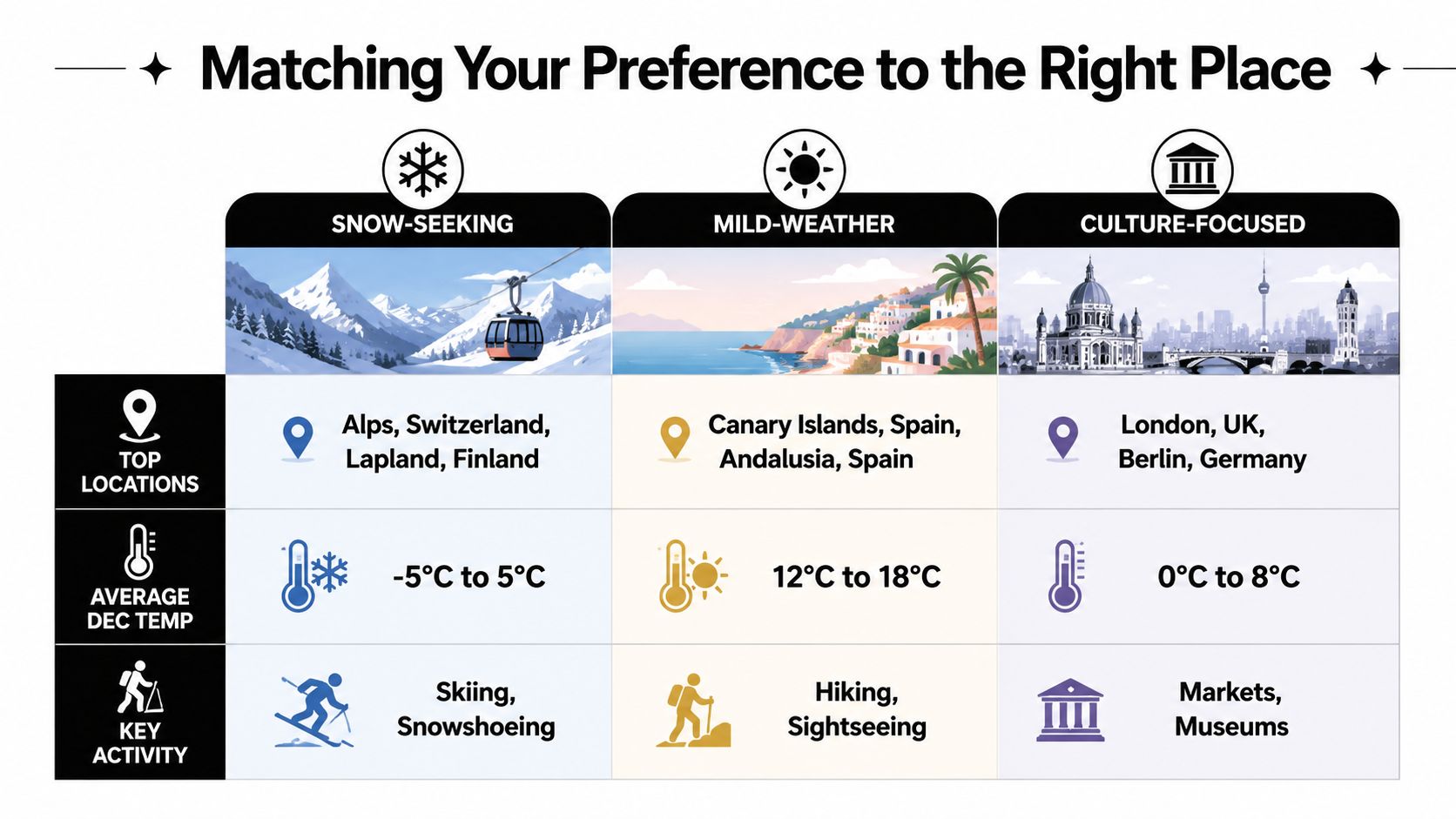
If snow is the priority
Choose the Alps, Dolomites, Lapland, or the Carpathians. These regions give you the strongest chance of a truly wintry setting, with mountain villages, snow activities, and scenes that feel distinct from an ordinary city break. Lapland suits travelers who want Arctic atmosphere and organized outdoor experiences. The Alps and Dolomites work better if you want mountain scenery combined with established villages and rail-connected bases. The Carpathians can appeal to travelers seeking a quieter, more rugged winter mood.
The compromise is logistical. Snow brings slower roads, equipment needs, and greater exposure to disruption. Don't choose a remote mountain itinerary if you're unwilling to build flexibility into transfers.
If mild weather matters most
Look toward the Canary Islands, southern Portugal, Andalusia, Malta, or Cyprus. Athens and Barcelona also fit the broader mild southern pattern, with long-term December normals showing average highs of 15°C and 14°C respectively in the city climate records. These destinations favor walking, architecture, food, coastal scenery, and outdoor cafés over snow-based activities.
The trade-off is visual rather than practical. You may get easier sightseeing and lighter luggage, but you shouldn't expect reliable snow or the classic frozen-market postcard.
If festive culture comes first
Vienna, Strasbourg, Nuremberg, Cologne, and Prague offer the strongest cultural case for December. Markets, illuminated squares, seasonal food, concerts, museums, and historic architecture create an atmosphere that mild coastal destinations can't reproduce.
But many budgets fail here. The most festive cities attract the most concentrated demand, especially around the main holiday period. Expect crowded central areas, higher accommodation pressure, and less room for spontaneous bargains. Book a secondary neighborhood, choose a weekday arrival, or select a smaller nearby city if the atmosphere matters more than collecting famous market names.
A useful pairing is culture in a central city, mild weather elsewhere. Spend a short festive stretch in Vienna or Prague, then continue south for more comfortable daytime walking. That approach costs more planning, but it avoids forcing one destination to satisfy incompatible weather expectations.
The Honest December Budget Picture
December isn't automatically cheap. It has at least two different pricing seasons, and weather can make the cheaper option less enjoyable if your itinerary depends on long outdoor days.
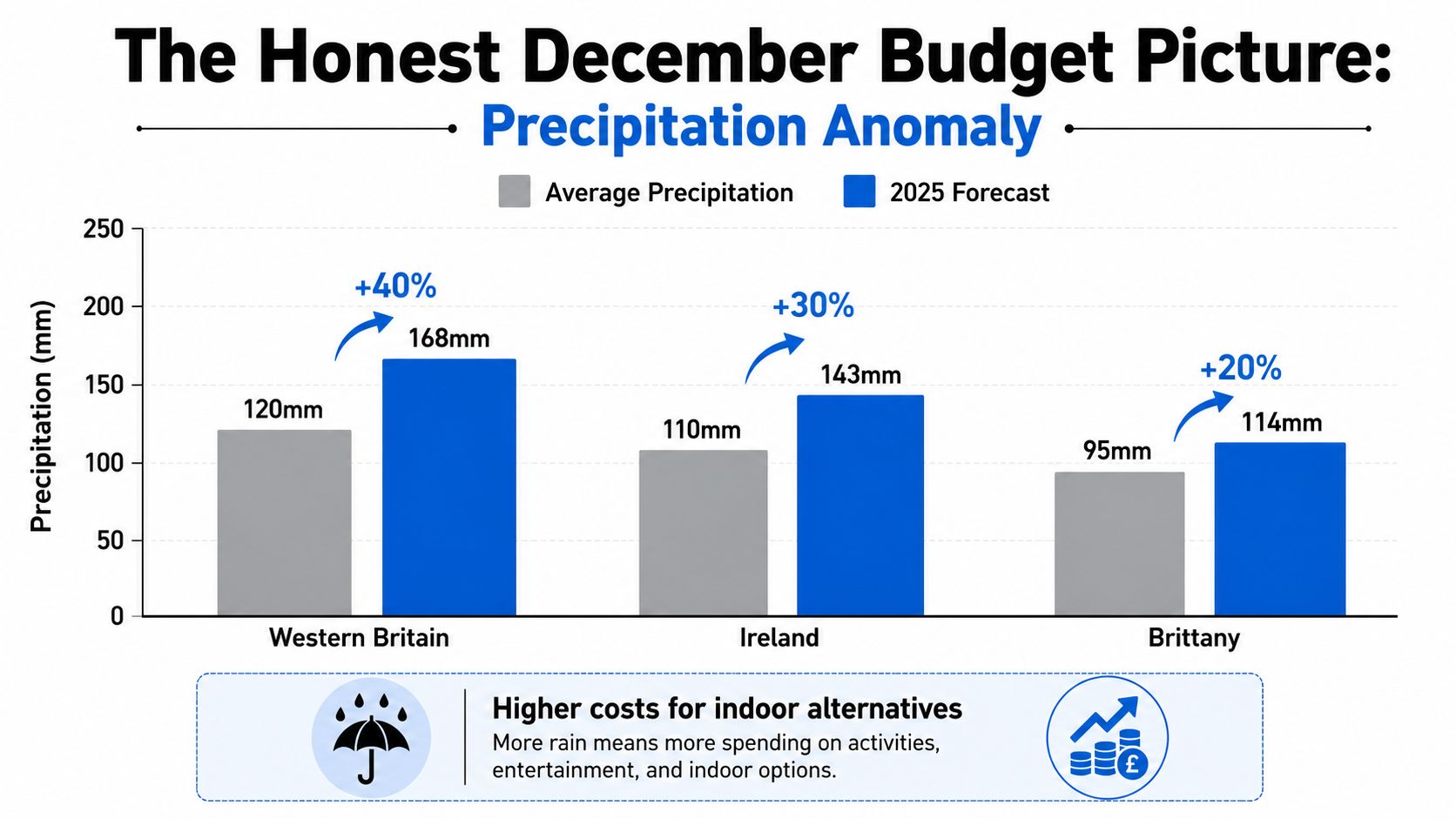
The first part of the month can offer better value in cities that rely heavily on holiday demand, particularly if you avoid the most famous central districts. The final holiday period is different. Festive markets, school breaks, and seasonal events can push demand high enough to erase the usual winter discount. A low room rate also loses its appeal if rain forces you into paid indoor alternatives or if transport delays disrupt a tightly packed route.
Weather patterns add another layer. Copernicus reported that December 2025 was wetter than average across western Britain, much of Norway, northern Sweden, Finland, and parts of the Atlantic and Mediterranean margins, while France, Germany, the Netherlands, Denmark, Switzerland, and large areas of Italy and the Balkans were drier than average, according to its December 2025 precipitation assessment. That doesn't predict your exact week, but it shows why two December itineraries can produce very different practical costs.
Where the discount is most believable
Look for:
- Early-month dates: The period before the main holiday rush can offer calmer streets and more accommodation choice.
- Secondary cities: Smaller cultural centers may deliver markets and museums without the same central-city premium.
- Weather-resilient routes: Regions with strong museums, public transport, and indoor attractions protect your plans when rain arrives.
- Flexible bookings: Refundable rooms and changeable transport reduce the cost of a forecast that shifts against you.
Demand remains resilient. European international tourist arrivals were up 5.6% and overnight stays up 5.5% in early 2026 compared with early 2025, according to the Copernicus December 2025 climate coverage. That signal makes last-minute bargains less dependable in popular corridors.
For a practical cost-planning framework, compare these conditions with guidance on the cheapest way to visit Europe. The honest rule is simple: December is cheapest when you avoid peak holiday dates, choose places that remain enjoyable in poor weather, and don't mistake a low headline fare for a low total trip cost.
Solo, Safe, and Ready for Short Days
Short daylight changes solo travel safety because you may finish a walking tour while streets are still busy, then return after conditions have become darker, wetter, or icier. Put your core outdoor sightseeing between roughly 10 a.m. and 3 p.m., then use museums, cafés, markets, and performances for the evening.
Carry a small headlamp, keep a reflective strap visible on rural approaches, and download offline maps before leaving accommodation. Take extra care on Prague's uneven lanes, Lisbon's steep hilltops, and northern rail stations where snow, darkness, and platform changes can combine into a stressful transfer.
Weather also makes delays more consequential. Reserve a refundable first-night stay, leave a buffer day before an important departure, and keep a printed emergency plan with accommodation details, transport alternatives, and local contact information. Don't build a solo itinerary around the final train or flight of the day when a missed connection would strand you.
Cities with reliable public transport, strong indoor attractions, and plenty of central accommodation are usually easier December bases. Use the destination ideas in this guide alongside European cities suited to solo travel, then choose the place whose daylight, weather, and backup options match your confidence level.
Travel Talk Today helps you turn seasonal travel questions into practical, affordable itineraries, with weather-aware planning, budgeting guidance, solo travel resources, and thoughtful destination ideas. Visit Travel Talk Today to choose your December climate zone, build a flexible route, and plan a trip that feels meaningful rather than rushed.