Most advice about finding a safe area in Mexico is lazy. It either says “Mexico is dangerous” or hands you a feel-good list of beach towns and calls it a day. Neither helps you make a smart decision.
The better question is simpler and far more useful. Not “Is Mexico safe?” Ask, “Which part of Mexico fits my travel style, risk tolerance, and actual itinerary?” That's how experienced travelers think. Mexico isn't one safety story. It's a patchwork of states, cities, neighborhoods, and transit routes that can feel completely different from one another.
That's good news, not bad news.
It means you're not stuck with a vague national headline. You can make targeted choices. You can pick a stronger state, a smarter city, a better neighborhood, and a safer way to get from the airport to your hotel. Those choices matter more than fear-based generalizations.
I'll be blunt. A lot of travelers get into trouble because they ask the wrong question. They obsess over whether Mexico is “safe” in the abstract, then book the cheapest arrival transfer, land late, stay in a random area, and wing it. That's backward. Safety in Mexico is mostly about specificity.
The safest trip isn't built by luck. It's built by narrowing your decisions.
If you want informed confidence, use a simple framework. Judge Mexico at four levels:
- State
- City
- Neighborhood
- Transit plan
Do that well, and Mexico becomes much easier to manage with a clear head. Skip it, and even a good destination can become a stressful one. That's the difference between nervous tourism and savvy travel.
Rethinking the Question About Safety in Mexico
The internet loves dramatic answers. “Mexico is unsafe.” “Mexico is totally fine.” Both are half-truths, and half-truths are useless when you're choosing where to sleep, how to move around, and whether to book that bus or that ride from the airport.
A safe area in Mexico depends on who you are and how you travel. A solo female traveler landing after dark has different needs than a couple staying in a walkable historic center. A backpacker using buses has different exposure than a family booking private transfers. If you ignore that, you'll end up with generic advice that doesn't fit your trip.
Ask traveler-specific questions
Start with your actual habits, not your fantasy itinerary. Be honest.
- Arrival pattern: Are you landing in daylight, or arriving late and tired?
- Movement style: Will you stay put, or hop between places every few days?
- Budget reality: Are you choosing the cheapest lodging, or paying more for a better location?
- Comfort level: Do you want a quiet base, nightlife, beaches, or a big city?
Those answers shape what “safe” means for you.
Stop treating the whole country as one destination
Mexico rewards travelers who think in layers. A state can be a good starting point, but one city may suit you better than another. A city can be solid overall, but one neighborhood may be clearly better for walking, sleeping, and late returns. Even then, your transport choices still matter.
That's why broad reassurance doesn't cut it. You need a method.
Practical rule: Don't choose a destination first and ask safety questions later. Choose safety filters first, then pick the destination that passes them.
If you take that approach, fear starts shrinking fast. You stop guessing. You stop scrolling doom-filled comment sections. You start comparing actual signals that affect your trip in the physical world.
Understanding Mexico's Real Safety Landscape
Here's the part travelers get wrong. They treat Mexico like a single safety verdict when it works more like a patchwork of very different local conditions. If you want to find a safe area in Mexico, stop asking for one national answer and start sorting risk by level: country, state, city, neighborhood, then your actual routine inside it.
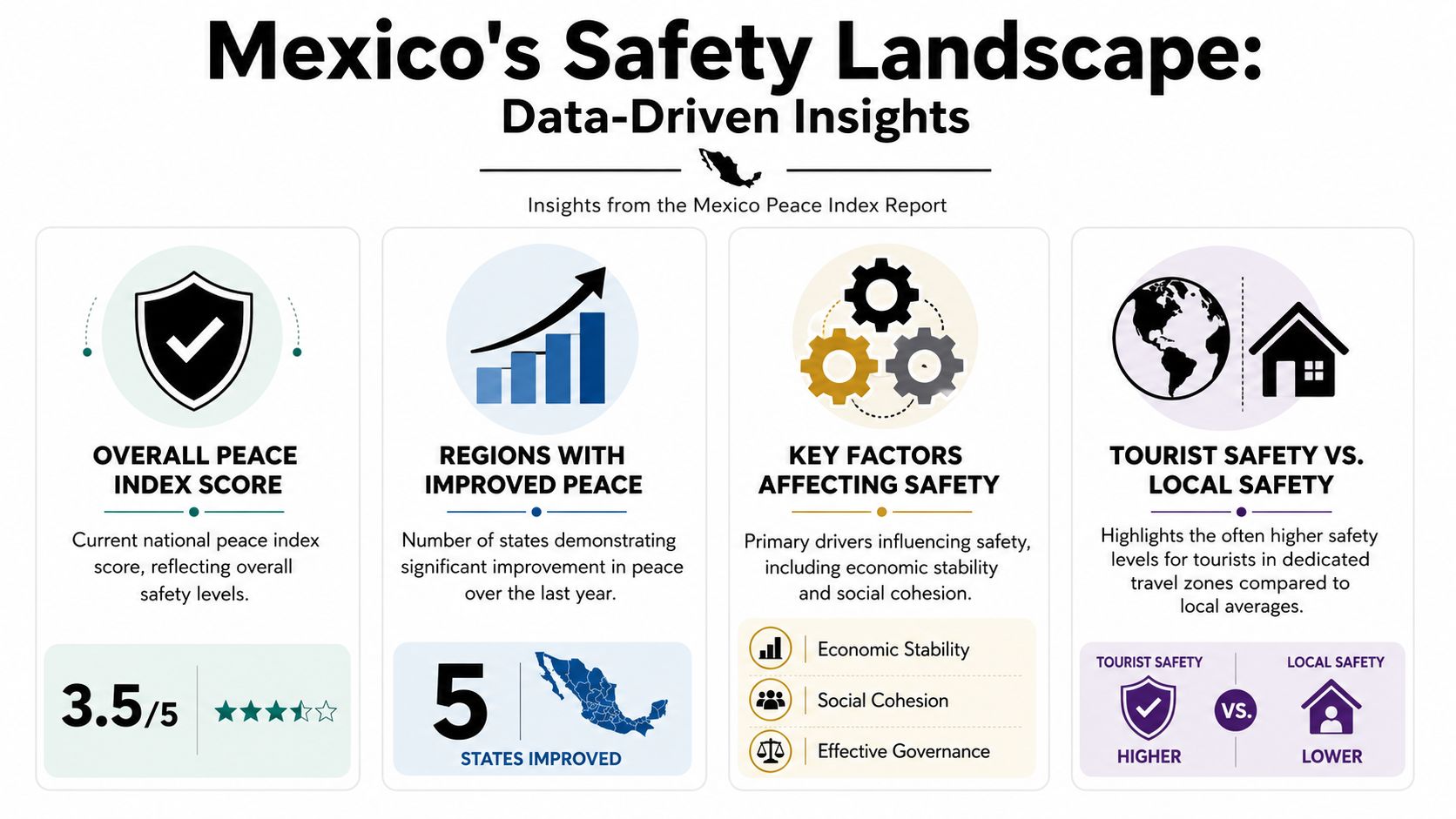
At the country level, the broad pattern is uneven. Analysts behind the Mexico Peace Index found that most states improved in peacefulness in the latest report, while a smaller group worsened. Yucatán remained the most peaceful state, Colima remained the least peaceful, and the national homicide rate moved down while overall peacefulness improved. Useful? Yes. Enough to book a hotel? Not even close.
What the national picture actually means
National data is a filter, not a final answer.
Use it to rule out weak bets and to spot states with a steadier record. Do not use it to assume your resort zone, downtown rental, or late-night transport plan is automatically fine. Travelers experience Mexico at street level, not spreadsheet level.
That distinction matters because national improvement can sit alongside serious security problems. The same report notes that missing persons cases have exceeded 113,000 since 2010 (Mexico Peace Index 2026). You should take that seriously. You should also refuse to let one national number do all your thinking for you.
Here's the practical read:
| What national data can do | What national data cannot do |
|---|---|
| Show which states are trending better or worse | Tell you which neighborhood to book |
| Help you eliminate obvious poor-fit regions | Confirm that every tourist area in a "better" state is low risk |
| Give you a starting point for comparison | Replace checking arrivals, transport, and after-dark conditions |
This is the mindset I recommend. Build your safety judgment the same way an insurer prices risk. Start broad, then narrow fast. Look for repeat signals that stack in your favor: a stronger state-level record, a city that functions well for your trip style, and a neighborhood that matches how you move around. Then back it up with a policy chosen through a travel insurance comparison guide.
Smart travelers judge Mexico by layers, not headlines.
That approach calms people down because it gives them a method. You stop reacting to fear-based commentary and start weighing location-specific odds like an adult who plans to enjoy the trip and come home without drama.
Pinpointing Safer States and Regions for Travel
If you ignore the state map, you're planning blind. That's not dramatic. It's just true. Mexico is one of those countries where the state-level view isn't a detail. It's the foundation.
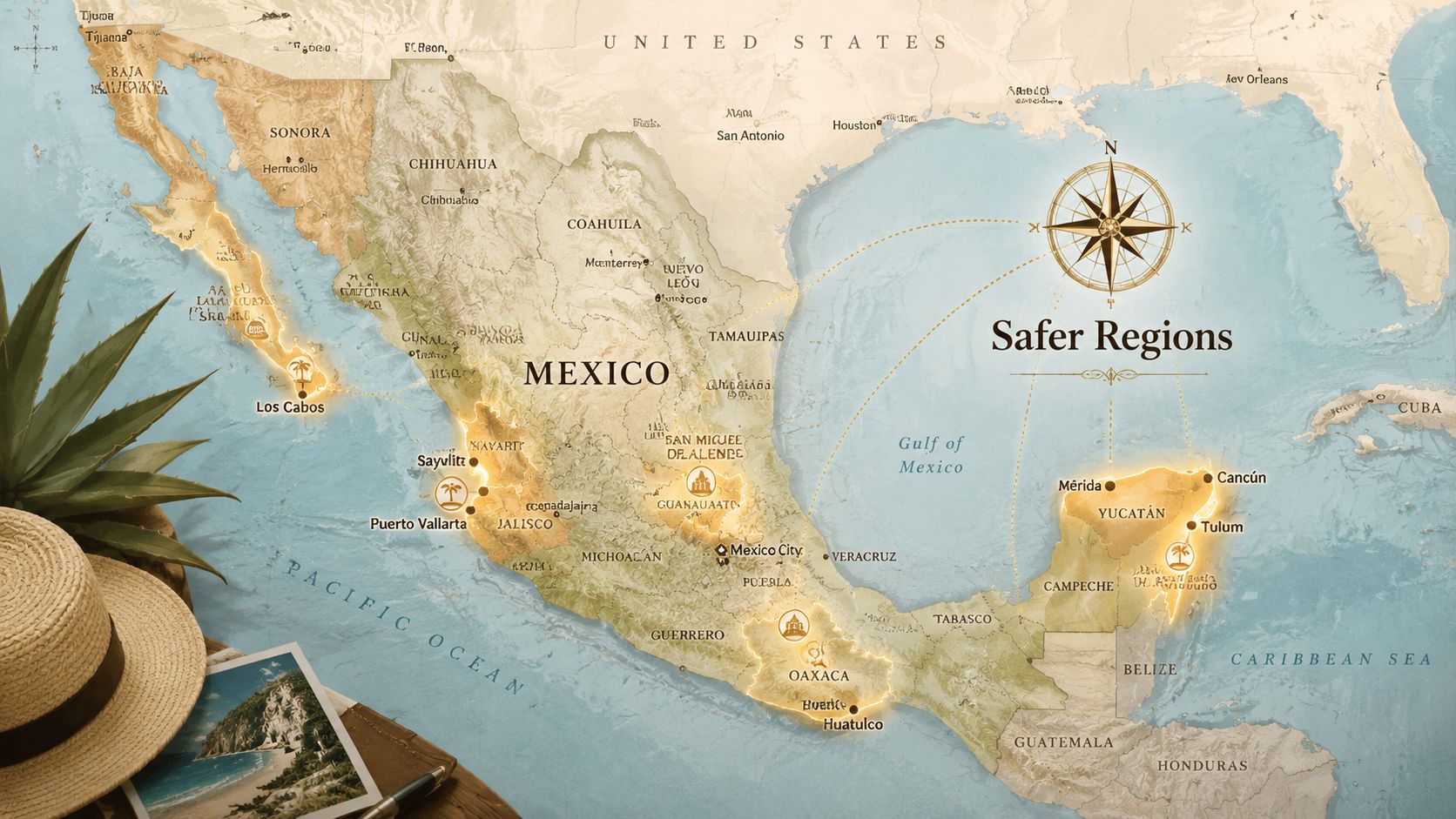
The U.S. Embassy doesn't treat Mexico as one uniform destination. It breaks the country into consular districts and maps travel risk operationally by region in its restricted areas and consular district guidance. That structure is useful because it mirrors how smart travelers should plan. State first. Then city. Then neighborhood.
Start with the states that make practical sense
The Embassy's district map shows, for example, that the Mérida district covers Campeche, Quintana Roo, and Yucatán, while the Mexico City district covers multiple states including Mexico City, Oaxaca, Querétaro, Puebla, and others. That tells you something important. Risk assessment in Mexico is already handled region by region by officials who have every reason to be precise.
My advice is straightforward. If you want a calmer first trip, start by looking hard at the Yucatán Peninsula, especially the areas tied to the Mérida district. That doesn't mean “switch your brain off.” It means those states deserve to be near the top of your shortlist when safety is a priority.
Use a simple regional sorting method
Don't overcomplicate it. Sort states into three practical buckets.
- Best first look: States with stronger peace indicators or stronger practical reputations for organized tourism and easier logistics.
- Possible with tighter planning: States where a specific city or corridor may work, but your route and neighborhood choices matter much more.
- Not worth forcing: States or corridors where you'd need to spend too much energy managing avoidable risk.
That's why I like Yucatán as a starting point for cautious travelers. If you want ideas once you narrow your map, this guide to Yucatán Peninsula attractions helps with the fun part after the risk filtering is done.
Pick the state the way you'd pick a hotel neighborhood. You're not looking for perfection. You're looking for fewer bad variables.
Don't let one famous destination override the map
Travelers often do this backward. They fall in love with a specific destination on social media, then try to talk themselves into the surrounding region. That's a mistake.
A destination can be beautiful and still be the wrong choice for your trip style. If you're traveling solo, moving on a budget, arriving at odd hours, or relying on local transport, the safer decision is often the place that demands less defensive planning.
That's what a good safe area in Mexico really is. Not the place with the most hype. The place where your itinerary stays simple, your arrival is clean, and your margin for error is wider.
Top Safe Cities for Every Type of Traveler
Once you've chosen the right region, city selection gets more personal. Many travelers finally relax at this stage, because the map starts looking human. You're no longer comparing states. You're comparing daily life. Walkability, vibe, transport, lodging options, and how much friction your trip will involve.
Independent safety data also shows why this step matters. In the International Citizens Insurance guide to safer places in Mexico, Mexico's countrywide safety index is 46.33 out of 100, while Sayulita is listed with a safety index of 90.0, a crime index of 10.0, and a homicide rate of 0 from April 2023 to March 2024. The same source also lists other comparatively safer cities with homicide rates as low as 1.5 per 100,000 and 3.5 per 100,000.
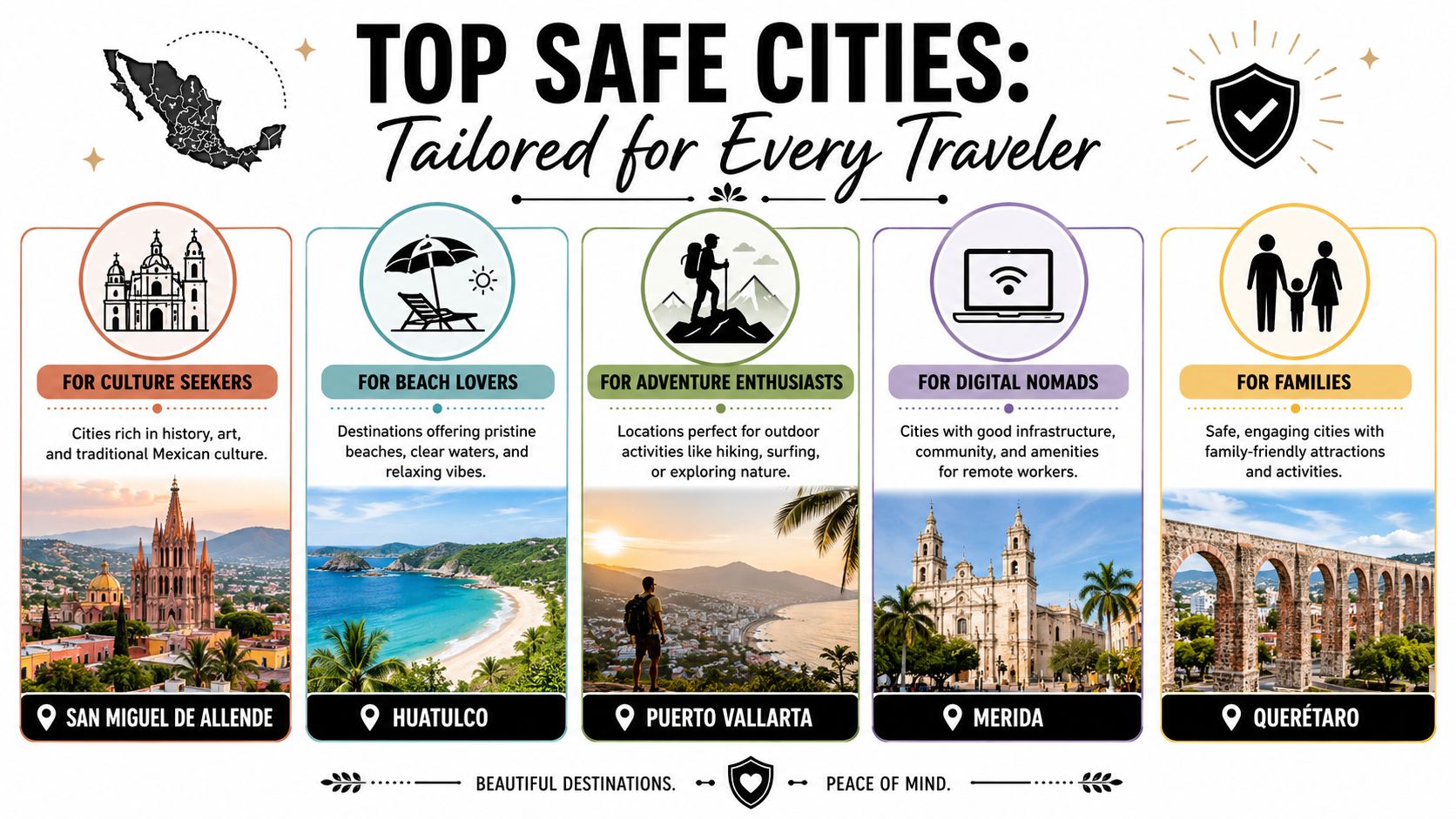
Match the city to the traveler
The lesson isn't “go to Sayulita because of one score.” The lesson is that city-level variation is huge, and tourist-friendly places can perform very differently from the national baseline.
Here's how I'd think about city fit:
| Traveler type | Better city profile | Why it works |
|---|---|---|
| Solo traveler | Walkable city with active central areas | Fewer isolated moments, easier returns at night |
| Digital nomad | Stable city with services and comfortable neighborhoods | Easier daily routine, less transit friction |
| Budget backpacker | Smaller tourist town or manageable regional city | Lower complexity, easier social connections |
| Family or cautious couple | Calm city with strong accommodation choices | Simpler logistics and fewer bad surprises |
For solo travelers, choose places where you won't need complicated transport every day. If you want broader ideas beyond Mexico, this roundup of best cities for solo travelers is useful for comparing what makes a destination feel manageable.
My practical city recommendations
I'd group strong options like this:
- Mérida for travelers who want a stable base, easier pacing, and less nightlife-driven chaos.
- Sayulita for people who want a social beach town and are comfortable with a tourist-focused environment.
- Querétaro for travelers who prefer urban structure without the intensity of the largest metros.
- Well-chosen parts of Mexico City for travelers who want culture and city energy but are willing to book carefully at the neighborhood level.
That last point matters. Mexico City can be a great trip. It can also be a sloppy trip if you book in the wrong area and treat the city as one homogeneous place.
A city isn't “safe” because it's popular. It's safer when its daily logistics are easy to control.
Don't chase a city that fights your habits
If you're a late-night wanderer, a quiet city with limited transport may not suit you. If you're budget-first and constantly changing hostels, a larger city may create more points of failure than a smaller one. If you're anxious in giant metros, don't force yourself into one because everyone online says it's exciting.
The best safe area in Mexico is the one that reduces decision fatigue. You want fewer awkward transfers, fewer unfamiliar zones, and fewer moments where you're improvising because something ran late. Good safety planning isn't glamorous. It's friction reduction.
Finding Your Safe Haven Within a City
Picking the right city is only half the job. The next half is where experienced travelers wisely save themselves a lot of hassle. They choose the right neighborhood.
That's especially true in major metros. In a city like Mexico City, one colonia can feel polished, walkable, and easy to get around, while another area a short distance away feels much less comfortable for a visitor. According to a travel safety review that cites GeoSure in this Mexico City safety article, Roma Sur, Nápoles, and Centro Histórico are among the comparatively safer areas, along with places such as Noche Buena, Piedad Narvarte, and Reforma Iztaccíhuatl Norte. The same review flags locations north of Cerro de la Estrella National Park as lower safety.
Use a neighborhood filter before you book
Don't start with the hotel. Start with the block.
A lot of travelers sort by price, photos, or aesthetics. That's how you end up in a pretty apartment on a bad street. Reverse the order. Choose the neighborhood first, then compare hotels and rentals inside it.
When I evaluate a neighborhood, I look for these signals:
- Street activity: Are there cafes, convenience stores, and people out at normal hours?
- Lighting: Does the area look walkable after dark, or does it empty out?
- Arrival ease: Can you get there from the airport or bus station without weird transfers?
- Building security: Is there controlled access, staffed reception, or a doorman?
- Return comfort: Would you feel fine coming back after dinner?
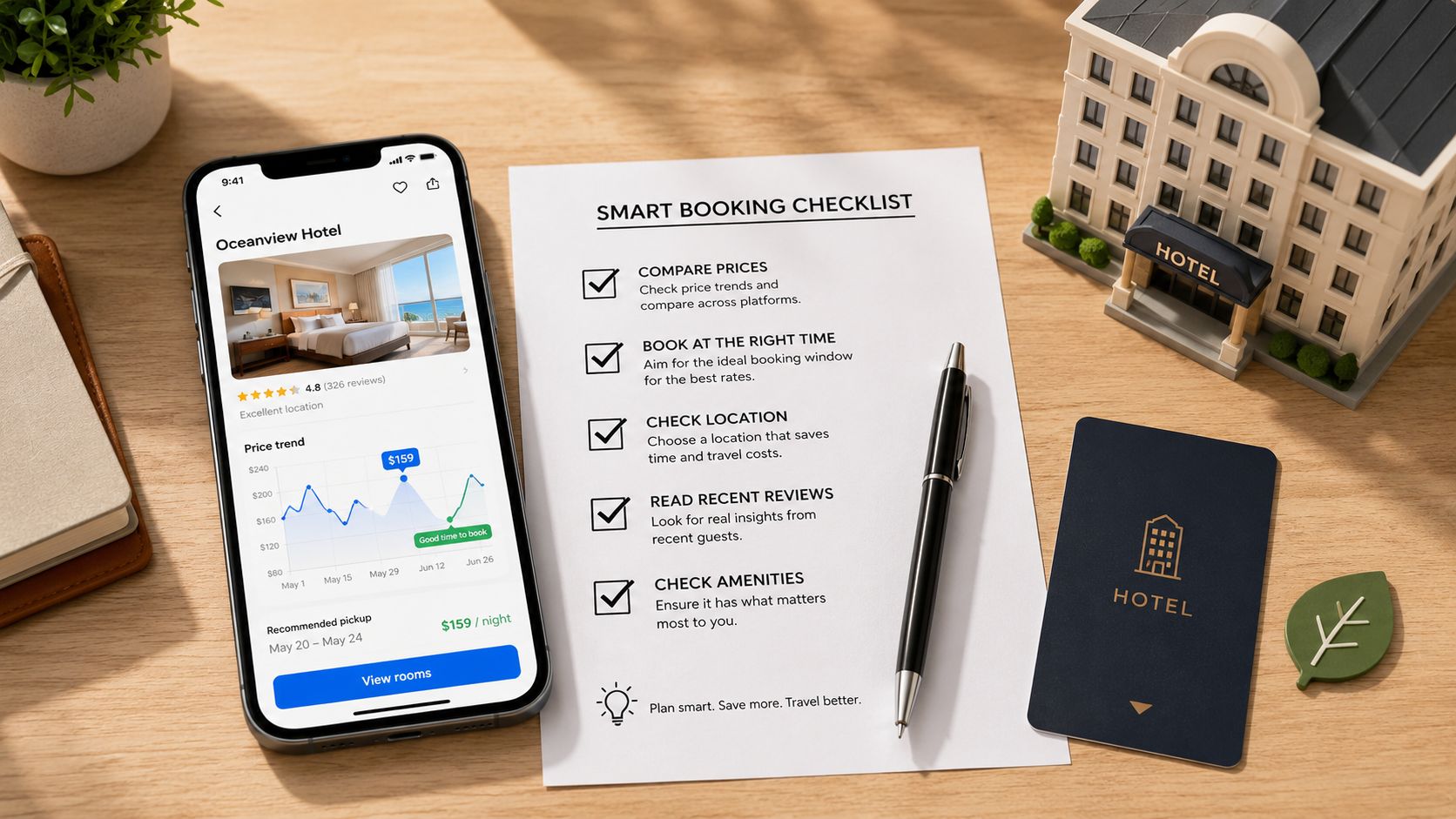
A quick booking checklist
Use this before you reserve anything in a city.
- Drop the pin into the map. If the listing won't show a real area, skip it.
- Scan nearby businesses. A few active places nearby usually beat a dead residential pocket.
- Read recent reviews for location language. You're looking for comments about walking, noise, late returns, and transport ease.
- Check access points. Main roads are useful. Being directly on a loud or chaotic artery often isn't.
- Choose controlled entry over extra square footage. A smaller room in a better building wins.
If you're balancing budget and location in beach destinations too, this guide to cheap places to stay in Playa del Carmen is a good reminder that cheaper doesn't have to mean careless.
Good neighborhood choices often matter more than the city label on your itinerary.
What to do once you arrive
Even a strong neighborhood needs a quick reality check in person. On your first walk, pay attention to who's using the streets. Families, workers, dog walkers, diners. That's usually a better sign than a photogenic listing description.
Then tighten your routine. Use authorized ride-hailing. Save your hotel pin. Note the nearest convenience store, pharmacy, and main avenue. If the area feels off after dark, listen to that and adjust fast.
A safe area in Mexico isn't just where crime is lower on paper. It's where your normal daily movements feel simple, visible, and easy to repeat.
The Smart Traveler Playbook for Everyday Safety
A lot of travel advice treats safety like a destination problem. It isn't. It's a behavior problem just as often. You can choose a solid area, then undercut yourself with careless transport, lazy lodging choices, or late-night decisions that add risk for no good reason.
One point gets overlooked constantly. Risk for travelers is often concentrated outside tourist zones and during transit, especially around arrivals and unofficial rides, as highlighted in this Going guide on safer cities in Mexico. That's why I care so much about movement. A good destination doesn't protect you from a sloppy transfer.
Transportation habits that actually matter
Your airport arrival is one of the most important moments of the trip. You're tired, distracted, carrying luggage, and easier to read as a visitor. That's when vague plans become bad plans.
Use a simple rule set:
- Book or confirm your airport transfer before landing when possible.
- Use official or vetted transportation only for airport pickups and late-night returns.
- Avoid improvising on the curb with anyone who approaches first.
- Don't switch transport modes repeatedly if one direct option is available.
Late-night movement deserves its own rule. If you wouldn't want a friend doing it alone in a place they don't know, don't romanticize it for yourself.
Accommodation habits that reduce friction
You don't need luxury. You need predictability.
Choose lodging that gives you:
- Controlled access
- A staffed check-in process or clear host communication
- Recent reviews that discuss the area, not just decor
- Easy pickup and drop-off points
If you're traveling alone, save the property name, exact address, and a screenshot of the map offline. Don't assume your phone will behave perfectly when you need it most.
Field rule: Most avoidable travel stress starts when you're tired, rushed, and making decisions in public.
Street sense without paranoia
You don't need to act scared. You do need to act switched on.
A few habits go a long way:
- Keep your phone use intentional. Don't stand on the sidewalk broadcasting confusion.
- Carry what you need for the outing, not your whole life.
- Return before things get inconvenient. Trouble often starts when transport options thin out.
- If a situation feels off, leave early. You won't regret being slightly overcautious.
If you travel solo, sharpen those basics with these solo travel safety tips. The core principle is simple. Reduce exposed moments. Don't create unnecessary ones.
The safest traveler in Mexico usually isn't the boldest one. It's the one who keeps margins, plans transfers, and avoids turning minor uncertainty into a complicated night.
Your Personal Checklist for Choosing a Safe Area
Good Mexico planning comes from a filter, not a feeling. The travelers who choose well usually ask the same questions every time: What do the state-level numbers look like? Does the city fit the kind of trip I'm taking? Can I handle arrival, sleep, transport, and daily movement without unnecessary exposure?
Use that framework and your choices get clearer fast.
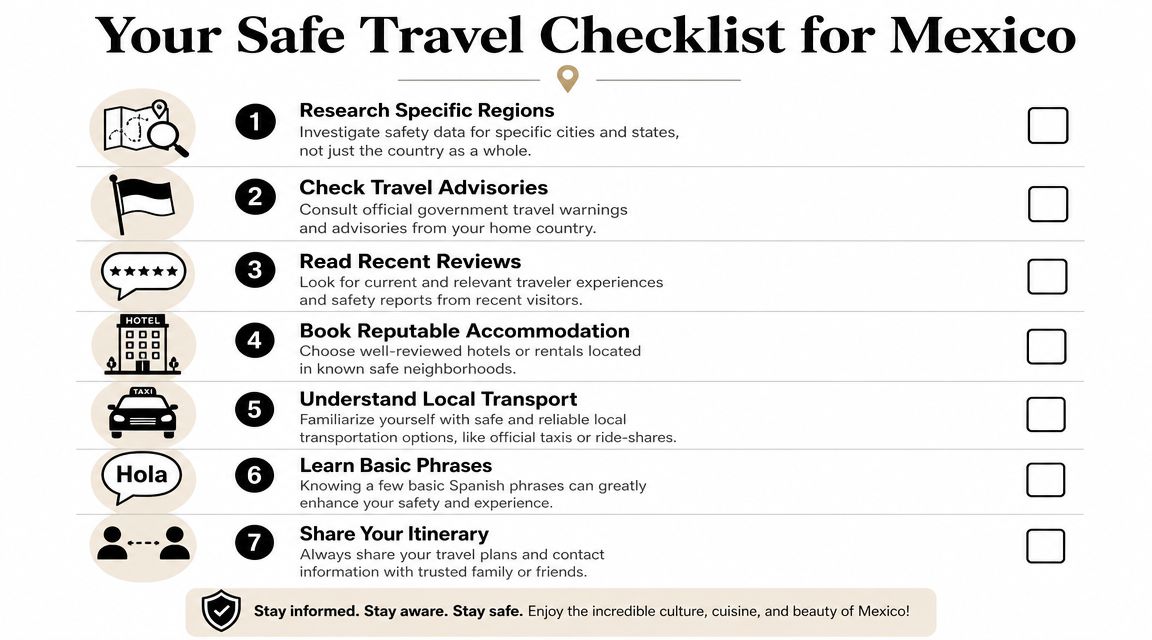
The seven-point decision filter
Run each destination through this filter before you book anything.
Start with the state
Check the official security picture first. If the state already sits outside your comfort zone, stop there and pick another option. No city hotel deal is good enough to override a weak starting point.Choose a city that fits your actual behavior
Pick a place that matches how you travel. If you like walking, early nights, and simple logistics, choose a city that supports that. If a destination only works when everything goes perfectly, it is a poor fit.Judge the neighborhood as hard as the hotel
Property photos sell rooms. The surrounding blocks determine how relaxed or exposed you feel. A modest hotel in a well-situated area usually beats a stylish stay in an awkward one.Solve arrival before you commit
Look at your landing time, airport distance, and transfer plan before you buy the ticket. Late arrival with no clear pickup plan is an avoidable mistake.Spend money where it reduces risk
Put your budget into location, airport transfer, and lodging with controlled access. Those upgrades matter more than extra square footage, rooftop decor, or boutique branding.Read reviews like a risk check, not a marketing brochure
Skip comments about cute tiles and free cocktails. Look for recent mentions of street activity, noise, walkability, transport, check-in, and how the area feels after dark.Keep the first trip simple
Fewer moving parts give you more control. One solid base with easy day trips is usually a smarter first Mexico itinerary than a rushed route across multiple cities.
A quick self-audit before you go
Be blunt with yourself. If your answers sound vague, the plan is still weak.
| Question | Strong answer | Weak answer |
|---|---|---|
| Do I know my exact neighborhood? | Yes, and I checked how it functions day and night | Not really, but the photos look good |
| Do I know how I'm leaving the airport? | Yes, it's booked or clearly vetted | I'll sort it out when I land |
| Does this city match my habits? | Yes, it suits how I move, sleep, and spend | It seemed popular online |
| Would I suggest this setup to a friend I care about? | Yes, without adding warnings | Maybe, with a few caveats |
If you have to keep justifying a choice, drop it.
My final recommendation
For travelers trying to find a safe area in Mexico, keep your method simple and repeatable. Start broad with official state-level conditions. Narrow to cities with straightforward logistics and tourism patterns that make daily movement easier. Then get picky about the neighborhood, because that is where your trip is lived.
That is the skill. You are not looking for a magical “safe” pin on a map. You are learning how to judge risk with the same criteria every time.
Mexico rewards travelers who prepare well and choose carefully. Do that, and you can relax for the right reasons. The plaza at dusk, the morning coffee run, the market lunch, the long walk back to your hotel that feels easy instead of uncertain.
Travel Talk Today helps travelers do exactly that: make smarter choices with practical, grounded advice instead of recycled hype. If you want more destination planning, safety frameworks, and budget-conscious travel guidance, explore Travel Talk Today.