You're probably closer to your next trip than you think.
A lot of travelers believe they need a dramatic breakthrough to finally book the flight, take the sabbatical, or say yes to the rail pass, the hostel, the island ferry, or the long weekend abroad. They wait for a tax refund, a bonus, or some mythical future month when money feels easy. Meanwhile, the actual driver of travel funding often starts much smaller.
That's why the puzzle of a penny doubled for 30 days still grabs people. On the surface, it sounds like a silly math trick. In practice, it reveals something deeper. Small actions can stay invisible for a long time, then suddenly look powerful. For travelers, that mindset matters far more than the fantasy itself.
The Million Dollar Question Most People Get Wrong
A friend offers you a choice.
You can take $1 million right now, or you can take one penny that doubles every day for 30 days. Grabbing the million is a common, unhesitating choice. It feels sensible. It feels safe. It feels like the grown-up answer.
Then the math flips the room.

The classic result says the penny wins. By the end of the challenge, the total reaches $5,368,709.12, based on the standard calculation shown by Math Central's penny-doubling example.
That answer feels absurd because the beginning feels so small. A penny barely registers. It won't buy airport coffee. It won't cover a baggage fee. It won't move your travel fund in any visible way. But that's the whole lesson. People tend to underestimate what happens when growth keeps stacking on itself.
Why travelers misread this puzzle
Travelers do this all the time with money.
You skip a dedicated savings account because the first deposit seems too tiny. You don't start collecting points because your first month looks slow. You tell yourself you'll build a travel cushion later, when you can save “real money.” Then later keeps moving.
A better approach is simpler. Start before it feels impressive.
If you want practical systems for that kind of consistency, these smart travel budgeting tips are a strong next step.
The biggest travel funds rarely begin with big money. They begin with a rule someone actually follows.
The penny puzzle is memorable because it exposes a blind spot. We respect big results, but we often ignore small beginnings. For travel, that's expensive thinking.
The Shocking Math of a Doubling Penny
A doubling penny works like a long road trip where the first few hours feel ordinary, then the distance covered in the final stretch changes the whole story. The math stays simple. Our instincts are what struggle.
The daily amount follows $0.01 × 2^(n-1). Each day is twice the day before. That rule creates a result that feels impossible at first glance. Early in the month, the numbers barely look worth tracking. Later, they jump so fast that the final days carry most of the weight.
A few checkpoints make that easier to see. On day 10, the daily amount is only $5.12. On day 20, it is $5,242.88. On day 30, the daily amount reaches $5,368,709.12.
That last leap is the part people remember. The slow start is the part that teaches the key lesson.
Why the pattern feels so strange
Daily saving usually feels linear. Put in ten dollars, then another ten, and the total rises at a pace your brain can follow. A doubling pattern behaves differently. It stays quiet for a long time, then the late days do work that the early days could never do on their own.
Travelers run into this mental trap all the time. A new savings habit can look too small to matter in week one, just like the penny looks too small to respect in day one. The math says patience matters more than early drama.
Here's the day-by-day view.
A Penny Doubled Daily for 30 Days
| Day | Amount for the Day | Total Accumulated |
|---|---|---|
| 1 | $0.01 | $0.01 |
| 2 | $0.02 | $0.03 |
| 3 | $0.04 | $0.07 |
| 4 | $0.08 | $0.15 |
| 5 | $0.16 | $0.31 |
| 6 | $0.32 | $0.63 |
| 7 | $0.64 | $1.27 |
| 8 | $1.28 | $2.55 |
| 9 | $2.56 | $5.11 |
| 10 | $5.12 | $10.23 |
| 11 | $10.24 | $20.47 |
| 12 | $20.48 | $40.95 |
| 13 | $40.96 | $81.91 |
| 14 | $81.92 | $163.83 |
| 15 | $163.84 | $327.67 |
| 16 | $327.68 | $655.35 |
| 17 | $655.36 | $1,310.71 |
| 18 | $1,310.72 | $2,621.43 |
| 19 | $2,621.44 | $5,242.87 |
| 20 | $5,242.88 | $10,485.75 |
| 21 | $10,485.76 | $20,971.51 |
| 22 | $20,971.52 | $41,943.03 |
| 23 | $41,943.04 | $83,886.07 |
| 24 | $83,886.08 | $167,772.15 |
| 25 | $167,772.16 | $335,544.31 |
| 26 | $335,544.32 | $671,088.63 |
| 27 | $671,088.64 | $1,342,177.27 |
| 28 | $1,342,177.28 | $2,684,354.55 |
| 29 | $2,684,354.56 | $5,368,709.11 |
| 30 | $5,368,709.12 | $10,737,418.23 |
The two numbers people mix up
This table shows both the amount for the day and the total accumulated because those numbers answer different questions.
The daily amount tells you what lands on that specific day. The accumulated total tells you what you would have after adding every prior day together. If those definitions stay fuzzy, the riddle turns into a mess fast.
That distinction matters beyond a math puzzle. In a travel fund, you might track how much you save this week, how much sits in the account today, and how close you are to the full trip target. Those are three separate measures, and clear labels keep your plan honest.
The penny itself is fantasy. The mindset is useful. Small actions can stay unimpressive for a while, then pile up into real options: a flight booked with cash instead of stress, a hotel paid before departure, or a weekend trip that does not touch your emergency fund.
If you want to turn that mindset into an actual plan, these ways to save money for travel show how to build steady progress without needing impossible math.
Exponential vs Linear Savings Visualized
Tables are useful, but a chart makes the lesson hit faster.
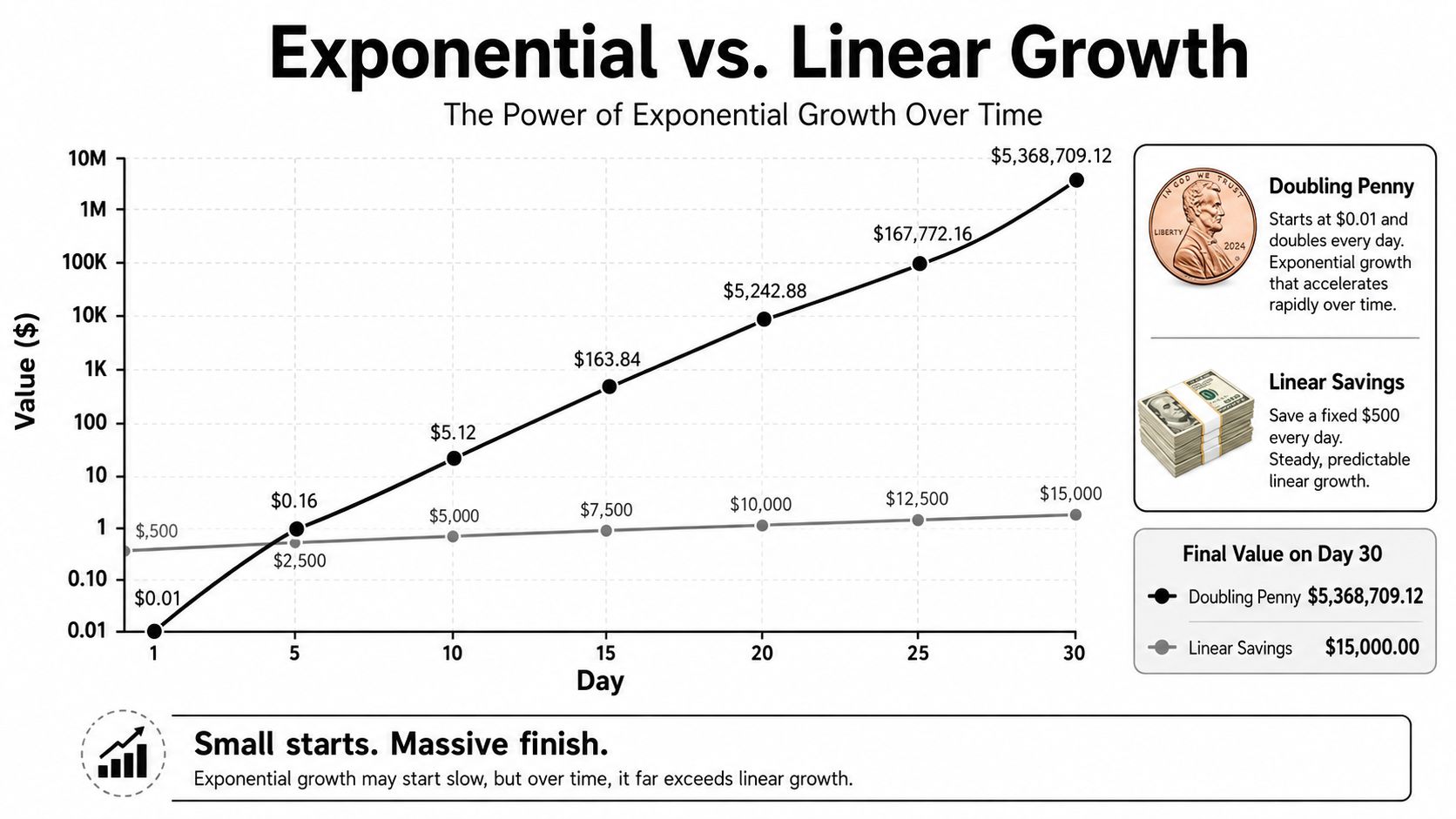
For most of the month, a steady savings habit looks stronger than the penny. If you save a fixed amount each day, you can watch the line climb in a calm, predictable way. The doubling penny behaves differently. It crawls, then curves upward so sharply that the final stretch barely looks related to the beginning.
What the chart teaches better than the riddle
The visual comparison between a doubling penny and a linear plan of $500 per day shows why patience matters. Early on, the steady saver looks smarter. Day after day, the linear line sits comfortably above the penny.
Then the late-stage curve takes over.
That's the mind-bender. Exponential growth hides its strength until the end. It rewards endurance more than excitement.
Why this matters for a travel budget
Real travel savings usually won't be exponential. They'll be much more ordinary. But the chart still teaches a useful habit of mind. Don't judge a savings strategy too early.
A travel fund can look sleepy for a while. Then a few months of automated transfers, reduced food delivery, redeemed points, and better category planning start to compound into choices. Better dates. Better routes. Better flexibility.
If you want to make those categories easier to manage, these travel budget categories that save you money can help you spot where your “linear” wins are hiding.
Growth often looks boring before it looks powerful.
That's true in investing, but it's also true in preparing for a trip.
From Magic Math to Real-World Travel Miles
At first glance, $5,368,709.12 feels like a travel fantasy generator. You can almost hear your brain sprinting ahead. Airport lounges. Long-haul premium seats. Boutique hotels. Open-ended itineraries. Maybe a year of saying yes to every museum, train, and spontaneous detour.

That's part of why the puzzle sticks. It turns a microscopic starting point into something enormous. It gives small beginnings a cinematic ending.
The catch that every traveler should understand
No real-world travel fund behaves like this.
The penny puzzle ignores friction. It assumes perfect doubling, every day, with no interruptions, no fees, no market volatility, no bad timing, and no erosion from real life. As Dan Merriam's discussion of the penny-doubling lesson points out, even a 10% annual return takes 7.2 years to double under the Rule of 72. Not one day.
That doesn't make the puzzle useless. It makes it more honest when treated as a principle instead of a plan.
What the principle gives travelers
The useful takeaway is not “find an investment that doubles daily.” That's fantasy.
The useful takeaway is this:
- Time matters more than drama. People who start early usually have more options later.
- Consistency beats intensity. A small habit you repeat is worth more than a big burst you abandon.
- Reinvestment changes outcomes. When savings, points, and spending discipline reinforce one another, travel gets easier.
That last point matters for modern travelers. A dedicated savings account is one lane. Rewards are another. If you use cards carefully and pay them off in full, the right setup can support your travel plan. A good place to compare that side of the strategy is this guide to travel rewards credit cards.
The puzzle shows what compounding can do in a frictionless universe. Your real budget succeeds in a messy one.
A better way to think about the fantasy number
Treat the giant number as a spotlight, not a destination.
It shines on something many travelers overlook. The biggest leap usually doesn't come from one heroic month. It comes from repeating a boring, effective process long enough that the results begin to feel surprising. Build the habit first. Let the visible payoff arrive later.
That's how trips become bookable without panic.
Applying the Penny Mindset to Your Travel Fund
The best use of a penny doubled for 30 days is psychological.
It teaches you not to dismiss a tiny start. That's priceless if your travel fund is small, inconsistent, or currently nonexistent. A lot of people don't fail because they can't save. They fail because they don't respect small savings enough to begin.
Start tiny, but make the rule real
Move the lesson out of fantasy and into your bank app.
Open a separate travel savings account. Name it after the trip if that helps. Then automate a transfer small enough that you won't argue with it every week. Small is fine. The goal at first is not heroism. It's repetition.
You can also use “found money” rules:
- Roundups: Let spare change from purchases flow into your travel bucket.
- Windfalls: Tax refunds, gifts, cash-back earnings, or side-income extras can go straight to the trip.
- One cut, one redirect: Cancel one nonessential expense and reroute that money automatically.
Clear rules matter more than motivation
One of the smartest lessons in the penny puzzle comes from the wording itself. The phrase is ambiguous. The discussion around it shows a split between counting 29 doublings or 30 doublings, and that wording gap creates a $2.68 million variance, as explored in this Reddit discussion about what “for 30 days” actually means.
That sounds like a math nerd detail. It isn't. It's a budgeting lesson.
If your travel savings rules are vague, your results will be vague too.
Try writing down answers to these questions:
- When does the transfer happen? Payday, every morning, or every Friday.
- What counts as travel money? Only direct deposits, or also roundups and rewards.
- When are you allowed to touch the account? Trip expenses only, or any “emergency” that pops up.
A budget improves the moment it stops being a wish and becomes a rule.
The penny mindset isn't about becoming rich in a month. It's about building trust with yourself. You save what you said you would save. You follow the process even when the early totals look unimpressive. That's how a travel fund starts acting like a plan instead of a daydream.
Start Your Own 30-Day Travel Savings Challenge
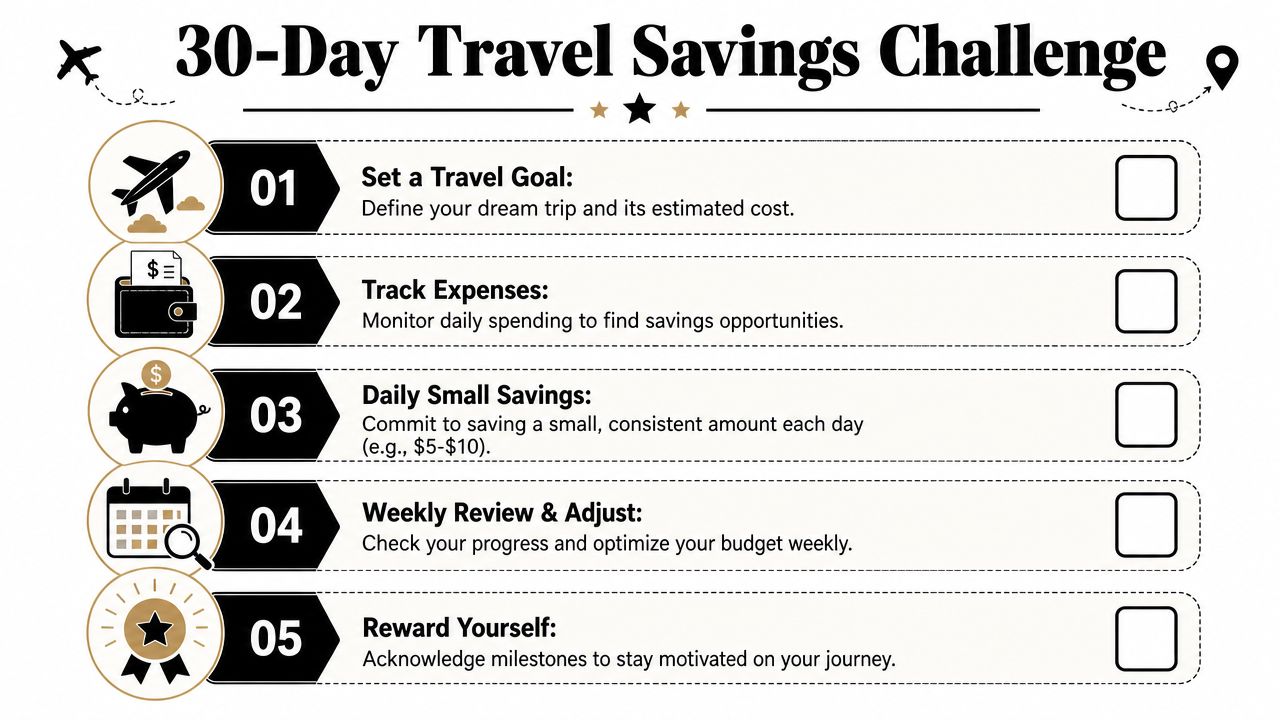
A traveler opens a savings app on day four and sees almost nothing. Day twenty feels different. The total is still modest, but the pattern is finally visible. That is the core lesson of the penny story. The early days look small enough to dismiss, and that is exactly why the habit matters.
Your goal here is not to copy impossible math. Your goal is to train your brain to respect small actions that grow. Travelers who wait for one big money breakthrough often stay stuck. Travelers who build a rule that gets a little stronger over time give themselves a real shot at the trip.
A realistic challenge that uses the penny mindset
Use a version that starts almost laughably small, then grows in a way your budget can handle. A rolling suitcase works the same way. At first you pack one shirt, one charger, one pair of socks. Later, those little choices add up to a trip that is ready to go.
Try this:
- Name one trip clearly: Pick a destination and a rough season. “Portugal next spring” works better than “travel someday.”
- Start with an amount that feels tiny: Save $1, $2, or $3 a day. The point is to prove you can begin without friction.
- Add a growth rule: Increase the amount a little over time, such as adding $1 each week or bumping transfers on every payday. That gives you the slow start and later acceleration of the penny principle in a realistic form.
- Tie the increase to one behavior: Skip one takeout meal each week, walk one extra commute, or redirect roundups. Your challenge should grow because a habit supports it.
- Automate the base amount: Let your bank move the minimum automatically, then add the weekly increase yourself if needed.
- Track the pattern, not just the balance: A simple note on your phone is enough. You are watching yourself become more consistent, not chasing a fantasy total.
- Use the money for travel only: Train your savings account to mean plane tickets, hostel nights, museum passes, or train rides.
Why this works better than a generic savings challenge
A flat savings plan teaches repetition. A growing savings plan teaches belief.
That difference matters. Travel goals often fail in the boring middle, when progress feels too slow to count. The penny mindset helps you stay in the game long enough to see momentum. You learn that small deposits are not weak deposits. They are the first steps of a curve that gets steeper later.
By the end of 30 days, you may have a few dozen dollars or a few hundred, depending on your rule. More important, you will have evidence. You can start small. You can follow a system. You can increase your effort without blowing up your budget.
Once that fund exists, stretching it becomes easier. These budget travel hacks for 2026 that help your savings go further can help you protect the progress you worked to build.
The penny story feels magical because the finish is huge. Its real value for travelers is quieter and more useful. Start with an amount that seems too small to matter. Give it a rule to grow. Then watch a trip move from wish to plan.