You land in CDMX after dark, open the rideshare app, and have one practical question: which neighborhood will let you settle in fast without spending the whole trip on guard? That decision matters more than broad, one-size-fits-all claims about whether Mexico City is “safe.”
Safety here is local. A well-connected neighborhood with steady foot traffic, busy cafés, reliable transit, and streets that stay active into the evening usually gives travelers a better margin for error than a cheaper area that feels empty after sunset. That does not mean every popular neighborhood fits every traveler.
The useful way to choose a base is to match the area to your trip. Some travelers want polished infrastructure and are happy to pay for it. Others want a residential district where they can walk to a bakery, learn the rhythm of the blocks, and stay for a few weeks without feeling stuck in a tourist bubble. If that second group sounds like you, neighborhoods with a stronger local rhythm can pair well with a trip focused on meaningful cultural immersion while still keeping logistics manageable.
That is why this guide goes past the usual big three of Polanco, Roma Norte, and Condesa. Those neighborhoods belong on the list, but they are not the whole story. Coyoacán and San Ángel suit travelers who want atmosphere and a calmer pace. Narvarte and Del Valle often make more sense for longer stays, moderate budgets, and people who value everyday livability as much as headline appeal. Cuauhtémoc sits in the middle, practical for travelers who want central access without paying Polanco prices.
A smart base lowers risk, but it does not replace street sense. In the neighborhoods covered here, the problems visitors are more likely to face are phone snatching, bag theft, overcharging, and bad late-night transport choices. Pick the right area, keep your habits tight, and Mexico City becomes far easier to handle with confidence.
1. Polanco

Polanco is the easiest recommendation for travelers who want the strongest security baseline and don't mind paying for it. It functions as the city's premier low-crime benchmark and has the absolute lowest nighttime crime rates in Mexico City, with one-bedroom Airbnb pricing around US$1,800 to US$3,500 per month, according to Kakapo Travel's 2026 neighborhood breakdown. That price tells you something important. Security, infrastructure, and convenience are built into the cost.
Polanco's polished sidewalks, visible security, embassies, business traffic, and high-end hotels all work in your favor. If you're arriving solo, landing late, or visiting CDMX for the first time, Polanco lowers friction. It's one of the few neighborhoods where many travelers feel comfortable settling into the city fast.
Why Polanco works
Polanco also gives you more than a sterile safe bubble. You can walk from cafés to museums to parks without feeling cut off from local life. That makes it a strong fit for travelers who want comfort and culture in the same neighborhood. If that's your style, this is also a good base for cultural immersion travel that still feels structured and easy.
A common Polanco day is simple. Breakfast near a leafy side street, an easy museum visit, a long stroll near Parque Lincoln, then dinner without having to think too hard about transport logistics. That simplicity matters more than people realize.
Practical rule: If you're tired, jet-lagged, or traveling solo for the first time in Mexico City, paying more for Polanco can be worth it because it reduces the number of safety decisions you need to make.
A few trade-offs matter:
- Best for comfort-first travelers: If you want late dinners, polished hotels, and easy walks home, Polanco is hard to beat.
- Less ideal for tight budgets: You're paying a premium for security and infrastructure, not just aesthetics.
- Better for calm evenings than scrappy discovery: Some travelers love that. Others find it a little too polished.
Use Uber or Didi at night instead of flagging a cab on the street. Even in a strong neighborhood, that habit keeps things simple and consistent.
2. Coyoacán
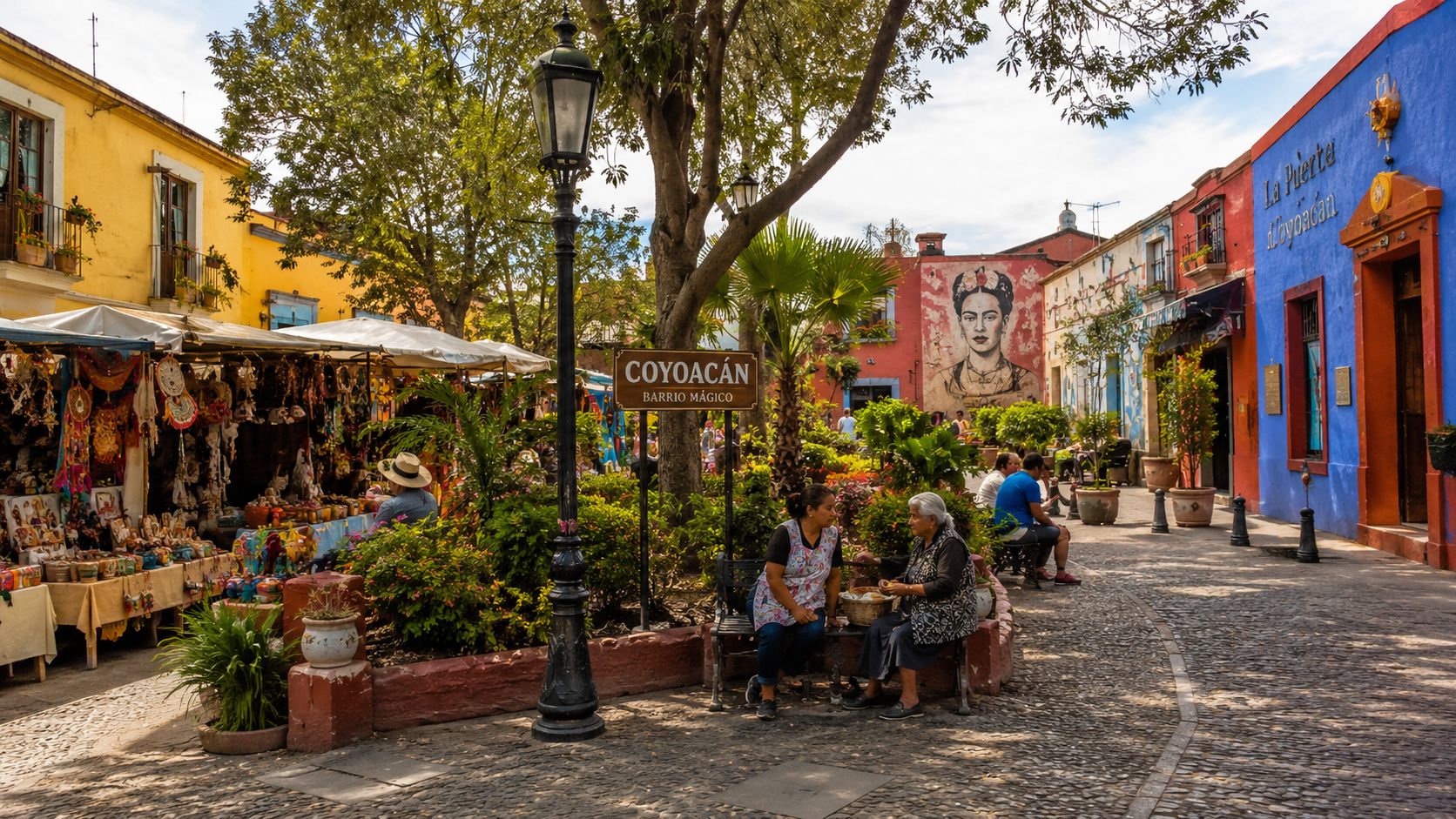
You finish dinner near Jardín Centenario, the plaza is still active, and the walk back feels easy because families, couples, and street vendors are still out. That is Coyoacán at its best. Safety here comes from lived-in streets, a slower pace, and a neighborhood rhythm that rewards travelers who do not need to be in the middle of the city's nightlife circuit.
Coyoacán is one of the better picks for travelers who care more about atmosphere than speed. It works especially well for solo travelers who want a calmer base, couples who prefer evenings that end earlier, and remote workers looking for a neighborhood with character instead of a polished hotel district. For some travelers comparing longer stays, that same balance of routine, cafés, and local life overlaps with what makes certain best countries for digital nomads appealing in the first place.
The trade-off is distance. You are farther from the high-demand restaurant and nightlife zones, so cross-city trips take more planning. In return, you get a district that feels more residential and less performative. That matters if your version of a good day is a museum, a market, a quiet lunch, and an evening walk instead of bar-hopping across neighborhoods.
Best for travelers who want community and a lower-pressure routine
Coyoacán is not uniformly convenient, and that is the detail people miss. The historic center feels comfortable because it stays active and legible. Outer streets can get quiet faster than first-time visitors expect.
That is why I would treat Coyoacán as a choose-your-micro-location neighborhood. Stay close to the central plazas, main cafes, and well-used streets. If your hotel or rental looks cheaper because it sits on the fringe, check the exact walk home after dark before booking.
A few habits make a real difference here:
- Book near the historic core: Being able to walk back from dinner or the plaza on active streets is the main advantage.
- Scout your route in daylight: Coyoacán is easier once you know which streets stay busy and which ones empty out.
- Use ride apps for later returns: If you stay out past the main evening activity, Uber or Didi is the simpler call.
- Plan around its rhythm: Early mornings and afternoons are great here. Very late nights are usually better spent elsewhere.
A realistic Coyoacán day is straightforward. Visit the Frida Kahlo Museum, wander the market, linger over coffee, then head back before the quietest residential blocks empty out. Travelers who do well here accept the neighborhood for what it is: a safer-feeling, residential base with strong local character, not a 24-hour convenience zone.
That distinction makes Coyoacán more useful than the usual safe-neighborhood shortlist suggests. It is not only about low stress. It is about fit. If Polanco is for travelers buying infrastructure and Roma Norte is for travelers who want energy, Coyoacán is for people who want to settle into Mexico City without feeling swallowed by it.
3. Roma Norte
You finish dinner at 10 p.m., pay the bill, and step onto a street that still has people walking dogs, couples heading to bars, and a corner café closing slowly instead of all at once. That is Roma Norte at its best. The neighborhood feels easy to use, and that matters for safety.
Roma Norte remains one of the most practical bases for travelers who want energy without signing up for constant friction. It works well for first-time visitors, solo travelers who prefer busy streets, and longer-stay guests who want cafés, gyms, coworking spots, and groceries within a short walk. It usually lands below Polanco on polish, but it often feels more lived-in and more flexible on budget.
The trade-off is simple. Roma Norte is safe by Mexico City standards, but it is not uniform. A good block here can feel comfortable late into the evening. A weaker block, especially near the edges or on darker residential stretches, can change fast once restaurants close and foot traffic thins. That is why I would book Roma Norte by exact location, not by neighborhood name alone.
For remote workers and slower travelers, that block-by-block choice matters even more. Roma Norte has the social setup and daily convenience that keep it in the conversation around cities that appeal to digital nomads, but the best stays are the ones that balance atmosphere with a reliable walk home.
A few habits make Roma Norte work in your favor:
- Book near active commercial streets: Aim for blocks with steady café, restaurant, and pedestrian activity, especially if you plan to walk home after dinner.
- Check nighttime rhythm before committing: A street that feels charming at 2 p.m. can feel isolated at 11 p.m. Look at the route from the nearest busy avenue to your door.
- Treat late nights differently than early evenings: Dinner and bar-hopping are usually easy here. Returning very late after the crowd has thinned is when ride apps make more sense.
- Keep phones and bags managed at transitions: The higher-risk moments are often a few minutes after leaving the busy strip, not while you are sitting in the café itself.
Roma Norte suits travelers who want community and character more than controlled luxury. That is what separates it from Polanco, and it is also why it stays on so many shortlists. If your priority is walkability, social energy, and a neighborhood you can use throughout the day, Roma Norte is a strong choice. Just pay for the right micro-location if you can. In this part of the city, that decision does more for your comfort than chasing the cheapest rate.
4. San Ángel
You finish a museum afternoon, the light starts to fade, and the street outside is suddenly much quieter than it was an hour ago. That is San Ángel in a nutshell. It feels polished, residential, and calm, which is exactly why some travelers sleep better here than they would in Roma Norte or Condesa.
San Ángel works best for travelers who value atmosphere and a settled local rhythm over late-night convenience. Safety here comes less from constant foot traffic and more from the kind of environment it is: established, well-kept, and residential. That trade-off matters. A quieter neighborhood can feel more comfortable during the day and less practical after dinner.
By daylight, San Ángel is one of the city's easiest places to enjoy at a measured pace. Markets, galleries, plazas, and older homes give it depth without the churn of busier central districts. It suits couples, older travelers, culture-focused visitors, and anyone who wants a base that feels more like a neighborhood than a social scene.
At night, judgment matters more.
The area is not difficult or high-stress, but it is less forgiving if you like to improvise. Side streets empty out faster, and the margin for a casual wrong turn feels smaller than it does in busier districts. Travelers planning their first solo visit should pair a stay here with the kind of routines covered in this guide to planning a solo trip with safer habits.
A few habits make San Ángel work well:
- Use it for mornings and afternoons: This is a strong fit for market visits, café stops, and gallery browsing. It is a weaker fit if most of your plans start late.
- Choose lodging near recognizable streets or landmarks: In a quieter neighborhood, being a few minutes closer to an active road can make evening returns more comfortable.
- Take rideshare seriously after dark: If dinner runs late or you are coming back from another part of the city, door-to-door transport is usually the smarter call.
- Watch your belongings in market crowds: The bigger risk here is still the ordinary city one. Busy shopping pockets create easy moments for distraction theft.
The best version of San Ángel is simple: breakfast, Bazar del Sábado, a slow afternoon, an early dinner, then a direct ride home. Travelers who want community feel and historic character often find that rhythm more appealing than a neighborhood built around bars. Travelers who want spontaneous nights out usually do better elsewhere.
5. Condesa
You finish dinner, step onto a leafy side street, and realize the block went quiet faster than you expected. That is Condesa in one sentence. Easy, attractive, and usually comfortable, but less forgiving once you drift away from the busy pockets.
Condesa remains a strong pick for travelers who want Mexico City to feel simple on the ground. You can walk to coffee, parks, restaurants, and shops without planning your whole day around transit. For first-time visitors, that convenience reduces a lot of small safety mistakes because you spend less time figuring out routes in unfamiliar areas.
Its trade-off is predictable. The neighborhood feels polished enough that visitors sometimes drop their guard. In practice, Condesa works best for travelers who enjoy being out and about during the day, want a sociable base, and are willing to switch from walking to rideshare earlier at night than they might in a denser commercial district.
That makes it a different kind of safe from quieter residential areas. Safety here comes from activity, visibility, and infrastructure, not from a sleepy local rhythm. If you are comparing visitor-friendly zones with more everyday neighborhoods, this broader guide to choosing a safe area in Mexico for independent travel helps frame the difference.
Condesa rewards good route choices
The best stays are close to parks, major avenues, and restaurant corridors where there is steady foot traffic. That setup gives you options. If one street feels too dim or too empty, you can adjust quickly without wandering.
After dark, be practical. Walk the lively stretches. Skip the shortcut through the quieter block. If you are tired, dressed up, carrying shopping, or checking your phone for directions, order the car.
- Best fit: Solo travelers, couples, and first-time visitors who want walkability, café culture, and an easy social atmosphere.
- Watch for: Pickpocket risk in busy dining areas and parks, plus quieter residential streets that feel less comfortable late at night.
- Smart approach: Do Condesa on foot during the day, keep your phone put away when walking, and use door-to-door rides at night without debating it.
Condesa is appealing for a reason. Just treat it like an active urban neighborhood, not a resort bubble, and it usually works very well.
6. Narvarte
You check into Narvarte after spending the day in Roma or Condesa, and the difference is obvious within a block. Fewer visitors. More residents. More people picking up dinner, walking dogs, or heading home from work. For the right traveler, that everyday rhythm is a real safety advantage.
Narvarte works well for travelers who care more about predictability than polish. It does not offer the same concentration of boutique hotels, nightlife, or tourist services as the big-name neighborhoods. What it gives you is a lived-in environment where routines are easier to read. If you want a base that feels residential without pushing too far from central areas, Narvarte earns its place on this list.
Safety here comes from pattern recognition. Active commercial streets, steady local foot traffic, and apartment-heavy blocks make it easier to notice what feels normal and what does not. That matters, especially on a longer stay, because familiarity improves judgment faster than many travelers expect.
Narvarte is usually a stronger fit for return visitors, digital nomads, and travelers who want community over scene. First-time visitors can do well here too, but only if they are comfortable using rideshares at night and do not expect every block to feel equally convenient. If you are weighing residential comfort against tourist infrastructure, this broader guide to choosing a safe area in Mexico for independent travel helps clarify the trade-offs.
The smart way to use Narvarte is simple. Learn your nearest busy avenue. Identify the cafés, pharmacies, and convenience stores you will frequent. Do your first walks in daylight, then keep your nighttime routine tight until the area feels familiar.
A good Narvarte stay often looks like this: breakfast at a neighborhood café, errands done on foot, rideshare for late dinners in other parts of the city, then a straightforward return. The mistake is booking here only because the rate looks better than Roma, then expecting the same visitor-friendly energy after dark.
- Best fit: Longer stays, budget-conscious travelers, remote workers, and visitors who prefer local rhythm over trend-driven hotspots.
- Watch for: Quieter stretches at night, fewer obvious tourist services, and the temptation to assume every nearby block is equally comfortable for walking late.
- Smart approach: Stay near active corridors, test your routes in daylight first, and use rideshare for late returns instead of improvising.
7. Cuauhtémoc
Step out of your hotel near the historic center at 8 a.m. and Cuauhtémoc can feel like one of the easiest bases in Mexico City. Streets are active, major sights are close, and you can cover a lot on foot. Return to the same area late at night with no route in mind, and the calculation changes fast.
That is the trade-off here. Cuauhtémoc gives you access, history, and often better rates than the polished west-side favorites, but it asks for more awareness in return. Safety in this part of the city depends less on the neighborhood name and more on exactly which pocket you book, how you move, and what hours you keep.
This area suits travelers who want the historic core within easy reach and do not mind using a more deliberate routine. Budget travelers often do well here. So do short-stay visitors focused on museums, architecture, and daytime sightseeing. Travelers looking for a relaxed, residential feel usually prefer Narvarte or Del Valle. Cuauhtémoc is more practical than cozy.
The best approach is to stay on known hotel corridors and treat route planning as part of the trip, not an afterthought. Busy avenues, staffed hotels, and predictable returns matter more here than in neighborhoods where evening foot traffic feels consistently comfortable.
A few habits make a real difference:
- Book for location, not just price: A cheaper room on a quiet, poorly lit stretch can cost you convenience and peace of mind.
- Use daylight well: Start early, see the big sites before crowds build, and handle longer walks while the area is at its most straightforward.
- Keep evenings simple: Use rideshare for late returns instead of testing unfamiliar side streets on foot.
- Watch your attention in crowded zones: Busy plazas, transit connections, and heavy tourist corridors are where distraction theft is most likely.
Cuauhtémoc works best for travelers who travel with intent. If your style is wandering until midnight and deciding plans block by block, this is not the strongest fit. If you want central access, strong sightseeing value, and a base that can be both workable and cost-conscious, it can be a smart choice.
8. Del Valle
You finish dinner, call a rideshare, and 15 minutes later you are back on a quiet, well-kept street where people are still walking dogs and picking up something small from the corner shop. That is Del Valle at its best. It gives travelers a calmer return home, which matters more than hype if you are staying more than a long weekend.
Del Valle works well for people who judge safety by daily comfort, not just by name recognition. The neighborhood feels established, residential, and organized. Streets are generally cleaner, routines are predictable, and the area has the kind of everyday activity that helps a place feel stable without the constant buzz you get in Roma or Condesa.
This is one of the strongest choices for travelers who want a base that supports real life. Remote workers, couples on longer stays, families, and anyone booking an apartment instead of a boutique hotel usually do well here. You get cafés, bakeries, supermarkets, parks, and practical transit access without paying for a nightlife district you may not use.
The trade-off is simple. Del Valle is comfortable, but it is not built for spontaneous bar-hopping until late. If your ideal night involves walking out the door and choosing between crowded cocktail spots on the next block, Roma Norte or Condesa will fit better. If you want easier mornings, quieter sleep, and a neighborhood that feels more local than performative, Del Valle often wins.
A few habits make Del Valle work even better:
- Stay near active avenues or park-adjacent blocks: The area is broad, and some streets feel much livelier than others after dark.
- Use rideshare for late returns: Del Valle is safer-feeling than many central zones, but the quieter residential stretches can feel empty at night.
- Book for routine, not novelty: A place near cafés, a supermarket, and a main road usually serves longer stays better than a prettier but isolated block.
- Learn your immediate radius fast: Know which OXXO, pharmacy, and breakfast spot you would use in the first 48 hours.
Del Valle is a good example of why “safe” in Mexico City should be matched to traveler type. For a first-timer chasing nightlife, it may feel too subdued. For someone who wants a dependable home base with lower friction and a more residential rhythm, it is one of the smartest picks in the city.
Safety Comparison of 8 Mexico City Neighborhoods
| Neighborhood | ⭐ Safety & Quality | 🔄 Navigation & Complexity | ⚡ Cost & Resource Efficiency | 📊 Expected Experience / Impact | 💡 Ideal Use Cases / Tips |
|---|---|---|---|---|---|
| Polanco: Upscale Safety & Cultural Immersion | Very high, lowest crime, private security and modern infrastructure. | Low, highly walkable, clear signage, English widely spoken. | High cost, ~30–40% pricier for lodging and dining. | Upscale, low-stress cultural immersion with world-class museums and shopping. | Best for travelers prioritizing safety and comfort; use authorized taxis/Uber; mix dining to save. |
| Coyoacán: Historic Charm with Community Safety | Moderate–high, strong neighborhood watch mitigates opportunistic crime. | Medium, cobblestone streets, some darker periphery; Metro access. | Moderate, cheaper than Polanco, good cultural value. | Authentic bohemian culture, markets, and museums with community vibe. | Ideal for cultural immersion on a budget; stay central, visit museums early, join group outings. |
| Roma Norte: Gentrified Safety & Trendy Exploration | High, improved safety from gentrification, but some side-street risks remain. | Low–medium, very walkable core; be cautious on quieter streets at night. | Moderate, rising costs but many budget F&B and hostels available. | Trendy urban culture with lively nightlife, cafes, and creative spaces. | Great for digital nomads and nightlife seekers; stay near Álvaro Obregón; use buddy system at night. |
| San Ángel: Artistic Enclave with Established Safety Networks | High, established, family-oriented safety and active community networks. | Medium, quieter layout; some areas less walkable, best by day. | Moderate–high, fewer budget stays; dining prices above average. | Quiet, art-focused experience with weekend artisan market and galleries. | Best for art and photography; visit Bazar del Sábado early and stick to main streets. |
| Condesa: Tree-Lined Streets with Tourist Infrastructure | High, consistent foot traffic, good lighting and police presence in main areas. | Low, excellent pedestrian boulevards and clear tourist infrastructure. | Moderate, tourist prices higher than non-touristy neighborhoods. | Comfortable, familiar urban experience with strong cafe and park life. | Suited to first-time solo travelers; stay near Parque España and avoid side streets at night. |
| Narvarte: Residential Safety with Local Authenticity | Moderate, natural safety from residential community but fewer tourist resources. | Medium, solid Metro links but requires local navigation confidence. | Low, very affordable accommodation and dining; high value for longer stays. | Authentic local living and cultural immersion away from tourist crowds. | Ideal for extended stays and language learners; learn basic Spanish and use Metro/offline maps. |
| Cuauhtémoc: Historic Center with Improving Safety Corridors | Moderate, major tourist corridors improved, peripheral areas riskier. | High, crowded and sometimes chaotic; follow main tourist routes. | Very low, most affordable accommodation and daytime services. | Exceptional historical and architectural value but requires vigilance. | Best for history-focused budget travelers; join organized tours and secure valuables. |
| Del Valle: Emerging Safe Neighborhood for Extended Stays | Moderate–high, residential calm with developing safety infrastructure. | Medium, quieter streets, suited to those comfortable navigating local routes. | Very low, excellent affordability for long-term/slow travel. | Genuine neighborhood experience with growing local services. | Excellent for digital nomads and slow travelers; rent locally, learn Spanish, plan extended stays. |
Your On-the-Ground Safety Toolkit and Final Thoughts
You finish dinner in Roma Norte around 10 p.m., your phone is at 18%, and the walk back to your hotel looks short on the map. That is the moment when good neighborhood choice stops being abstract and starts doing real work. In Mexico City, safety is rarely about finding one perfect area. It is about picking a base that fits how you travel, then making smart decisions block by block.
That is why the safest area for one traveler can be the wrong call for another. Polanco works well for visitors who want polished infrastructure, easy hotel logistics, and fewer surprises, but they will pay for it. Narvarte and Del Valle often make more sense for longer stays, remote workers, or travelers who want a residential rhythm and better value, as long as they are comfortable with a less tourist-facing setup. Coyoacán and San Ángel suit travelers who prefer quieter evenings and a more local pace. Roma Norte and Condesa are still solid choices, but they are not the only good ones, and they are not automatically the best fit.
Use this practical toolkit once you arrive.
Contacts and transport
- Emergency: Dial 911 for police, ambulance, or fire.
- Rides at night: Use Uber or Didi instead of hailing a random cab on the street.
- Offline backup: Save your hotel pin, screenshot your route home, and keep one low-battery option in mind before you go out.
Street-level habits that matter
- Walk on active streets with restaurants, pharmacies, convenience stores, and visible foot traffic.
- If a street goes quiet fast, change course early instead of second-guessing yourself halfway down the block.
- Keep your phone and wallet out of sight in crowded areas, especially near Metro entrances, markets, and busy plazas.
- On the Metro, wear your bag in front and avoid standing near the door with your phone out when the train is packed.
Read the block, not just the neighborhood
Neighborhood labels help, but they do not protect you by themselves. One avenue can feel busy and comfortable, while two turns later the street is poorly lit and empty. Travelers who do well in CDMX pay attention to the small signals. Open storefronts. Families out walking. Well-lit corners. Traffic still moving. A visible flow of people heading somewhere.
I use a simple rule at night. If I would hesitate for even a second before walking a block alone, I call a rideshare and move on. That decision costs very little and solves a lot.
This matters even more for solo travelers, especially women. In many of the neighborhoods covered above, the bigger issue is not the café, bar, or restaurant itself. It is the last ten minutes between the venue and your door. Plan that part before you need it.
A few final calls are straightforward. Do not drift into higher-risk areas out of curiosity, especially after dark. Do not assume a cheap stay far from your evening plans is a bargain once you factor in late-night transport and extra friction. Do choose a neighborhood that matches your budget, your tolerance for complexity, and the kind of trip you want. Community feel, polished infrastructure, nightlife access, and long-stay value are all different versions of "safe" in a city this large.
Mexico City rewards travelers who stay alert, choose their base carefully, and adjust early when a situation feels off. Do that, and the city becomes much easier to enjoy.
Travel Talk Today helps readers turn neighborhood research into trips that work on the ground. For more practical, budget-conscious guidance on safer stays, smarter planning, and meaningful travel, visit Travel Talk Today.