For most travelers, a simple Type A plug adapter is all you need for Japan, because Japan uses 100V power and many phones, laptops, and USB chargers already accept 100–240V. A bulky voltage converter is usually unnecessary, and that's good news for both your budget and your carry-on.
If you're reading this with tabs open for “Japan adapter,” “Japan converter,” and “will my charger work in Tokyo,” you're in the same spot a lot of travelers hit right before a trip. The confusion usually comes from mixing up two separate questions. First, will your plug physically fit the wall? Second, can your device safely use Japan's electricity?
Once you separate those two questions, buying the right adapter for Japan gets much easier. In many cases, you may discover you already own what you need, or you only need one small, cheap add-on instead of a heavy converter you'll regret packing.
The Power Plug Puzzle Unlocking Japan's Outlets
You arrive at your hotel in Tokyo, reach for your phone charger, and pause for a second at the wall outlet. The good news is that Japan is usually much simpler than the internet makes it sound.
Japan mainly uses Type A outlets, the two-flat-pin style many travelers from North America will recognize. Some places also have Type B outlets with an extra grounding pin, and Japan runs on 100V, as explained in Electrical Safety First's guidance on travel adaptors for Japan.
Here's the part that helps people stop overbuying. There are really three separate things to notice. The plug has to fit the wall. Your device has to accept Japan's power. And in daily travel, those are often much smaller problems than they sound.
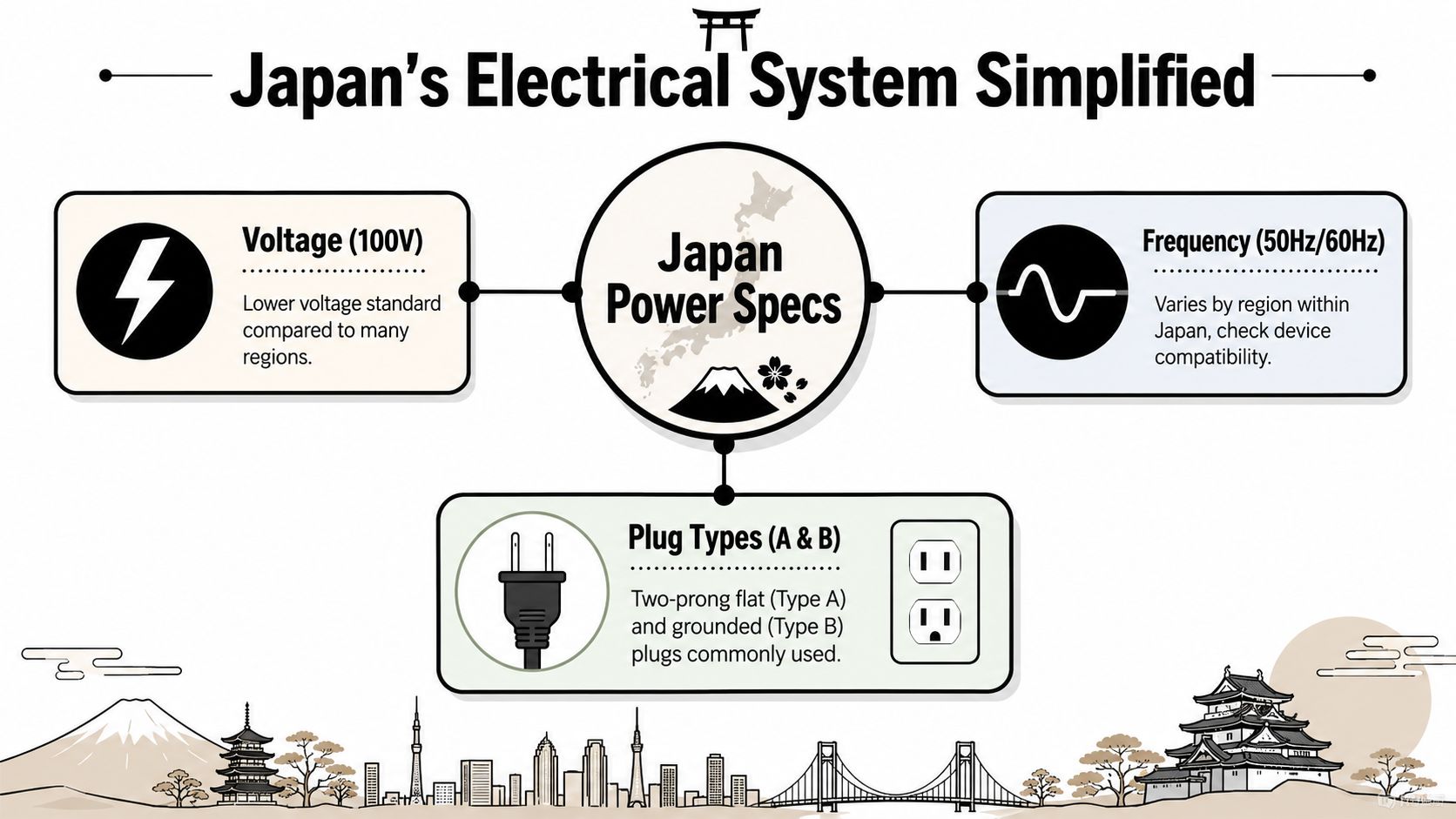
What Type A and Type B actually look like
Type A has two flat pins. Type B is similar but includes a round grounding pin below them.
For a traveler, this usually matters in one specific situation. Small phone chargers, camera chargers, and many laptop chargers often have a simple two-prong plug, so they physically fit Type A outlets without much drama. Bulkier three-prong plugs are the ones more likely to cause annoyance, because the socket may not accept that grounded shape.
A good way to picture it is a key and lock. Sometimes the issue is not the power at all. The plug just does not match the opening.
Practical rule: If your device uses a compact charger or USB power brick, the question is often "Will it fit?" rather than "Will it work?"
Why Japan sounds more complicated than it usually feels
Japan's 100V can make travelers nervous because it differs from what they use at home. In practice, many everyday electronics are built for travel and can handle a range of voltages. That is why a basic adapter is often enough, which is good news if you are trying to pack light and stick to smart travel budgeting tips for international trips.
Japan also uses 50Hz in the east and 60Hz in the west. That sounds like a detail you need to study, but for common charging tasks, it usually does not change much. If you are charging a phone, laptop, camera battery, e-reader, or power bank, this split is rarely the thing that causes trouble.
What this means for you
The simplest way to approach Japan is to separate the problem into two quick checks:
- Fit check: Does your plug match the outlet?
- Power check: Can your device use Japan's 100V safely?
That small shift saves people money. Instead of buying a heavy converter "just in case," many travelers only need a small adapter, and some do not need even that if their plugs already match.
For modern electronics, Japan is often one of the easier countries to pack for. The puzzle itself is usually smaller than expected.
Do You Need an Adapter or a Converter
This is the question that causes the most unnecessary purchases.
A travel adapter changes the shape of your plug so it can fit the wall socket. A voltage converter changes the electricity itself. Japan's mains supply is 100V, and Wise's guide to Japan plug types makes the distinction clearly: the adapter changes physical fit, while the converter is only needed when a device is not rated for 100V input. It also notes that this matters most for heat-producing appliances like hair dryers.
Here's the simplest side-by-side view:
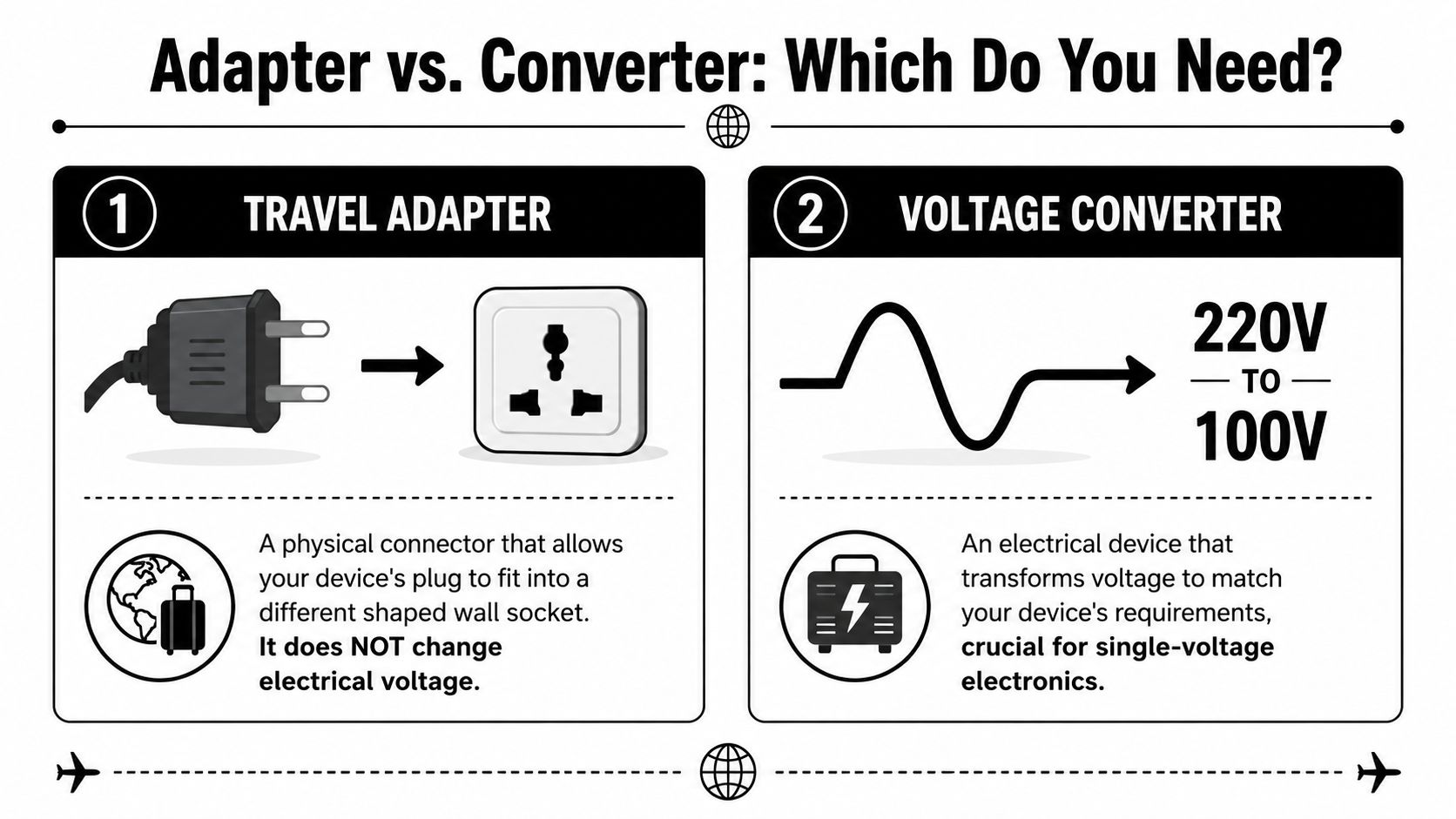
The easy pile and the risky pile
When I pack for Japan, I mentally sort devices into two groups.
Adapter-only items usually include:
- Phone chargers
- Laptop power bricks
- Camera battery chargers
- E-readers
- USB charging hubs
- Power banks
These often accept a wide input range and just need help fitting the outlet.
Converter-or-leave-it-home items often include:
- Hair dryers
- Curling irons
- Hair straighteners
- Travel irons
- Other heat-producing appliances
These are the items most likely to run badly, overheat, or not behave the way you expect if they aren't designed for Japan's supply.
A good travel test
If the device gets hot on purpose, be cautious.
A phone charger may get warm, but its job is to convert power for electronics. A hair dryer's job is to create heat and airflow. That's why those appliances are the classic troublemakers in Japan. They draw more power and are less forgiving.
An adapter is like a shape translator. A converter is like changing the language and the volume at the same time.
That's also why buying a converter “just in case” usually isn't smart for budget travelers. It adds weight, takes up space, and often solves a problem you do not have. If you're trying to trim trip costs in other areas too, these travel budgeting tips for smarter packing and spending pair nicely with keeping your power kit minimal.
A simple decision framework
Use this three-step check before you buy anything:
Look at the plug
If your plug shape doesn't match Japan's outlet, you need an adapter for Japan.Look at the voltage input
If the charger or device accepts 100V, you probably do not need a converter.Look at the kind of device
If it's a heat-producing appliance, pause and check carefully. If you're unsure, don't assume it's safe.
Here's a quick comparison table:
| Device type | Likely need in Japan |
|---|---|
| Phone charger | Adapter only in many cases |
| Laptop charger | Adapter only in many cases |
| Camera charger | Adapter only in many cases |
| Hair dryer | Converter or skip it |
| Curling iron | Converter or skip it |
| Three-prong grounded device | Adapter that supports grounding may matter |
The money-saving lesson is straightforward. Don't shop for a converter first. Start by checking whether you need one at all.
How to Check Your Devices Before You Fly
This is the part that saves people from buying gear they never needed.
For many travelers, the choice isn't only adapter or no adapter. It's Type A adapter, Type B compatibility, or no adapter at all if the device is dual-voltage and the accommodation has Type B sockets, and a label such as 100-240V usually means only a plug adaptor is needed, according to Tourist Japan's explanation of whether you need an electrical adapter in Japan.
Here's what to look for on your own gear:
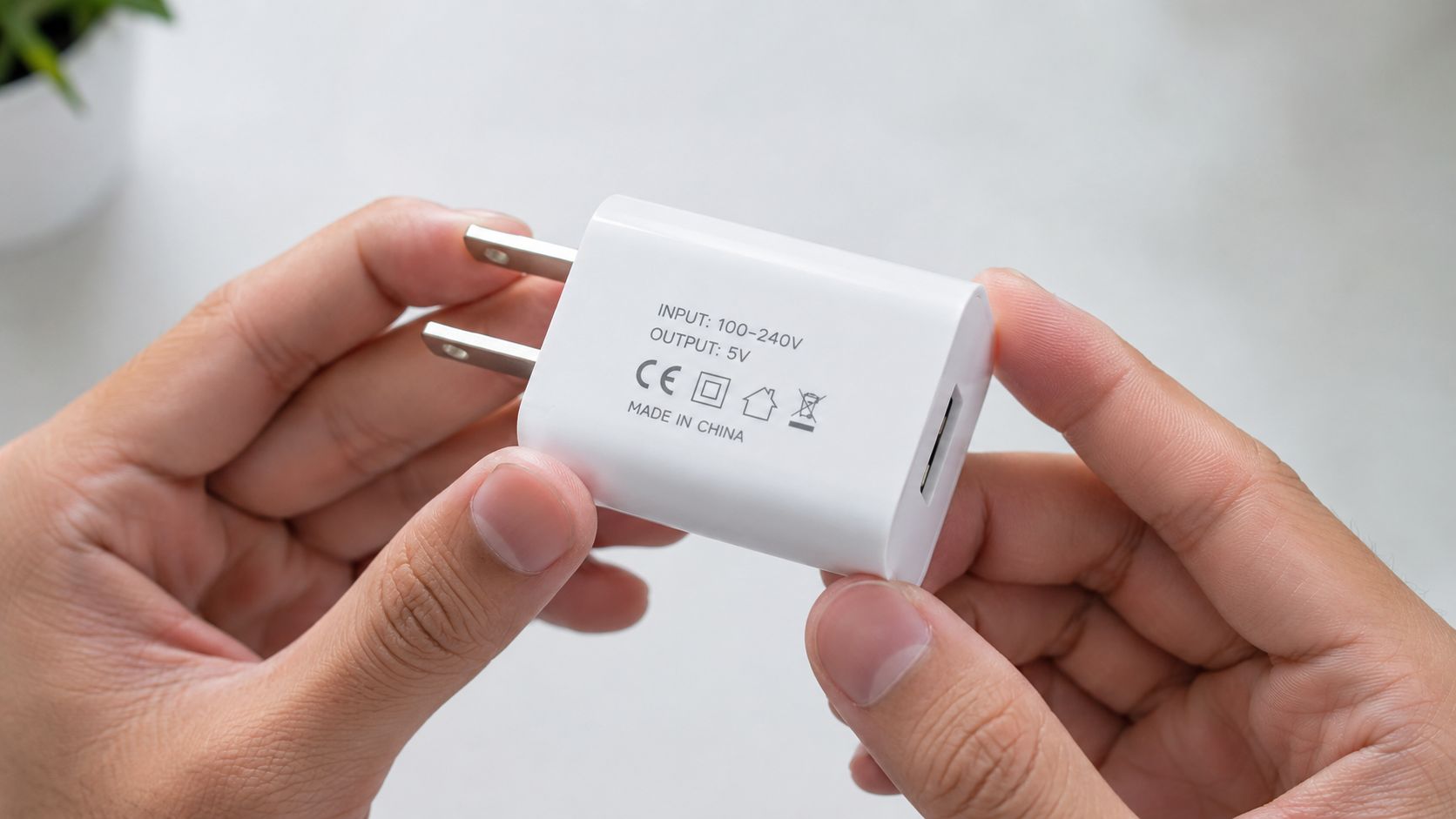
Where the fine print usually hides
Check these spots first:
- Phone charger brick: Look on the side with the tiny printed text.
- Laptop charger: Turn over the power brick and find the line labeled “Input.”
- Camera battery charger: Check the back or underside.
- Electric toothbrush charger: Inspect the adapter body, not just the handle.
- Hair tool handle or base: If there's voltage info, it's often printed near the cord.
What you want to see
Look for wording like:
- Input 100-240V
- 100V-240V
- 50/60Hz
If you see 100-240V, that's usually your green light for Japan. You still may need a plug adapter, but you generally do not need a voltage converter.
If you only see a single-voltage marking and it does not include 100V, be careful. That's when travelers get into trouble.
Check the charger, not your memory of what you bought. The label decides.
A five-minute pre-trip routine
Before you zip your bag, lay out every item you plan to plug in and do this:
- Read the label
- Take a phone photo of it
- Adapter only
- Special check needed
- Japan is your only international stop
- You pack light
- You mostly charge a phone, camera, or power bank
- You want the smallest and cheapest tool that does the job
- You visit multiple countries
- You want one kit for future travel
- You like built-in USB ports
- You'd rather carry one slightly bulkier tool than several tiny adapters
- Top up before long train days: A day built around maps, translation, mobile tickets, and photos drains a phone faster than many travelers expect. Charge before you leave in the morning, not only when the battery gets low.
- Carry a power bank for transit-heavy days: This helps most in Japan because you may spend hours moving between stations, platforms, and neighborhoods where you do not want to stop just to hunt for an outlet.
- Use outlets politely in cafes and public spaces: Some cafes offer sockets, some do not, and some expect you to buy something and keep charging brief. If an outlet is not clearly provided for customers, do not assume it is free to use.
- Do not count on every train seat having power: Some Shinkansen services and seat types offer outlets, but not all. Treat onboard charging as a bonus, not your main plan.
- Pack one reliable cable, not a tangle of backups: A cable you know works is better than three random ones from the junk drawer.
- Use coin lockers wisely: If you store a day bag in a station locker, make sure your power bank or charging cable is not buried inside it when you still need your phone for tickets, directions, or translation.
If you want a broader pre-flight packing routine, this backpacking essentials checklist is a handy companion to your device check.
This small habit removes the guesswork. It also stops the panic-buy cycle at the airport, where tired travelers throw money at the wrong solution.
Choosing the Best Travel Adapter for Japan
Once you know you need an adapter, the next question is which kind.
Japan primarily uses Type A outlets, with Type B also present in some locations. For travelers from countries that use different plug shapes, such as Australia's Type I, a plug adapter is necessary because the plug shape doesn't match Japanese sockets, and the technical edge case is grounding, according to Trip.com's guide to Japan power plugs.
The minimalist choice
A single-country Type A adapter is the leanest option.
It's great if:
For a backpacker or solo traveler trying to keep every item purposeful, this is often the best adapter for Japan.
The flexible choice
A universal travel adapter makes more sense if you travel often or already know another trip is coming.
It's useful if:
The tradeoff is size. Universal adapters are more versatile, but they're usually bulkier than a simple Type A plug.
Don't ignore grounding
Some travelers often accidentally buy the wrong thing.
If your device has three prongs, especially for a laptop or metal-cased device, grounding may matter. A basic ungrounded adapter may let you charge, but it may not preserve the safety setup the device was designed for.
A quick shopping filter helps:
| Traveler type | Best fit |
|---|---|
| One-country minimalist | Simple Type A adapter |
| Frequent flyer | Universal adapter |
| Traveler with three-prong gear | Adapter that supports grounding |
If you shoot photos or video on the road and carry multiple chargers, it's worth building your tech kit around your actual gear instead of the broadest possible adapter. This is especially true for creators who already travel with batteries, chargers, and accessories, much like the gear choices covered in this guide to the best video cameras for travel.
My practical shopping advice
Buy for the devices you're bringing, not for every possible future scenario.
If your bag contains a phone, a laptop, and a camera charger, a compact Type A adapter may be perfect. If your bag contains a grounded laptop plug and you travel internationally several times a year, a grounded universal adapter is the smarter long-term buy.
The best adapter for Japan is rarely the fanciest one. It's the one that fits your gear, your route, and your packing style.
Where and When to Buy Your Adapter
You finish packing, zip your bag, and then the thought hits. Did you pack the right plug for Japan?
This part is simpler than many travelers expect. In Japan, travelers usually find familiar two-flat-pin outlets, so the main question is not "Will I be able to find something?" It is "Do I want to solve this now at home, or solve it while tired after landing?"
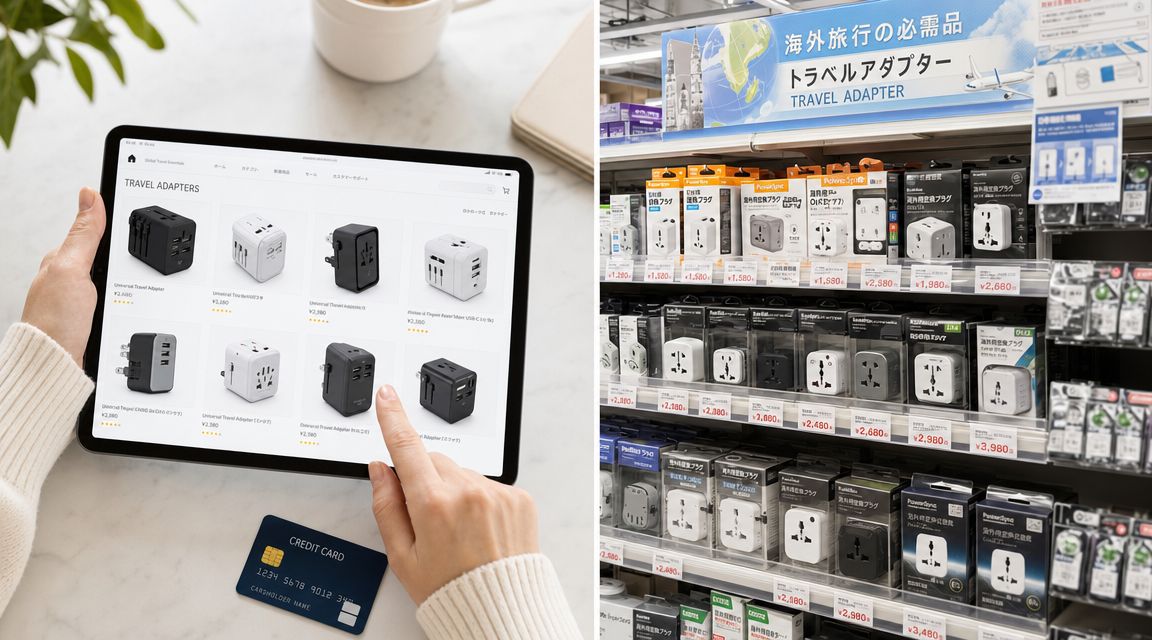
Buying before you leave
For most travelers, this is the easier choice.
Buying ahead gives you time to test your setup in a calm setting. You can plug in your charger, make sure the adapter fits snugly, and confirm you bought the right version for your actual gear. That matters more than people think. An adapter is like a key. It is much better to test the key at home than outside your hotel room at 10 p.m.
It also helps you avoid paying for a rushed solution at the airport or settling for a bulky universal adapter when a small Japan-friendly plug would have done the job.
Buying in Japan
This can still work fine, especially if you forgot or if one breaks during the trip.
Simple plug adapters are often sold in places travelers already pass through, including airport shops, electronics stores, and some variety or discount stores in larger cities. Big electronics chains are usually the easiest place to check if you want more than the bare minimum.
The downside is choice. You may find something usable quickly, but not always the exact style you wanted, especially if you were hoping for a grounded model or a compact adapter for a tight packing setup.
Which option makes the most sense
A simple rule works well here.
If you already know you need an adapter, buy it before departure. If you are unsure whether you even need one, check your charger first, then decide. That approach saves money and avoids the common mistake of buying extra gear "just in case."
Travelers who like to prep once and forget about it should add the adapter to their packing list now. A good travel planning checklist for small but easy-to-miss items helps catch things like this before they turn into arrival-day errands.
The practical middle ground is buying one before your trip and treating stores in Japan as backup. That keeps your first day simple and your bag light.
Pro Tips for Safe and Savvy Charging in Japan
Japan is easy for charging once you follow one simple rule. Use only the gear you checked before the trip, then charge with a little patience and a little etiquette.
Your adapter is just the door key. Safe charging depends on what you plug into it, where you charge, and how much space you really want to give this stuff in your bag.
Small habits that make a real difference in Japan
Hotel rooms in Japan are often efficient and compact. That is great for sleeping, but it can mean fewer conveniently placed outlets near the bed. A small multi-port charger can help if it already matches Japan's power setup, especially when two people are sharing one room and charging phones, watches, and earbuds at night.
One more tip saves both money and frustration. Skip extra gadgets unless you know you will use them. A phone, one charger, one cable, and a power bank usually cover what travelers need in Japan. That setup is lighter, cheaper, and easier to keep track of in small hotel rooms and busy station stops.
If you rely heavily on your phone, a few travel apps that help with maps, bookings, and trip organization can replace extra single-purpose devices.
The practical goal is simple. Bring less gear, check it well, and treat charging like part of your daily route planning. That way, you avoid buying things you do not need, and your adapter for Japan stays what it should be: a small, boring tool that does its job.