You've probably done this already. You search for an African safari, open a few glossy lodge websites, see a price that looks like a rent payment, and close the tab convinced the whole idea belongs to honeymooners, retirees, and people who never check their bank balance.
That reaction makes sense. Safaris are expensive trips. But “expensive” and “impossible” are not the same thing. An affordable African safari exists for travelers who make the right trade-offs on destination, season, transport, and comfort. The trip stops being a fantasy once you stop asking for the cheapest safari and start building the smartest one.
The Affordable Safari Is Not a Myth It Is a Plan
An affordable African safari starts with one uncomfortable truth. There is no single cheap version of safari travel. There is only a price spectrum, and your choices determine where you land on it.

Current pricing benchmarks put African safaris at roughly $125 to $1,500 per person per night, with a budget safari averaging about $150 per night, according to SafariBookings' cost guide. That same guide notes a single-park visit can be as low as $250 per person if you plan carefully and keep the trip simple.
That's the mental shift often required. A safari isn't affordable because someone publishes a magical bargain. It becomes affordable when you narrow the geography, lower the service level, and stop paying for features you don't care about.
What affordable really means
Most travelers say they want a budget safari when what they want is this:
- Good wildlife viewing without paying for luxury branding
- Safe, workable logistics without charter flights or over-designed itineraries
- A memorable trip length that doesn't collapse under transfer time
- A cost they can plan for before hidden add-ons wreck the budget
That's why nightly prices can be misleading. A safari bundles transport, guide time, accommodation, meals, and often park access in complicated ways. A trip that looks cheap on paper can become expensive fast if it depends on extra road transfers, premium reserves, or too many park moves.
Practical rule: Cheap-looking safaris often get expensive in the details. Affordable safaris are the ones where the details were planned first.
The travelers who do this well
The people who pull off a strong-value safari usually do three things well.
First, they decide what matters most. If your priority is seeing wildlife, you may be fine with a tent, a shared vehicle, and a long drive. If your priority is comfort, your “budget” has to stretch in other places.
Second, they choose restraint. One park can beat three parks if it saves transfer costs and gives you more time watching animals.
Third, they prepare for it the way they'd prepare for any major trip. A realistic savings plan helps, and these travel saving habits make a bigger difference than last-minute deal hunting.
An affordable African safari is not a watered-down dream. It's the version of the dream built by someone willing to trade a little convenience and comfort for access to the wild.
Choose Your Destination and Season Wisely
A traveler lands in East Africa with a cheap flight, a famous park on the wish list, and a lodge rate that looked manageable online. Two days later, the budget is bleeding out through extra transfers, peak-season pricing, and park choices that only made sense on Instagram. This is usually where safari costs go wrong.
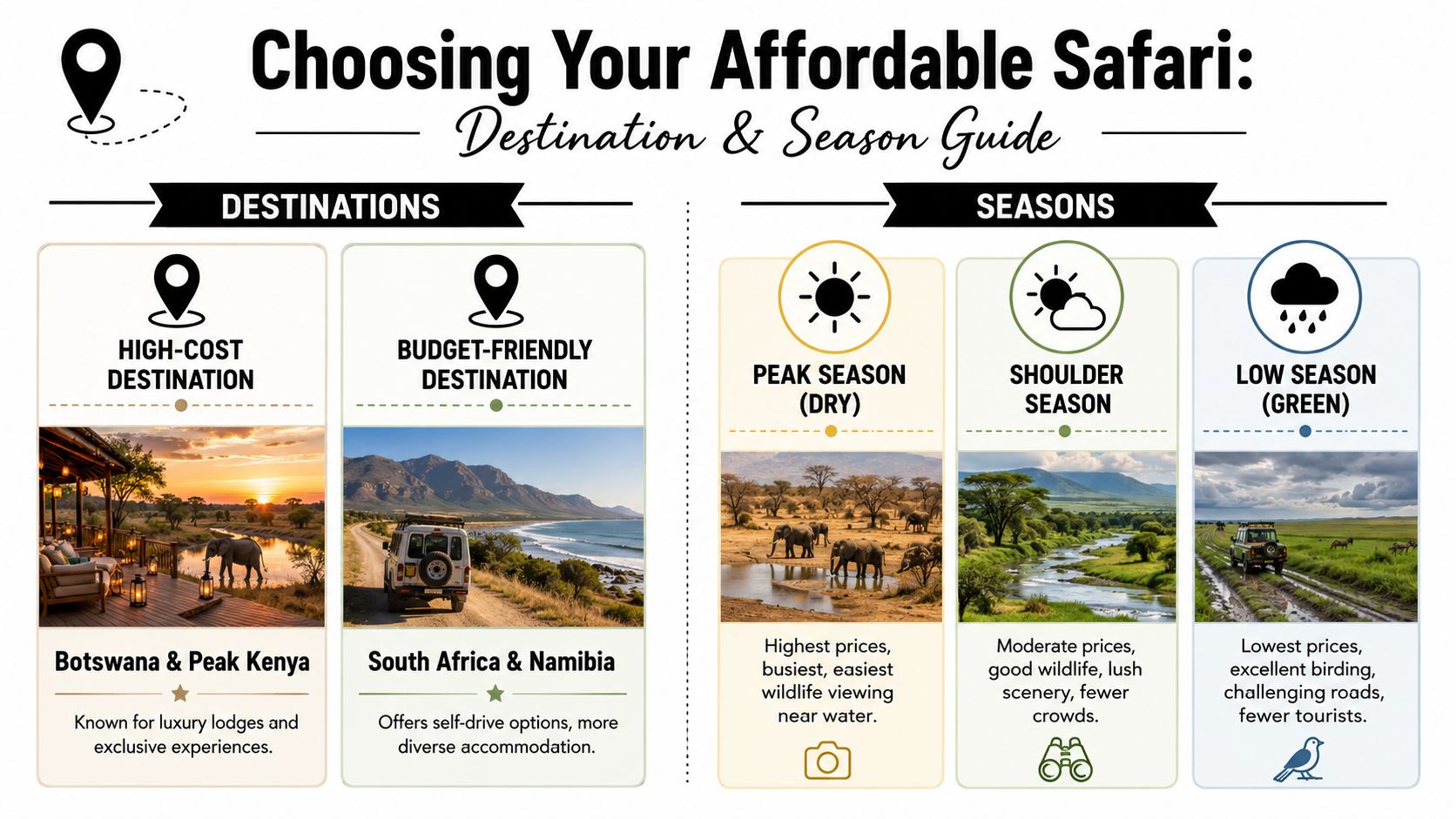
If you only get two decisions right, get these right. Pick a destination that is realistic for your budget. Then pick dates that do not force you into the most expensive version of that destination.
Some countries are easier to do well on limited funds. South Africa and Namibia stand out because road travel is practical, independent planning is realistic, and you can choose from more than one accommodation tier. Kenya, Tanzania, Uganda, and Malawi can also work, but the margin for error is smaller once you start adding domestic flights, private transfers, or gorilla permits. Botswana and Rwanda often deliver a premium experience, but they are tough places to build a low-cost first safari.
Why South Africa and Namibia make sense for budget travelers
These two reward restraint.
In South Africa, a traveler can build a strong first safari around Kruger or nearby public and private areas without needing a fly-in itinerary. In Namibia, the driving route is often part of the trip, so the hours between parks do not feel like dead budget in the same way they can elsewhere. Both countries give budget travelers more room to choose simple guesthouses, self-drive options, and shorter point-to-point routes.
The trade-off is straightforward. You may give up some exclusivity and some of the prestige that comes with remote luxury reserves. What you gain is time in the bush without burning cash on logistics.
A simple comparison helps:
| Destination style | What saves money | What you give up |
|---|---|---|
| Accessible safari hubs | Easier road transfers, more accommodation choice, fewer internal flights | Less privacy, more vehicles in popular areas |
| Remote prestige parks | Little to nothing on price. They usually cost more from the start | Higher transport costs, more planning, higher nightly rates |
| One-park trips from major cities | Lower total spend, fewer transfer days, simpler logistics | Less variety in scenery and wildlife settings |
That last row matters more than many first-timers expect. One park done properly often beats two or three parks done in a rush. A shorter route from a major city can leave more money for extra game drives, an extra night, or a better guide. Those choices usually improve the safari more than another long transfer ever will.
Season changes the price faster than people expect
High season usually wins on easy viewing. It also comes with the rates, crowds, and booking pressure to match. African Budget Safaris notes in its affordable safari tips that peak dry-season prices often climb sharply, while shoulder periods such as April to May or November can cut costs substantially.
That discount comes with trade-offs.
Roads can be rougher. Some afternoons may be wet. Grass can be higher in certain areas, which can make spotting animals harder. But shoulder season also brings real advantages: fewer vehicles at sightings, better accommodation availability, and a budget that stretches into an extra night or a better park choice.
I usually tell budget travelers to decide which pain they prefer. Pay more for easier conditions, or accept a little weather and uncertainty for better value.
A practical filter for choosing well
Use this before you lock anything in:
- If you dislike long road days: choose a destination with a direct, manageable transfer from a major airport or city.
- If price matters more than perfect visibility: target shoulder season and skip the peak dry-season rush.
- If this is your first safari: choose the country with the simplest logistics, not the one with the strongest social media reputation.
- If flights are wrecking the numbers: use the cheapest months to fly internationally to shape your safari dates before you choose a park.
The expensive mistake is chasing the name everyone knows and the season everyone wants. The smarter move is choosing the version of safari that your budget can support without cutting the trip down to the bone.
Master Your Transport and Accommodation Costs
Once destination and season are set, your budget lives or dies on the ground. Transport and beds are where “affordable” becomes real or falls apart.
The strongest cost-control levers after timing are transport and itinerary length. Road-based safaris and budget camping formats can start around US$150 to $200 per person per day, while one industry guide places a typical lodge-based floor near US$500 per person per day, as outlined in Go2Africa's safari cost guide.
Transport choices that actually move the needle
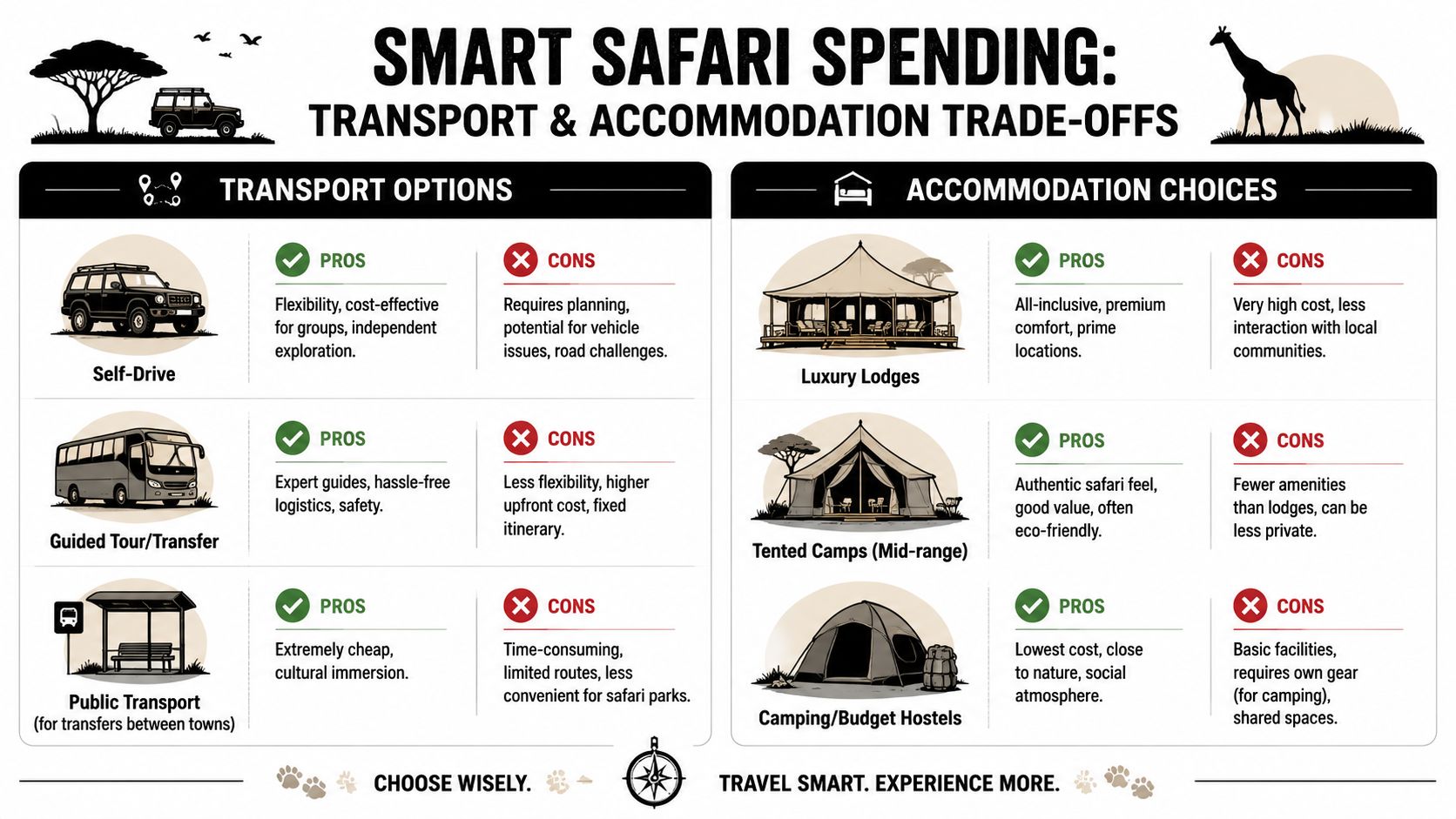
Internal flights are convenient. They also eat budget fast. If your route can be done by road without turning the trip into a punishment, road transfers usually offer the best value.
A simple comparison helps:
- Self-drive: cheapest in the right countries, flexible, great for confident planners. It adds responsibility, navigation, fuel planning, and the stress of being your own problem-solver.
- Small-group road safari: strong middle ground. Costs are shared, logistics are handled, and you don't need to think about route planning every hour.
- Fly-in itinerary: best for time-poor travelers and remote areas. Usually the wrong choice if affordability is your main goal.
Sleep where your priorities are
Accommodation on safari is not just about comfort. It shapes your whole daily rhythm.
| Style | Good for | Trade-off |
|---|---|---|
| Participation or guided camping | Lowest costs and social travel | Less privacy, more dust, more setup |
| Budget tents or simple camps | Authentic feel without full roughing it | Fewer amenities |
| Rest camps, chalets, or budget lodges | Better sleep and easier logistics | Higher nightly cost |
| Lodge-only itineraries | Comfort and service | Cost climbs quickly |
If you're trying to build an affordable African safari, the sweet spot is often not the absolute cheapest bed. It's the one that lets you rest well enough to enjoy early drives without paying for luxury touches you'll barely use.
Field note: Travelers often underestimate how tiring safari days are. A slightly better mattress can be worth paying for. A plunge pool usually isn't.
What works better than people think
Staying outside park gates is one of the clearest money-saving moves, as covered later in the article. So is shortening the route. A compressed itinerary with fewer transfers often delivers a better experience than a sprawling one that burns cash and energy.
Flight hunting still matters for the long-haul portion, and these cheap flight search tactics can help protect your safari budget before you even reach Africa.
What doesn't work well is mixing luxury expectations with budget mechanics. If you want private game drives, premium lodge locations, and short transfer times, you're not planning a low-cost safari. You're planning an expensive trip and hoping someone else will absorb the difference.
Go DIY or Choose a Small Group Tour
This is the fork in the road that matters most for many travelers. Do you build the trip yourself, or do you buy into a small-group safari that handles the messy parts?
Both can work. Neither is automatically cheaper in every situation.
DIY is best for control
A do-it-yourself safari gives you the most power over spending. You choose where to sleep, how long to stay, how many parks to include, and whether a detour is worth it.
DIY usually works best for travelers who are comfortable with research and okay with some friction. You need to compare routes, understand transfer times, read the fine print on park access, and accept that you are the operations team. If one booking slips, there's no guide stepping in to fix the chain reaction.
DIY is strongest when:
- You're traveling in a destination with straightforward roads and accommodation options
- You want to self-drive or build your own low-cost base near one main park
- You'd rather spend time planning than pay someone else to package convenience
Small-group tours are often best for first-timers
Budget travelers sometimes dismiss tours too quickly. That's a mistake. A well-priced small-group safari can solve the hardest parts at once: transport, guiding, park logistics, and on-the-ground timing.
There's a real-world example behind that logic. A documented 5-day Kruger National Park camping safari cost about US$900, showing how a guided camping format in South Africa can bring the per-person cost down in a practical way, according to this detailed Kruger budget planning write-up.
That kind of trip appeals to solo travelers in particular. Sharing a vehicle and guide lowers costs without forcing you to rent a car, handle directions, or solve problems in a place you've never visited.
What each option gets wrong
DIY fans often underestimate fatigue. Safari planning looks fun at home. It's less fun when you're driving long distances, checking in late, and still trying to be alert at dawn for wildlife.
Tour skeptics often assume all group travel feels boxed in. Good small-group trips can still offer plenty of wildlife time and remove the most expensive mistakes, especially for people who don't want to learn every booking system and route detail from scratch.
If your safari budget is tight, your time is limited, and this is your first trip, a small-group camping or budget lodge safari is often the smarter buy than a fully independent plan.
One factual option in this space is Travel Talk Today, which offers Africa tours and holidays that include safari elements such as a safari vehicle, game drives, accommodation, and meals on selected itineraries. That won't suit every traveler, but packaged ground services can make sense when logistics are the part you'd rather not build yourself.
The right choice isn't ideological. It's practical. If you enjoy planning and can handle uncertainty, DIY can save money. If you want low stress and predictable ground costs, a small group can be the better value.
Craft Your Budget Safari Itinerary
A workable safari itinerary is short, focused, and honest about trade-offs. The mistake I see most often is travelers trying to squeeze in too much geography because they assume more parks automatically means a better trip.
It doesn't. More parks often means more transit, more coordination, and more ways to spend money while not looking at wildlife.
Build around one anchor park
For a budget safari, start with one anchor area and ask whether a second location adds enough to justify the movement. If the answer is “maybe,” leave it out.
Daily safari rates can be deceptive. Travel Weekly reports that budget safaris can start around $150 to $300 per day and midrange trips around $360 to $550 per day, often including accommodation, meals, and game drives, but those numbers don't always settle the all-in cost once transport, park fees, and timing are factored in, as explained in Travel Weekly's safari budget overview.
Sample 7 day budget safari cost breakdown
Use this as a planning framework, not a universal quote. The ranges below stay qualitative where the verified data doesn't support a precise line item.
| Expense Category | Low-End Estimate (DIY/Camping) | High-End Estimate (Budget Operator/Lodge) |
|---|---|---|
| Accommodation | Built around budget camping rates | Built around budget lodge or tented camp rates |
| Transport on the ground | Self-drive or road transfers | Shared guided vehicle or packaged transfers |
| Game drives | Self-drive viewing or separately arranged drives | Usually bundled into operator pricing |
| Meals | Self-cater some meals or eat simply | More meals included |
| Park fees | Must be checked carefully and budgeted separately where not included | Sometimes included, sometimes extra |
| Season effect | Lowest in shoulder or off-peak periods | Higher if dates drift toward peak demand |
| Overall trip style | Lower comfort, more planning, tighter control | Easier logistics, less flexibility, higher base cost |
The key is not to chase the lowest daily headline. It's to compare final trip cost based on what is and isn't included.
A strong low-budget formula
A practical formula looks like this:
Pick one affordable destination
South Africa is the easiest place to start for many travelers because the mechanics are more forgiving.Travel in shoulder or low season
You lower the accommodation burden and often find easier availability.Use road transport
Every avoided internal flight helps.Stay longer in fewer places
Two nights minimum in any safari base usually feels more human than constant movement.Decide where comfort matters
Many travelers can camp happily, but not every traveler sleeps well enough for that to be good value.
Booking discipline matters
Before paying anything, run through a real planning checklist. A solid trip-planning checklist helps catch the usual weak points: what's included, what's separate, how many transfers you are buying, and whether your first and last day are useful safari days or just expensive transit.
The best-value safari itinerary usually looks modest on paper. On the ground, it feels spacious. That's what you want.
Smart Packing Safety and Sustainable Travel Tips
The expensive safari mistakes often happen before the first game drive. A forgotten charger becomes an overpriced lodge-shop purchase. The wrong bag slows every transfer. Shoes that looked fine at home become miserable by day two.
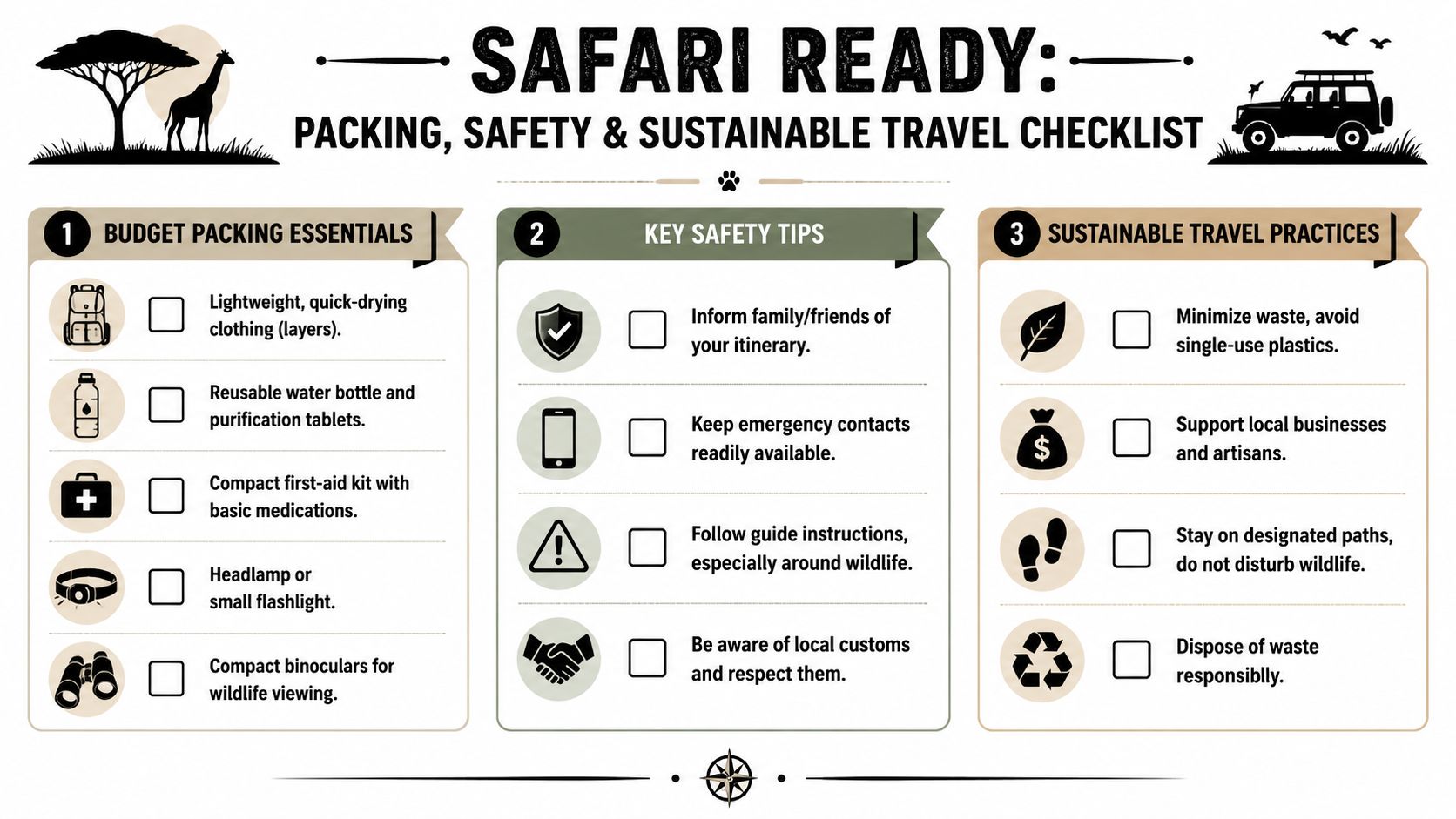
Budget safari packing has one job. Reduce repeat costs and daily friction. You do not need more stuff. You need the few things that keep you comfortable enough to enjoy long drives, cold mornings, dusty roads, and basic camps without buying fixes along the way.
Pack for repetition
On an affordable safari, you will re-wear clothes, hand-wash items in sinks, and live out of one bag more than you expect. Pack with that reality in mind.
A smart kit usually includes:
- Quick-drying layers: Fewer clothes, easier washing, less luggage weight.
- Reusable water bottle: Useful every day, especially where safe refills are available.
- Headlamp or small flashlight: Helpful in campsites, shared bathrooms, and before sunrise departures.
- Compact first-aid kit: Bring the basics you already know how to use.
- Binoculars: One of the few items that directly improves wildlife viewing.
If you are camping or staying in simple rooms, add a small dry bag, a power bank, and lightweight sandals. Those are not glamorous purchases. They save hassle.
Cheap gear can cost more on the road
This is one place where the lowest price is not always the best value. A flimsy duffel with a broken zip, a dead power bank, or bargain shoes with no grip can create costs fast. I usually spend a little more on the bag, shoes, and binoculars, then keep the rest simple. That trade-off pays for itself because those items affect comfort every single day.
The same logic applies to weight. Packing too much often means baggage fees, slower bus changes, and more chances to leave something behind. Packing too little can mean buying basics in tourist areas at inflated prices. Aim for the middle. Enough to be self-sufficient, not enough to be burdened.
Safety on a budget comes down to routine
Wildlife safety matters, but many budget-travel problems are smaller and more common. Lost cash. A phone left charging in a shared space. Arriving late and trying to find a guesthouse after dark in an unfamiliar town.
Keep your systems boring:
- Follow guide instructions around animals.
- Store passport, cash, and phone in the same place every time.
- Send your route and booking details to someone at home.
- Reach your overnight stop before dark when possible.
That kind of discipline protects both your wallet and your time.
Spend less without treating the place badly
Sustainable safari travel is often just careful travel. Use refillable bottles where safe. Choose locally run camps or guesthouses when the pricing and standards work for you. Do not push guides to get closer to animals for a photo. Crowding wildlife for a better view is not smart budget travel. It can also ruin the sighting for everyone else.
Sleeping outside a park boundary is a good example of the trade-off. It often lowers your nightly cost. It can also spread your spending into nearby communities. But you may give up the atmosphere of staying inside the park, and your day can start earlier because of the extra drive to the gate. For travelers who care more about total trip cost than lodge setting, that is often a fair exchange.
For habits that work well beyond safari trips, these practical sustainable travel tips are worth applying before you book.
An affordable African safari still asks for judgment. Spend on the items and habits that protect your health, your sleep, and your ability to enjoy the wildlife. Cut the extras that only look good in photos.
Travel Talk Today shares practical guides for travelers who want meaningful trips without luxury pricing, and you can explore more destination advice, budgeting strategies, and safari-friendly planning ideas at Travel Talk Today.