The most repeated advice about international airfare is also the least useful: avoid summer, fly in winter, and hope for the best.
That sounds tidy. It also misses how airline pricing works. Summer can be expensive, yes, but it isn't uniformly expensive. Winter can be cheap, but not for every route, every cabin, or every booking pattern. If you only follow broad travel folklore, you'll miss the true advantage, which is understanding the rhythm behind fares.
The cheapest months to fly internationally aren't random. Airlines don't throw prices into the air like confetti. They adjust them around predictable waves of demand, especially school breaks, holiday travel, and route-level competition. Once you see that pattern, you stop shopping emotionally and start booking strategically.
That shift matters for more than your budget. Lower-fare periods often overlap with quieter travel windows, and quieter travel windows usually create better trips. Streets feel less staged. Museums feel less rushed. Local businesses can talk to you. You're not just saving money. You're buying a different kind of experience.
Your Adventure Awaits Without the Hefty Price Tag
A cheap international flight usually isn't the result of luck. It's the result of traveling when fewer people want the same seat you want.
That's why the best airfare advice starts by questioning the usual assumptions. Many travelers still believe peak summer is always the worst time to book and always the worst time to fly. But one data set can point one way while another shows a different low-cost window for a different traveler profile. That doesn't mean pricing is chaotic. It means airfare is segmented.
Cheap doesn't mean random
Airlines sell seats the way concert promoters sell tickets. If they know a route will attract families during school vacation, they can charge more because many travelers have limited flexibility. If they expect softer demand, they lower fares to keep planes full. The important point is that this pattern repeats.
For budget travelers, that repeatability is good news. It means you can build trips around timing rather than chasing one-off sales. A spring city break, a late-summer long-haul escape, or a fall cultural trip can all become more accessible when you line up your travel dates with the market's quieter moments.
Practical rule: Cheap flights usually appear where your calendar is more flexible than everyone else's.
Better timing creates better travel
There's another layer that doesn't get enough attention. Lower fares often align with more thoughtful travel. Shoulder-season trips can reduce crowd pressure in overvisited places while giving you a fuller sense of local life. You trade queue-heavy sightseeing for slower mornings, easier restaurant reservations, and a city that feels inhabited rather than performed.
Understanding the advantage of knowing the cheapest months to fly internationally is essential. You are not just reducing transportation costs; you are using timing as a strategic tool. The same trip can feel cheaper, calmer, and more meaningful because you shifted it a few weeks.
Unlocking the Global Flight Calendar
The global airfare calendar behaves less like a mystery and more like a tide chart. Prices rise when large groups of people need to travel at the same time, then fall when demand relaxes. Once you think in those terms, the cheapest months to fly internationally become easier to predict.
For US-based travelers, one broad window stands out. February and March are the cheapest months to fly internationally, while summer fares rise sharply. Hopper reports that, for travelers departing from the United States, February and March stand out as the cheapest months to fly internationally, and summertime international seat prices from the US swell to an average of $1,023 according to Hopper's international airfare analysis.

Off-peak and shoulder season matter more than travel myths
The core concept is simple. Off-peak season is when fewer people travel. Shoulder season sits just before or after the biggest rush. Both periods tend to produce better airfare than the height of summer and major holiday stretches.
February and March work because they sit in a gap. The winter holiday surge is over. Spring and summer family travel hasn't fully arrived. Demand softens, and airlines need bookings from people who can move outside the obvious vacation weeks.
That's why a traveler with date flexibility can often beat someone who starts searching earlier but insists on a narrow departure window. Timing your trip well often matters more than trying to outguess a single booking day.
The calendar has predictable pressure points
There are a few recurring fare triggers that shape the international market:
- School holidays: Family travelers tend to cluster around the same windows, especially summer and holiday breaks.
- National holidays: Long weekends and major celebrations create short bursts of heavy demand.
- Weather-driven tourism: Travelers flock to destinations when conditions feel most comfortable, even if those dates carry the highest prices.
- Bucket-list habits: Many people default to summer for Europe, beach season for the Caribbean, and year-end breaks for long-haul trips.
These habits concentrate demand. Airlines don't need every traveler to pay a high fare. They only need enough travelers who must fly at that time.
When you move your trip outside the obvious weeks, you're not gaming the system. You're simply shopping where competition is weaker.
Use the calendar as a filter, not a guess
A smart search starts with months, not routes. Decide your likely low-demand window first. Then compare destinations inside that window.
That approach flips the usual process. Instead of saying, “I want Rome in July, now how do I make it cheap?” ask, “When is the market softest, and which destinations become most attractive then?” Travelers who use that framework consistently find more options. If you want a practical search workflow, this guide on how to find cheap flights is a useful companion.
The hidden pattern is that the calendar itself does much of the savings work. You don't need a secret trick. You need to travel in the weeks when fewer people insist on doing the same thing.
Why Flight Prices Fluctuate Seasonally
The simplest way to understand airfare is to stop thinking like a traveler and start thinking like a venue manager.
A concert promoter doesn't price every show the same way. If a major artist performs on a holiday weekend, the promoter can raise prices because demand will be strong. If a lesser-known act plays on a wet midweek evening, the promoter cuts prices to fill seats. Airlines do the same thing, only with more data and faster adjustments.
Airlines sell the same seat at different values
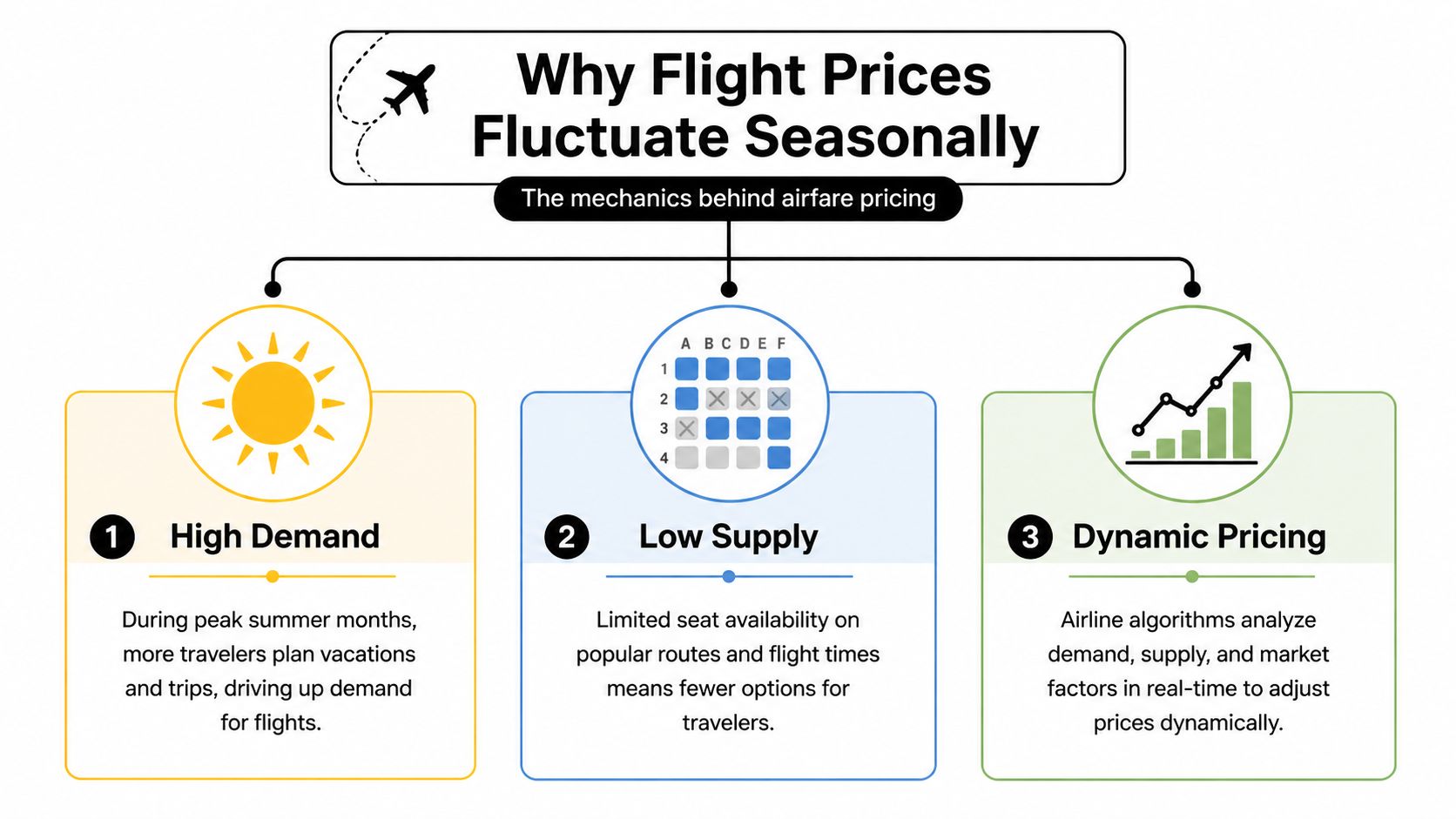
A plane has a fixed number of seats once the schedule is set. That makes pricing a constant balancing act. Airlines want enough people to book early so flights don't look weak, but they also want to hold back inventory for travelers who'll pay more later.
That's where revenue management comes in. Airlines group seats into fare buckets and release them based on expected demand. During high-demand periods, cheap buckets disappear quickly or never appear in meaningful volume. During softer periods, airlines leave lower fares on sale longer because filling the plane matters more.
The price gap is larger than most travelers assume
The seasonal spread can be dramatic. International fares average $1,024 in October and $1,180 in March, compared with $1,720 in July, a 68% price differential driven by airline revenue management systems that adjust capacity allocation, according to Dollar Flight Club's seasonal airfare breakdown.
That's the kind of gap that changes trip design. It can determine whether you take one long trip or two shorter ones. It can also decide whether you choose a direct flight, upgrade your lodging, or stay longer once you land.
Demand elasticity explains the swings
Economists use the term demand elasticity to describe how sensitive buyers are to price changes. In airfare, leisure travelers with flexible dates are more elastic. If the fare is too high, they wait, pick another destination, or skip the trip. Travelers tied to school schedules, weddings, reunions, and holiday breaks are less elastic. They often book anyway.
Airlines know this. They don't just react to demand. They predict who is likely to tolerate a higher fare and when.
Here's how that plays out in practice:
- Peak windows attract inflexible travelers. Summer and holiday periods bring families and event-based trips.
- Airlines protect higher fares. They make fewer low-price seats available when they expect strong demand.
- Shoulder periods attract flexible travelers. To stimulate bookings, airlines keep lower fare classes open longer.
- Prices move constantly. The system adjusts as bookings come in, not on a fixed public schedule.
Airfare feels volatile because travelers see the output. The logic underneath is often stable.
Cheap months are a signal about traveler behavior
The deeper lesson isn't just “October beats July” or “shoulder season is cheaper.” It's that fare drops tell you where the crowd isn't. That matters because airfare pricing is partly a map of human behavior. It shows where calendars bunch up and where they loosen.
When you understand that, you stop asking whether a fare is “good” in isolation. You ask a sharper question: how much demand pressure am I competing against right now?
That's the mindset that helps travelers outsmart the system. You're not trying to beat airline software at its own game. You're choosing moments when the software has a reason to work in your favor.
A Regional Guide to Finding Cheap Flights
Global patterns help, but regional timing shapes the actual bargain. A cheap month for one destination can be a poor choice for another because climate, school calendars, festival seasons, and local travel habits all pull prices differently.
The table below is best used as a decision guide, not a rigid rulebook. It combines the broad data-backed windows already discussed with destination-level seasonality logic.
Cheapest Months to Fly by International Region 2026
| Region | Cheapest Months | Notes on Seasonality |
|---|---|---|
| Europe | February, March, October | Winter and early spring often see softer demand outside major holiday periods. October can pair lower airfare pressure with comfortable city travel. |
| Southeast Asia | February, March, August, October | Demand shifts around weather expectations and school breaks. August can surprise travelers who assume all late summer is expensive. |
| East Asia | February, March, October | Business and leisure flows vary by route, but broad shoulder periods often create more favorable pricing than midsummer. |
| Central America and Caribbean | February, March, August | Early-year windows can work well from the US, while some late-summer trips price more gently if travelers accept warmer, wetter conditions. |
| South America | February, March, October | Prices often ease outside the biggest holiday and peak vacation stretches, especially for city-focused itineraries. |
| Australia and New Zealand | February, March, August, October | Long-haul routes tend to reward flexibility. Shoulder periods can be more forgiving than travelers expect. |
| Middle East | February, March, October | These months often avoid the strongest summer leisure patterns and some major holiday congestion. |
| Africa | February, March, October | Conditions vary sharply by subregion, so airfare opportunity often depends on whether you're prioritizing safari timing, cities, or coastlines. |
Europe rewards travelers who separate weather from value
Europe gets trapped inside one big travel myth: summer equals best. Summer may offer long daylight, but it also concentrates demand from families, students, and first-time visitors. If your goal is affordability, that's the wrong benchmark.
February and March can produce stronger flight value for urban itineraries. Cities such as Lisbon, Madrid, Budapest, and Rome remain culturally rich even when beach weather isn't part of the equation. October is especially interesting because it often gives travelers a better trade. You still get active street life and easier walking conditions, but without midsummer crowd density.
A useful way to think about Europe is this: if your trip is driven by museums, neighborhoods, food markets, and photography, shoulder months usually improve the experience.
Southeast Asia and the late-summer surprise
Southeast Asia confuses travelers because they often focus only on weather labels. “Dry season” sounds ideal, so demand piles in. But airfare doesn't reward idealized weather. It rewards lower competition.
That's where August becomes intriguing. Expedia's 2025 analysis identified August as the cheapest month for US travelers booking economy international tickets, which challenges the assumption that every summer month is automatically expensive. On some Southeast Asia routes, that can align with a traveler's willingness to accept mixed weather in exchange for lower flight costs.
Good travel value often appears where comfort is still acceptable but certainty is lower.
This is especially relevant for backpackers and slow travelers. If you're staying longer, a few rainy afternoons matter less than they do on a rushed weeklong vacation.
Latin America and the Caribbean benefit from flexibility
For travelers from the US, nearby international regions often respond strongly to broad seasonal demand patterns. February and March can work well because they sit outside the heaviest summer travel surge. But route-specific local peaks still matter. Beach destinations, resort corridors, and event periods can create short fare spikes even when the broader season looks favorable.
That's why “region” and “trip type” should be paired. A cultural trip to a capital city can price very differently from a beach escape in the same month.
If you're still choosing where your money will stretch furthest once you land, this roundup of cheapest countries to travel can help narrow the shortlist.
Long-haul regions reward slower, more intentional itineraries
Australia, New Zealand, parts of Africa, and much of East Asia ask more from your budget because the flight itself is a larger share of total trip cost. That raises the value of timing even further.
For these destinations, the smartest move is often to anchor your trip around a shoulder-season airfare window, then build a slower itinerary around it. Long-haul travel becomes more rational when you spread the flight cost across more days and avoid arriving during the destination's busiest weeks.
A useful comparison:
- Peak-season long haul: Higher airfare, more crowd pressure, tighter booking competition
- Shoulder-season long haul: Better fare potential, more breathing room, easier pace on the ground
- Off-peak long haul: Best for travelers who prioritize budget and flexibility over guaranteed ideal weather
The hidden pattern across regions is simple. Cheap months rarely promise perfect conditions. They offer a better balance between access, experience, and cost.
Beyond the Month Timing Your Booking Window
Choosing the right month gets you into the right neighborhood. Choosing the right booking moment helps you avoid overpaying inside that neighborhood.
Many travelers focus on travel dates and ignore purchase timing. That's a mistake because airlines don't only price by season. They also price by how urgently they think you need the seat.

Departing day matters more than booking superstition
One of the oldest travel myths says there's a magical booking day when fares always drop. That idea survives because people want certainty. But fare systems are more fluid than that.
A more useful signal is the day you depart. Expedia's 2025 flight data analysis found that Thursday is the cheapest international departure day, with savings of up to 8% versus Sunday, and it also identified August as the cheapest month for US travelers booking economy international tickets, with savings of up to 12% compared to other months, according to Expedia's airfare timing report.
That tells you something important. The market often penalizes convenience. Sunday appeals to travelers trying to maximize weekend time, so it gets priced accordingly. Thursday sits in a less crowded lane.
Booking windows work like a pressure gauge
A good booking window is less about one exact day and more about avoiding two expensive extremes:
- Too early: Airlines may keep fares high while demand is still uncertain.
- Too late: As departure approaches, urgency gives airlines pricing power.
- Middle window: This is often where fares become more competitive because airlines have better visibility into demand and still need to stimulate bookings.
Hopper notes that booking at least 25 days in advance can knock up to $250 off the total ticket price on international trips, with some routes seeing optimal windows as far out as 100 days, as described in this guide to the best time to book flights.
A practical booking rhythm
The smartest booking process is disciplined rather than obsessive.
- Start with a flexible month search. Look at a whole calendar rather than one fixed departure date.
- Set alerts early. Use Google Flights, Skyscanner, or Expedia to monitor route movement.
- Check midweek departures first. Thursday has strong data support, and flexible travelers can compare nearby weekdays.
- Watch price consistency, not one flashy drop. A stable fare in a cheap month is often better than waiting for a perfect dip that never returns.
- Book when the fare fits your budget and trip goals. Saving money matters, but so does preserving the itinerary you want.
If you've found a fare in a low-cost month, on a lower-pressure departure day, and within a reasonable advance window, you've already stacked the odds in your favor.
Why this matters for real trips
A cheap travel month without a smart purchase strategy can still produce a mediocre result. You might choose the right season but depart on a premium day or wait until prices harden. Booking strategy turns seasonal advantage into actual savings.
That's what separates occasional bargain hunters from travelers who consistently pay less. They don't rely on folklore. They align month, weekday, and purchase window into one decision.
Navigating Exceptions and Finding Hidden Deals
Every airfare rule has an exception. That isn't a flaw in the strategy. It's where strategy becomes useful.
The broad pattern says shoulder season wins. But airline pricing operates at several levels at once. A month can look cheap in aggregate and still contain expensive pockets. A summer month can look expensive by reputation and still produce deals on specific route types.
Micro-peaks can overpower a cheap month
Major festivals, school breaks, and cultural events create what I think of as micro-peaks. These are short periods when local demand pressure overwhelms the broader monthly pattern. A destination may be in a nominally cheaper season, yet fares jump because a large number of travelers suddenly want the same week.
That's why good timing isn't just “pick March” or “pick October.” It's “pick the right part of March” or “avoid the event week inside October.” Travelers who ignore that detail often think airfare trends are unreliable when the underlying problem is event concentration.
August breaks the usual script
August is the cleanest reminder that travel myths age badly. Many travelers assume it must be one of the most expensive times to fly because it sits in summer. Expedia's data complicates that story by identifying August as the cheapest month for US travelers booking economy international tickets. The market can soften after the strongest early-summer rush, especially when travelers have already taken their main vacation.
That doesn't mean August is cheap everywhere. It means broad assumptions can hide route-level opportunity.
A smart traveler treats airfare guidance as a map with contour lines, not a single answer.
- If a route is family-heavy, school schedules may dominate.
- If a route is weather-driven, climate expectations may matter more.
- If a route has strong business traffic, leisure assumptions can mislead you.
- If a route serves a major event, one week can price like a different season entirely.
Sustainable travel and cheap travel often overlap
One of the most appealing exceptions to mass-market advice is that the “less obvious” travel window is often the more responsible one. Visiting a city just outside its tourism peak can reduce crowd stress on transit, public spaces, and local housing pressure. It can also spread spending more evenly through the year.
That doesn't make every off-peak trip automatically sustainable. But it does create a better starting point. You're less likely to arrive when a destination is already operating at full strain, and more likely to encounter everyday local life rather than a city rearranged around visitors.
The cheapest ticket can sometimes buy the richest version of a place, simply because fewer people are competing to consume it at once.
Use tools, but don't outsource judgment
Fare alerts, flexible-date calendars, and multi-airport searches are excellent. Google Flights and Skyscanner are especially useful for comparing date grids. But tools don't replace context. They show price movement. You still need to ask why a fare is low.
Sometimes the answer is favorable shoulder-season timing. Sometimes it's a less convenient routing. Sometimes it's a signal that a destination is in a weather transition or demand lull that suits your travel style perfectly.
If you're open to opportunistic planning, these cheap last-minute travel deals can help you spot windows that don't fit the standard calendar but still make strong sense.
Your Action Plan for Affordable International Travel
Affordable international travel isn't about chasing miracles. It's about stacking small advantages until the trip becomes financially easy to say yes to.
The travelers who consistently do this well follow a repeatable process. They don't begin with the airline. They begin with the calendar, then narrow by region, then book with discipline.
A smarter way to book your next trip
Use this checklist:
- Choose a destination category first. Decide whether you want Europe, Latin America, Southeast Asia, or a long-haul trip where timing matters even more.
- Match it to a lower-pressure month. February and March remain strong starting points for many US-origin international trips, while August and October can also create attractive opportunities depending on route and traveler type.
- Avoid obvious crowd magnets. Check for festivals, school breaks, and holiday periods that can turn a cheap month into an expensive week.
- Search flexible departures. Compare a few midweek options rather than locking yourself into the most convenient day.
- Track before you buy. Use Google Flights, Skyscanner, or Expedia alerts so you can recognize a good fare when it appears.
- Book with purpose, not hesitation. If the fare fits your budget, dates, and travel goals, take it.
- Use rewards strategically. A solid points setup can reduce the remaining cost of a well-timed fare, especially if you're building toward bigger trips with one of the best credit cards for travel rewards.
The real payoff
The cheapest months to fly internationally matter because they shift the trip from stressful to possible. But the bigger win is confidence. Once you understand why fares rise and fall, you stop feeling manipulated by the market.
You start seeing options other travelers miss. A late-summer departure that defies the stereotype. An October trip that feels better than July. A shoulder-season itinerary that costs less and delivers more.
That's how thoughtful travelers outsmart airfare. They don't demand perfection from the market. They move when the market is least crowded.
Travel planning gets easier when good advice and good timing meet. For more practical, budget-conscious guidance on meaningful trips, explore Travel Talk Today.