You've booked the Black Hills trip. Mount Rushmore is on the list, Custer State Park is calling, and now the flight search is getting messy. Rapid City looks obvious, but sometimes the best airport for this trip isn't the closest one on the first search result.
That's why travelers keep comparing airports near Rapid City SD instead of blindly booking RAP every time. Sometimes you want the shortest possible drive after landing. Sometimes you want a small airport with easier parking and less airport stress. Sometimes you need a backup because summer dates into Rapid City get tight.
The good news is that you don't need dozens of options. You need the right option for your trip shape. Some airports work best for a straight shot into Rapid City hotels. Others are better for southern Black Hills stays, park-heavy itineraries, or trips where flight flexibility matters more than absolute proximity. This guide breaks each one down by the problem it solves, so you can match the airport to the kind of traveler you are.
1. Rapid City Regional Airport (RAP)
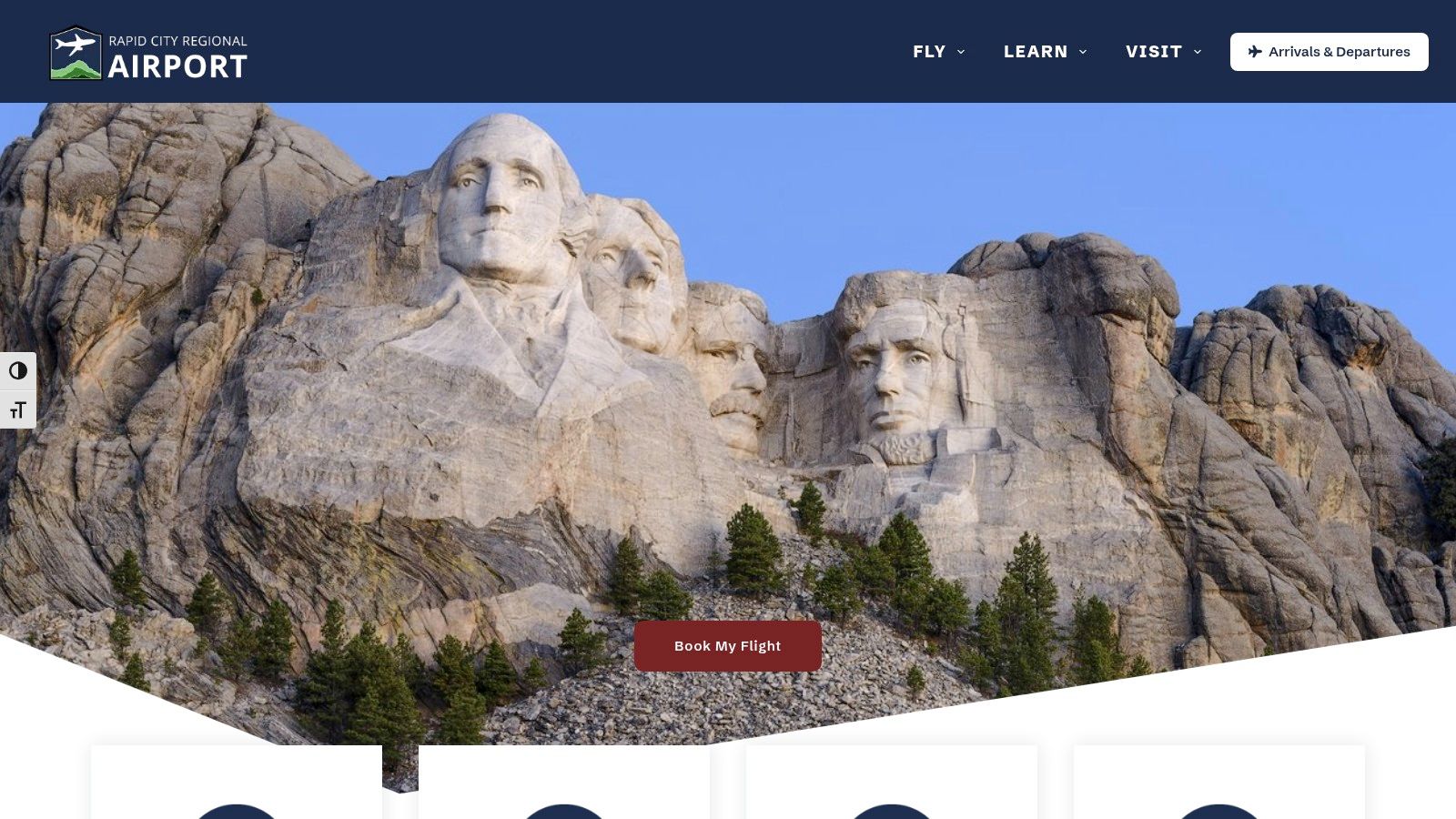
You land in western South Dakota at 8 p.m., pick up the rental car, and want to be checked into your hotel before the kids melt down or the daylight disappears. That is the trip shape where Rapid City Regional Airport earns its keep. RAP sits 9 miles southeast of Rapid City, so it solves the biggest problem on short Black Hills trips: wasted ground time.
RAP is the default choice for travelers who value time more than the chance of shaving a little off the airfare. If you are staying in Rapid City, heading to Mount Rushmore the next morning, or only have a long weekend, this airport usually gives you the cleanest plan with the fewest moving parts.
It also offers more airline flexibility than the smaller alternates in this guide. United, Delta, and American all serve RAP, which matters most when weather, missed connections, or schedule changes force you to rebook fast. Smaller airports can work, but they usually give you fewer ways out if the first itinerary falls apart.
Best for the shortest drive and the safest overall bet
I usually point budget travelers to alternate airports only when the savings are real enough to justify the extra drive. RAP is the airport to choose when that trade-off does not pencil out. A cheaper ticket elsewhere can disappear once you add more fuel, more rental car time, and a half day lost on the road.
Here is where RAP stands out:
- Closest arrival point: You get the shortest drive to Rapid City hotels and an easier first day in the Black Hills.
- Better hub access: Service on major network carriers gives you more practical connection options than tiny regional fields.
- Stronger backup value: If one flight goes sideways, you have a better chance of finding another routing the same day.
- Good fit for short trips: Weekend travelers get more usable vacation time and less airport-to-highway fatigue.
RAP also keeps improving its passenger setup. The airport is in the middle of a terminal expansion project, which reflects the steady demand for Black Hills travel and should help with gate and terminal flow over time.
The main drawback is price pressure during peak travel periods. Summer, holiday weekends, and event dates can make RAP look expensive compared with farther-out airports. That is when it pays to compare total trip cost, not just the base fare, and use a few cheap flight search strategies that actually lower your fare before giving up on RAP.
Schedules also shift by season, especially for nonstop options, so check current service on the Rapid City Regional Airport website. If you're renting a car, it's also smart to compare your airport rental options with broader budgeting advice like these ACE car rental review considerations.
2. Pierre Regional Airport (PIR)
Pierre is the airport for travelers who hate airport chaos more than they hate driving. It's a smaller regional field, and that changes the experience immediately. Parking is simpler, the terminal is easier to get around, and the whole trip feels more manageable if RAP fares spike or your preferred dates get awkward.
The biggest hidden value here is offset cost. Pierre's airport highlights free on-airport parking and booking paths that connect travelers into larger airline networks through the official Pierre Regional Airport site. For someone doing a longer trip or leaving a car behind, that kind of simplicity can matter as much as the ticket.
Best for low-stress departures
Pierre works well when your biggest problem is stress, not distance. If you'd rather trade extra highway time for a calmer check-in and less terminal friction, PIR makes sense.
What works:
- Free parking: That's one of the clearest advantages over busier airports.
- Simple terminal flow: Small airports are easier when you're traveling solo, with older relatives, or with bulky outdoor gear.
- Useful fallback: Through-ticketing can keep it practical even though the airport itself is small.
What doesn't:
- Limited frequencies: Fewer daily departures mean less room for error.
- Connection risk: If the first leg slips, rebooking options can be thinner than at a larger airport.
A small airport only saves money if the schedule fits your day. If the connection forces an overnight or a brutal layover, the “cheap” option stops being cheap fast.
If you're price-shopping airports near Rapid City SD, Pierre belongs on the search list when RAP gets expensive. Before you book it, though, compare the full itinerary with a structured fare-search approach like this guide on how to find cheap flights.
3. Northeast Wyoming Regional Airport (GCC), Gillette

Gillette is the practical pick for travelers coming at the Black Hills from the northwest side. If your trip includes Devils Tower, Spearfish, or a loop that spends real time outside central Rapid City, GCC can fit better than people expect.
Its appeal is straightforward. Northeast Wyoming Regional Airport offers daily nonstop United or United Express service to Denver, which gives you a single clean connection point into a much bigger national network. That's not glamorous, but for many itineraries it's efficient enough.
Best for northwest Black Hills trips
I like Gillette best when the trip isn't centered on Rapid City itself. If you're building a driving route that touches northeastern Wyoming and western South Dakota, GCC can reduce backtracking and keep the airport experience simple.
Here's the trade-off in plain language:
- Good fit: Travelers who want a smaller airport and are comfortable connecting through Denver.
- Less ideal: Anyone who needs multiple rerouting options in case of delays.
- Worth checking: Peak travel dates when RAP prices feel out of line.
The airport's small scale also means less congestion and a faster curb-to-gate rhythm than larger hubs. That's often worth more than people admit, especially on return day when everyone's tired and trying to get home.
For road-trippers, GCC can pair well with a longer scenic loop. If that's your style, use practical planning habits from these money-saving road trip tips that actually work so the airport savings don't disappear into gas, snacks, and a poorly timed overnight stop.
4. Chadron Municipal Airport (CDR)

Chadron is the airport for travelers staying south of Rapid City. If your itinerary leans toward Custer State Park, Wind Cave, Hot Springs, or the southern Black Hills, CDR can make more sense than people assume from a map glance.
This is one of those alternate airports that shines because it avoids a common mistake. Travelers often default to the “cheapest flown” big-city option without fully counting the ground burden. The Black Hills travel discussion at All Black Hills transportation guidance points out that Denver is often pitched as the cheapest flight, but that advice usually ignores the long drive north to Rapid City. It also notes that Billings and Sioux Falls are often overlooked alternatives for park-focused trips, even though they may balance flight cost and ground travel more intelligently.
Best for southern Black Hills lodging
Chadron works when your hotel or cabin isn't in Rapid City at all. If you're sleeping in Custer, Hot Springs, or somewhere that puts you closer to the southern parks, a Nebraska arrival can feel much more logical.
CDR's practical strengths include:
- Small-airport speed: Check-in and boarding are typically easier than at bigger regional airports.
- Denver Air Connection service: That gives you access to onward connections through Denver.
- Interline support: The airport notes through-ticketing and baggage arrangements with larger carriers through its service setup on the Chadron Municipal Airport page.
Its weakness is schedule flexibility. You have to build in breathing room for connections, and this isn't the airport to choose if your whole trip collapses when a single segment moves.
Local-style advice: Chadron makes the most sense when your first night is already south of Rapid City. Otherwise, the convenience advantage fades.
When you're piecing together parks, lodging, and airport timing, a simple planning workflow helps. This travel planning checklist is useful for catching the details that usually get missed with smaller regional airports.
5. Western Nebraska Regional Airport – Scottsbluff (BFF)

Scottsbluff is a strong pick for travelers who want a southern alternate without going all the way down the small-EAS rabbit hole. It still gives you the simple, low-stress feel of a regional airport, but it tends to feel a bit more established for people who want a straightforward United connection through Denver.
What many travelers like here is the balance. Western Nebraska Regional Airport offers free parking, a short walk from parking to check-in, and clear airport information through local airport and city channels. That's the kind of airport where the departure day is less likely to feel like a project.
Best for budget-minded travelers coming from the south
Scottsbluff earns its spot when RAP doesn't pencil out and your route naturally approaches the Black Hills from the south. It's not the closest alternate, but it can be a smart compromise between price, ease, and terminal simplicity.
A quick read on BFF:
- Why choose it: You want United network access and a calmer airport day.
- Why skip it: You're staying in Rapid City and don't want extra driving.
- When it's strongest: Peak tourism dates when close-in airports get crowded or pricey.
The downside is obvious. It still leans heavily on Denver as the connection point, so disruption on that route can ripple through the whole trip.
That said, travelers who are already committed to a budget-first approach often do well here because they're more willing to optimize the entire trip, not just the flight. This guide on how to plan a trip on a budget fits that mindset well.
6. Alliance Municipal Airport (AIA)

Alliance is the backup plan that experienced travelers use. It's not the first airport commonly searched, and that's part of the point. When nearby regional options get tight, AIA can be the pressure-release valve that saves a trip.
Alliance offers nonstop service to Denver on Denver Air Connection under Essential Air Service, with service details and updates available through the Alliance airport site. The airport also highlights interline ticketing arrangements, which helps make a very small airport more usable for real-world itineraries.
Best for the sold-out week problem
This is the airport I'd check when summer inventory gets weird. If RAP, Chadron, and Scottsbluff all look expensive or awkward, Alliance deserves one careful search before you give up and overpay.
Why it works:
- Very low-stress boarding: Small terminal, simple process, less waiting around.
- Useful backup role: It broadens your search area without pushing you to a giant hub.
- Good for southern stays: Especially if your trip is weighted toward Hot Springs, Custer, or a Nebraska panhandle swing.
Why it doesn't:
- Very limited frequencies: You need generous connection windows.
- Less schedule freedom: This isn't an airport for tight same-day business timing.
Alliance is about optionality. It won't beat RAP for convenience, and it won't beat a large regional airport for inventory. But when the obvious choices fail, it can rescue an otherwise overpriced trip.
7. Casper/Natrona County International Airport (CPR)
Casper is the alternate for travelers who want more actual flight inventory, not just a smaller airport. Among the airports near Rapid City SD on this list, CPR is the one I'd look at when the tiny regionals feel too fragile and RAP isn't giving you the schedule or fare you need.
It's still a regional airport, but it offers a bigger terminal footprint, more rental-car choices, and more scheduled service depth than the EAS fields. The Casper airport website regularly posts airport authority information and operating updates, which is another sign that this is a more substantial alternate rather than just a niche backup.
Best for flight choice over proximity
Casper solves a different problem than Chadron or Pierre. You choose it when your main goal is finding more routing options while avoiding the scale and hassle of a major hub airport.
More inventory can be worth a longer drive if it protects the rest of the trip. That's especially true when you're traveling on fixed vacation dates and can't easily shift by a day.
The catch is the drive. Casper is the farthest-feeling choice on this list in practical trip planning terms, so it only makes sense when the savings or schedule improvement is meaningful enough to justify the extra road time.
Still, there are situations where CPR is the smart move:
- You need better flight selection than the small alternates offer
- You want a regional airport with more service depth
- You're willing to drive farther in exchange for itinerary flexibility
7-Airport Comparison Near Rapid City, SD
| Airport | Connectivity & Booking Complexity 🔄 | Resource Requirements ⚡ | Expected Outcomes ⭐ | Ideal Use Cases 📊 | Key Advantages & Tips 💡 |
|---|---|---|---|---|---|
| Rapid City Regional Airport (RAP) | Multiple seasonal nonstops to major hubs; easy via United/Delta/American; seasonal route shifts increase booking variability | Minimal drive to Black Hills lodging; standard parking and expanding terminal to reduce post‑security crowding | Best direct access and shortest ground transfers; fares can be higher at peak events | Primary choice to minimize driving and maximize direct access to Rapid City area | Closest gateway, check seasonal schedules and airport site for arrivals/departures |
| Pierre Regional Airport (PIR) | EAS service (Denver, sometimes MSP); through‑ticketing via major carriers simplifies connections | Longer drive to Rapid City than RAP but free on‑site parking reduces cost | Low‑hassle experience with limited frequency; higher risk of connection disruption | Cost‑sensitive alternate when RAP prices spike or you prefer quick terminals | Use free parking and through‑ticket links; monitor limited daily frequencies |
| Northeast Wyoming Regional (GCC), Gillette | Daily United nonstops to DEN; straightforward booking via United | Good for northwestern approaches (Devils Tower); small terminal, short lines | Competitive fares to DEN and fast processing; single‑hub dependency limits reroute options | Travelers approaching from the northwest or seeking DEN connections | Often cheaper on peak dates, expect limited carrier diversity and reroute risk |
| Chadron Municipal Airport (CDR) | EAS Denver Air Connection with through‑ticketing and interline baggage | Close for southern Black Hills; very short lines and quick turnarounds | Fast processing and reliable EAS contract; few daily frequencies may affect connections | Ideal for Wind Cave/Custer State Park visitors or when RAP inventory is tight | Excellent quick‑processing option, confirm EAS schedules and connection windows |
| Western Nebraska Regional – Scottsbluff (BFF) | Daily United/United Express to DEN; simple United connectivity | Longer drive from Rapid City than PIR/CDR; free parking and short walks to terminal | Often cheaper than RAP with minimal lines; single‑hub limits alternate routing | Southern approach or budget alternate when RAP options are limited | Good United network access and low stress, weigh drive time vs savings |
| Alliance Municipal Airport (AIA) | Denver Air Connection (Key Lime Air) EAS nonstop to DEN; interline available | Uncrowded field with free parking; suited for southern lodging near Custer/Hot Springs | Very easy boarding but very limited frequencies and schedule flexibility | Backup when Scottsbluff/Chadron are sold out or for southern lodging | Strong as a fallback, allow generous connection windows in DEN |
| Casper/Natrona County Int'l (CPR) | Multiple carriers and seasonal routes; larger schedule inventory than EAS fields | Longest drive from Rapid City on this list; more rental‑car and facility options | Greater flight frequency and carrier choice; weather over divides can affect winter operations | Use when RAP dates/prices don't work and you need more availability | More options and rental choices, confirm road time and winter weather impacts |
Fly Smarter, Not Harder, to the Black Hills
Choosing an airport for the Black Hills isn't just about what's physically closest. It's about what problem you're trying to solve. Rapid City Regional is the obvious front-runner when you want the shortest ground transfer and the cleanest start to a Mount Rushmore or Rapid City stay. For most travelers, that convenience is hard to beat.
But alternate airports can absolutely earn their place. Pierre makes sense when you want a calmer, simpler departure. Chadron and Alliance are useful when your lodging is farther south or when summer availability gets tight. Gillette helps if your route leans toward Devils Tower or the northwest side of the region. Scottsbluff is a practical budget-minded compromise, and Casper is the move when you need more flight inventory than the smallest airports can offer.
The biggest mistake is focusing on airfare alone. A cheaper fare can stop being cheaper once you add a long drive, a late-night arrival, extra fuel, or an overnight stay you didn't originally need. That's especially true in this part of the country, where airport geography shapes the whole trip. The right comparison isn't just ticket versus ticket. It's full trip versus full trip.
If you're still narrowing it down, keep the framework simple. Choose RAP for convenience. Choose a small regional airport when lower stress, easy parking, or southern Black Hills access matters more. Choose Casper when flexibility and flight options outweigh extra driving. Then verify schedules directly with the airport and airline before you lock anything in, especially for seasonal routes.
A smart Black Hills trip starts before touchdown. It starts when you pick the airport that matches the way you travel.
Travel Talk Today helps travelers make those kinds of choices with less guesswork and more confidence. If you want more practical, budget-conscious trip planning ideas beyond airports near Rapid City SD, explore Travel Talk Today for thoughtful guides on affordable travel, smarter itineraries, and meaningful adventures that don't waste your time or your money.