A stork clattered on a rooftop chimney just as I rolled into Alcácer do Sal, and the whole town seemed to pause with it. The Sado River was flat and silver, the houses climbed the slope in white layers, and within ten minutes I knew this was the kind of place that rewards slowing down.
Discover Alcácer do Sal A Timeless Alentejo Jewel
Some towns ask to be toured. Alcácer do Sal asks to be absorbed.
You feel it first on arrival. The river doesn't rush. The traffic doesn't bully you. People linger at café tables instead of treating coffee like fuel. If you've spent time in Portugal's busier coastal hotspots, alcacer do sal lands differently. It has beauty, but it doesn't perform for you.

The classic view is hard to resist. A hillside castle watches over the Sado, whitewashed homes stack below it, and storks perch where other towns might place decorative statues. But its deeper charm isn't the postcard scene. It's the rhythm underneath it. Morning starts softly. Afternoons stretch. Evening light turns the riverfront into the best seat in town.
Why this place works so well
Alcácer do Sal suits travelers who get more from a place by doing less. That doesn't mean there's nothing to do. It means the best moments often aren't ticketed.
A few things stand out quickly:
- The river sets the pace. Walk beside it early or near sunset, and you'll understand why locals don't hurry.
- The town still feels lived in. Laundry hangs, old men talk in doorways, and neighborhood cafés serve regulars first and visitors second.
- The scale is manageable. You can wander without turning the day into a logistical exercise.
If you're building a Portugal itinerary around places that still feel underappreciated, this belongs beside other underrated travel destinations worth slowing down for.
Practical rule: Don't treat alcacer do sal as a checklist stop between bigger names. Give it at least one unstructured evening. That's often when it clicks.
What not to expect
This isn't the town for nightlife chasers or travelers who want a packed attraction every hour. If you need constant stimulation, you may get restless.
What works here is different. Sit by the river with a coffee. Climb toward the castle when the light softens. Duck into a side street because it looks interesting, not because an app ranked it. Alcácer do Sal rewards that kind of traveler every time.
The Enduring Legacy of an Ancient Port
To understand alcacer do sal, start with the hill and the river. Everything important happened because of those two features.
Alcácer do Sal is one of Portugal's oldest continuously inhabited settlements, with roots reaching back to the Neolithic period. The Phoenicians are credited with founding the city over a millennium before Christ and establishing it as a key trading port. During Moorish rule, it became the capital of the Al-Kasser province, and its fortress was reinforced with up to 30 towers before its final integration into Portugal in 1217, as described by Visit Portugal's history overview of Alcácer do Sal.
That sounds grand on paper. In person, it means the town makes sense the moment you look around. The high-set fortress isn't decorative. The riverside wasn't accidental. The urban shape reflects centuries of people protecting trade, controlling movement, and rebuilding on top of what came before.
How to read the town chronologically
Start by imagining alcacer do sal as a trading point rather than a sleepy inland town. The Phoenicians saw commercial potential here. Later, under Roman rule, the settlement became Salacia Urbs Imperatoria, tied to the salt economy and river trade along the Sado, with agricultural products such as wheat, olive oil, and wine moving outward through that corridor according to the historical summary on Wikipedia's Alcácer do Sal entry.
Then the Moorish era sharpened its military role. The Arabic root al-qasr, meaning “the castle,” survives in the town's name. That's not just linguistic trivia. It tells you exactly what mattered. Defense. Control. Holding the high ground.
Finally came the Christian reconquest and the transfer of power to the Order of Santiago. That layer matters when you notice how churches, walls, and reused stone sit in close conversation with older structures.
What to look for on the ground
Use this sequence when you walk the town:
- Begin at the riverfront. This helps you grasp why trade mattered before you head uphill.
- Climb toward the castle. The defensive logic becomes obvious as the views widen.
- Notice the materials and irregular lines. Alcácer do Sal doesn't feel uniform because it isn't.
- Read the name as history. “Alcácer” points to the castle. “Do Sal” points to salt production and the economy that sustained the town.
The best historical towns don't hide their past in museums alone. They leave it in street layout, building height, reused walls, and the view from the strongest point.
Why this history changes the visit
Without context, the castle is scenic. With context, it becomes evidence of a place that spent centuries connecting Atlantic Iberia to wider Mediterranean networks and defending what it had.
That's a distinct pleasure of alcacer do sal. You're not looking at a single monument from a single era. You're walking through a settlement that kept adapting, and the town still carries those adjustments in plain sight.
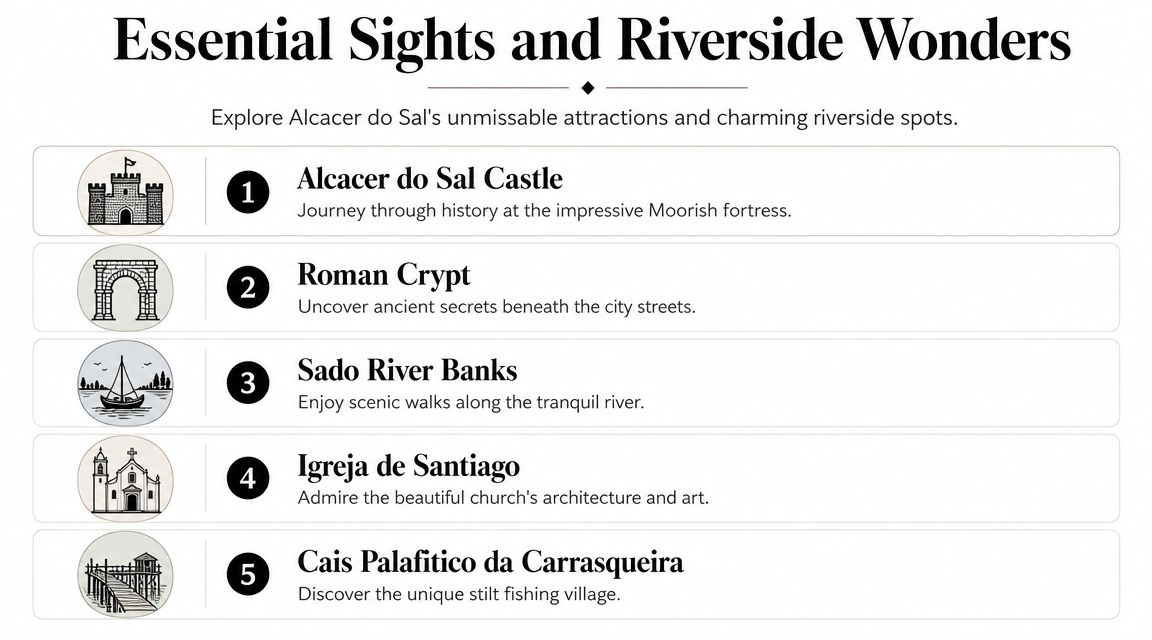
Essential Sights and Riverside Wonders
Most visitors make one mistake in alcacer do sal. They treat the castle as the main event and everything else as filler. The better approach is to think in layers: fortress, town, river, then edges.
Start high at the castle
The castle is the obvious anchor, and it deserves the first slot in your day. This fortification sits on a hilltop about 60 m above the Sado River, was extensively rebuilt by the Almohads between 1191 and 1217, uses a mix of stone and taipa construction, follows a roughly elliptical plan of about 260 m, and historical accounts describe up to 30 towers, with the tallest reaching around 25 m, according to Archaeology Travel's detailed look at Alcácer do Sal Castle.
Those details matter because they explain why the site feels more like a defensive system than a neat fairytale castle. Expect complexity, not symmetry. Expect layered building techniques, broad views, and traces of multiple eras pressing into the same space.
Then come down slowly
The downhill walk is where alcacer do sal starts feeling personal rather than monumental. Side lanes open into viewpoints. Quiet corners give you framed glimpses of tiled roofs and the river. This is also where photographers do best. Not from the obvious overlook, but halfway down, where the town compresses into white walls, chimneys, and stair-step streets.
If you like wandering places that don't demand spending to be memorable, this town belongs with other free things to do that feel richer than paid attractions.
The riverside is not an afterthought
The Sado riverfront deserves real time. Don't just pass through it on the way to lunch. Walk it twice if you can, once in the morning when the light is clear and once near sunset when the town glows warmer and reflections soften.
Look for:
- Traditional boats and working-river details that remind you this place wasn't built only for scenery.
- Benches and café edges where you can pause without needing a plan.
- The long view back to the hill, which is one of the best ways to understand the town's shape.
Stay long enough for the light to change. Alcácer do Sal improves by the hour.
Add one or two quieter stops
Some travelers try to do every point of interest and end up flattening the experience. Better to choose a few contrasts.
A good mix looks like this:
| Place type | Why it matters | Best approach |
|---|---|---|
| Castle precinct | Strategic history and views | Go earlier or later in the day for softer light |
| Riverside promenade | Daily life, reflections, atmosphere | Walk without headphones |
| Church or chapel stop | A quieter cultural layer | Keep visits brief and respectful |
| Backstreets | Texture, photography, local rhythm | Wander with no strict route |
| Nearby waterside excursion | Expands the landscape beyond town | Best if you have extra time |
If you have a car, the Cais Palafítico da Carrasqueira makes a strong side trip because it adds a completely different waterside mood to the day. It's not in town, so don't force it into a rushed schedule. Pair it with a slower afternoon instead.
Perfect Itineraries for Every Traveler
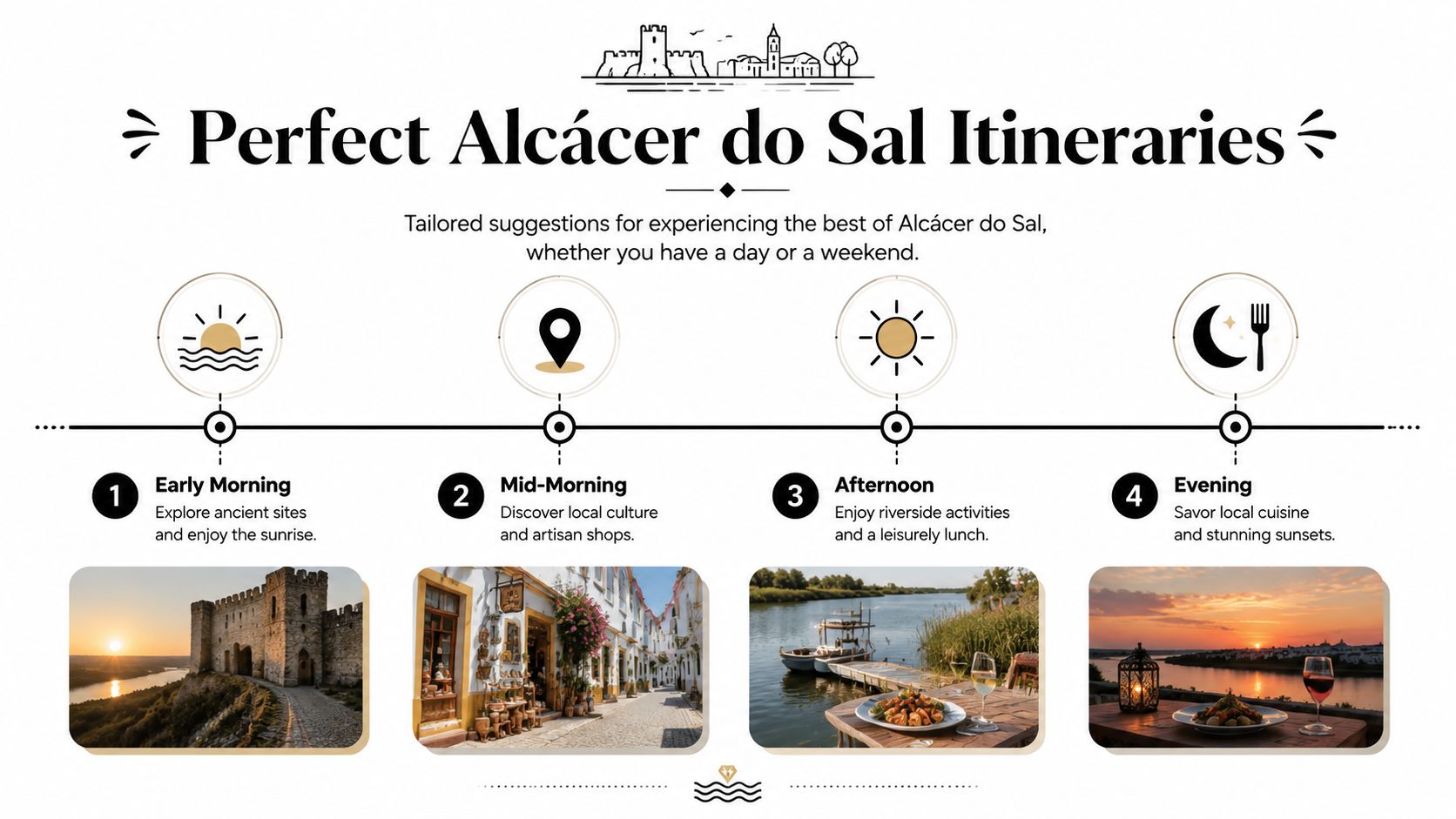
Alcácer do Sal is easy to overplan. It's compact enough that people assume they can improvise everything, then they arrive midday, climb in harsh light, eat at the first tourist-facing place they see, and leave too soon. A simple route fixes that.
Half day taster
This works for travelers passing through or pairing alcacer do sal with another stop.
Morning version
- Arrive early and park or get dropped near the lower town.
- Have coffee before sightseeing. The town reveals itself better when you're not rushing uphill hungry.
- Walk toward the castle while the streets are still quiet.
- Spend your main energy on the hilltop and viewpoints.
- Descend slowly for a late snack or early lunch by the river.
Why this flow works: you tackle the climb in cooler hours and finish with the easiest, most relaxed part of town.
Full day discovery
This is often considered the sweet spot.
Start with history, pause for lunch, end with atmosphere. That's the structure.
- Early morning for the castle and upper town.
- Late morning for side streets, church stops, and unhurried wandering.
- Lunch near the river, ideally somewhere with a local crowd.
- Afternoon for the promenade, a second coffee, and a slower look at the town's details.
- Sunset back by the water or at a viewpoint halfway up the slope.
If you enjoy city breaks built around walking, meals, and mood rather than nonstop attractions, the pacing isn't far off the logic behind a well-balanced 2 days in Florence itinerary, just on a much smaller and quieter scale.
Two day slow travel plan
A second day transforms the experience because it lets you stop treating the town like a stopover.
Day one for the core town
Use the full-day discovery rhythm. Keep the evening loose. Have dinner late by local standards, then take one final riverside walk instead of trying to cram in another attraction.
Day two for the wider landscape
Use the town as a base and branch out gently. This is the day for the Sado estuary area, nearby nature, craft shopping, or a waterside detour such as Carrasqueira if it fits your route and transport.
A useful way to think about the two-day version:
- Day one is vertical. River to hill, hill back to river.
- Day two is horizontal. Town outward into wetlands, artisan stops, and surrounding Alentejo scenery.
Don't fill every gap. Alcácer do Sal works best when your itinerary has breathing room built in.
Which itinerary should you choose
| Traveler type | Best fit | Why |
|---|---|---|
| Road trippers | Half day | Easy to sample without stress |
| Culture-first travelers | Full day | Enough time to connect history with place |
| Photographers and slow travelers | Two days | Better light, fewer rushed decisions, more local texture |
If you only have one day, resist the urge to add too many side trips. Alcácer do Sal isn't improved by treating it like a task list.
Mastering Your Alcácer do Sal Logistics
The logistics here are straightforward, but the choices still matter. The main trade-off is simple: flexibility versus simplicity.
Getting there from Lisbon
A car is the easiest option for most travelers. It gives you freedom to arrive early, stay through sunset, and explore places beyond the center without depending on fixed schedules. If your plan includes nearby rural stops, estuary detours, or independent food hunting, driving is the cleaner choice.
A bus makes sense if you want a lower-stress day and don't care about branching into the countryside. You avoid parking decisions and can focus fully on the town. The downside is reduced spontaneity, especially if you fall in love with the riverside and want to linger longer.
For broader trip planning, the same logic applies across the continent. Matching transport style to trip style saves money and frustration, which is why these best ways to travel Europe decision frameworks are useful before you lock anything in.
When to go
For most travelers, spring and autumn are the smart picks. The weather is generally more comfortable for walking, and the town's calm personality shines when you're not navigating peak summer intensity.
Summer can still work well, especially if alcacer do sal is part of a wider Alentejo or coast-focused route. Just plan differently. Start earlier, protect your midday hours, and leave your longest walks for later in the day.
Winter has its own appeal if you like quieter towns and moody river views, but some travelers will find the atmosphere a little too subdued for a first visit.
Budget without overcomplicating it
I won't invent a daily cost range where no verified data exists, so here's the practical version.
Alcácer do Sal can be approached on a modest budget if you keep the trip simple:
- Food gets cheaper when lunch is your main meal and you use cafés, bakeries, and straightforward tascas instead of polishing every meal into an occasion.
- Transport costs stay under control if you combine the town with a wider route instead of making it a separate out-and-back detour.
- Activities are naturally lighter here because much of the appeal comes from walking, viewpoints, and soaking up the riverfront.
Spend on one thing that deepens the stay, not three things that pad the itinerary. In alcacer do sal, that usually means a better room, a memorable meal, or extra time.
What usually works best
If you're budget-conscious but still want depth, the strongest combination is this:
| Choice | Best for | Trade-off |
|---|---|---|
| Day trip by bus | Simplicity | Less flexibility |
| Overnight with car | Slow travel and side trips | Higher overall spend |
| Shoulder season visit | Balanced weather and fewer crowds | Less beach-style energy nearby |
| Summer stopover | Pairing with coast travel | Heat changes your walking schedule |
The mistake isn't choosing the wrong option. It's choosing a fast travel style for a place that rewards patience.
Authentic Flavors and Restful Stays
Alcácer do Sal is exactly the kind of town where generic choices weaken the trip. Chain-style convenience exists in many destinations. What you came here for is the local grain of the place.
Eat where people are eating regularly
The best meals in town usually aren't sold by polished branding. Look for family-run tascas, dining rooms with handwritten specials, and riverside spots that seem built for repeat customers rather than passing traffic.
Dishes worth seeking out include açorda de marisco, grilled fish, Alentejo-style comfort food, local rice dishes, and regional sweets if you see them at cafés or bakeries. Menus can be seasonal and house-specific, so flexibility helps. Ask what's good that day instead of arriving with a rigid order in mind.
Why this matters goes beyond taste. Eating locally keeps your money in the town and gives you better insight into what people cook and serve here. That's almost always a better memory than a safe but forgettable meal, and it fits the spirit of authentic travel experiences that leave a real impression.
Sleep in character, not in neutrality
You've got three broad stay styles, and each has a different payoff:
- Castle stay if you want atmosphere and a memorable base.
- Family-run guesthouse if you value conversation, local recommendations, and a more personal rhythm.
- Simple budget room if alcacer do sal is one stop on a longer route and you'd rather spend on food and time.
A family-run place often gives the best overall value, not because it's always the cheapest, but because it usually comes with the sort of advice no booking filter can deliver. Where to park. Which café opens early. What street gets the nicest evening light. Which restaurant is good on weekdays but crowded on weekends.
Ask your host where they'd send a visiting cousin for dinner. That answer is usually better than any top-ten list.
What doesn't work as well
A rushed lunch in a scenic but indifferent place. A one-night stay so short you only see the town in the harshest daylight. Booking solely for modern convenience and then wondering why the destination felt flat.
In alcacer do sal, character beats standardization almost every time.
Smart Travel Tips for a Deeper Experience
The final layer in alcacer do sal isn't about seeing more. It's about seeing better.
Use the light well
Photographers should work early and late. Morning gives you cleaner façades and softer streets uphill. Late afternoon and sunset do the heavy lifting by the river, where reflections and warm tones make the town feel fuller.
Skip the first obvious viewpoint if it's crowded. Walk a little farther, or head halfway down the hill and shoot across rooftops instead of straight at them.

Travel solo with confidence
Alcácer do Sal feels manageable for solo travelers because the center is compact and the pace is gentle. That said, common sense still matters.
- Stay central if possible so evening walks back are simple.
- Tell your host your rough plans if you're heading beyond town.
- Choose active cafés or restaurant terraces if dining alone at night feels more comfortable.
- Keep offline maps saved because wandering is part of the pleasure here.
Keep it sustainable
Support the town by spending thoughtfully. Buy from local makers. Eat in independently run places. Don't treat quiet residential lanes like open-air sets for endless photo shoots. If you explore natural areas around the Sado, stick to responsible operators and follow local guidance around wildlife and fragile natural settings.
A few habits go a long way:
- Learn basic Portuguese greetings. It changes the tone of interactions immediately.
- Carry water and a small snack so you're not defaulting to convenience buys.
- Leave room in your day. Slow travel is more respectful here than aggressive box-ticking.
The most local way to experience alcacer do sal is simple. Arrive curious, move slowly, and spend where the town still feels like itself.
If you're building a Portugal trip around places with soul, sensible pacing, and stronger local connection, Travel Talk Today is worth bookmarking for more thoughtful destination guides, practical planning advice, and affordable ways to travel deeper instead of just faster.