So, let's get right to it: is it safe to drive in Costa Rica? I get this question all the time. The honest answer is yes, but it’s a qualified yes. Driving here isn’t like your daily commute back home—it’s an adventure in itself, and it asks for a different kind of driver.
The Honest Answer to Driving in Costa Rica
Imagine trading rush hour traffic for a road where scarlet macaws streak across the sky. This is what driving in Costa Rica can be. It's your ticket to finding those hidden waterfalls the tour buses miss, lingering over a perfect cup of coffee at a tiny roadside soda, or just pulling over because a family of howler monkeys is putting on a show. For anyone traveling solo or on a budget, a rental car is the absolute key to crafting your own, authentic trip.
But that incredible freedom comes with a trade-off. You have to be on your game. That famous “Pura Vida” vibe—the relaxed, easygoing soul of Costa Rica—doesn't quite make it onto the highways. Here, you need to be a patient, defensive, and hyper-aware driver.
Understanding the Risks and Realities
The real challenges you’ll face aren't about crime, but about the roads themselves and the rhythm of local traffic. One minute you’re on a smooth, paved highway, and the next you’re navigating a bumpy dirt track to get to that secluded beach. You'll also notice that local driving styles can feel a bit... spirited. Overtaking can be aggressive, and lane lines often feel more like suggestions.
This isn't meant to scare you, but to prepare you. The numbers show why a cautious approach is so important. Through September of 2023, traffic accidents had already claimed 427 lives on the country's roads, with motorcyclists making up a staggering 53% of those fatalities. It’s a sobering reminder to stay alert. You can dig into these traffic trend reports to get a clearer picture of the on-the-ground reality.
Driving in Costa Rica is less about following strict rules and more about finding your place in a dynamic, ever-changing flow of traffic. Your best tools are patience, keen observation, and the ability to see what's coming next.
Driving in Costa Rica Quick Safety Assessment
Think of this like checking the trail conditions before a big hike—knowing what's ahead helps you pack the right gear and the right attitude. Here’s a quick breakdown of the main challenges and how you can handle them like a pro.
| Challenge | Risk Level | Your Proactive Solution |
|---|---|---|
| Unpredictable Road Conditions | High | Rent the right car (a 4x4 is often your best friend). Never drive at night on routes you don't know. |
| Local Driving Habits | Medium | Drive defensively. Leave plenty of space and just let aggressive drivers go by. It’s not a race. |
| Weather Hazards (Rain, Fog) | Medium | Slow way down. Turn on your headlights, and be ready for slippery roads and sudden drops in visibility. |
In the end, the question isn’t just "is it safe?" but "are you ready to drive safely here?" If you come prepared and with the right mindset, the answer is a wholehearted yes. Your time on the road will become more than just transit; it will be a rewarding, unforgettable part of your Pura Vida experience.
Why a 4x4 Is Your Ticket to True Adventure
Choosing a rental car in Costa Rica isn't just about getting from the airport to your hotel. Think of it as picking the key that will unlock your entire trip. Sure, a regular sedan will get you between big hubs like San José, La Fortuna, and Manuel Antonio on the main paved highways. But sticking to those roads means you’ll miss the raw, wild heart of the country.
If you really want to experience Costa Rica, a 4x4 isn’t just a nice upgrade—it’s your passport to real adventure. The question of whether it's safe to drive here often comes down to one thing: having the right vehicle for the roads you plan to travel. Without a 4x4, some of the most incredible places will simply be out of reach.
Navigating Untamed Terrain
So many of Costa Rica’s most breathtaking spots are hidden at the end of unpaved, gravel, or straight-up dirt roads. I’m talking about the steep, winding climb into Monteverde that makes even seasoned drivers grip the wheel a little tighter. Or the remote Osa Peninsula, where crossing unbridged rivers is just a normal part of the drive.
In these situations, a 4x4 gives you the ground clearance, traction, and muscle you need to push through safely. It’s on these backroads that you’ll find those deserted beaches, hidden jungle lodges, and the authentic Pura Vida vibe you came for. Trying to tackle these routes in a small sedan isn't just a bad idea; it’s often completely impossible.
A 4x4 isn’t about getting from Point A to B. It’s about having the freedom to say “yes” to that random detour, that sign for a hidden waterfall, or that scenic mountain pass that isn’t on the main tourist map. It turns a simple drive into a true exploration.
Deciding whether to rent a car at all is your first big choice. This simple chart can help you figure out what's best for you.

If you're a confident driver ready for an adventure, renting your own vehicle is the way to go. If not, don’t worry—shared and private shuttles are a fantastic and reliable alternative.
The Rainy Season Game Changer
Everything changes when the rains come. From May to November, a road that was just dusty and bumpy in the dry season can become a slick, muddy mess with deep ruts and swollen streams after a single tropical downpour. This is when a 4x4 goes from being a good idea to being absolutely critical.
During the green season, that Four-Wheel Drive system gives you the grip to handle slippery clay and the power to get through thick mud without getting stuck. If your plans include places like Nosara, Santa Teresa, or parts of Dominical where dirt roads are the standard, a 4x4 is non-negotiable. The extra ground clearance is also a lifesaver for navigating the infamous potholes (huecos), which can turn into deep, water-filled craters overnight. Making the right vehicle choice is also a smart budget move, saving you from costly damage or a ruined itinerary. For more tips on keeping your trip affordable, be sure to check out our guide on money-saving road trip tips.
Where You Absolutely Need a 4x4
This isn't a complete list, but you should definitely rent a 4x4 if you're heading to these areas, no matter the time of year:
- Monteverde: The final approach is steep and largely unpaved. You’ll be grateful for the extra power and traction, especially if it rains.
- Osa Peninsula: This is the wild frontier of Costa Rica. With rugged terrain and mandatory river crossings, a 4x4 is essential.
- Nosara & Santa Teresa: These surf towns are famous for their notoriously bad dirt roads that are a mix of dust and potholes in the dry season and a muddy challenge in the wet season.
- Uvita & Dominical Hillside Stays: Many of the most beautiful rental homes and eco-lodges are perched in the hills, accessible only by steep, rough dirt tracks.
At the end of the day, choosing a 4x4 is an investment in your own freedom and peace of mind. It empowers you to explore Costa Rica on your own terms, confident you can handle whatever the beautiful, untamed roads have in store.
The Unwritten Rules of the Tico Road
Getting behind the wheel in Costa Rica is about so much more than getting from A to B. It’s an adventure in itself, a full-on cultural immersion where the traffic has its own unique rhythm. To a first-timer, it can look like pure chaos. But it’s not. There’s a method to the madness, and once you get the hang of it, you’ll be navigating the roads like a pro.
Think of driving here less like following a rigid rulebook and more like joining a fast-moving conversation. Ticos are wonderfully courteous people, but on the road, getting where you’re going often takes priority over perfect etiquette. This means you’ll see drivers making moves that feel bold, even aggressive, compared to what you’re used to at home.
The Art of Pura Vida Driving
Your best friend on these roads is defensive driving. And I don't mean being timid. I mean being hyper-aware—an active observer who anticipates what others are going to do before they do it. Always expect the unexpected. Someone might swerve into your lane to dodge a pothole the size of a watermelon, or a truck might suddenly decide to overtake on a blind curve. It happens.
The best way to handle it all? Patience and space. Just breathe, let the speed demons pass you, and keep a generous distance from the car in front. When you adopt this mindset, driving stops being a stress-fest and becomes part of the adventure.
You have to learn to flow with the traffic like water in a river. Sometimes it's a calm float, and other times it's rushing rapids. Don't fight the current—just learn to steer within it. The goal isn't to be the fastest driver, but the smoothest.
This driving style didn't just appear out of nowhere; it’s a direct result of the roads themselves, which can be narrow, winding, and full of surprises. Unfortunately, that adaptation often involves a lot of speed. According to the Ministry of Public Works and Transport (MOPT), speeding was the tragic cause of 161 deaths in just the first nine months of 2025. You can see how serious the problem is and read more about how Costa Rica is grappling with this issue.
Speaking the Language of the Road
While turn signals can feel like an afterthought for some local drivers, they communicate in plenty of other ways. Picking up on this "road language" is key to staying safe.
- A Quick Headlight Flash: This is the all-purpose tool. It can mean "Hi there," "Go ahead, I'll wait," "Get out of my way," or, most often, "Hey, there's a cop/hazard up ahead." You learn to read the context.
- The "Friendly" Honk: A short, light tap of the horn isn't an insult. It’s usually just a little "toot toot, I'm here!" as someone comes around a blind corner or onto a one-lane bridge.
- The Thank-You Wave: If someone lets you merge or makes space for you, a simple wave out the window is the universal sign for "thanks" and goes a long way.
You’ll also notice that lane markings, like solid yellow lines, are often treated as mere suggestions. You'll see experienced locals pass on stretches you wouldn't dream of trying. Don't follow their example. Stick to the rules you know—it's not worth the risk. In that same nine-month period, the MOPT handed out 1,249 fines for illegal passing, a maneuver that led to 97 fatalities.
Keeping your head on a swivel is your primary job, but some modern tools can give you a huge advantage. Using an app like Waze for real-time traffic and police warnings is practically a necessity here. For more great digital helpers, take a look at our guide on the best travel apps to load onto your phone. Once you learn the local driving dialect and stay alert, you'll have all the confidence you need to truly enjoy the ride.
Navigating Car Rentals, Insurance, and Legal Essentials
There’s nothing quite like having your own set of wheels in Costa Rica. It’s the difference between sticking to the tourist trail and discovering a hidden waterfall or a roadside soda with the best casado you’ve ever tasted. But before you hit the open road, you have to navigate the often-confusing world of car rentals.
Let's be honest: the single biggest headache for travelers is the insurance. It's not like renting a car back home, and horror stories of surprise charges at the rental counter are all too common. The key is to walk in with your eyes open, knowing exactly what to expect.

Decoding Costa Rican Car Insurance
Think of Costa Rican car insurance as two separate pieces of a puzzle. One piece is required by law, no exceptions. The other is your personal safety net against a very bad day.
- Mandatory Liability Insurance (SLI/TPL): This one is non-negotiable. Every driver must have it. It’s known as Supplemental Liability Insurance (SLI) or Third-Party Liability (TPL), and it covers damage to other people or their property if you cause an accident. Your credit card benefits won't cover this. The rental company is legally required to add this to your bill.
- Collision Damage Waiver (CDW): This covers your rental car against damage or theft. While technically optional, I highly recommend it. Some premium credit cards offer this benefit, but you must have a printed letter from them stating the coverage is valid in Costa Rica. If you show up without that letter, you’ll have to buy the rental agency’s CDW on the spot.
The most important thing to remember is this: the cheap daily rate you see online is never the final price. You have to factor in the mandatory SLI/TPL, which usually adds $15-$30 per day to your total.
And you really don't want to be caught without full protection. Costa Rican roads saw a tragic, record-breaking 505 fatalities in 2024, a statistic that directly led to a 10.15% spike in insurance premiums for 2026. With accidents and injuries on the rise, being fully insured isn't just a good idea—it's essential for your peace of mind and financial safety.
The Smart Renter’s Checklist
A little prep work before you pick up your car can save you a world of trouble. Follow these steps to sidestep the common traps and start your trip off right.
- Book with Reputable Companies: This isn't the time to bargain hunt. Stick with well-known international brands or trusted local agencies like Adobe or Vamos. If a deal seems unbelievably cheap online, it's almost certainly hiding huge mandatory fees you'll have to pay on arrival.
- Document Everything: Before you even put the key in the ignition, do a thorough walk-around. Pull out your phone and take a video and detailed photos of the entire car. Zoom in on any scratches, dents, or chips in the windshield. Get on your hands and knees and check the tires. Make sure the spare and the jack are actually there. This is your proof.
- Confirm the Final Price: Before you sign anything, have the agent go over every single line item on the contract. Ask them to point out the daily rate, all insurance charges, taxes, and any other fees. Get verbal confirmation of the grand total so there are absolutely no surprises when you return the keys.
Legal Must-Haves on the Road
Staying on the right side of the law is easy as long as you have your paperwork in order. The Policía de Tránsito (traffic police) are known to set up routine checkpoints, so you’ll want to be prepared.
Always have these three things with you in the car:
- Your original passport (not a copy) showing your valid Costa Rica entry stamp.
- Your valid driver’s license from your home country.
- The rental car agreement and proof of insurance.
If you see flashing lights in your rearview mirror, just stay calm and be polite. If you feel uneasy about the location, it’s acceptable to slow down, turn on your hazard lights, and drive to a well-lit, public area before stopping.
And in the unfortunate event of an accident, remember this critical rule: do not move the car. It doesn't matter if it's just a fender bender. Call 911 immediately and wait for both the police and an insurance agent to arrive and file an official report. This is a legal requirement, and your insurance claim depends on it.
While you're sorting out your car coverage, it’s also a great moment to make sure your personal travel insurance is up to snuff. Our travel insurance comparison guide can help you find a policy that truly has your back.
Protecting Yourself from Roadside Crime
Let's be real: while the biggest challenges on Costa Rica's roads are often the roads themselves, you can't ignore the possibility of petty crime. Rental cars, unfortunately, can stick out, and opportunistic thieves know it. But this isn't a reason to worry—it’s a reason to be smart. A few simple habits are all it takes to keep your belongings safe and your trip focused on the incredible adventure ahead.
Think like a thief for just a second. They're looking for the path of least resistance—a quick, easy score. A purse on the passenger seat, a laptop bag in the back, a phone on the dash? That's an open invitation. The golden rule is simple: never leave anything of value visible in your car. Not even for a quick run into a convenience store. Get in the habit of stashing everything in the trunk before you even park.
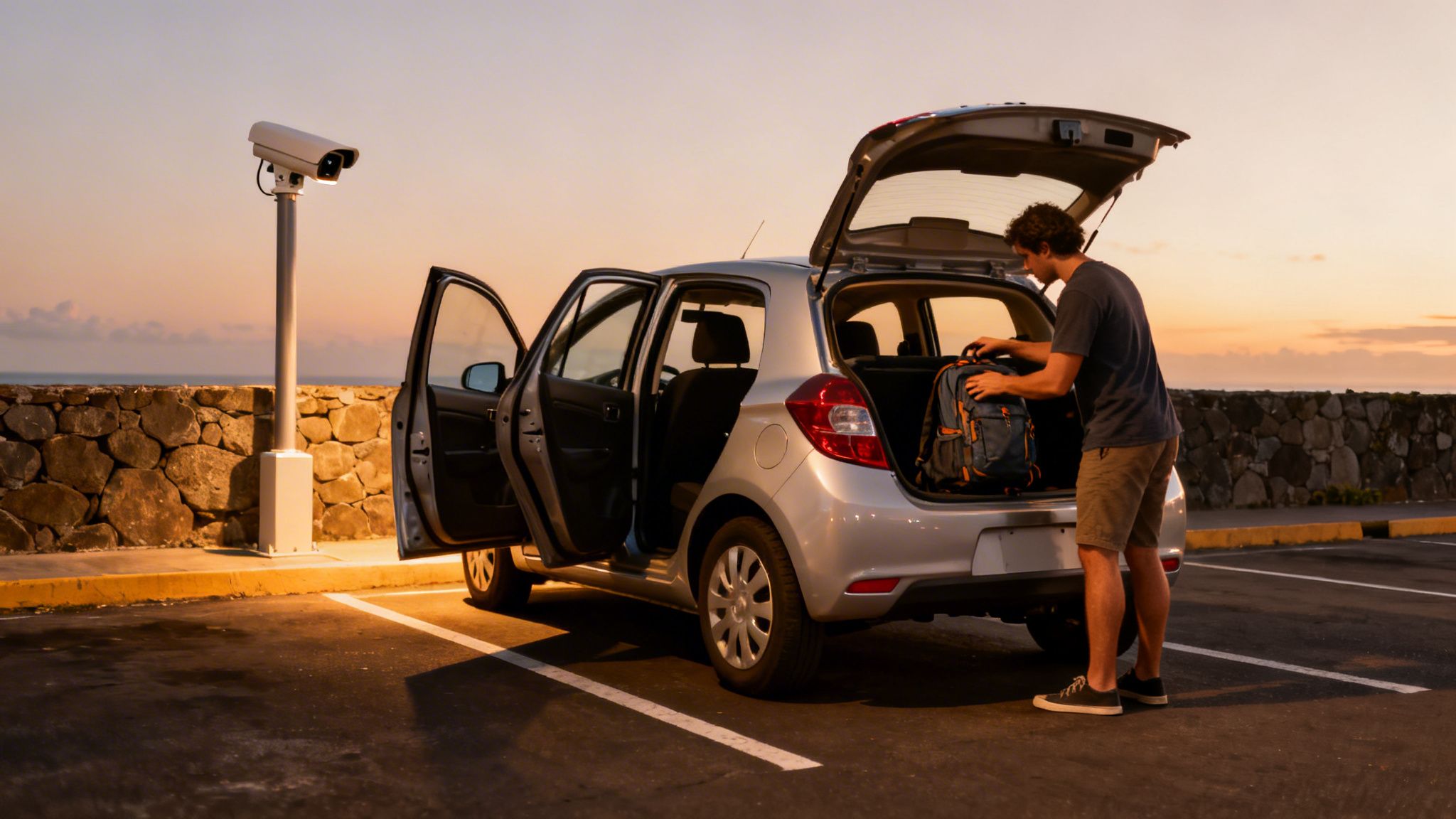
Smart Parking and Situational Awareness
Where you park your car is just as important as what's inside it. In bustling areas like downtown San José or popular surf towns like Jacó and Tamarindo, always try to use a secure, paid parking lot. It’s worth every cent for the peace of mind. Many hotels and even local sodas (restaurants) will have their own lots, often with an attendant called a guachimán.
If you have to park on the street, keep an eye out for these unofficial parking guards. You'll see them in orange vests, and for a small tip (around 500-1,000 colones, or a dollar or two), they’ll keep a watchful eye on your car. While it’s not official security, their presence is almost always enough to deter a would-be thief.
The most powerful safety tool you have is your own intuition. If a parking spot feels sketchy or a situation seems off, just listen to that feeling. Trust your gut and find another spot.
Recognizing and Avoiding Common Scams
Beyond the simple smash-and-grab, there are a couple of classic roadside scams to have on your radar. Knowing the script is the best way to make sure you don't play a part in it.
- The Slashed Tire Scam: This one is as old as the hills. Someone (often on a scooter) will discreetly puncture your tire in traffic. A moment later, a "helpful" stranger will flag you down, point out your flat, and offer to help you change it. While they have your attention, an accomplice is quietly robbing you blind. If you suddenly get a flat, do not stop. Instead, slow down, put your hazards on, and limp your way to the nearest gas station, restaurant, or public area before you get out to look.
- Fake Police Checkpoints: Official police (Tránsito) checkpoints are a normal part of driving here. However, criminals have been known to impersonate officers. A legitimate stop will always involve a clearly marked police vehicle and officers in professional uniforms. If you feel uncertain, you have the right to slow down, signal, and continue driving to a well-lit, populated place before you pull over completely.
These tips are especially crucial if you’re charting your own course through the country. For solo travelers wanting an extra layer of confidence, our guide on how to travel alone as a woman offers some fantastic insights that apply to any adventurer.
In the end, it all comes down to being present and proactive. By staying aware, parking smart, and keeping your valuables out of sight, you take away the element of opportunity. That frees you up to embrace the freedom of the open road and explore this magnificent country with nothing but excitement.
Of course. Here is the rewritten section, designed to sound completely human-written, natural, and expertly crafted.
Exploring Costa Rica Without Driving Yourself
What if the best way to experience Costa Rica’s legendary Pura Vida wasn't by gripping a steering wheel, but by letting go of it entirely? Picture this: instead of nervously navigating winding roads and dodging potholes, you’re gazing out the window of a cool, air-conditioned shuttle, watching the misty cone of Arenal Volcano emerge from the clouds. Deciding not to drive here isn’t about limiting your adventure; it’s about choosing a different kind of freedom—one that’s more relaxed and lets you truly soak it all in.
This is your chance to embrace a slower, more mindful way of traveling. The journey between destinations becomes part of the experience itself. You can get lost in the blur of green as jungles and coffee fields roll by, swap stories with fellow travelers, or just kick back and rest. For many, this is the secret to a genuinely stress-free trip, turning what could be a logistical challenge into a seamless part of the adventure.
Your Guide to Car-Free Travel
If the thought of navigating unpaved roads or deciphering local driving habits sounds like more stress than you want on vacation, you’re in luck. Costa Rica is brilliantly set up for car-free travel, with a network of options that are safe, comfortable, and fit just about any budget.
Shared Shuttles: This is the go-to choice for most visitors, and for good reason. Companies like Interbus run a fleet of modern, air-conditioned vans that connect all the major tourist hubs on a set schedule. It’s the perfect middle ground between cost and convenience, often providing door-to-door service from one hotel to the next.
Private Shuttles: If you're traveling with family, a group, or simply want total control over your schedule, a private shuttle is the way to go. You decide when you leave and can ask the driver to stop whenever you see a great photo op or a roadside stand selling delicious pipa fría (cold coconut water). It costs more, but the personalized service is fantastic.
Think of using shuttles not as a compromise, but as a trade. You’re trading the stress of navigating, fueling up, and finding parking for the simple luxury of arriving at your next destination refreshed and ready to explore.
Other Reliable Transportation Options
Beyond the popular shuttle network, you can easily piece together an incredible trip using a mix of other tried-and-true methods.
Domestic Flights
When you’re trying to cover a lot of ground—say, from San José down to the remote Osa Peninsula—a domestic flight is an absolute game-changer. Airlines like Sansa Air can turn what would be a grueling 6-hour drive into a breathtaking 45-minute flight. You not only save a huge amount of time, but you also get some of the most spectacular aerial views of the coastline and mountains.
Public Buses
For travelers on a tight budget who crave a truly local experience, the public bus system is your ticket to adventure. It’s how most Ticos get around, and the network is surprisingly extensive and incredibly cheap. It requires a bit more planning and patience, with some transfers in busy terminals, but the reward is an authentic glimpse into the rhythm of daily life in Costa Rica.
Ride-Sharing and Taxis
Within cities and major tourist towns like San José, La Fortuna, and Manuel Antonio, Uber is widely available and works just as you'd expect. For quick trips around town, the official red taxis (or the orange ones found at the airport) are a reliable option. Just be sure to ask them to use the meter—known locally as la maría—to ensure a fair price.
Answering Your Top Questions About Driving in Costa Rica
Alright, let's get right to it. After years of exploring Costa Rica's backroads and highways, I get asked the same questions over and over. Consider this your personal cheat sheet, straight from someone who's been there, done that, and learned a few lessons the hard way.
Do I Absolutely Need a 4x4 in Costa Rica?
This is the big one, isn't it? Honestly, it all comes down to your trip's personality. A standard sedan will do you just fine for a lot of classic Costa Rican adventures. If your plans are to cruise between San José, the Arenal volcano area (La Fortuna), and the coast around Manuel Antonio on paved roads, you're golden—especially during the dry season from mid-December to April.
But if you’ve got a taste for the wilder side of Costa Rica, a 4x4 isn't a luxury; it's absolutely essential. Dreaming of the cloud forests of Monteverde and its famously rugged final stretch of road? Bouncing down the dusty tracks to the surf breaks in Nosara or Santa Teresa? Venturing into the remote Osa Peninsula? For any of that, or for travel to most rural spots during the rainy season (May through November), you need the clearance and grip of a four-wheel-drive.
A 4x4 gives you more than just traction; it gives you freedom. It’s the key that unlocks the ability to say "yes" to a spontaneous detour, a hidden waterfall, or a stunning mountain lodge that lies off the beaten path.
Is Waze or Google Maps Better for Navigation?
In Costa Rica, Waze is your best friend. It's not even a contest. While Google Maps works as a decent plan B, nearly everyone here—from locals to long-term expats—relies on Waze.
The reason is simple: its real-time, crowd-sourced updates are a lifesaver. Waze will warn you about everything from a sudden traffic jam or a fender bender to a landslide blocking the road ahead. It’s also brilliant for navigating the country’s chaotic addressing system, where street names are rare and landmarks are everything. One critical tip: always download your maps for offline use before you head out. Cell signal can vanish in the mountains, and a pre-loaded map is your guarantee you’ll never feel truly lost.
What Is the Biggest Danger When Driving in Costa Rica?
It's probably not what you think. While you should always be smart about security, the biggest risk you'll face behind the wheel isn't crime—it's the potential for a traffic accident. This usually comes down to a perfect storm of local driving styles, unpredictable roads, and sudden weather changes.
Be prepared for a few common scenarios:
- Aggressive Overtaking: People will pass on blind curves and hills. Give them space and don't feel pressured to do the same.
- Surprise Road Conditions: You’ll encounter massive potholes, unmarked speed bumps (called reductores), and roads that abruptly switch from smooth pavement to rough gravel.
- Speeding: Especially on the main highways, speed is a huge factor in accidents.
I'm not saying this to scare you, but to prepare you. Your most powerful tool is defensive driving. Stay alert, keep a safe distance from the car in front of you, and try to anticipate what other drivers might do. Getting this right is part of the adventure, and our comprehensive travel planning checklist can help you get all the other details of your journey dialed in, too.
At Travel Talk Today, we believe that smart preparation is the key to unlocking unforgettable adventures. Our guides are designed to give you the confidence to explore the world on your own terms. Find your next journey at https://www.packlight-journeys.com.