Georgia made sense to me in a bakery before it made sense on any itinerary. I was standing on a side street in Tbilisi with a hot khachapuri in my hands, watching carved wooden balconies sag over the lane and listening to a mix of church bells, traffic, and bakery orders shouted across the counter. That combination explains the country better than any checklist of sights.
Georgia carries its history in everyday life. Wine is the clearest example. UNESCO recognizes Georgia's qvevri winemaking tradition as part of the Intangible Cultural Heritage of Humanity, and that old practice still shows up in family cellars, restaurant menus, and village harvests rather than only in museums. The same continuity runs through creative city districts, Soviet-era leftovers, Black Sea resort towns, and mountain villages where roads, weather, and livestock still set the pace more than tourism does.
A lot of Georgia guides stay on the familiar Tbilisi, Kazbegi, Kakheti circuit. Those places are worth your time, but they do not suit every traveler in the same way. A strong Georgia trip depends on matching the country to your style. Hikers need to think about road access and short alpine seasons. Food-focused travelers should build in time for markets, guesthouse meals, and regional dishes, not just restaurant stops. Slow travelers will usually get more out of village stays and public transport than out of trying to cover half the country in five days.
That is the point of this guide. It is organized around how people travel: adventure, culture, food, and slower rural experiences. Each recommendation includes Budget Tips, Solo-Traveler Notes, and Best Season details, because Georgia rewards good timing and practical choices. Some places are cheap but hard to reach without a driver. Some are easy by train or marshrutka and work well even on a short budget trip. If you enjoy cities on foot, Georgia also fits nicely into the wider conversation around Europe's most walkable city breaks, especially once you stop treating Tbilisi as a quick stopover.
Travel here is rarely difficult, but it does punish vague planning.
A monastery can be a peaceful half-day or a tiring detour depending on road conditions. A mountain trek can be unforgettable in September and miserable in late spring. A beach town can feel flat if you only stay on the waterfront. The best things to do in Georgia country are the ones that fit your budget, your pace, and your tolerance for long drives, shared vans, and weather that changes fast.
1. Explore the Historic Old Town of Tbilisi
Old Tbilisi is where most trips should begin, not because it's a box to tick, but because it helps the rest of the country make sense. You'll walk through sulfur bath domes, Orthodox churches, faded merchant houses, wine bars, courtyards with laundry lines, and streets where Persian, Ottoman, Soviet, and modern Georgian layers all show at once.
It's also one of the easiest parts of Georgia to explore on foot. If you like cities that reward wandering, Tbilisi belongs in the same conversation as the most walkable cities in Europe, especially once you settle into the older neighborhoods and stop trying to do everything by taxi.

What actually works here
The mistake most travelers make is treating the old town like a half-day stroll. It isn't. Give it at least a full day, preferably two, so you can do the obvious sights and still leave room for small finds like courtyard cafés, bakery stops, and evening walks when the streets calm down.
The sulfur baths are worth doing, but timing changes the experience. Early morning is quieter and feels less performative. By late afternoon, the bath district can feel more like a photo stop than a reset.
Practical rule: Download an offline map before you start wandering. Tbilisi's old lanes twist, split, and reconnect in ways that make perfect sense only after you've been lost once.
Budget tips, solo notes, best season
- Budget Tip: Skip expensive restaurant breakfasts. Small bakeries and simple cafés in and around the old town usually give you the best value and a more local rhythm.
- Solo-Traveler Note: Old Tbilisi is one of the easier places in the country to explore alone. Stay aware on steep lanes at night, but overall it's a comfortable base for solo women and first-time visitors.
- Best Season: Spring and fall are the sweet spots. Summer can be hot in the city, and winter is atmospheric but less pleasant for long walking days.
A good Tbilisi day has very little rush in it. Walk, stop often, and don't over-schedule. Georgia rewards people who leave room between plans.
2. Hike the Scenic Trails of the Kazbegi Region
The first time I arrived in Kazbegi, the weather changed three times before lunch. Clear ridgelines turned to fog, then opened again just long enough to make the whole valley look unreal. That is the region in one lesson. Come for the famous views, but plan like the mountains owe you nothing.
Kazbegi suits travelers who want a strong mountain experience without committing to a multi-day expedition. Stepantsminda makes a practical base. You can sleep in a simple guesthouse, eat well, and reach rewarding trails without complicated logistics. For many travelers, that balance of access and real alpine scenery is what makes this part of Georgia such a good fit.

What works here
Gergeti Trinity Church draws nearly everyone, and it should. The mistake is treating it like a quick photo stop. The better approach is to use it as your entry point into the region. Walk up early, stay long enough to watch the light shift across the slopes, and if conditions are stable, continue beyond the church on a longer trail rather than heading straight back down.
This region rewards restraint as much as ambition. Day hikes are enough for first-timers. Start early, carry a waterproof layer even on blue-sky mornings, and keep an eye on turnaround time. Trails that feel straightforward in sunshine can become tiring and exposed once cloud, wind, or rain moves in.
Kazbegi is also a smart testing ground before bigger mountain plans elsewhere in Georgia. If you are planning a backpacking trip across multiple regions, a few hikes here will tell you a lot about your pace, gear, and tolerance for altitude and weather shifts.
Budget tips, solo notes, best season
- Budget Tip: Stay in a family-run guesthouse in Stepantsminda instead of a polished hotel. Prices are usually lower, breakfast is often included, and hosts often give better trail advice than tour desks.
- Solo-Traveler Note: Solo hiking is common, but mountain safety still comes down to judgment. Ask about same-day conditions before you leave, download your route offline, and do not hesitate to turn back if visibility drops.
- Best Season: Late spring to early autumn is the easiest window for most hikers. Summer gives the longest days, while September usually brings crisp air and fewer crowds. Winter is beautiful but better suited to travelers with cold-weather experience and the right gear.
Go early. Kazbegi feels very different before the convoy of day-trippers arrives from Tbilisi.
3. Go Wine Tasting in Kakheti
Kakheti is one of the clearest reasons Georgia feels unlike anywhere else. Wine here isn't a polished add-on. It's history, agriculture, hospitality, ritual, and daily life all rolled into one.
Georgia is widely recognized as the birthplace of wine, with archaeological evidence confirming winemaking began in the region around 8,000 years ago. The country has 52 distinct indigenous grape varieties, and vineyards in Kakheti account for 70% of production while traditional qvevri fermentation is recognized by UNESCO.
Why Kakheti beats rushed day trips
A lot of people visit Kakheti from Tbilisi as a quick tasting loop and leave thinking they've “done” Georgian wine. Usually they've sampled a few pours, taken a photo in Sighnaghi, and missed what makes the region memorable.
The better version is slower. Stay at least one night. Visit one larger winery and one family-run cellar if you can. The contrast matters. One teaches scale and context. The other usually gives you the human side, where toasts stretch out, food keeps appearing, and the conversation becomes the experience.
Kakheti also works well for travelers who don't want to rent a car. That said, winery-hopping without a plan gets messy fast. Organized small-group trips or guesthouse-arranged drivers usually work better than improvising after lunch.
Budget tips, solo notes, best season
- Budget Tip: Buy bottles directly from wineries when you can. It's usually a better value than ordering the same wines later in city bars.
- Solo-Traveler Note: Wine culture here is social by nature, which can be great if you're alone. Just pace yourself. Georgian hospitality is warm, but the pressure to keep participating can be real.
- Best Season: Shoulder season is ideal for most travelers. Harvest time has special energy, but it also brings more movement and less quiet.
For travelers who care about food, local traditions, and staying close to daily life, Kakheti is one of the strongest answers to the question of what things to do in Georgia country are worth rearranging a trip for.
4. Trek to Waterfalls in Tusheti and Svaneti
I've seen travelers treat Tusheti and Svaneti as interchangeable because both promise towers, high valleys, and dramatic waterfall trails. On the ground, they feel very different. Svaneti is the mountain region you can usually plan with reasonable confidence. Tusheti is the one that can still force a rewrite of your itinerary because of road conditions, transport gaps, or weather.
That difference matters more than the trail itself.
Georgia's high mountain routes reward travelers who are willing to work a little harder for them. In Svaneti, waterfall hikes and multi-day walks are easier to fit into a broader trip, especially if you base yourself in Mestia or Ushguli. In Tusheti, the sense of remoteness is stronger from the moment you arrive. Villages are smaller, services are thinner, and even a short trek can depend on whether you managed transport well the day before.
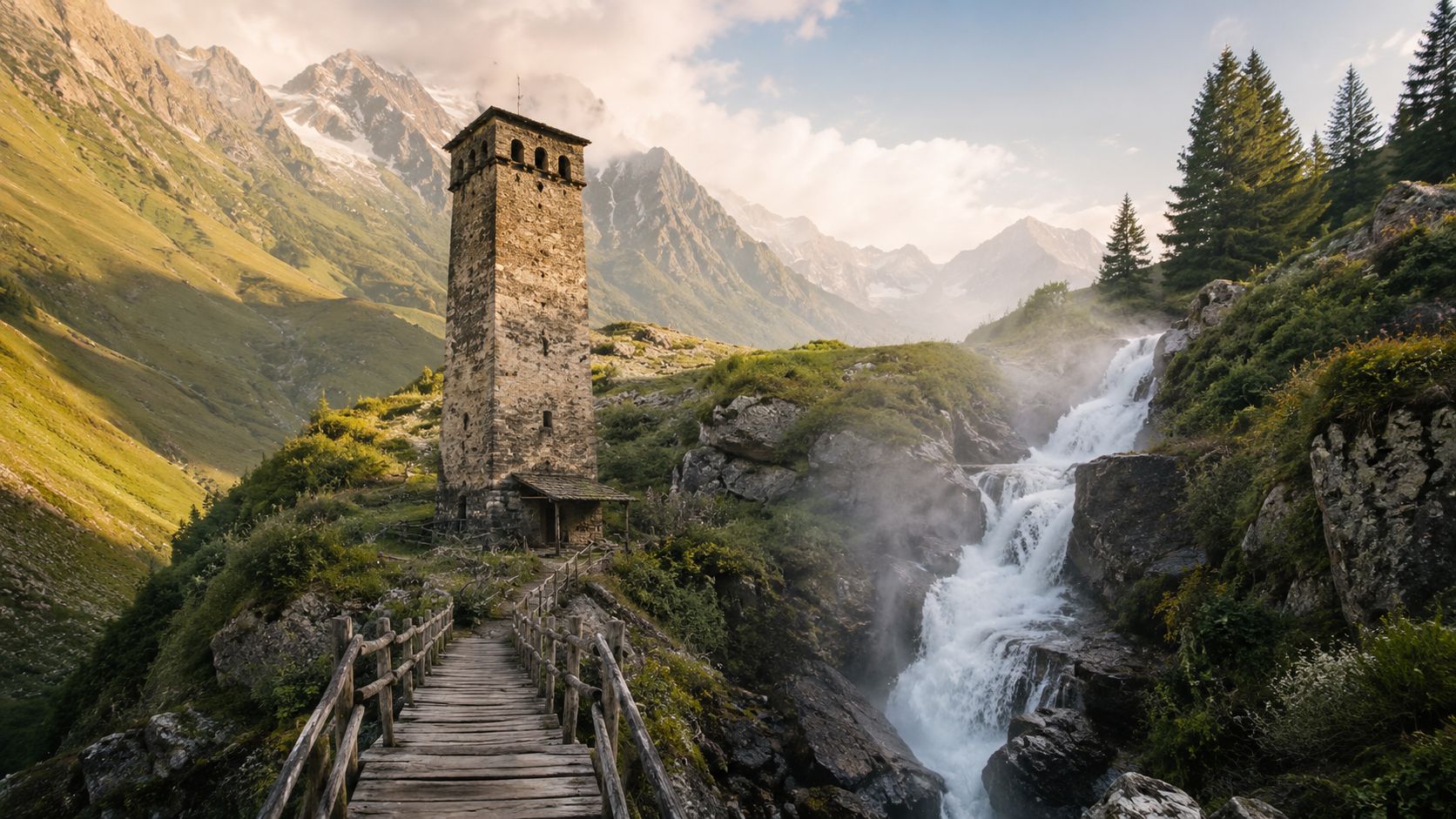
For travelers who want more authentic travel experiences, this is one of the strongest mountain choices in Georgia. You trade convenience for depth. You get guesthouses with real character, long walking days that still feel quiet, and scenery that haven't been flattened into a simple day-trip product.
The practical decision is straightforward. Choose Svaneti if you want alpine scenery, waterfall access, and a better chance of keeping your trip on schedule. Choose Tusheti if isolation is the point and you're comfortable building in extra time, extra cash for transport, and some uncertainty. That is the trade-off many glossy lists skip.
Budget tips, solo notes, best season
- Budget Tip: In Svaneti, sleeping in guesthouses and eating where you stay usually costs less than organizing camping logistics or private vehicle support. In Tusheti, shared jeeps and guesthouse-arranged transport save money if you ask around early.
- Solo-Traveler Note: Solo travel is realistic in both regions, but Tusheti is less forgiving if a plan falls apart. In remote valleys, pairing up for transport or hiring a local driver through your guesthouse is often the smarter call.
- Best Season: Summer is the reliable window for both. Early autumn can be beautiful, but access gets less predictable fast, especially in Tusheti.
If your goal is a mountain trip with fewer moving parts, start with Svaneti. If you want the version of Georgia that still feels raw, quiet, and slightly inconvenient in the best way, Tusheti is worth the effort.
5. Experience Georgian Cuisine Through Cooking and Shared Meals
If you only eat Georgia, you'll still understand a huge amount about it. The cuisine changes by region, families take feeding guests seriously, and meals often become your best cultural access point.
A formal cooking class can be great, but some of the best food experiences happen in guesthouses, homestays, and family-run spaces where the “class” feels more like joining someone's real kitchen. That's the sweet spot for travelers who want authentic travel experiences instead of staged entertainment.
What to prioritize
Learn a few dishes and one dining ritual. Khinkali is more fun once someone shows you how locals eat it. Khachapuri makes more sense when you see how regional versions differ. And if you're invited into a supra, pay attention to the toasting culture, because the meal isn't just about food.
Markets also deserve time. Go in the morning when produce, cheese, herbs, and bread stalls are active. Even if you don't book a class, a market visit followed by lunch at a small family-run place often gives you more insight than a polished dinner in a tourist-heavy district.
Budget tips, solo notes, best season
- Budget Tip: Family-run cafés and guesthouses usually offer the best-value meals. Ask your host where they eat, not where they send tourists.
- Solo-Traveler Note: Food experiences are one of the easiest ways to meet people in Georgia. Group classes, hostel dinners, and guesthouse tables remove a lot of solo-travel awkwardness.
- Best Season: Spring and early autumn are especially good because markets feel abundant and travel conditions are comfortable in most regions.
A meal in Georgia can start as lunch and turn into your whole afternoon. Don't fight that. It's often where the country opens up most.
6. Find the Best of Batumi Beyond the Beach
Batumi divides travelers. Some love the energy, some bounce off the flashy skyline, and some make the mistake of staying only on the seafront and deciding the whole city is style over substance.
That's too quick. Batumi works best when you treat it as a coastal base, not just a beach resort. Come for sea air, long walks, café time, and the botanical side of the region. Then the city starts to make sense.
Beach town, with caveats
The Black Sea coast is highly seasonal in practice, and Georgia is better understood as a cluster of seasonal micro-destinations than as a single all-season trip. Batumi is a perfect example. In shoulder season, the city is easier, cheaper in feel, and more pleasant for walking. In peak summer, some travelers will enjoy the buzz. Others will find it crowded and less restful than expected.
The Botanical Garden is the move if you want Batumi without the noise. Go early, take your time, and combine it with a slower coastal day instead of trying to force in too many sights. If you're the kind of traveler always looking for hidden gems in Europe, the better Batumi experiences often sit just outside the obvious center.
Budget tips, solo notes, best season
- Budget Tip: Consider staying just outside the most tourist-heavy strip if prices in the center feel inflated.
- Solo-Traveler Note: Batumi is easy to get around alone, and the promenade gives solo travelers a comfortable public space day and night.
- Best Season: Late spring and early autumn are the best balance of weather, access, and atmosphere.
Batumi isn't Georgia's deepest cultural experience. That's fine. It earns its place by giving your itinerary contrast.
7. Visit Ancient Monasteries and Spiritual Sites
Georgia's religious sites aren't just for architecture fans. They're one of the fastest ways to understand how identity, history, and daily life still connect here.
Mtskheta is usually the best starting point. It's tied closely to the country's spiritual history, and the monasteries around it are easier to grasp when you see how they sit in their setting rather than as isolated monuments.
How to visit respectfully and well
Dress modestly before you arrive. Don't treat active churches like museums. If a service is happening, step back and watch or focus on the exterior and grounds.
The better monasteries don't need much performance from you. Stand still, look up, and give the place time. Jvari's setting does part of the work. Svetitskhoveli rewards slower observation. Bodbe feels different again, softer and more intimate than the headline stops.
- Budget Tip: Monastery visits are one of the cheapest high-value experiences in the country, especially if you combine several in a day by public transport or shared ride.
- Solo-Traveler Note: These are comfortable solo visits, especially in daytime. The one thing that matters most is cultural sensitivity, not confidence.
- Best Season: Spring and autumn give you better walking weather and cleaner light for photography.
For travelers interested in depth over spectacle, monastery visits are among the most grounding things to do in Georgia country.
8. Explore Tbilisi's Street Art, Museums, and Creative Spaces
My favorite Tbilisi days usually start without a checklist. I pick a neighborhood, walk until the polished center gives way to courtyards, pasted posters, painted walls, and cafés full of people working on laptops or arguing over wine. That is often where the city feels most alive.
This part of Tbilisi suits travelers who want culture with less ceremony. Old Town gives you the postcard version. The creative districts show how people live, make, and experiment now. If your travel style leans toward urban wandering, design, food, or contemporary culture, set aside at least half a day for it.
How to do it without wasting time or money
Street art works better at district level than as a scavenger hunt for single murals. Walk, pause, look up, and pay attention to side streets. Then balance that wandering with one museum or gallery. Too many indoor stops in one day can make the city feel flattened, while only doing cafés and murals can leave the experience a bit vague.
On rainy days, museums earn their place. On clear evenings, creative courtyards, gallery events, and design-forward cafés give you more of the city's current mood. Hostel staff and guesthouse owners are often more useful than outdated blog lists because exhibitions, pop-ups, and small events change quickly.
A good plan is simple. One neighborhood walk. One museum. One place to sit for an hour.
Travelers who enjoy cities through local scenes rather than landmarks will probably also like these adventurous ways to shape a trip around experience, not just sights, even if your version of adventure is cultural rather than physical.
Tbilisi makes sense faster once you stop separating the historic city from the creative one. They overlap block by block.
Budget tips, solo notes, best season
- Budget Tip: Free gallery openings, low-cost museum entries, and self-guided neighborhood walks can fill a full day for very little. Save your money for one good meal or a late drink in a creative venue.
- Solo-Traveler Note: This is easy solo territory. You can move at your own pace, spend an hour in a museum, then linger in a café without standing out. Evening wandering is fine in busy central areas, but use normal city judgment if you drift into quieter backstreets late.
- Best Season: Spring and autumn are best for long neighborhood walks. Winter works well if you want more museums and cafés. Summer is still enjoyable, but the afternoon heat can make aimless walking less pleasant.
9. Try Adventure Sports if Hiking Isn't Enough
One of the best days I have had in Georgia started with a normal mountain road and ended clipped into a harness, asking a guide a lot more questions than the booking page had answered. That is the pattern with adventure sports here. The setting is world-class. The quality control varies.
If long hikes are not enough, Georgia gives you plenty of ways to raise the intensity. Paragliding is common around Gudauri. Rafting, canyoning, horseback routes, climbing, and winter sports all have their place depending on the region and season. The appeal is obvious, but this is not the part of a trip where it makes sense to chase the absolute lowest price.
Choose operators like your safety depends on it, because it does
Outdoor travel is well established in Georgia, and guided trips are a normal part of the market, especially in mountain areas. That matters because conditions change fast. Roads close. Weather shifts. River levels rise. Good operators adjust plans without drama. Weak ones keep selling the original idea and hope for the best.
Ask direct questions before you book. Who is guiding? What equipment is included? Is transport covered? What happens if weather cancels the activity? If the reply is vague, casual, or focused only on “fun,” keep looking.
I would also check how the company handles mixed ability levels. A cheap group trip can turn into a frustrating one if half the group wants a beginner outing and the other half expects something technical.
Georgia works especially well for travelers who want to build an active trip around different styles of adventure, not just one big-ticket activity. If you want more inspiration for that kind of trip planning, this guide to adventurous travel experiences worth building a trip around is a useful place to start.
Budget tips, solo notes, best season
- Budget Tip: Shared departures usually bring costs down a lot, especially when transport is part of the package. Save money on private transfers if you can, but do not cut corners on guide quality or safety gear.
- Solo-Traveler Note: Georgia is a practical place to book adventure activities solo because many operators can place you in a group. Stick with established companies, confirm pickup details in writing, and avoid remote last-minute bookings based only on Instagram messages.
- Best Season: Summer and early autumn are the most reliable months for many mountain and river activities. Winter is excellent for snow sports, but only if you are prepared for road delays and weather-related changes.
The sweet spot is controlled adventure. Georgia already supplies the drama. You do not need extra risk to make the day memorable.
10. Slow Down With Rural Village Life and Agritourism
One of my favorite Georgia memories is not a famous sight. It is a quiet evening in a village guesthouse, sitting under grapevines while a host brought out tomatoes, cheese, bread, and wine made a few meters away. Nothing on the schedule looked impressive on paper. The day stayed with me longer than plenty of bigger attractions.
Rural Georgia rewards travelers who stop trying to cover the whole country too fast. A family guesthouse in Kakheti, Imereti, Racha, Guria, or the mountain regions gives you something a hotel rarely can. You see how meals are built around the garden, how work changes with the weather, and how hospitality here is tied to daily life rather than performance for tourists.
That matters because money spent in villages tends to spread more directly through small households. Sleep in a local guesthouse, eat dinner there, buy honey, churchkhela, wine, or preserves from the family, and your budget reaches the people hosting you.
Why slow travel works so well here
Georgia is one of the easier countries to try slow travel without needing a luxury budget. Guesthouses often bundle breakfast and dinner, hosts frequently help arrange marshrutkas or a driver, and daily life itself becomes part of the experience. That is especially useful for travelers who care more about depth than ticking off another church or viewpoint.
Kakheti is the simplest place to start because village stays are easy to find and the learning curve is low. You can join harvest activities in season, visit a small cellar, walk between vineyards, and still sleep somewhere affordable. Mountain villages offer a deeper break from city pace, but they ask more from you. Roads can be rough, weather changes plans, and comfort levels vary a lot between properties.
Stay at least two or three nights if you can. One night gives you dinner and a bed. A few nights give you context.
This section works best for slow travelers, food-focused travelers, and anyone getting tired of constant transit days.
Budget tips, solo notes, best season
- Budget Tip: Look for family guesthouses that include two meals. The nightly rate can seem slightly higher at first, but it often costs less than paying separately for transport, dinner, and breakfast in transit-heavy itineraries.
- Solo-Traveler Note: Rural stays can be excellent for solo travelers because hosts often fold you into meals and conversation, which removes a lot of the isolation. Choose places with recent reviews, confirm arrival logistics in advance, and download offline maps because village signage is not always clear.
- Best Season: Late spring through autumn is the easiest window for this style of travel. September and October are especially rewarding for wine country and harvest life. Highland villages are best once roads are reliably open, while winter works better in lower-altitude rural areas unless you are comfortable with transport uncertainty.
If you want Georgia to feel personal rather than performed, spend part of the trip in a village. It is one of the strongest ways to travel deeper, spend smarter, and come home with a clearer sense of how the country lives.
Top 10 Things to Do in Georgia, Comparison
| Activity | Implementation Complexity 🔄 | Resource Requirements ⚡ | Expected Outcomes ⭐📊 | Ideal Use Cases | Key Advantages |
|---|---|---|---|---|---|
| Explore the Historic Old Town of Tbilisi | Low, self-guided walking, minimal planning | Minimal, comfortable shoes, offline map, <$30/day | High cultural immersion & photo ops (⭐⭐⭐) | Budget backpackers, solo explorers, photographers | Free to explore, highly walkable, abundant cheap street food |
| Hike the Scenic Trails of Kazbegi Region | Moderate, trail navigation, acclimatization needed | Moderate, hiking gear, layers, optional guide $25–40/day | Dramatic alpine views & varied trekking (⭐⭐⭐⭐) | Adventure backpackers, trekkers, nature photographers | Accessible high-mountain scenery, affordable vs major ranges |
| Wine Tasting in the Kakheti Wine Region | Low–Moderate, bookings or transport planning | Low, tastings $3–15, tours/rental $25–35 | Strong gastronomic & cultural learning (⭐⭐⭐) | Budget foodies, wine enthusiasts, group travelers | Ancient qvevri tradition, excellent value wines at source |
| Trek to the Waterfalls of Tusheti and Svaneti | High, remote logistics, multi-day routes | High, guide recommended $20–60/day, solid gear, time | Pristine wilderness & immersive culture (⭐⭐⭐⭐) | Experienced trekkers, photographers, cultural explorers | Untouched landscapes, minimal crowds, unique heritage sites |
| Experience Traditional Georgian Cuisine & Cooking Classes | Low, advance booking advisable | Low, class fees $25–45, markets; ingredients provided | Hands-on skills & cultural exchange (⭐⭐⭐) | Food-focused travelers, sustainable tourism advocates | Learn recipes, support family-run hosts, market access |
| Discover Hidden Gems in Batumi (Beach & Botanical Gardens) | Low, seasonal planning for best weather | Low, accommodation $12–25, transport $3–5 | Relaxation + botanical/urban photography (⭐⭐) | Budget beach travelers, nature photographers, solo travelers | Affordable botanical garden access, free beach, walkable town |
| Explore Ancient Monasteries & Spiritual Sites | Low, modest dress code, some remote access | Minimal, $0–$2 entry, minibuses or short guides $15–25 | Spiritual reflection & architectural study (⭐⭐⭐) | Spiritual travelers, history buffs, architecture photographers | Mostly free access, scenic locations, living monastic communities |
| Discover Street Art, Museums & Creative Communities | Low, self-guided or short tours | Low, museum entries $1–5, optional tour $10–20 | Contemporary cultural insight & photo ops (⭐⭐⭐) | Urban explorers, creatives, solo travelers | Vibrant, affordable art scene; independent galleries and music |
| Adventure Activities: Paragliding, Climbing, Canyoning | Moderate–High, certified instruction, safety checks | Moderate–High, $35–150/activity, rental gear, insurance | High-adrenaline experiences & unique perspectives (⭐⭐⭐⭐) | Thrill-seekers, active solo travelers, adventure photographers | Professional operators, lower cost than many European sites |
| Immerse in Rural Village Life & Agritourism | Moderate, flexible plans, clear expectations needed | Low–Moderate, homestays $15–30/night, minimal connectivity | Deep cultural immersion & skill learning (⭐⭐⭐) | Slow travelers, sustainable tourism advocates, cultural explorers | Direct support to local families, authentic daily-life experiences |
Your Georgian Journey Starts Now
Georgia sticks with people because it doesn't behave like a neat, polished destination. It's generous, sometimes chaotic, occasionally inconvenient, and often far better than expected once you stop trying to force it into a standard Europe itinerary. The best trips here don't come from chasing every famous stop. They come from choosing the style of travel that matches you, then letting the country unfold at its own pace.
If you're drawn to cities, start in Tbilisi and give it room. Don't reduce it to a quick old-town circuit and a church viewpoint. Spend time with the baths, the neighborhoods, the food, the creative spaces, and the side streets that never make it onto “must-see” reels. If you're here for mountains, decide whether you want access or remoteness. Kazbegi is easier and still spectacular. Svaneti goes deeper. Tusheti is for travelers willing to trade convenience for rawness.
If food is your way into a place, Georgia is one of the most rewarding countries in the region. Wine in Kakheti, market visits, guesthouse dinners, cooking classes, regional breads, dumplings, and supra culture all offer much more than a meal. If your budget matters, that's good news. Georgia still gives a lot of value when you stay in guesthouses, ride public transport where it makes sense, and save your money for the experiences that shape the trip.
Season matters more here than many travelers expect. Georgia isn't one tidy all-season destination in practice. It's a set of micro-destinations with different best windows. That means planning smartly matters. Use shoulder season for cities, wine country, and lower-stress travel. Save high mountain plans for the periods when roads and trails are realistically open. Don't let a glossy list talk you into a version of a place that isn't available when you arrive.
The other thing that matters is how you move. Some classic routes are easy without a car. Others are not. Tbilisi, parts of Kakheti, Mtskheta, and Batumi can work well by train, marshrutka, and arranged rides. More remote regions often need 4WD, a driver, or a willingness to simplify your route. Accepting that early saves money, time, and frustration.
That's the secret to finding the best things to do in Georgia country. Don't try to do everything. Build a trip around what you care about most. Pick two or three strong threads. Food and wine. Mountains and village life. City culture and monasteries. Coast and slow travel. Georgia has enough depth to reward any of those choices.
If you want a starting point beyond this guide, Travel Talk Today has resources built around thoughtful, affordable trip planning, which is exactly the mindset Georgia rewards. Pack light, leave space in the itinerary, and expect the best moments to happen between the headline stops. That's usually where Georgia does its best work.
Travel Talk Today helps travelers turn ideas like these into practical itineraries with affordable, experience-focused planning. If you're mapping out your own Georgia route, browse Travel Talk Today for destination guides, budgeting advice, slow travel ideas, and smarter ways to travel deeper without overspending.