You've opened six hotel tabs, compared Shinjuku with Shibuya, and still can't tell whether you're choosing Tokyo's best base or just its most famous one. That's the trap. Tokyo is so spread out that the right answer depends less on what looks exciting on a map and more on how you'll move, eat, sleep, and recover after a full day on your feet.
The smartest way to decide what neighborhood to stay in Tokyo is to start with your travel rhythm, then choose the district that supports it. A nightlife-heavy trip needs a different base from a family holiday, a photography weekend, or a long stay built around quiet cafés. Use the guide below as a practical matching tool, not a popularity ranking.
Choosing the Right Tokyo Neighborhood
Tokyo's “best neighborhood” doesn't exist in isolation. The best base is the one that removes the most friction from your specific trip.
Start with three filters.
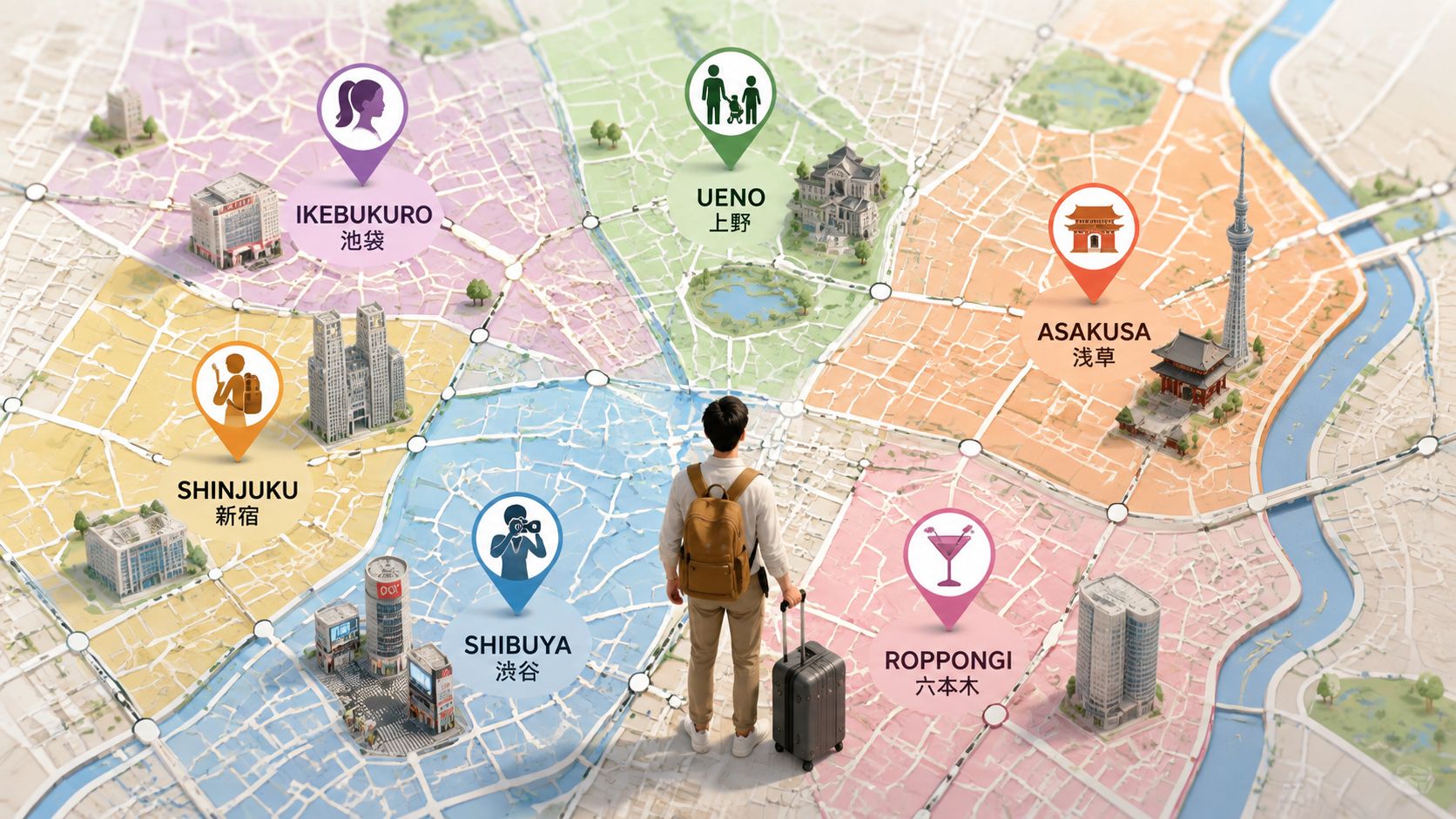
Match the district to your travel style
A solo traveler who wants calm evenings shouldn't book the same pocket of Shinjuku as someone planning to eat and drink until the last train. Families usually benefit from a lower-rise area with parks, casual restaurants, and straightforward walks. Backpackers care about hostel supply and rail access, while photographers may happily sacrifice a perfect central location for better morning streets and evening light.
Your daily route matters just as much. If you're planning museums, old temples, and traditional shopping streets, Asakusa or Ueno makes more sense than paying for a polished business district. If your itinerary revolves around Shibuya, Harajuku, live music, and late dinners, staying farther east creates unnecessary backtracking.
Decide how late your neighborhood needs to function
Tokyo changes character after the commuters disappear. Some districts remain noisy and brightly lit, with restaurants and bars open late. Others become residential and quiet, which is excellent when you want sleep but inconvenient if you're hoping to wander out for a midnight meal.
Be honest about your return time. A peaceful base can feel perfect at breakfast and frustrating after an evening across the city. Conversely, a hotel beside a major entertainment hub can save transport hassle while making rest harder.
Choose your priority, then accept the trade-off
Pick one dominant priority:
- Food and nightlife: Shinjuku or Shibuya.
- Heritage and atmosphere: Asakusa, Ueno, or Yanaka.
- Transit efficiency: Minato, Ginza, or a major station hub.
- Value: Nakano, Ueno, or Ikebukuro.
- Quiet local texture: Koenji, Kiyosumi-Shirakawa, or Ningyocho.
Booking Shinjuku or Shibuya by default isn't wrong. It's lazy decision-making if you don't want crowds, shopping malls, and intense station traffic. The districts are famous because they're useful and exciting, not because they suit every traveler.
Practical rule: Choose the neighborhood that makes your least enjoyable daily task easier. If you hate transfers, prioritize a direct line. If you hate noisy nights, prioritize a residential edge. If you hate searching for dinner, stay near a dense restaurant area.
The profiles ahead cover budget backpackers, solo female travelers, photographers, nightlife seekers, families, long-stay visitors, and first-timers who want a dependable default. Find your type first. The map becomes much easier afterward.
How Tokyo's Districts Actually Differ
Tokyo's neighborhood personality still reflects an old geographic divide. Shitamachi, the lower city, preserves much of the merchant-and-artisan identity associated with Edo-period Tokyo, while Yamanote, the higher-ground side, was historically connected with samurai and aristocratic residences. The distinction isn't a perfect modern boundary, but it remains a useful way to understand why nearby districts can feel radically different.
Asakusa, Ueno, and Yanaka in Taitō Ward are central examples of shitamachi. They retain older street patterns, compact lanes, temples, traditional shops, and a smaller-scale relationship between buildings and sidewalks. This overview of Ueno, Senso-ji, and Yanaka explains why these districts remain closely associated with older Tokyo and why Yanaka is especially valued for visible historic spatial patterns.
Shitamachi works well when you want to walk without feeling that every block was designed around corporate towers. Asakusa leans into temples and traditional shopping. Ueno combines museums, parkland, markets, and inexpensive food. Yanaka offers a quieter, more residential version of old Tokyo, although its accommodation supply is smaller.
The western contrast
Yamanote-side areas such as Shibuya, Roppongi, and Meguro generally feel more modern, vertical, and commercially polished. Their streets can be wider, their buildings taller, and their evening economy more oriented toward offices, fashion, clubs, and international dining.
That doesn't make one side better. It changes the experience. A hotel in Asakusa may put you near a temple district and quieter lanes, while a hotel in Shibuya puts shopping, nightlife, and major rail connections outside your door. The map may show a manageable distance, but the emotional experience of returning to each base is completely different.
If you're also comparing neighborhood logic in another huge city, this guide to where to stay in Paris is useful for the same reason. A famous central label doesn't automatically tell you how the area feels at night, how easily you'll reach your itinerary, or whether the local rhythm suits you.
Why the divide affects your budget
Accommodation clusters unevenly across Tokyo. A ward-level lodging study recorded 843 facilities in Taitō Ward, 661 in Sumida Ward, 549 in Shinjuku Ward, and 458 in Shibuya Ward at the point covered by the source, showing how strongly lodging supply concentrates in selected central districts. The same analysis reported that Sumida's hotels and accommodation facilities grew from 262 at the end of fiscal 2019 to 1,000 at the end of fiscal 2024, about 2.8 times as many.
That concentration gives travelers more choice in places such as Asakusa, Ueno, and nearby Sumida. It also explains why a less glamorous district can sometimes deliver better availability than a fashionable hub.
Seven Traveler Types and Their Best Tokyo Base
Use this as your fast answer before getting into the detail. Each pick favors a different kind of day, so don't choose the neighborhood with the most impressive name. Choose the one that fits the way you'll travel.
| Traveler Type | Primary Pick | Why It Works |
|---|---|---|
| Budget backpacker | Ueno | Strong hostel and casual dining supply, with practical rail access |
| Solo female traveler | Ebisu or Daikanyama | Calmer residential edges and an easier evening atmosphere |
| Photographer | Shimokitazawa | Independent streets, creative venues, and distinctive local texture |
| Nightlife seeker | Shinjuku | The easiest base for bars, late food, and entertainment |
| Family with kids | Asakusa | Human-scale streets, heritage sights, and a calmer night rhythm |
| Long-stay slow traveler | Koenji | Residential value, local eateries, and a less tourist-heavy feel |
| First-time visitor | Ueno | A balanced mix of museums, food, transport, and manageable scale |
The quick verdicts
Budget backpackers should start in Ueno. You'll get more choice than in tiny heritage districts and a more useful sightseeing position than in many outer neighborhoods.
Solo female travelers should look at Ebisu or Daikanyama. These areas don't offer Shinjuku's constant action, but they're easier to come back to after dark and better suited to a composed evening routine.
Photographers should choose Shimokitazawa if street texture and independent culture matter more than being beside the biggest tourist sights. For a stronger mix of neon, polished streets, and atmospheric canals, consider Ebisu or Nakameguro instead.
Nightlife seekers belong in Shinjuku. Shibuya is a valid alternative if shopping, clubs, and youth culture lead the itinerary, but Shinjuku offers a broader late-night ecosystem.
Families should choose Asakusa. The district's temple area can be crowded by day, yet its smaller streets and early-closing evenings make it less exhausting as a hotel base.
Long-stay travelers should look beyond the tourist shortlist. Koenji is my value pick for a slower stay, while Nakano is the stronger choice if direct rail access matters more than neighborhood charm.
First-timers who want a dependable default should choose Ueno. It's less overwhelming than Shinjuku, more connected than Asakusa, and packed with enough food and culture to keep the first few days easy.
Comparing the Top Tokyo Neighborhoods to Stay
The six names below dominate most Tokyo searches for good reason. They solve different problems, though, and the cheapest room isn't always the cheapest stay once you add longer journeys, transfers, and late-night taxi temptation.
The price figures in this table are the specific guide benchmarks supplied for comparison, not a live quote. Tokyo rates move sharply with dates and demand, so treat them as directional rather than guaranteed.
| Neighborhood | Main Station | Avg. Nightly (Mid-Range) | Vibe | Best For | Verdict |
|---|---|---|---|---|---|
| Shinjuku | Shinjuku Station | Varies by date | Bright, crowded, restless | Late-night food and nightlife | Best for late-night energy |
| Shibuya | Shibuya Station | Varies by date | Youthful, commercial, fast | Shopping and clubs | Best for contemporary Tokyo |
| Asakusa | Asakusa Station | Around ¥14,000 for a twin near Senso-ji | Historic, compact, quieter at night | Families and heritage | Best for traditional atmosphere |
| Ginza | Ginza Station | Business hotels from about ¥22,000 | Polished, central, upscale | Premium convenience | Best for location and comfort |
| Ueno | Ueno Station | Varies by date | Local, practical, cultural | Budget travelers and museums | Best under ¥12,000 when deals appear |
| Ikebukuro | Ikebukuro Station | Varies by date | Dense, useful, less curated | Value with strong connections | Best for budget-conscious first-timers |
Shinjuku
Pick Shinjuku if you want restaurants, bars, department stores, and rail connections immediately outside the hotel. The eastern side is more useful for visitors who want food and entertainment, while the western side feels more office-oriented. Avoid it if crowds and a complex station will drain you before breakfast.
Shibuya
Shibuya is the choice for fashion, shopping, clubs, and the visual drama of contemporary Tokyo. The cost is usually justified only when you plan to spend substantial time in the southwest. Avoid it if you want traditional streets or a restful return after a long sightseeing day.
Asakusa
Asakusa gives you Senso-ji, Nakamise-dori, low-rise streets, and a strong historical identity. Hotels around the Senso-ji area cluster around ¥14,000 for a twin in the supplied benchmark, making it an attractive family and value option. Avoid it if your itinerary is dominated by western Tokyo.
Ginza
Ginza is expensive, but it's hard to beat for polished hotels, central positioning, and easy access toward Tokyo Station. Business hotels start near ¥22,000 in the supplied comparison. Avoid it if you want a neighborhood that stays lively after office hours.
Ueno
Ueno is my most practical all-rounder. It combines parkland, museums, market food, and strong rail access, with a more grounded atmosphere than Shinjuku or Shibuya. Avoid it only if nightlife is your central reason for visiting Tokyo.
Ikebukuro
Ikebukuro offers a useful balance between price and access. The Yamanote connection puts Shibuya about 11 minutes away, according to the supplied benchmark, which makes the area more versatile than its less glamorous reputation suggests. Avoid it if your priority is temple scenery or a small-town feel.
A Two-Base Tokyo Itinerary That Cuts Transit Time
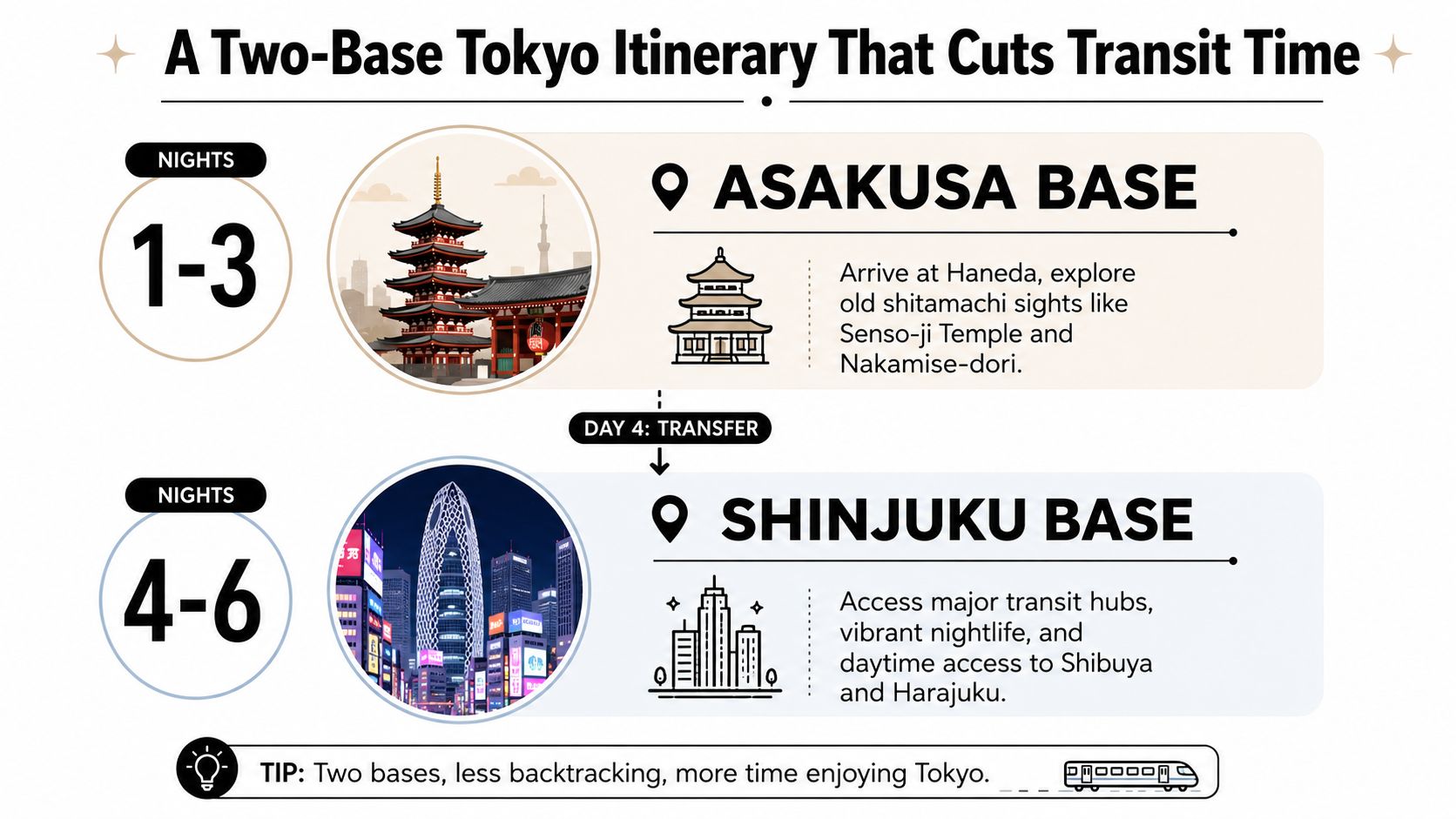
A single hotel is convenient, but it can force every day to begin and end from the same side of Tokyo. For a six-night trip, I prefer a split base: three nights in Asakusa, followed by three nights in Shinjuku.
Nights 1 to 3 in Asakusa
Arriving at Haneda, head east and settle into Asakusa. Your first evening stays simple: walk around Senso-ji after the main crowds thin, browse the nearby lanes, and eat close to the hotel rather than crossing the city while jet-lagged.
Day two naturally groups the eastern sights. Start with Asakusa, walk or ride toward Ueno Park, then continue to Akihabara. That sequence keeps the day geographically coherent and gives you a changing view of shitamachi Tokyo, museums, markets, and electronics culture.
Day three can cover the Sumida River, Tokyo Skytree, and nearby shopping before an early night. Asakusa's quieter evening character becomes an advantage here, especially if you're still adjusting to Tokyo's pace.
The transfer day
Move to Shinjuku on day four. Pack light, use a station locker, or arrange luggage delivery if your bags are awkward. The actual rail swap is manageable, but dragging suitcases through large stations is where a simple hotel change becomes irritating.
For navigation, save offline maps and use a reliable transit app. You can also compare tools in this practical guide to the best travel apps.
Nights 4 to 6 in Shinjuku
Day five works westward: Shinjuku in the morning, Shibuya Crossing later, then Shimokitazawa for independent shops, cafés, and evening atmosphere. You'll finish closer to your new base instead of returning east after a full day.
Day six can absorb Harajuku, Meiji Jingu, Yoyogi, and a final Shinjuku dinner. This arrangement reduces the repeated westbound commuting that a single Ueno base would require for a west-heavy second half.
If you land at Narita, use the Keisei route and consider the Skyliner rather than building the itinerary around a Haneda arrival. The broader principle remains the same: place each hotel where it serves the cluster of days around it.
Best Neighborhood by Traveler Profile
The cleanest choice depends on what you'll do between breakfast and bed. These pairings give you a primary base, a fallback, and a clear reason not to choose it when the trade-off cuts against your plans.
| Traveler Type | Primary Base | Backup Base | Sample Stay | Price Band | Why It Wins |
|---|---|---|---|---|---|
| Budget backpacker | Ueno | Asakusa | Ueno hostel or ICHIYU | ¥3,500 to ¥5,500 for a capsule | Low-cost beds and useful transport |
| Solo female traveler | West Shinjuku | Kiyosumi-Shirakawa | Hotel near a staffed station area | Varies by date | Easier late returns and practical services |
| Photographer | Ebisu | Nakameguro | Small design-led hotel | Varies by date | Strong evening light and street variety |
| Nightlife seeker | Shibuya Center-gai | Shinjuku | Hotel with a buffer from the busiest lanes | Varies by date | Clubs, bars, and late food nearby |
| Family with kids | Asakusa | Ueno | Family room or apartment-style hotel | Varies by date | Walkable sights and calmer nights |
| Remote worker | Jimbocho | Nakano | Business hotel near cafés | Varies by date | Quiet work rhythm and rail access |
| Long-stay slow traveler | Koenji | Nakano | Residential apartment-style stay | Varies by date | Local life without constant tourist traffic |
Budget backpackers
Choose Ueno first. Capsule beds in the supplied range of ¥3,500 to ¥5,500 can make the district a strong base for stretching your yen, and the surrounding food scene keeps daily costs manageable. Asakusa is the backup if you want quieter nights and more traditional surroundings.
Skip Ueno if you need a polished, design-forward hotel rather than a functional base.
Solo female travelers
I'd choose a quiet pocket near Shinjuku's west exit or Kiyosumi-Shirakawa over the loudest entertainment streets. Look for a hotel with a 24-hour concierge, clear reception access, and a well-lit walk from the station. Ebisu and Daikanyama are also strong choices when you want restaurants without Kabukicho's intensity.
Skip these calmer bases if you plan to spend every night in Shibuya clubs. Your return journey will become the dominant feature of the trip.
Photographers
Ebisu and Nakameguro offer a productive mix of canal light, side streets, cafés, and polished residential architecture. Shimokitazawa is the better backup for rougher textures, vintage storefronts, and creative scenes.
Skip Nakameguro if your photography brief is mainly temple dawns. In that case, Asakusa or Yanaka will give you more useful subject matter immediately outside the door.
Nightlife seekers
Stay near Shibuya Center-gai if clubs and contemporary nightlife lead your itinerary. Shinjuku is the more flexible alternative, especially if you want small bars, late meals, and a broader range of entertainment. In either district, use a hotel as a buffer from the busiest lanes rather than booking directly above a noisy venue.
Families with kids
Asakusa is my first pick because the streets feel more human-scale and the area delivers major sights without requiring a complicated first day. Ueno is the practical backup, particularly for museum visits and access to larger accommodation formats.
Skip both if Tokyo Disney is the trip's main purpose. In that case, choose a bayside package hotel and accept that central Tokyo will be a day-trip destination.
Remote workers
Jimbocho is the smart base for a work-heavy stay. Book near a café cluster and the Marunouchi Line, then use the neighborhood's quieter rhythm to separate work hours from sightseeing. Nakano is the backup for better direct rail access, with this guide to the best countries for digital nomads useful for broader long-stay planning.
Skip Jimbocho if you need nightlife directly downstairs. Its strength is focus, not spectacle.
Long-stay travelers
Koenji gives you more of a lived-in routine than the headline districts. Nakano is the better alternative when you want direct access to central Tokyo without accepting Minato's premium pricing. For extended stays, a kitchen, laundry access, and a supermarket nearby often matter more than a dramatic skyline.
Safety, Disasters, and Booking Tips
Neighborhood advice shouldn't stop at restaurants and train lines. Tokyo's geography creates real differences between upland districts and eastern lowland areas, and those differences matter more when you're traveling alone, carrying children's gear, or staying for several weeks.
Independent ward-level safety and hazard references identify Bunkyo, Meguro, Suginami, Setagaya, and Nerima as stronger upland or western options on crime and/or natural-disaster exposure, while Edogawa, Katsushika, Arakawa, Adachi, Sumida, and Koto face greater flood and zero-meter-zone concerns. This ward-level Tokyo neighborhood safety overview is worth checking before you finalize a long stay.
That doesn't mean you should avoid every eastern ward. It means you should check the exact hotel address, read the local hazard map, and understand whether your accommodation sits in a low-lying or flood-sensitive area. Minato also needs nuance. Its central access is excellent, but bayside locations shouldn't be assessed the same way as upland Minato streets.
| Neighborhood | Night Safety Rating | Disaster Risk | Best Booking Window |
|---|---|---|---|
| Bunkyo | Quieter | Lower relative exposure in the supplied ward comparison | Book early for limited accommodation |
| Ebisu or Daikanyama | Calm residential feel | Review the exact address | Book once dates are fixed |
| Shinjuku | Busy, with entertainment-zone caution | Check the specific block | Book early for popular periods |
| Asakusa | Generally calmer at night | Review eastern lowland hazard maps | Book early for heritage-season demand |
| Koto or Sumida | Varies by block | Higher flood and lowland concerns | Confirm the hazard map before booking |
| Minato | Premium central option | Bayside exposure varies by location | Reserve early because premium stock is limited |
Make the room work for you
Put a portable Wi-Fi unit or eSIM on your arrival checklist, especially if you'll move through unfamiliar stations late at night. Carry a small amount of cash for lockers and vending machines, and pack a compact rain layer that can handle heat as well as sudden showers.
You'll also want a Japan-compatible power adapter. This guide to choosing an adapter for Japan can help you avoid discovering the problem at the airport.
Book with cancellation flexibility
Cherry blossom periods and Golden Week can squeeze affordable rooms out of popular districts quickly. Reserve refundable accommodation once your route is stable, then keep checking for a better location or rate.
A 90-day cancellation window is a useful planning point for comparing capsule hotels, business hotels, and small ryokan, but availability varies by property. Before paying, confirm the cancellation deadline, station walking route, luggage policy, and whether the room can handle your actual bags.
Before departure, screenshot your hotel address in Japanese, save your first train route, download offline maps, confirm your check-in time, and check the ward hazard map. Those small preparations remove more stress than another hour spent comparing lobby photos.
Picking Your Tokyo Home Base
Reduce the decision to three questions.
- What kind of traveler are you? Choose from the profiles above rather than starting with a neighborhood name.
- What's your nightly ceiling? Decide the maximum you'll pay before falling in love with a room.
- How much transit friction can you tolerate? A cheaper hotel isn't a bargain if every evening ends with a tiring cross-city journey.
Score each candidate from one to five for price, rail access, night comfort, and atmosphere. Give double weight to the category that matters most, then use the verdict tags in the comparison table to break a tie. For booking tactics that protect your budget, see this guide to booking cheap hotels.
Best all-rounder: Ueno, for a balanced mix of culture, food, rail access, and manageable scale.
Best under ¥10,000 per night: Start with Ueno, Ikebukuro, Nakano, or Asakusa, then compare the exact dates rather than assuming one district will always be cheapest.
Best first 72 hours in Japan: Asakusa, if you want a gentle introduction to Tokyo's historic side, or Ueno if you want the most flexible sightseeing base.
Don't book the most famous district because every guide repeats it. Book the neighborhood that makes your actual itinerary feel easier.
Travel Talk Today offers practical, affordable travel guidance for choosing smarter bases, managing peak-season costs, and traveling with greater confidence. Visit Travel Talk Today to turn your Tokyo neighborhood choice into a well-planned trip with useful checklists, budgeting advice, and thoughtful destination ideas.