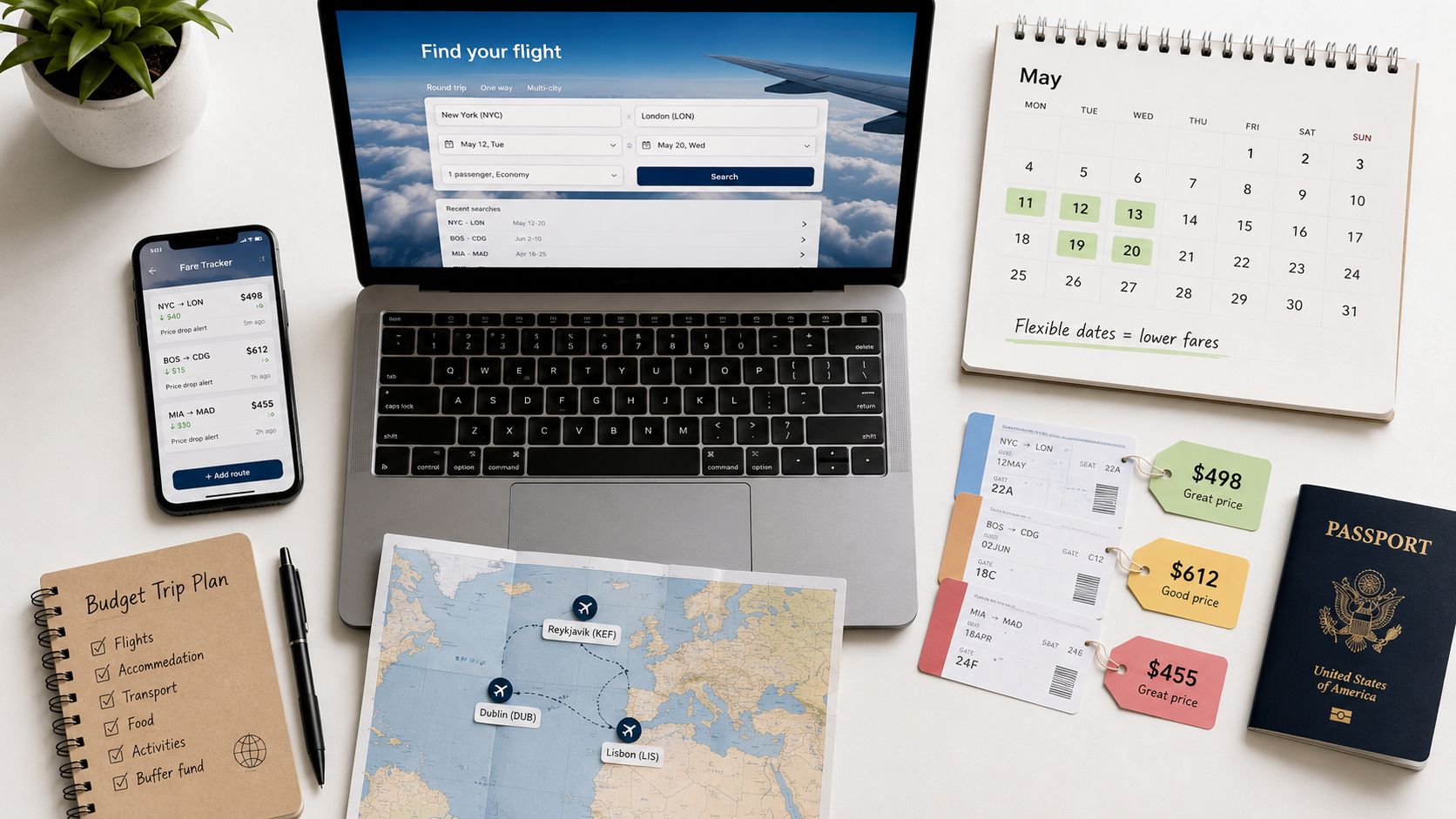
The cheapest fare isn't always the best deal. No single booking day guarantees the lowest price, and old advice about searching at one exact hour can distract you from decisions that matter more. CheapAir's historical airfare research found that domestic U.S. fares were cheapest, on average, about 54 days before departure, while Google Flights analysis placed a typical low-price range around 34 to 86 days before departure. Those findings point to a window, not a magic button. (CheapAir airfare analysis, Google Flights timing coverage)
The strongest booking flight tips combine fare monitoring with flexible dates, nearby airports, seasonal awareness, and a final review of baggage, transfers, connection time, comfort, and safety. A ticket that looks cheap can become expensive after ground transport, seat costs, overnight accommodation, or a risky self-transfer.
Use the following tactics as a decision process. Start with timing, then test the itinerary itself, and pay only after you know what the trip will really cost.
1. Treat Tuesday booking advice as a comparison point
Tuesday is a useful checkpoint, not a booking rule. Expedia's 2025 Air Hacks report found that Sunday was the cheapest day to book on average, with savings of 15% on domestic flights and 10% on international flights compared with Friday. It also reported that booking at least two months ahead saved domestic travelers nearly 40% on average compared with booking a month ahead. (Expedia 2025 airfare findings)
That pattern supports a broader recommendation: compare purchase days, but give greater weight to the route, travel date, and booking window. CheapAir's historical study found less than a 0.6% difference between days of purchase, so delaying a workable fare to reach Tuesday rarely makes sense. (CheapAir's historical booking analysis)
Use Tuesday to review, not to gamble
Set a fare alert, then check the same itinerary on Google Flights and the airline's website. Compare nearby travel dates, airports, baggage rules, connection lengths, and the total cost of reaching your destination. Separate tickets or a longer transfer may reduce the fare while adding missed-connection risk, extra transport, or less comfort.
If the price fits your budget and the itinerary keeps the journey safe and manageable, book it. Do not wait for a theoretical weekly drop.
Practical rule: A good fare on the right itinerary beats a Tuesday bargain that may never appear.
For background on weekday advice and sensible comparison habits, review these cheapest time to book flights guidelines. Use the guidance to structure your checks, then decide from fare history and the complete trip total, not from a superstition about the clock.
2. Skip the cookie myth and compare prices properly
Private browsing can make flight shopping feel cleaner, but don't assume incognito mode automatically lowers the fare. The most useful role of a private window is to separate searches, reduce clutter from old sessions, and help you verify whether a displayed price changes across booking channels. Airline fares usually respond to inventory, demand, route competition, and fare rules, so clearing cookies isn't a substitute for monitoring.
Use a fresh private window when you want a clean comparison, then repeat the search on the airline's own website. Don't log out of useful loyalty accounts merely because you fear a price penalty. An account may show your baggage benefits, points, or eligible fare conditions, and those details affect the value of the ticket.
Build a clean comparison routine
- Start a fresh search: Open a new private window when you begin comparing a route or date combination.
- Check the airline directly: Confirm the same flight, fare family, baggage allowance, seat conditions, and change rules on the carrier's website.
- Compare the final screen: Look for payment charges, agency fees, currency differences, and restrictions before deciding.
- Keep useful account benefits: Sign in when your status, credit, or loyalty benefits materially change the total trip value.
A solo traveler should also avoid booking through an unfamiliar intermediary just because the first result looks cheapest. If a schedule changes or a connection fails, support quality matters. Paying directly through the airline can make disruption handling simpler, though you should still compare the complete terms before checkout.
Private browsing is a verification tool, not a pricing strategy. Use it alongside alerts, flexible dates, and direct comparison. That approach gives you evidence without relying on the unsupported claim that an airline is secretly raising your fare because you searched twice.

3. Move your travel days before chasing a booking day
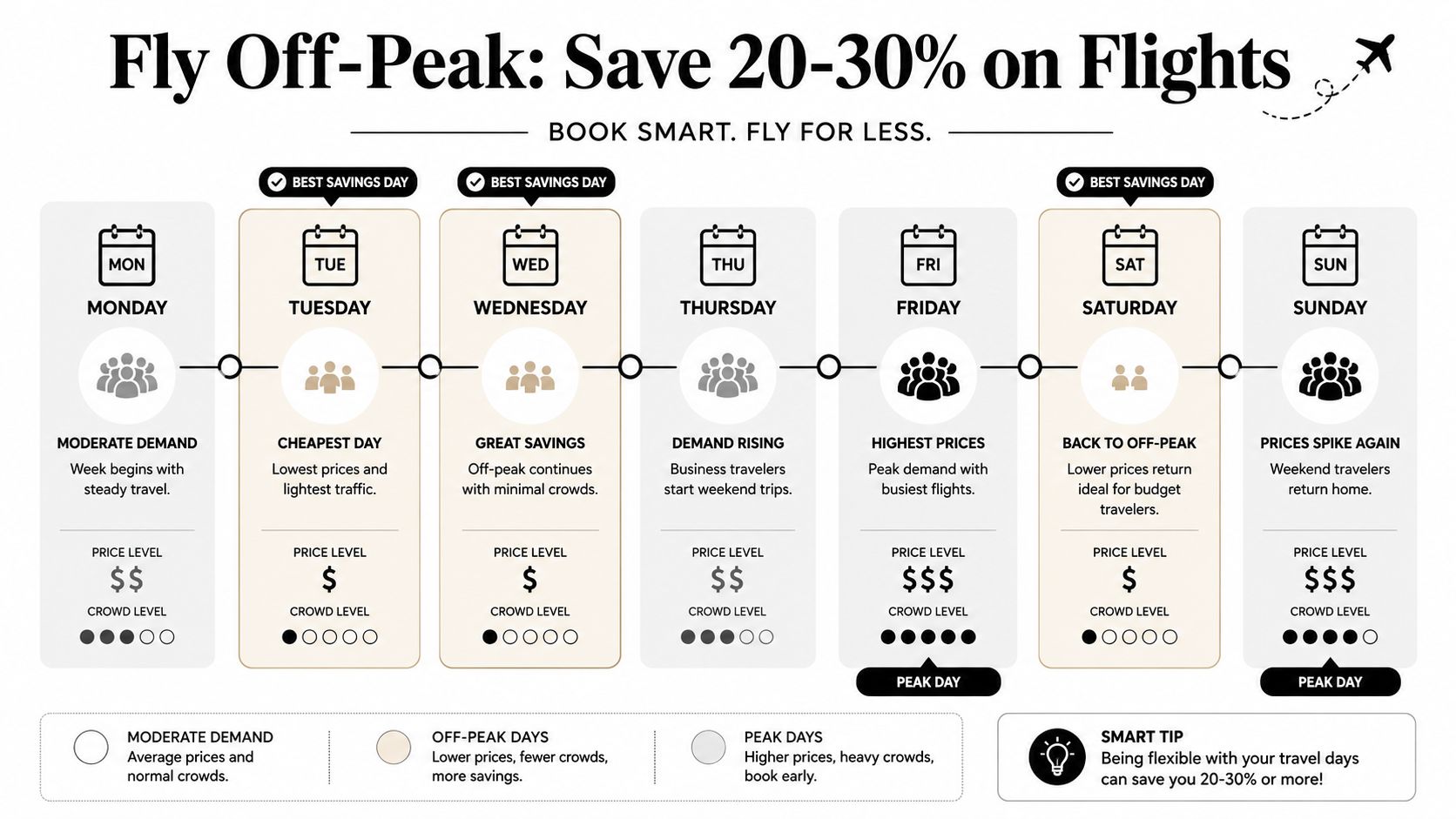
Changing the day you fly can matter more than changing the day you buy. CheapAir's historical research found that Tuesday and Wednesday flights were cheaper than Sunday flights by an average of $73, while purchase-day differences were minimal. The practical lesson is simple. If your schedule allows it, test midweek departures and returns before you spend time searching for a perfect booking moment. (CheapAir's domestic airfare study)
Flexible dates also improve comfort. A Tuesday departure may cost less, but an overnight flight with a long airport transfer could leave you paying for an extra hotel night or arriving too exhausted to enjoy the first day. Compare the whole travel experience, especially if you're traveling alone and need a straightforward arrival.
Search the calendar, not just one itinerary
Use Google Flights' date grid or calendar view to scan the surrounding options. Test combinations such as a Wednesday departure with a Saturday return, then compare them with the cheapest-looking dates after adding baggage, seats, and local transport.
- Check departure and return separately: The cheapest outbound date may pair poorly with the cheapest return.
- Review arrival times: A late landing can create safety concerns, limited public transport, or an expensive taxi.
- Price the schedule: A slightly higher fare may be worthwhile if it removes an overnight stay or a stressful transfer.
- Protect recovery time: Budget travel shouldn't require an unsafe rush through an unfamiliar airport or city.
A traveler flying into a major European city for a short break may benefit from a midweek itinerary, but only if the arrival airport connects easily to the accommodation. For a backpacker with a flexible route, the better choice may be the flight that preserves an extra day for local travel rather than the flight with the lowest headline fare.
4. Match the booking window to the trip
Domestic and international flights need different booking approaches. Expedia's 2025 report found that domestic travelers saved nearly 40% on average by booking at least two months ahead instead of one month ahead. For international flights, booking at least three months ahead rather than two months or less produced savings of about 10%. (Expedia's 2025 Air Hacks findings)
Historical Google Flights analysis placed the domestic low-price window around 34 to 86 days before departure. Google's 2025 holiday guidance narrowed that domestic range to 23 to 51 days, with the lowest prices often appearing around 39 days before departure. Treat these figures as comparison points, not promises. Route, season, demand, and flexibility still determine the right decision. (Google's 2025 holiday travel guidance)
Set a window, then set a decision point
Start monitoring before your likely booking window. That gives you a baseline for the route and makes a price increase easier to recognize. Begin earlier for international trips with fixed dates, high demand, or limited nonstop service. For domestic travel, keep comparing through the broader mid-range window instead of paying extra just for early reassurance.
CheapAir's airfare timing research identified a first-dibs premium period for flights purchased six to eleven months ahead and found that bookings in the final two weeks were highest on average, about $150 more than bookings made in the prime window. That pattern supports a practical rule: monitor early, then buy when the fare fits the full trip rather than waiting indefinitely.
Use these best time to book flights recommendations as a starting framework. Confirm the fare against baggage, arrival time, airport access, and your comfort and safety requirements before booking.
5. Let alerts do the repetitive work
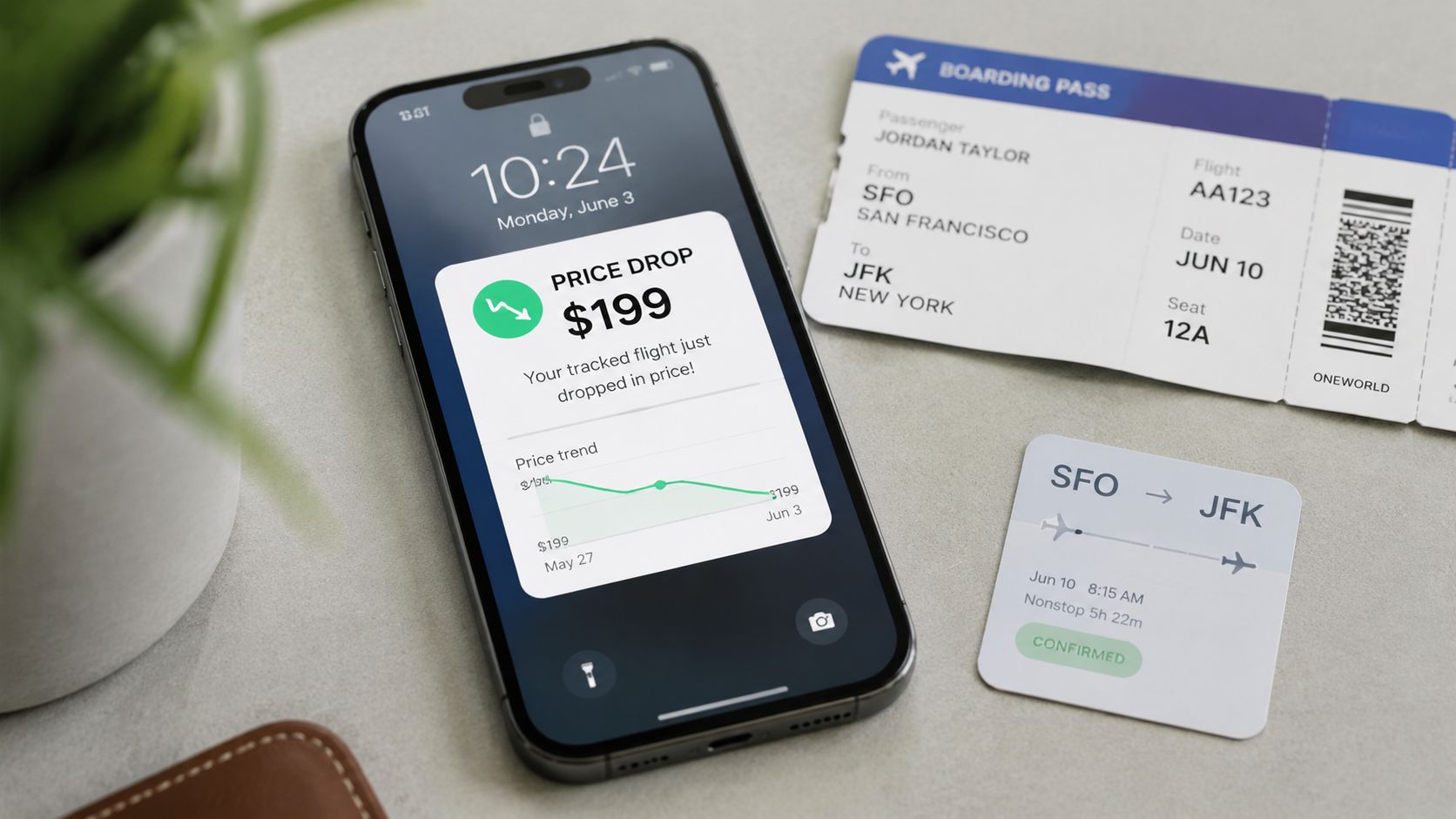
Price alerts turn flight shopping from a daily chore into a controlled observation process. Google Flights, Hopper, Kayak, and Skyscanner can monitor routes and notify you when fares move, but their predictions shouldn't replace your judgment. A tool can identify a price change. It can't decide whether the connection is sensible, the airport is safe for your arrival time, or the fare includes the luggage you need.
Create alerts for the exact itinerary first, then add flexible alternatives. A budget traveler might track a nonstop flight, a one-stop option, and nearby departure airports. A solo traveler might prioritize daytime arrivals and shorter connections even if a different alert produces a lower headline price.
Compare alerts with your actual trip plan
- Track route variations: Monitor different dates, airports, and reasonable connection points.
- Read fare conditions: Check whether the alert refers to a basic fare with restricted baggage or seat selection.
- Set a personal ceiling: Decide what you're willing to pay for a safe, comfortable itinerary before the alert arrives.
- Act when the total works: Don't wait for the absolute bottom if the current fare fits your budget and plans.
You can also compare the alert result with the airline's direct price. An online travel agency may display a lower initial fare but provide weaker support when schedules change. Direct booking may offer clearer communication, though it isn't automatically the cheapest or most flexible option. Compare the final payable amount and the terms.
For practical tools that support fare monitoring and itinerary planning, explore these best travel apps for flight research. Use alerts to narrow your choices, not to outsource the decision.
6. Price separate one-way tickets with care
Two one-way tickets can give you more control than a traditional return ticket. You can choose different airlines, change the return independently, or build an open-jaw trip that arrives in one city and departs from another. But separate tickets aren't automatically cheaper, and they can create real risks when you connect between unrelated bookings.
Start by comparing the complete one-way combination with the return fare. Check baggage charges on both airlines, payment fees, airport changes, seat costs, and the price of getting from your arrival airport to the next departure point. A low-cost outbound paired with an expensive return can cost more than a single return ticket.
Protect independent connections
If separate tickets create a self-transfer, leave enough time to collect bags, clear immigration, travel between terminals, and check in again. A missed connection usually isn't protected by the second airline when the first ticket is delayed. Travel insurance may have conditions, so read the policy instead of assuming it will reimburse every disruption.
Two separate tickets can create flexibility, but they also create two separate responsibilities.
This strategy works well for a solo traveler with an open schedule who wants to extend a stay or choose a different return city. It works less well when you have an important event, checked luggage, a tight connection, or a route with limited daily service. Comfort matters too. The cheapest combination may require an airport transfer, an overnight stay, or a long wait that erases the fare difference.
Use flexible-date searches to compare one-way combinations, then investigate open-jaw options for multi-city travel. These cheap flight-finding strategies can help you discover useful combinations, but book only after checking protection, transfer logistics, and the cost of every leg.
7. Search nearby airports, then price the ground journey
Alternative airports can reveal better fares, especially when a city has several gateways or when a secondary airport serves low-cost routes. Don't stop at the airport name printed in your first search. Add nearby airports and compare the full journey from your home to the accommodation.
The airport with the lowest fare may be far from the city, served by infrequent transport, or difficult to reach after a late arrival. Ground costs can include rail tickets, buses, shuttles, taxis, parking, luggage surcharges, and a hotel near the airport. For solo travelers, also assess the arrival route, lighting, transport reliability, and whether you'll be navigating an unfamiliar area late at night.
Use a total-arrival-cost test
Write down four figures before choosing the alternative gateway:
- Airfare total: Include baggage, seats, payment charges, and any fare difference for a usable ticket.
- Airport transfer: Price the train, bus, shuttle, taxi, or rental car from the airport to your base.
- Time cost: Account for longer ground travel, early departures, and possible overnight accommodation.
- Safety and comfort: Consider arrival hours, luggage handling, connection complexity, and the reliability of the route.
A secondary airport can be a smart choice when transport is frequent and the fare difference remains meaningful after these additions. It can be a poor choice when a cheap ticket forces a rushed cross-city transfer or an arrival after public transport ends.
Search multiple gateways in the same comparison, then verify the airport codes before paying. Destination research, including practical location planning such as this Hawaii airports map, can help you understand how airport choice changes the shape of a trip.
8. Use shoulder season to improve the whole trip
Shoulder season often gives travelers a better balance of price, availability, weather, and crowd levels than peak periods. Instead of choosing dates only by airfare, identify the months between the busiest and quietest seasons, then check local weather, festivals, school holidays, and transport schedules.
This approach can also improve the quality of a budget trip. Less crowded destinations may make it easier to find accommodation, use public transport, speak with residents, and spend time in local neighborhoods rather than moving through a rushed tourist circuit. But shoulder season isn't automatically ideal. Some attractions reduce opening hours, weather can change quickly, and seasonal transport may be limited.
Check the destination before changing your dates
- Study local seasons: Weather patterns differ across regions, even within the same country.
- Review the event calendar: A festival can raise demand during an otherwise quieter period.
- Confirm operating schedules: Ferries, tours, restaurants, and attractions may run less frequently.
- Protect the experience: Choose a quieter period only when the conditions support your intended activities.
A photographer may prefer a less crowded period with workable light and open access, while a solo traveler may prioritize dependable transport and busy enough public spaces. A backpacker can often accept more weather uncertainty, but should still budget for delays and backup accommodation.
Avoiding peak demand isn't just a fare tactic. It changes the entire cost structure of the trip, including lodging, local transport, and activities. Choose a season that supports your plans, then monitor flights within that period rather than forcing an unsuitable month for a lower fare.
8-Point Flight Booking Comparison
| Strategy | 🔄 Complexity | ⚡ Resources / Effort | 📊 Expected Outcomes | 💡 Ideal Use Cases | ⭐ Key Advantage |
|---|---|---|---|---|---|
| Book Flights on Tuesday Afternoons for Lower Prices | Low, simple timing window | Minimal, check midweek (Mon–Tue) | 📊 ~10–15% average savings historically; variable by route | Flexible, budget-conscious travelers monitoring fares | ⭐ Consistent midweek fare dips; no tools required |
| Use Incognito Mode and Clear Cookies When Flight Shopping | Very Low, single-step habit | Minimal, browser mode; optional VPN | 📊 Possible small savings (~5–10%); mixed evidence | Tech-savvy bookers and international-route shoppers | ⭐ Prevents some cookie-based dynamic pricing; free |
| Fly on Off-Peak Days (Tues/Wed/Sat) to Save 20–30% | Low–Medium, needs date flexibility | Minimal, choose cheaper weekdays | 📊 ~20–30% savings; also less crowded flights | Flexible itineraries, backpackers, slow travelers | ⭐ Large fare reductions + more comfortable travel |
| Book Domestic 1–3 Months Ahead; International 2–3 Months | Medium, requires planning calendar | Moderate, set reminders and monitor windows | 📊 Reliable timing reduces volatility; domestic ~58 days, intl ~76 days | Organized planners and multi-leg trip schedulers | ⭐ Data-backed “sweet spot” for consistent pricing |
| Leverage Airline Fare Alerts & Price Tracking Tools | Medium, initial setup, ongoing checks | Low ongoing, apps/services (Google, Hopper, Kayak) | 📊 Often finds 15–20% better deals; saves time | Travelers managing multiple routes or flexible dates | ⭐ Automated monitoring and predictive notifications |
| Book One-Way Flights Instead of Round-Trip | Medium, manage multiple bookings | Moderate, two bookings, check baggage/policies | 📊 Typical savings ~10–15%; flexibility gains may outweigh cost | Multi-country travelers, open-ended itineraries | ⭐ Maximum flexibility; optimize each leg separately |
| Search Nearby Airports & Multiple Gateways for Lower Fares | Medium, extra research & transit planning | Moderate, compare airports + ground costs | 📊 Savings commonly $50–200+ but adds transfer time/cost | Urban metro travelers with multiple nearby airports | ⭐ Access to budget carriers and lower fares in metro areas |
| Travel During Shoulder Season and Avoid Peak Times | Medium, align dates with seasons/events | Low, choose off-peak months, verify weather | 📊 Large savings 30–50% and fewer crowds; seasonal caveats | Sustainable travelers, solo explorers, budget seekers | ⭐ Best balance of price, experience, and availability |
Turn fare hunting into a safer travel plan
Start with the trip you want to take. Choose flexible dates if you have them, consider nearby destinations or gateways, and decide which comforts you won't sacrifice. A low fare isn't useful if it creates an unsafe arrival, an impossible connection, or a transfer that costs more than the flight.
Next, set alerts for several sensible combinations. Track the exact route, nearby airports, and a few date variations. Compare the airline's direct price with reputable booking platforms, and use Tuesday searches as a review point rather than a guarantee. Current data supports route-specific decisions. Google's 2025 guidance places domestic low prices around a 23 to 51 day range for some trips, while Expedia's findings show that some international itineraries can reward booking just 18 to 29 days before departure rather than more than three months early. (Google's 2025 travel guidance, Expedia timing analysis)
Before payment, calculate the trip total. Add checked or carry-on baggage, seats, meals, airport transfers, overnight stays, travel insurance, and any separate-ticket risk. Compare connection times and airport changes. If you're traveling solo, check the arrival route and transport options before choosing a late landing only to save money.
Booking behavior is also increasingly digital. A 2026 global survey of 4,060 consumers found that 81% use digital platforms for travel planning, 26% already use AI tools such as ChatGPT or Gemini, 47% identify payment security as a top concern, and 53% say identity-verification steps sometimes or often cause booking abandonment. Those findings make a practical point for travelers and booking teams alike. Use trusted payment pages, verify the airline and airport details, and don't rush through a checkout process that hides important conditions. (BCD Travel's 2026 travel buyer survey)
Online booking is also standard for business travel. BCD Travel's 2026 survey of 833 business travelers found that 90% book business trips through online booking tools, while nearly 40% of online booking tool users rely on them exclusively. (BCD Travel's business traveler research) For personal travel, the same principle applies. Search digitally, but keep human judgment in the final decision.
Use Travel Talk Today for budgeting frameworks, solo-travel safety guidance, sustainable tourism ideas, and practical itinerary planning. The best booking flight tips don't promise that every search will produce a bargain. They help you recognize a fair fare, understand the trade-offs, and build a trip that remains affordable, comfortable, and safe after you click purchase.
Travel Talk Today offers practical guidance on flight timing, budgeting, solo-travel safety, sustainable tourism, and meaningful itinerary planning. Use its current travel resources to compare fare options and shape a trip that fits your real budget, then visit Travel Talk Today to plan your next journey with greater confidence.