You're probably staring at a map right now, tracing a line south and wondering whether this is a bold, memorable overland trip or a bureaucratic mistake with good scenery. That's the right question.
A drive to Costa Rica pulls hard on the imagination. Your own vehicle. Your own pace. Border signs changing language and currency while the road keeps pulling you forward. But the romance only survives if the logistics are solid. Most advice online skips past the hard part and jumps straight to beaches, waterfalls, and rental car tips inside the country. That's not where overlanders get stuck.
They get stuck at borders, on timing, on paperwork, and on the false assumption that distance in Central America works like distance back home. It doesn't. If you want to drive to Costa Rica successfully, think like an expedition planner first and a road trip dreamer second. That mindset is what gets you there.
Is This Epic Drive Really for You?
You are three borders into the trip, it is hot, your phone signal is weak, and a customs official has just sent you to a photocopy booth you did not notice on the way in. That moment decides whether this drive feels rewarding or miserable.
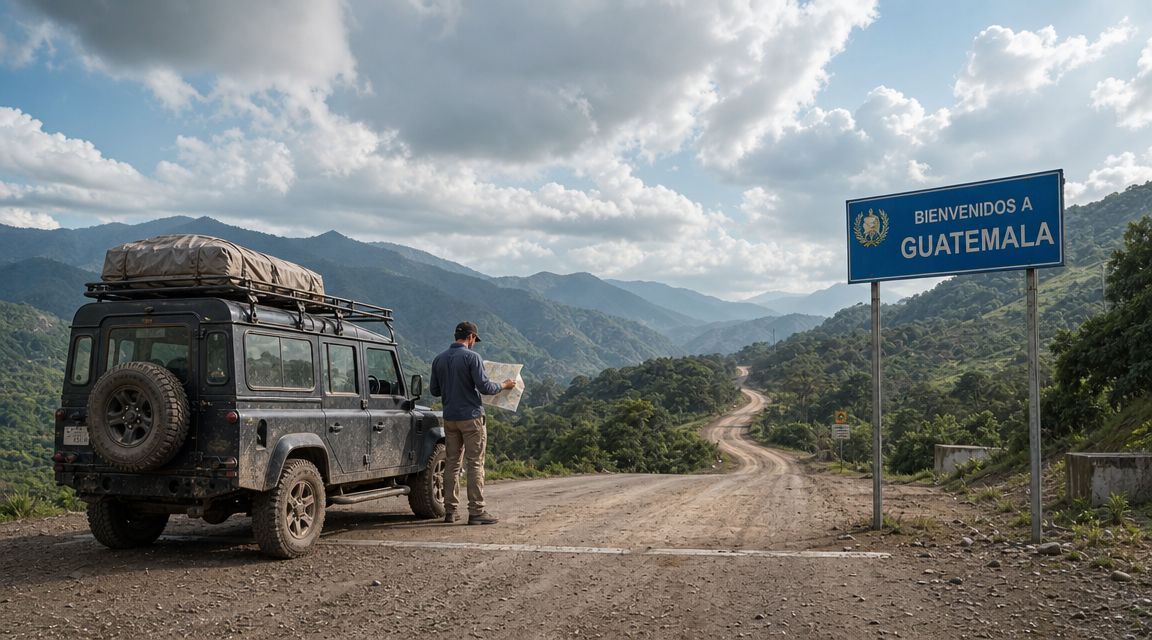
A drive to Costa Rica suits travelers who can treat delays, paperwork, and constant small decisions as part of the route. It wears down travelers who only enjoy the driving once everything goes to plan. The road itself is often the easy part. The harder part is staying patient when an entry process takes half a day, insurance rules change at the next frontier, or a "short" transfer day disappears into lines and waiting rooms.
That trade-off matters more than people expect. Plenty of travelers are comfortable with long mileage days at home and still hate this trip because overland time in Central America is rarely measured by distance alone. It is measured by border timing, daylight, document prep, and how well you cope when the system is slower than you hoped.
Who usually enjoys this drive
The people who do well on this route tend to share a few habits.
- Slow travelers: If you already travel with flexible days and care more about the experience than the fastest arrival, the mindset behind slow travel fits this route well.
- Overlanders with their own setup: A vehicle stocked for sleeping, cooking, and waiting gives you options when a crossing takes longer than expected.
- Flexible planners: The trip goes better if you can drop a stop, add a buffer night, or call it early without feeling like the whole plan failed.
Who should think twice
Some travel styles clash with this route almost immediately.
| Travel style | Likely outcome |
|---|---|
| Tight itinerary | Border delays wreck the schedule fast |
| Confidence driving long distances at home | Limited use if you are tired, lost, or arriving late |
| Low tolerance for admin | Frustration starts early |
| Genuine interest in the overland process | Much better fit |
I have found one simple test helps. Ask yourself whether you can stay calm after losing several hours to forms, copies, insurance checks, and one unclear instruction. If the answer is no, flying in and renting locally is usually the better call.
This trip also asks for honest self-assessment beyond attitude. Older vehicles can absolutely make it, but they give you less margin for error once you add heat, rough patches, and long waits at borders. Families with young kids can do the drive, though they usually need shorter days and more buffer nights than couples or solo travelers. Pet travel adds another layer of paperwork, and that paperwork does not get easier because you are tired.
A drive to Costa Rica is best for travelers who want the full overland experience and accept the administrative weight that comes with it. Done right, it is memorable for all the right reasons. Done casually, it turns into a string of preventable problems.
Charting Your Course to Pura Vida
By the time you are two countries into this run, the route stops feeling like a line on a map and starts feeling like a chain of deadlines. You need fuel before the next long stretch, daylight for the city bypass, a print shop before the border, and a place to sleep that does not leave your vehicle loaded on the street. Such is the nature of a drive to Costa Rica.
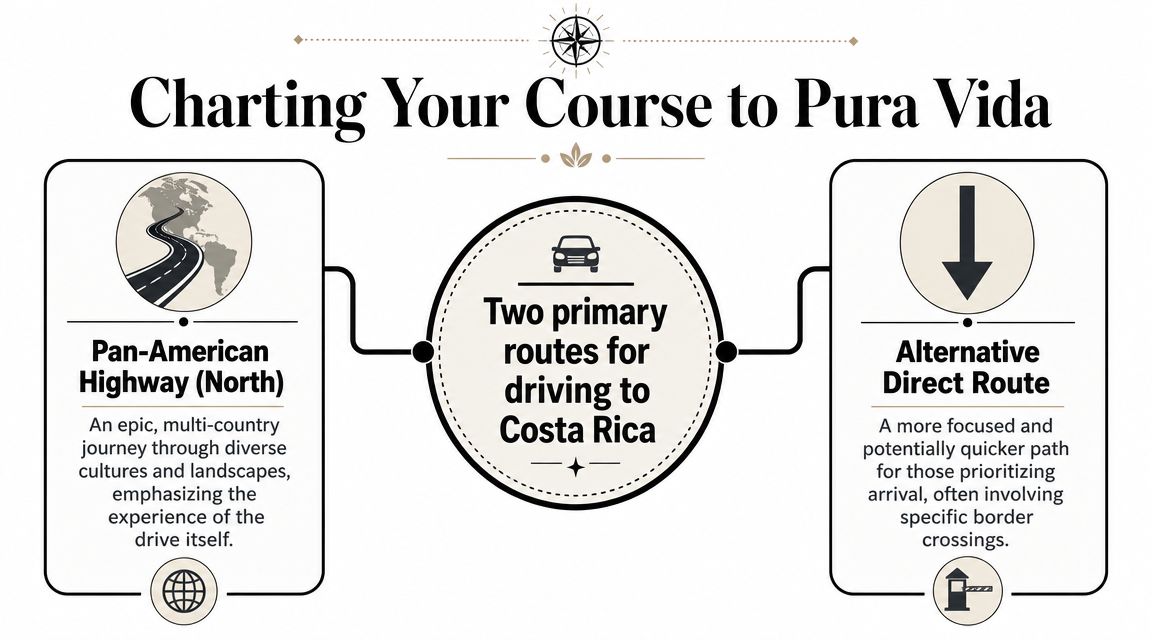
Most travelers are choosing between two very different approaches. One is the long overland run south through multiple borders, usually following the Pan-American corridor for much of the trip. The other is the short entry into Costa Rica from a neighboring country, usually Nicaragua or Panama.
The long northern route
The full overland route rewards people who want the journey itself. You get the changing food, weather, road conditions, and the satisfaction of bringing your own vehicle all the way down. It is the version people talk about for years afterward.
It is also the route where small planning mistakes keep showing up.
A late start in one country can put you at the next border after lunch, which is exactly when lines get slower and tempers get shorter. A hotel chosen only by distance can leave you on the wrong side of a city ring road the next morning. Border towns matter more than they look on Google Maps.
Practical route notes from driving to Costa Rica via the Pan-American Highway make the same case over and over. Pre-plan the route, keep paperwork organized, carry copies, use tools like iOverlander, and expect each crossing to run a little differently.
The shorter southern or northern entry
Coming in from Nicaragua or Panama is a different job. You are not managing a long chain of border systems. You are trying to hit one crossing cleanly, get through it without losing a full day, and arrive in Costa Rica with enough energy left to drive safely to your first stop.
That shorter entry usually makes more sense for travelers who already know they want time in Costa Rica, not a long overland build-up beforehand. It reduces the administrative load, but it does not remove it. A single rough crossing at Peñas Blancas or Paso Canoas can still eat hours.
I have found that this route rewards discipline more than ambition. Leave early, arrive with copies ready, keep your lodging flexible, and do not plan a long post-border drive unless you are comfortable finishing after dark if things go sideways.
Why the map keeps fooling people
Mileage is the wrong planning tool for this trip. Border hours, road condition changes, traffic near cities, and weather matter more than the number on the screen.
That gets more obvious the closer you are to Costa Rica. Mountain roads, slower secondary routes, and rain can turn a short-looking transfer into the biggest day of the week. The same judgment you would use on a scenic, stop-heavy road trip like a drive from Miami to Key West helps here, except Central America gives you less margin for bad timing.
Route planning works better when you ask practical questions instead of romantic ones. Where will you sleep before the border? Can you reach that stop well before dark? Is there fuel after the crossing if the process takes longer than expected? Those answers shape the trip more than the headline distance.
Route choice in plain terms
- Choose the long overland route if crossing countries is part of the reason you are going.
- Choose the neighboring-country entry if Costa Rica is the goal and you want fewer moving parts.
- Plan shorter driving days than you use at home if this is your first overland run through Central America.
- Build the route around border towns and overnight stops because that is where the trip is usually won or lost.
The Border Crossing Playbook
You can be having a great overland day, pull into a border zone before lunch, and still find yourself sweating over paperwork at 4 p.m. That is normal. The hard part of driving to Costa Rica usually is not the road itself. It is handling the handoff between countries without missing a stamp, a permit cancellation, or an insurance step that comes back to bite you later.
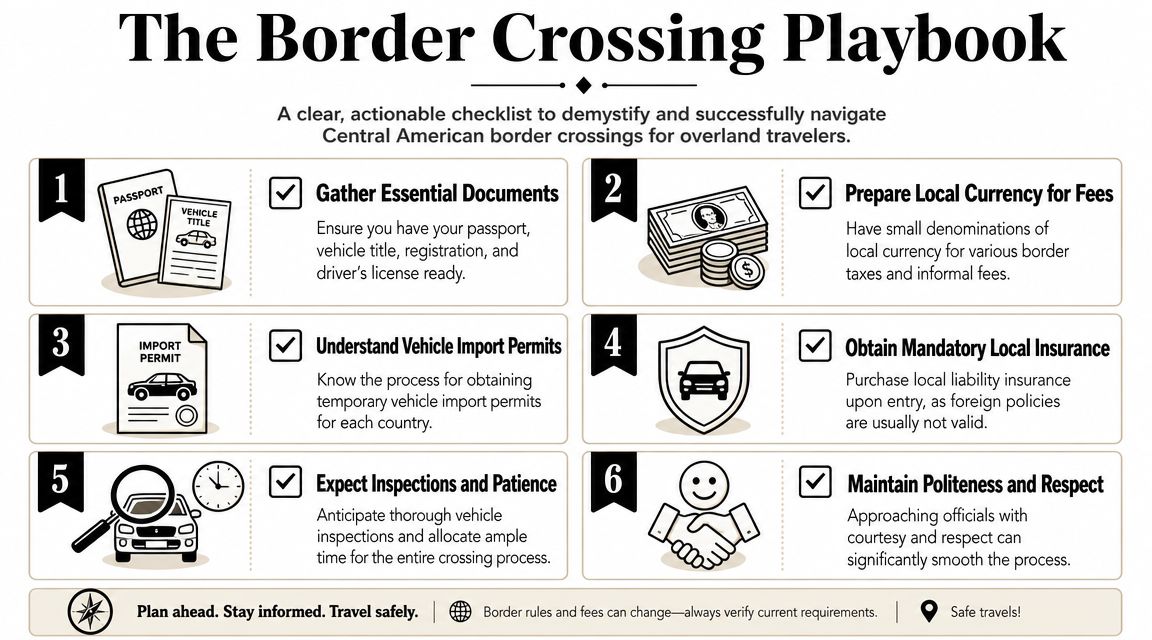
The piece travelers underestimate is the temporary vehicle import process. You are clearing yourself through immigration, and you are clearing the vehicle through customs. Those are related, but they are not the same line, not always in the same building, and not handled by the same official. Once you understand that, border days stop feeling random.
What you need before you roll up
Arrive with your paperwork sorted in a single folder, in the order you expect to use it. Digging through bags in a hot parking lot is how people lose time and miss details.
Keep these ready:
- Passport: Original, easy to grab.
- Driver's license: A valid home-country license is generally accepted for driving in Costa Rica, based on practical guidance on crossing into and driving in Costa Rica.
- Vehicle title or registration: Bring the original document you are permitted to present for border processing.
- Proof of insurance: Carry the policy documents you need for the next country, not just your home coverage.
- Copies of everything: Multiple paper copies still save headaches at many crossings.
If you financed the vehicle, borrowed it, or the name on the title does not match the passport of the driver, sort that out before the trip. Border officials care less about your story than your paperwork.
The order that usually keeps you out of trouble
The sequence changes a bit from border to border, but the workflow stays familiar. Exit the country you are leaving. Enter the next one as a person. Then import the vehicle.
A reliable rhythm looks like this:
Park where official processing starts
Take a minute to confirm you are in the right area before talking to anyone offering help.Close out the old vehicle permit if that country requires it
Skip this step and you can create a problem for yourself later, especially if the system still shows your vehicle inside the country.Handle exit immigration
Get stamped out first unless officials direct you otherwise.Handle entry immigration on the new side
Your passport status has to be legal before the vehicle paperwork makes sense.Process the temporary vehicle import
This is often the slowest part. Expect inspections, copies, and window-to-window movement.Buy local insurance if required
Do not assume your existing policy follows you across the border. A good travel insurance comparison for cross-border trips helps with the personal side of coverage, but vehicle requirements are usually separate and country-specific.
One practical habit helps a lot. Before leaving each desk, ask plainly, “Am I finished here?” and “What is the next office?” That sounds basic, but it prevents a lot of unnecessary backtracking.
Border days reward travelers who stay organized, answer clearly, and keep documents in one place.
What actually makes crossings easier
The best border strategy is boring. Arrive with daylight, have your documents ready, carry small cash, and keep the first stop after the crossing close enough that a delay does not turn into a night drive on unfamiliar roads.
That last point matters more than many route guides admit. A border can drain more energy than a full driving day because you are parked, waiting, watching your paperwork, and trying not to miss a step. Even a short drive after that can feel longer than it should.
What works:
- Arriving early enough to absorb delays
- Keeping your first post-border night nearby
- Having small-denomination cash for fees, copies, and routine purchases
- Treating every crossing as its own process, even when the countries are neighbors
What causes problems:
- Showing up tired, hungry, or already behind schedule
- Assuming the vehicle permit is automatic once your passport is stamped
- Letting a fixer rush you before you understand the official sequence
- Planning a long transfer after the crossing
The mindset that saves time
Method beats speed at borders. Keep your papers stacked, your answers short, and your vehicle keys where you can reach them if an inspection comes up. Check every document before you pull away, especially permit dates, plate numbers, and passport stamps.
I have seen travelers lose an hour because one digit on a plate number was wrong and they did not catch it until the next checkpoint. Border crossings punish sloppy detail. They usually go fine for drivers who stay patient and verify everything before leaving the lot.
Preparing Your Vehicle for the Journey
Your vehicle needs to be boring in the best possible way. It should start easily, stop straight, track cleanly, and carry your gear without turning every rough stretch into a mechanical drama. This is not the trip to postpone tire issues or hope a weak suspension “makes it one more month.”
The mechanical priorities
A pre-trip inspection should focus on the systems that fail badly when roads get rough or weather turns.
- Tires: Check condition, pressure discipline, and your spare.
- Brakes: You want confidence on long descents and wet pavement.
- Suspension: A tired suspension makes potholes and broken surfaces much worse.
- Lights and wipers: Visibility issues become a real safety problem fast.
- Cooling system: Slow climbs and stop-start border traffic expose weakness.
If your vehicle has any unresolved issue that affects steering, braking, or ground clearance confidence, fix it before departure. Overland optimism is not a repair strategy.
Gear that earns its place
Pack for simple roadside problems first. That usually matters more than packing for fantasy-level scenarios.
I'd prioritize:
- Paper document folder
- Offline maps plus Waze for in-country navigation
- Basic tool roll
- Tire repair and inflation setup if you use one
- Reflective warning gear
- Water and snacks for long border days
Insurance is part of vehicle prep too. Your home policy may not protect you the way you expect once you cross borders, so review it carefully and compare your options with a practical framework like this travel insurance comparison guide. The exact border insurance requirements vary, which is why document prep and country-specific verification matter before each crossing.
Renting usually isn't the real workaround
A lot of travelers assume they can skip the complexity by renting. For a multi-country overland trip, that usually falls apart fast. Cross-border rental restrictions often make the “easy” solution impossible or so limited that it no longer solves the problem.
If your goal is to drive to Costa Rica, this is usually a bring-your-own-vehicle journey, not a casual rental-car hack. That changes how you pack, budget, and think about maintenance. Your car isn't just transportation now. It's your access, your storage, and your margin for error.
Staying Safe on Costa Rican Roads
You clear the last border, get your paperwork back, and finally point the hood south. That's when a lot of drivers relax too early. Costa Rica is usually the easiest part of the trip emotionally, but it still demands full attention behind the wheel.
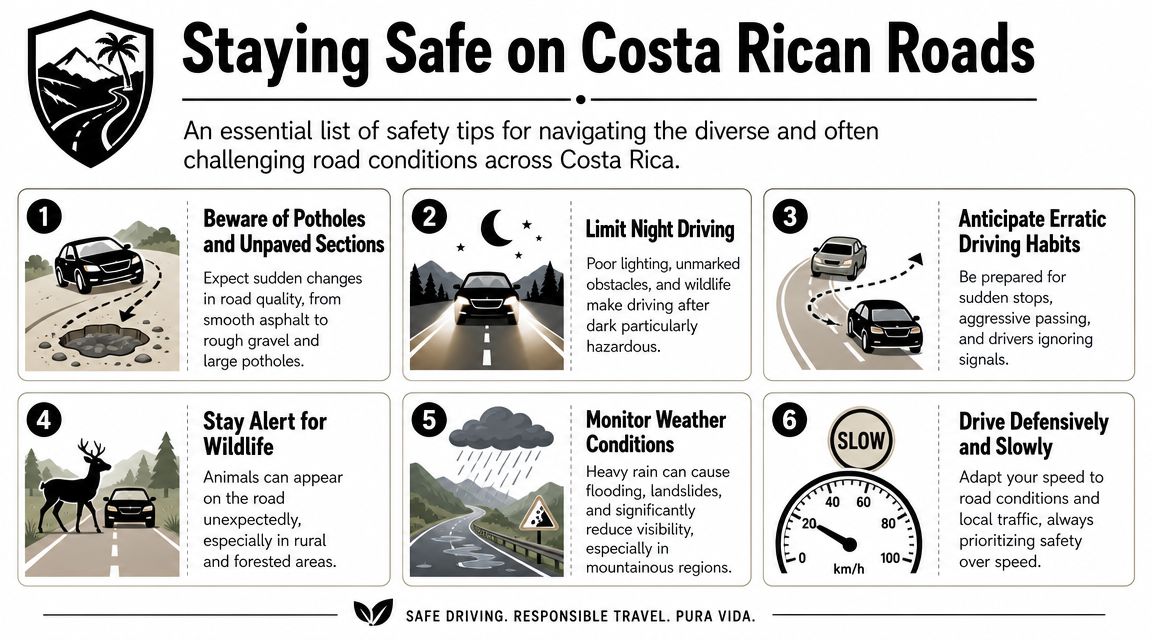
The first mistake I see is treating Costa Rica like the reward after the hard part. The border run through Central America teaches patience, document control, and timing. Costa Rican roads test something different. Line choice, speed discipline, and judgment when the road surface changes with no warning.
A route can look straightforward on the map and still turn technical fast. Pavement quality shifts. Shoulders disappear. Mountain curves stack up one after another. Rain cuts visibility hard, especially in the afternoon, and some trucks use more of the lane than you want them to. If you want a wider read on the risk profile, this guide on whether driving in Costa Rica is safe for travelers gives useful context.
What catches drivers off guard
The hazard isn't one dramatic obstacle. It's the constant need to adjust.
Outside the main urban corridors, expect narrow roads, inconsistent lighting, rough pavement, soft edges, and signs that appear late or not at all. Add motorcycles, buses, pedestrians, dogs, and slow agricultural traffic, often in places where you have very little room to react.
Night driving raises the difficulty quickly. I treat daylight arrival as a safety rule, not a preference. If a route starts slipping later than planned, I stop short and finish the next morning. That decision costs a night. It can save a bumper, a wheel, or a much worse problem.
Defensive habits that actually pay off
Good overland drivers usually do the same boring things well. Costa Rica rewards that.
Drive slower than the road seems to allow
A clear stretch can hide a pothole, a washed edge, or an oncoming truck cutting a blind curve.Leave extra following distance
You need room for abrupt stops, rough patches, and drivers who change pace without much warning.Set up early for turns and junctions
Signage can be easy to miss, and lane choices often come up faster than expected.Treat rain like a road condition change
Braking distances grow, visibility drops, and standing water can hide damage in the pavement.Assume every blind rise has company
A bus, cyclist, tractor, or dog can be waiting on the other side.
Local driving culture also takes a little time to read. You may see headlight flashes or hand signals from truck drivers. Sometimes they are helpful. Sometimes they are only part of that driver's plan. Use them as one input, not permission.
Rural trouble spots
River crossings still exist on some secondary routes, especially if you wander off the obvious corridors or head toward more remote beaches and mountain areas. If the water looks questionable, stop and assess it properly. Depth, bottom surface, current, and exit angle matter more than confidence. If you cannot verify those four things, turn around or wait for better information.
Tolls are the easy part by comparison. Keep small bills and coins where you can reach them without digging through the car. After a long international drive, tiny delays get expensive in attention. The safer move is to keep the cockpit organized and keep traffic flowing.
The right mindset after the border
Crossing into Costa Rica feels like you made it. In one sense, you did.
But the overland reality is that border stress and road stress are different jobs. At the border, the risk is delay. On the road, the risk is damage, injury, or getting stranded somewhere that turns a simple driving mistake into a full lost day. Stay patient, finish before dark, and drive like the next corner has a reason to surprise you.
Your Pre-Departure Checklist
The night before departure is where this trip usually gets won or lost. Not on the highway. Not at the Costa Rica border. In a hotel parking lot, a driveway, or a gas station where you finally notice the registration is buried under camping gear, the spare is jammed in by luggage, and your border paperwork is spread across three bags.
Get organized before the wheels start rolling. A drive to Costa Rica is a chain of border days, police checks, fuel stops, toll booths, and long stretches where a small mistake costs half a day.
Documents dossier
Keep every travel and vehicle paper in one folder that stays in the cab, not in the trunk under your gear. Border crossings move faster when you can put your hand on the right paper in seconds.
Carry:
- Passport and backup copies
- Valid driver's license
- Vehicle title or registration originals
- Printed copies of key documents
- Insurance paperwork
- A written list of your intended border sequence
That last item gets overlooked. It helps more than people expect. After several crossings, the days blur together, and it is easier to stay sharp when you already know your next border, your overnight stop, and which documents you will need first.
If you are traveling solo, your system needs to work one-handed and under pressure. You may need to lock the vehicle, step to a window, return for a paper, and move again without turning the cabin upside down.
Vehicle readiness
Prep the vehicle for delays, not just miles. A car that feels fine at home can become a problem fast when you are idling in heat at a border, driving rough detours, or arriving late to a town with limited services.
Check these before you leave:
- Fuel up before long or remote stretches
- Check tire condition and spare access
- Test lights, wipers, and brakes
- Pack water where you can reach it fast
- Keep some cash ready for tolls and road expenses
Cash still solves small problems quickly. Keep small bills and coins where you can reach them without opening your main wallet at every stop. As noted earlier, Costa Rican tolls are usually straightforward, but the bigger lesson applies across the whole route. Easy-access cash keeps lines moving and your attention on traffic instead of on digging through bags.
If your route could include river crossings or washed-out side roads, add one more line to your checklist. Stop and inspect before committing the vehicle. Confidence does not tell you water depth, bottom surface, or exit traction.
Solo and budget traveler notes
Budget travel on this route works best when it protects your margin for error. Saving money is useful. Saving money by arriving after dark, running low on fuel, or skipping a needed overnight stop usually backfires.
A few habits help:
- Offline maps first: Don't depend on signal at the exact moment you need a turn.
- Cash strategy: Keep small amounts separated, not all in one wallet.
- Arrival discipline: Don't stretch a day just to save one night's lodging.
- Simple spending plan: Budgeting early helps avoid bad decisions made to push through.
If you want to trim costs without making the trip harder, these money-saving road trip tips that actually work in 2025 fit well with an overland run because they focus on reducing waste and avoiding expensive mistakes.
The final check is simple. If your papers are sorted, your vehicle is easy to service on the roadside, and your route has slack built into it, you are in good shape. That is usually the difference between a long border day that stays manageable and one that wrecks the schedule.
Travel planning gets easier when the advice is practical and grounded in how people move through the world. For more smart, budget-aware trip ideas and planning guides, visit Travel Talk Today .