You're probably staring at photos of ash plumes at sunrise, wondering if Volcán Santiaguito is one of those rare places that's both spectacular and doable on a backpacker budget. It is spectacular. “Doable” depends on how honest you are about risk.
Santiaguito isn't the kind of volcano where casual bravado makes the story better. It's the kind where distance, timing, and local judgment matter more than fitness or nerve. A lot of online content sells it like a dramatic hike with a big payoff. The situation is more serious. This is a living volcanic system with sudden behavior, changing conditions, and a long record of destructive activity.
That's why the smartest approach to Volcán Santiaguito Guatemala isn't asking whether it's worth visiting. It's asking how to see it safely, respectfully, and without letting tourist hype override common sense.
Witnessing the Power of a Living Volcano
The first time most travelers see Santiaguito erupt from a safe vantage point, the reaction is the same. Silence, then a fast reach for the camera, then the delayed realization that what looked cinematic from town is much more violent when you're watching the mountain breathe ash into the sky.
That tension is what makes this place unforgettable. It's beautiful, but not gentle. It feels close, but it isn't approachable in the casual sense many travel blogs imply.
A lot of coverage treats Santiaguito as a photogenic outing. That misses the most important truth. It's a dome complex that has been growing since the 1920s, and for many travelers the most realistic and responsible experience is distance-based observation from Santa María, not trying to get near the active area, as noted in this overview of Santiaguito travel perspective and safer observation.
The best volcano experiences aren't always the closest ones. Sometimes the smart choice gives you the better memory anyway.
If you care about meaningful adventure, this is one of those trips where restraint is part of the experience. You go to witness power, not to prove something. That mindset leads to better decisions on the trail, better interactions with local guides, and usually better photos too.
For travelers who want something deeper than a checklist stop, this sits firmly in the territory of authentic travel experiences that change how you see a place. Santiaguito rewards patience, respect, and a willingness to let the mountain set the terms.
Understanding Santiaguito's Fiery Personality
Santiaguito makes more sense once you stop picturing a classic volcano cone. It isn't one.

It formed after the catastrophic 1902 Santa María eruption and began erupting in 1922, developing into a complex of lava domes rather than a single summit. Since 1977, activity has been concentrated at the Caliente dome, which is one reason it's treated as a high-threat volcano in Guatemala, according to this history of Santiaguito's formation and persistent activity.
What that means on the ground
If you've hiked other volcanoes in Central America, Santiaguito can trick you into applying the wrong model. A big cone often encourages a simple question: active or inactive today? Santiaguito doesn't work like that.
Its behavior is better understood as continuous but pulsed. Gas, ash, extrusion, collapses, and explosive bursts can all be part of the pattern. That means a quiet-looking moment doesn't prove safety. It may only mean you're between pulses.
The practical hazards people underestimate are usually these:
- Rockfalls and avalanches from unstable material on the dome
- Ash and gas bursts that can change the feel of the area quickly
- Pyroclastic density currents that move fast and aren't something a hiker can outsmart
- Rainy season lahars in drainage channels below
Why distance matters more than courage
A lot of backpackers are comfortable with steep trails, loose footing, and pre-dawn starts. None of that prepares you for volcanic collapse behavior. Physical fitness helps on Santa María. It doesn't make proximity to Caliente a smart choice.
Here's the mental model that works better: you are not visiting a landmark. You are observing an active system that keeps changing shape.
Practical rule: If your plan depends on “it should be fine if activity stays calm,” your plan is already weak.
That's why the safer viewpoint strategy isn't boring or overly cautious. It matches the geology. Once you understand what Santiaguito is, the responsible way to experience it becomes obvious.
Safe Viewing Options and Sample Itineraries
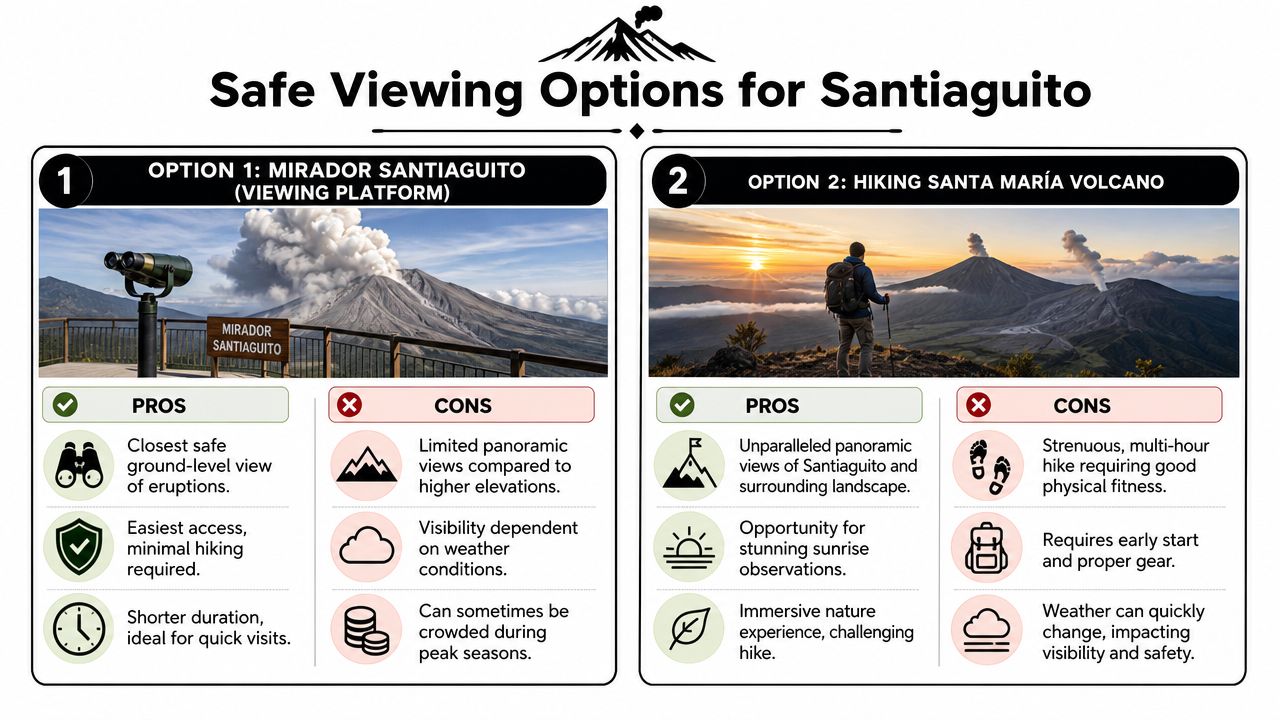
There are two broad ways travelers usually think about seeing Santiaguito. One is the ground-level viewpoint approach. The other is the higher, more demanding hike on Santa María. The right choice depends less on ambition and more on weather, fitness, and whether you're willing to prioritize safety over proximity.
Option one, a lower-effort viewpoint
For some travelers, a designated mirador-style stop is the better fit. It requires less output, less exposure time on the trail, and less pressure to “summit” anything. If visibility is good, you still get the core experience: watching an active volcano from a safer remove.
This option works well for:
- Budget travelers on a tight schedule who can't dedicate a full hiking day
- Photographers scouting conditions before committing to a bigger outing
- People unsure about altitude or fitness who want a lower-risk first look
The trade-off is that the panorama is usually less dramatic than what you'll get from higher up on Santa María.
Option two, the Santa María viewpoint approach
For most independent travelers, this is the strongest choice. You hike Santa María in the dark, reach the viewpoint area around sunrise, and watch Santiaguito from a distance that is both humbling and far more sensible than trying to push closer.
A typical rhythm looks like this:
- Leave Xela very early. Most groups start well before sunrise.
- Climb in the dark with a headlamp. The trail effort is real, especially if you arrived in town recently.
- Reach the upper viewpoint area at first light. This is when the surroundings become visible and the volcano starts to feel alive in a very different way.
- Wait. Patience matters. Eruptions don't perform on command.
Official monitoring has reported explosions at roughly 1 to 2 per hour with ash-and-gas columns reaching about 800 meters above the dome, and authorities also highlight sudden rockfalls and pyroclastic flows as primary dangers in the area, which is why staying outside the exclusion zone matters, as summarized in this report on the reaffirmed Santiaguito ascent prohibition and hazard profile.
What works and what doesn't
A simple comparison helps.
| Approach | What works | What doesn't |
|---|---|---|
| Santa María viewpoint | Best combination of drama, perspective, and responsible distance | Underestimating the hike or showing up without layers |
| Ground-level viewing area | Easier logistics and less physical strain | Expecting the same panoramic reward as higher elevation |
| Trying to get closer to active zones | Nothing worth recommending | Treating closure lines as suggestions |
If you want the strongest memory, pick the option that lets you stay calm enough to actually observe. Fear, rushing, and bad positioning ruin the experience faster than distance does.
A sample day that makes sense
A solid backpacker plan is simple: sleep in Xela, organize transport and guide details the day before, start early, carry enough water and warm layers, and treat visibility as a bonus rather than a guarantee. If cloud cover closes in, don't chase a view by making riskier choices.
That's the right mindset for Volcán Santiaguito Guatemala. You don't conquer this one. You position yourself well and let the mountain decide what you get to see.
How to Choose a Reputable Local Guide
A good Santiaguito guide does more than lead the trail. They filter noise, read conditions, and make the call when a plan needs to change.
That matters because public information around the volcano is messy. Official monitoring exists, but tourist advice online often lags behind conditions or turns into rumor. The strongest guides bridge that gap. They know what local observers are seeing, what routes are sensible that day, and when a viewpoint plan should be cut short or canceled.
Authoritative monitoring includes a dedicated INSIVUMEH observatory near the volcano, while public-facing information can be inconsistent and anecdotal. That gap is exactly why travelers benefit from someone who can interpret day-of risk, especially when reported eruption timing can vary from every 15 minutes to every few hours, as described in the listing for the INSIVUMEH Santiaguito observatory and monitoring context.
Questions worth asking before you book
Don't overcomplicate this. Ask direct questions and pay attention to whether the answers sound practiced, calm, and safety-focused.
- What do you check before departure? A strong guide should mention current conditions, local reports, and visibility, not just trail logistics.
- What makes you turn back? You want a clear answer. Hesitation here is a bad sign.
- Where will we view from? If the language sounds like “getting as close as possible,” keep looking.
- How do you handle solo travelers? Good operators should have a normal process for this, especially for women traveling alone.
- What gear do you expect me to bring? Serious guides usually care about footwear, lights, layers, and water.
Green flags and red flags
Use common sense, but be picky.
Good signs
- A calm safety briefing before departure
- Clear route expectations
- No macho language about risk
- Willingness to cancel or reroute
- Consistent communication in English or Spanish you can follow
Warning signs
- Mocking official restrictions
- Promising “guaranteed eruptions”
- Pressuring you to decide fast
- Bragging about getting around closures
- Dismissing your questions as overcautious
The guide you want sounds more like a mountain professional than an adrenaline salesperson.
If your Spanish is basic, it's worth brushing up on key trail and safety language before you go. Even a small amount helps you ask better questions and understand briefings. This primer on learning Spanish in Guatemala for practical travel is useful for that.
Your Trip Planner Timing Weather and Packing
Santiaguito rewards early starts and realistic packing. If you get either wrong, the day becomes harder than it needs to be.
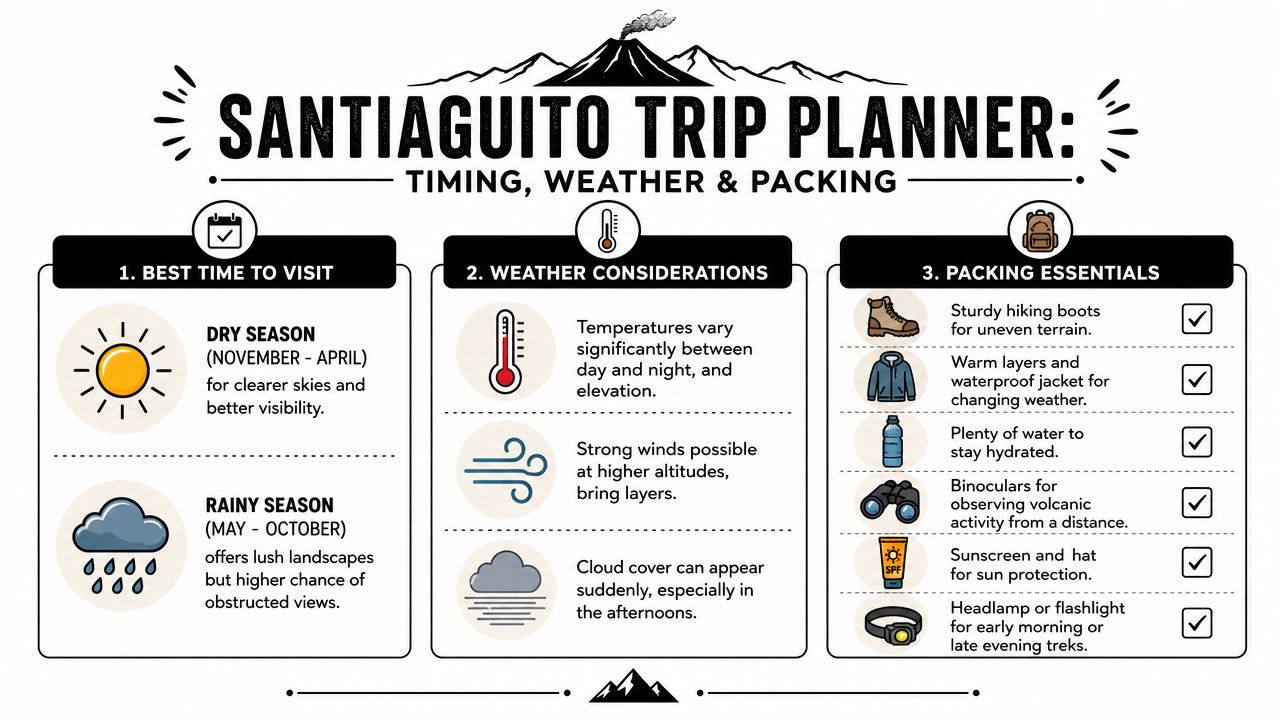
Timing that gives you the best chance
Most travelers prefer the dry season from November to April because skies are often clearer and views are more reliable. Even then, the key move is starting early. Morning usually gives you the cleanest visibility and the nicest light, while later hours often bring cloud buildup that can erase the whole show.
If you're visiting in wetter months, the scenery can be greener and moodier, but flexibility matters more. Don't build an itinerary that leaves no room for weather delays or a changed plan.
What to wear and carry
Here, people either make the hike smooth or miserable.
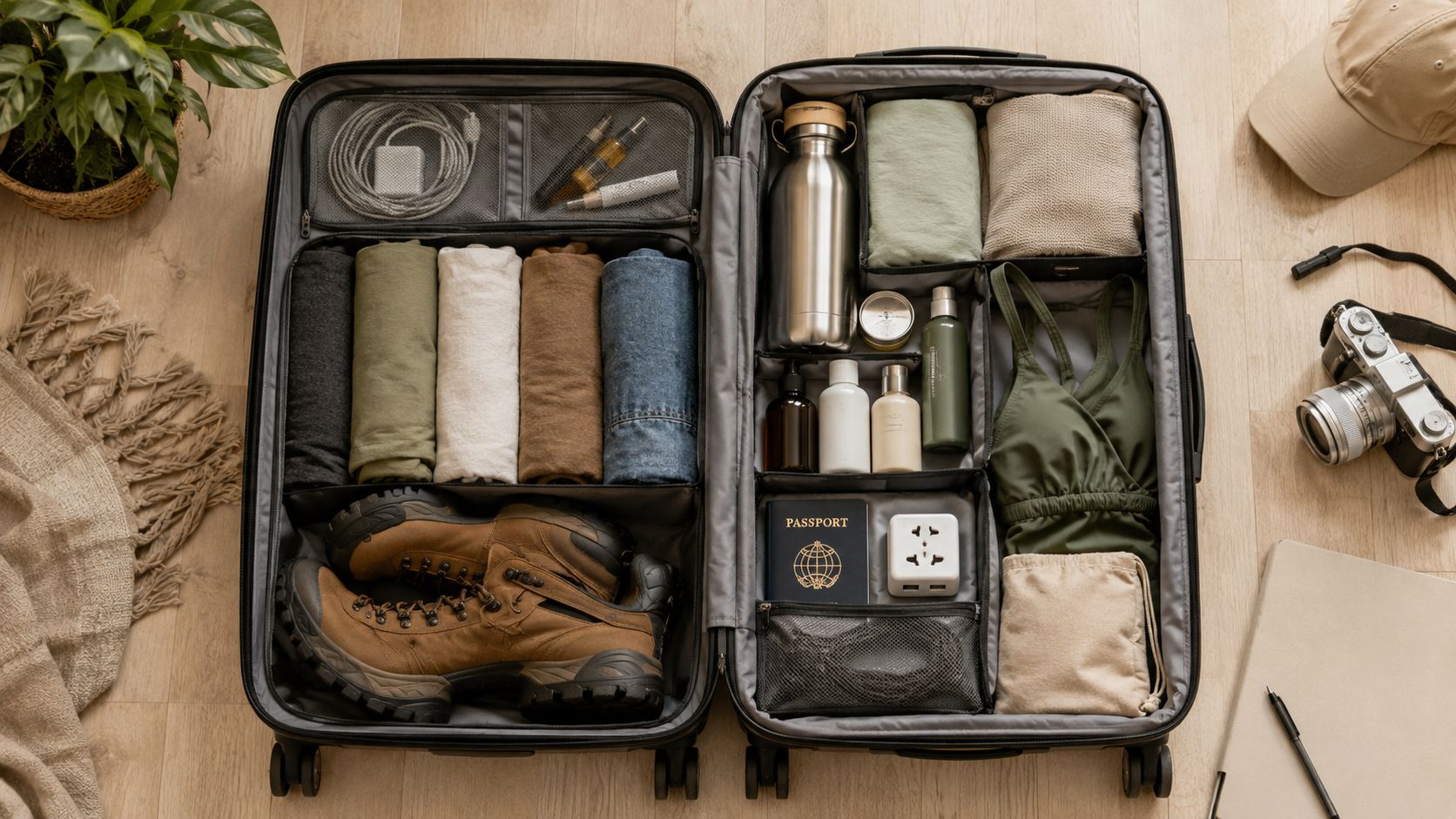
- Footwear first. Wear actual hiking shoes or boots with grip. Loose trail sections punish casual sneakers.
- Use a layer system. Pre-dawn starts can feel cold, then the climb heats you up fast.
- Bring enough water. The mountain doesn't care that you only packed one small bottle.
- Carry a headlamp. Your phone flashlight is backup, not your plan.
- Pack sun protection. Once the sun is up, exposure can feel intense.
- Add a waterproof shell. Conditions can shift quickly.
A compact checklist helps, especially if you're traveling light. This backpacking essentials checklist is a smart baseline, then you can add volcano-specific items like extra layers and a dust-conscious buff or face covering.
Photography without bad decisions
Santiaguito is one of those places where camera choices can affect safety. People chase a tighter shot, drift too far, or stop paying attention to terrain because they're locked into the screen.
A better setup is simple:
- A zoom lens beats trying to get physically closer
- A tripod helps at dawn
- A lens cloth matters if ash or mist is in the air
- Keep one eye on the volcano, not only the camera display
The strongest images usually come from patience, stable framing, and good light. Not from pushing your position.
If you're shooting sunrise from Santa María, pack for the cold wait at the top, not just for the climb itself. That's the moment many people get wrong.
Travel with Respect and Sustainability
Santiaguito isn't just a dramatic setting. It's part of people's daily reality. Communities live with its risks, guides work around its moods, and local knowledge isn't some optional add-on for tourists. It's part of how this place is approached responsibly.

That's why good volcano travel starts with a simple rule: don't act like the mountain exists for your content. Stay on established routes, listen when local people tell you conditions have changed, and pack out everything you carried in. Banana peels, snack wrappers, wipes, broken gear, all of it.
Small choices that matter
Responsible travel here isn't abstract. It looks like this:
- Hire local when you can. Money spent on local guides and transport stays closer to the community.
- Buy nearby. Snacks, breakfast, and small supplies from Xela or local stops do more good than bringing every detail from a chain store.
- Respect closures. Ignoring restrictions doesn't make you adventurous. It makes you a burden if something goes wrong.
- Keep the trail clean. The standard is simple. Leave less than you found.
Safety and sustainability are linked
People often separate personal safety from responsible tourism. On Santiaguito, they're tied together. Travelers who respect local systems usually make better risk decisions. Travelers who chase shortcuts often ignore both safety and impact at the same time.
If that broader approach matters to you, these sustainable travel tips for lower-impact trips fit this kind of destination well.
Respect isn't soft. On volcano trips, it's a practical skill.
Frequently Asked Questions About Visiting Santiaguito
Is Santiaguito safe to visit
It can be visited more safely when you choose a responsible viewing plan, use a reputable local guide, and accept that some days are not appropriate for going. What isn't safe is treating it like a normal summit objective or ignoring restrictions because the weather looks good for the moment.
Its history explains the seriousness. The volcano's record includes the 1983 lahar that destroyed El Palmar, an eruptive event associated with more than 5,000 deaths, and 86 strong explosions in 2016 reported by CONRED, all of which underline why closures and warnings matter, according to this summary of Santiaguito's destructive history and ongoing eruptive activity.
Is it a good trip for solo female travelers
Yes, with the usual mountain common sense and a strong guide or group setup. The main issue here isn't urban solo travel risk. It's route judgment, communication, and day-of conditions. Book with operators who answer questions clearly and don't use macho sales language.
Do I need to acclimatize
Many travelers feel fine, but some definitely notice the elevation around Xela and on the hike. If you've just arrived in Guatemala, give yourself a little time if possible. Hydrate, sleep properly, and don't schedule your hardest outing on the same day you arrive from a long transfer.
What if the volcano is too active or visibility is bad
Then you don't force it. This is the trip where flexibility is part of the cost. Build your schedule so you can move the hike, swap to a different activity, or accept that the volcano gave you clouds instead of a performance.
Is the Santa María viewpoint better than trying to approach Santiaguito
For most travelers, yes. It's the more realistic combination of spectacle and judgment. You still get the scale, the eruptions, and the emotional impact, but without pretending that closer automatically means better.
What should I do if I start feeling unwell on the hike
Say it early. Don't try to “push through” altitude discomfort, dehydration, or anxiety just because the group is moving. Good guides would rather adjust early than deal with a bigger problem higher up. For a useful baseline on staying functional while moving through demanding trips, this guide on how to stay healthy while traveling covers the habits that matter.
Is this a good destination for photographers
Absolutely, if you like working with distance, patience, and changing light. It's less about dramatic proximity and more about timing, atmosphere, and reading the scene. Bring gear that helps you stay where you should be, not gear that tempts you into bad positioning.
Travel well, pack light, and make room for places that deserve your full attention. Travel Talk Today shares practical guides for travelers who want safer adventures, smarter budgets, and deeper experiences than a rushed itinerary can offer.