Let's be honest—the biggest hurdle between you and that dream destination is often the price of the flight. But what if I told you that snagging an incredible deal isn't about luck? It's about having the right game plan.
Forget the old myths about booking on a Tuesday or searching incognito. Real, repeatable savings come from a blend of smart timing, a little flexibility, and knowing exactly where to look. I've spent years mastering this process, and I'm here to show you how to turn your travel dreams into your next boarding pass.
Your Game Plan for Finding Cheaper Flights
Ready to make your travel budget go further than you ever thought possible? The world is out there waiting, and getting there is more achievable than you might think. This entire guide is built on four powerful strategies that consistently unlock the best fares.
- Timing Your Purchase: We’ll dive into the booking windows that almost guarantee a better price.
- Smarter Search Techniques: I’ll show you the tricks to uncover hidden fares most travelers miss.
- Playing the Points Game: We'll explore how loyalty programs can drastically cut—or even eliminate—the cost of your flights.
- Dodging Annoying Fees: Learn how to keep your final price low by sidestepping those extra charges for bags and seats.
To give you a bird's-eye view of what's to come, here's a quick look at the core pillars of our flight-saving strategy.
Core Flight Savings Strategies at a Glance
This table breaks down the four key areas we'll be focusing on. Think of it as your cheat sheet for every time you start planning a trip.
| Strategy Pillar | Key Action | Potential Savings |
|---|---|---|
| Timing & Tracking | Booking within the "prime booking window" and setting price alerts. | 15-25% |
| Search & Booking | Using flexible dates, nearby airports, and multi-city searches. | 20-50% |
| Loyalty & Rewards | Earning and redeeming points/miles from airlines and credit cards. | 50-100% |
| Fees & Baggage | Packing light and understanding airline-specific fee structures. | $50-$150+ per trip |
Mastering these four areas is the foundation for becoming an expert at finding affordable flights. Now, let's look at the bigger picture.
Why You Should Be Optimistic About Flight Costs
It's easy to get discouraged when you see prices jump around, but I want to share a piece of data that should give you a major dose of optimism. While it feels like the cost of everything is soaring, air travel has actually become a fantastic bargain over the long run.
For instance, when you compare average airfares from February 2026 to those from a decade prior in February 2016, U.S. ticket prices have actually decreased by 1.0%. That's pretty amazing on its own, but it's staggering when you consider that prices for all other consumer items shot up by 37.4% during that same period.
This trend sends a powerful message: cheap flights are out there, waiting to be found. Your mission, should you choose to accept it, is simply to learn the proven methods for finding them again and again.
The Right Tools for the Job
Throughout this guide, I’ll point you to the best online tools and apps that do the heavy lifting for you. Marrying these powerful resources with the right strategy is the fastest route to saving money. For a deeper dive, check out our guide on the best travel apps that can help you manage everything from booking to boarding. Your next adventure is just one smart search away.
Master the Art of Perfect Timing
Let's start by debunking a common myth: there's no magic day of the week to find cheap flights. Forget the old advice about booking on a Tuesday at midnight. Airline pricing is a complex, constantly shifting beast driven by real-time demand, and the real key to saving is understanding the booking window.
This is that sweet spot in time when airlines are most likely to offer the lowest prices for a particular flight. For trips within the country, you’ll want to start looking seriously about 1 to 3 months before you plan to leave. For a bigger international journey, give yourself a longer runway—aim to book anywhere from 2 to 8 months out. Book too early or leave it to the last minute, and you’ll almost always pay more than you have to.
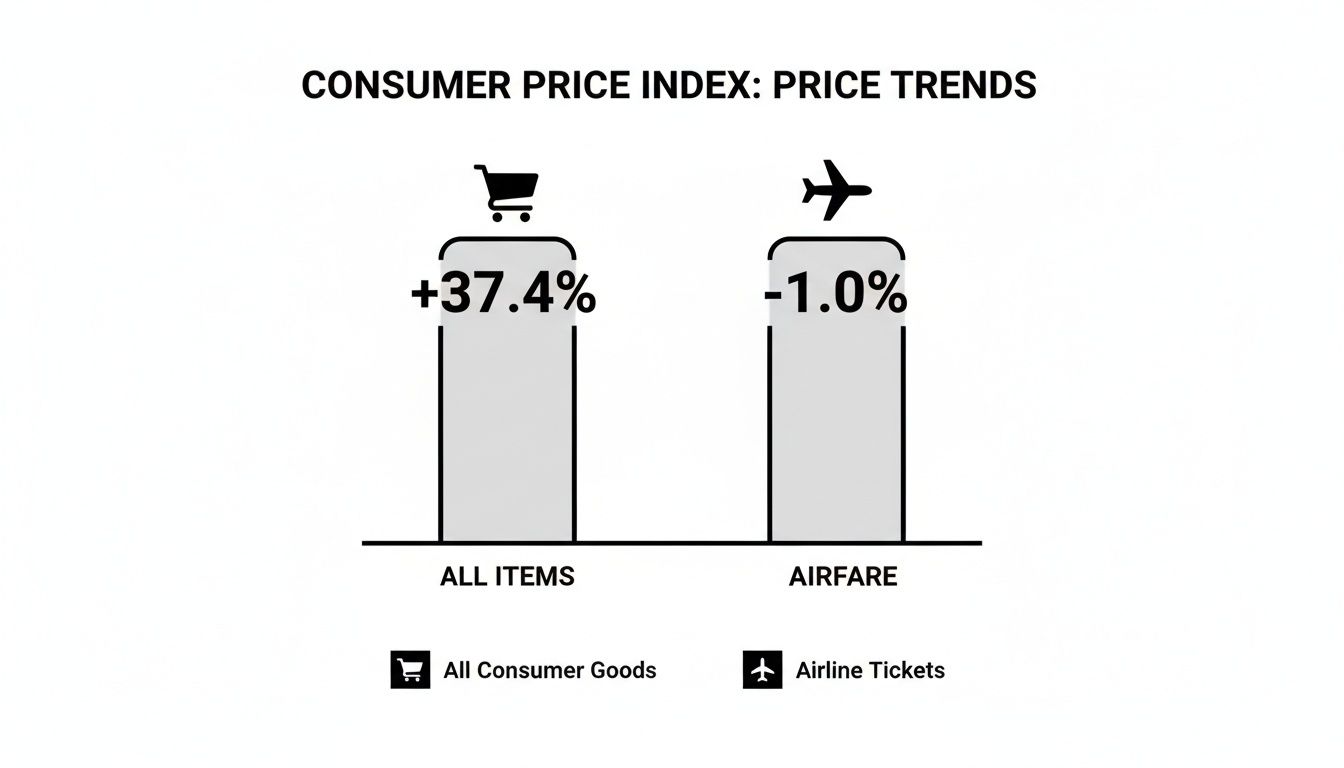
While the cost of nearly everything else has climbed, this data shows that airfare has actually held steady or even dropped. It’s a powerful reminder that amazing deals are out there if you know when and how to look.
Ride the Seasonal Waves
Beyond the booking window, the single biggest factor affecting flight prices is the time of year you travel. Prices swing wildly with the seasons, creating predictable pockets of opportunity for those in the know. The strategy is simple: fly when others aren't.
Fall, for instance, is a goldmine for bargains. Once the summer vacation rush dies down, airlines often slash prices. You can find fares dropping by as much as 32% in September and October. The same thing happens after the holidays, with January and February offering fares that are often 30% lower than peak season.
Of course, this also means you need to be aware of the peak times. The chaos from mid-December to early January, along with the prime summer months of June through August, will almost always be the most expensive times to get on a plane.
To help you visualize these patterns, here's a breakdown of what to expect throughout the year.
Seasonal Flight Price Trends
| Season | Typical Price Level | Best Time to Book | Notes for Travelers |
|---|---|---|---|
| Spring (Mar-May) | Moderate | 2-4 months out | Shoulder season. Prices are decent before the summer spike. Watch for Spring Break price hikes. |
| Summer (Jun-Aug) | Peak | 4-8 months out | The most expensive season. Book as early as possible and be flexible with your dates. |
| Fall (Sep-Nov) | Low | 1-3 months out | Often the cheapest time to fly. Demand is low, and deals are everywhere, especially after Labor Day. |
| Winter (Dec-Feb) | Varies (High/Low) | 3-6 months out | December is peak-priced. January and February are incredibly cheap. Avoid holiday travel for the best deals. |
Thinking in seasons, rather than specific dates, can fundamentally change how you plan and save on travel.
I once saved a fortune on a trip to Italy just by shifting my dates. My initial plan was to go the first week of September, with flights costing around $950. Out of curiosity, I checked prices for just two weeks later, and the exact same route dropped to $620. That’s a $330 savings simply for waiting until the summer crowds were truly gone.
Let Technology Do the Heavy Lifting
Thankfully, you don't have to spend hours every day manually searching for the perfect fare. This is where you let technology become your secret weapon. Setting up price alerts is an absolute must for any traveler serious about saving money.
Tools like Google Flights and Skyscanner are brilliant for this. You can tell them the route you want to fly, and they’ll send you an email the second the price goes up or down. It’s like having a personal travel agent who works for free, 24/7. This lets you watch the trends effortlessly and pounce when the price hits a number you’re happy with.
Ready to put this all together? Here’s how to make it happen for your next trip.
- Pinpoint Your Ideal Timeframe: Start with the dates you want, but build in a little wiggle room. Even a few days of flexibility can unlock huge savings.
- Identify the Prime Booking Window: Based on whether your trip is domestic or international, figure out that 2-3 month stretch when prices are historically at their best.
- Set Up Smart Price Alerts: Head over to your favorite flight search engine and set up alerts. Don't just track your perfect dates; create a second alert with the "flexible dates" option to catch unexpected deals.
- Watch, Wait, and Act: Now, just let the notifications roll in. When you get an alert for a price that looks like a great deal compared to the average, you’ll know it’s time to book with confidence.
By blending savvy timing with smart technology, you’re no longer just hoping for a deal—you’re actively making one happen. For an even more in-depth look at this strategy, check out our complete guide on the best time to book flights.
Time to Master the Art of the Advanced Search
Alright, let's move beyond the basics. A simple A-to-B search will get you a standard, run-of-the-mill price. But if you want to find the kinds of deals that make your friends ask, "How did you do that?", you have to start thinking differently. It’s all about being flexible and using the search engine’s best features to your advantage.
The real magic happens when you stop telling the search engine exactly what you want and instead ask it, "What have you got for me?" This opens up a world of possibilities and fares you would have never seen with a rigid search.
Let Your Calendar Guide You to Cheaper Fares
One of the most powerful moves you can make is to search with flexible dates. Forget locking yourself into one specific day. Tools like Google Flights and Skyscanner have brilliant calendar views that show you prices across an entire month, or even help you pinpoint the "cheapest month" of the year to fly.
Instead of plugging in "October 15th," search for the whole month. You'll get a beautiful, color-coded calendar or chart that instantly shows you the cheap days (green) and the pricey ones (red). It takes all the guesswork out of it.
Here’s a peek at what Skyscanner’s "Whole month" view looks like—it’s a game-changer.
This visual layout immediately reveals the pricing landscape. You’ll be amazed at how shifting your departure by just a day or two can sometimes save you hundreds of dollars. It’s all about spotting those little dips in the pricing pattern.
This works so well because airfare is constantly in flux. We see significant price swings from week to week and month to month, creating little windows of opportunity. For example, in early 2026, airfares jumped 3.5% between January and February alone. By keeping an eye on these trends with flexible date tools, you can learn to pounce when the prices drop. OAG's industry analysis often highlights these volatile trends.
Think Outside the Main Airport
Here’s another simple trick I use all the time: always check nearby airports. Major metro areas are often served by more than one, and the price difference can be staggering. Budget airlines, especially, love to use smaller, secondary airports to keep their own costs down—and those savings get passed directly to you.
When you're searching on Google Flights, you can pop in multiple airport codes at once. Flying to London? Don't just search for Heathrow (LHR). Add Gatwick (LGW), Stansted (STN), and Luton (LTN) to your search.
I once saved over $200 on a flight to the Washington, D.C. area by choosing to fly into Baltimore (BWI) instead of Reagan (DCA). The one-hour train ride into the city was a tiny inconvenience compared to the massive savings.
It’s a tiny adjustment that takes just a few seconds but can make a huge difference to your bottom line.
Get Creative with Your Itinerary
Who says you have to fly back from where you started? Booking a multi-city (or "open-jaw") ticket is one of my favorite ways to build a better, and often cheaper, adventure. You simply fly into one city and fly home from another.
This is the perfect strategy for any trip where you plan on traveling over land.
- A Classic Europe Trip: Fly into London, take the train to Paris, and then fly home from Paris. No backtracking, no wasted time.
- A Southeast Asia Backpacking Route: Fly into Bangkok, make your way through Cambodia and Vietnam, and then fly out of Ho Chi Minh City.
Booking this as a single multi-city ticket is almost always cheaper than buying two separate one-way flights. If you're looking for more ways to build smart itineraries, you’ll find some great ideas in our ultimate guide on how to find cheap flights.
For the Bold: The High-Risk, High-Reward Tactics
If you're truly flexible and feeling a bit daring, there are some more advanced—and riskier—strategies you can explore.
One of these is "hidden city" ticketing, sometimes called skiplagging. The idea is to book a flight with a layover in the city you actually want to visit. For example, a flight from New York to Orlando with a layover in Charlotte might be cheaper than a direct flight to Charlotte. You would just get off the plane in Charlotte and skip the final leg of the journey.
Be warned: this is a serious gamble.
- Airlines absolutely hate this practice. They can cancel your return flight without a refund or even ban you from their frequent flyer program.
- You can't check a bag. It will be tagged through to the final destination on your ticket.
- If the airline has to reroute your flight due to weather or mechanical issues, you might bypass your intended layover city entirely.
This is a strategy for seasoned travelers who know exactly what they're getting into and are willing to accept the consequences if things go wrong. Proceed with caution.
Using Points and Miles to Fund Your Travels
So far, we’ve covered some great ways to chip away at the cost of a flight. But this is where the game truly changes. What if I told you the cheapest flight is the one you get for free?
Welcome to the world of points and miles. It might sound like something reserved for globetrotting executives, but it’s more accessible than you’d ever imagine. The real secret isn't flying more—it's being smarter with your everyday spending.
Understand the Two Types of Travel Points
First things first, let's break down the two main kinds of points you'll encounter. Getting this right is the foundation of a powerful, money-saving travel strategy.
Airline Miles: These are the loyalty points you earn directly from an airline, like Delta SkyMiles or United MileagePlus. They're great if you're loyal to one airline, but they can be pretty limiting when you want to shop around.
Flexible Credit Card Points: This is where the real magic is. Points from programs like Chase Ultimate Rewards, American Express Membership Rewards, or Capital One Miles are the ultimate travel currency. Their superpower is flexibility; you can transfer them to a whole roster of different airline and hotel partners.
This versatility is your biggest advantage. You’re no longer stuck with one airline’s schedule or award availability. Instead, you can find the best flight deal out there and simply move your points to whichever airline offers it.
Think of a stash of flexible points as a universal key to the travel world. If you find a fantastic award flight on Air France, you can send your Chase or Amex points over. See a better deal on British Airways? No problem, you can send them there instead. You always have options.
Earning Points Without Flying an Inch
Believe it or not, the fastest way to build a huge balance of points isn’t by flying at all. It’s through credit card sign-up bonuses. Travel rewards cards often come with huge welcome offers after you spend a certain amount in the first few months.
A single sign-up bonus of 50,000 to 100,000 points can easily be enough for a round-trip ticket across the country, or even an international flight. You earn these points by putting your normal, everyday spending—groceries, gas, bills—on the new card until you hit the minimum spend. For a closer look at the best cards out there, explore our in-depth guide to travel rewards credit cards.
Just remember the golden rule: this only works if you pay your credit card balance in full every single month. Any interest you pay will instantly erase the value of the rewards you’ve earned.
Get to Know the Airline Alliances
Even when you’re dealing with miles from a specific airline, you’re not as locked in as you might think. Most major airlines belong to one of three global alliances, which let you book flights on partner airlines using your miles.
The three main alliances are:
- Star Alliance: Home to United, Lufthansa, Singapore Airlines, Air Canada, and dozens more.
- oneworld: Connects American Airlines, British Airways, Cathay Pacific, Qantas, and others.
- SkyTeam: Includes Delta, Air France, KLM, Korean Air, and their partners.
What does this mean for you? It means your United miles aren't just for flights on United—you could use them to book a trip to Germany on Lufthansa. Your American Airlines miles could land you a seat on a Japan Airlines flight to Tokyo. This network opens up a world of possibilities and makes your miles incredibly more valuable.
Don’t Overlook the Extra Perks
The savings don't stop once you've booked your "free" flight. Many of the best travel credit cards are packed with extra benefits that save you real money on fees you'd otherwise be paying out of pocket.
Some of the most valuable perks include:
- Free Checked Bags: This one benefit can easily save a family of four over $200 on a single round-trip journey.
- Airport Lounge Access: A quiet escape from a chaotic terminal, complete with free food, drinks, and Wi-Fi.
- TSA PreCheck or Global Entry Fee Credits: Get the application fee for these time-saving programs covered, and breeze through airport security.
- No Foreign Transaction Fees: An absolute must for international trips, this perk saves you about 3% on every purchase you make abroad.
When you start adding up these benefits, you'll often find that the annual fee on a good travel card pays for itself several times over, long before you even redeem a single point.
Dodging Hidden Fees and Packing Like a Pro
You've done it. You found that unbelievably cheap flight, and you’re already mentally packing your bags. But that initial rush of victory can fade fast once you hit the checkout page.
Airlines have gotten incredibly good at tacking on extra charges, turning that bargain fare into a budget-buster. The biggest offender? Baggage fees. Your best defense is knowing how to play the game, and that starts with rethinking what you pack.
Mastering the art of carry-on-only travel is, without a doubt, the single best skill you can develop to save money. It’s not just about dodging a $60 checked bag fee; it’s about the incredible freedom of waltzing off the plane, bypassing the baggage claim chaos, and starting your adventure immediately.
The Carry-On Mindset
Going with just one bag isn't about sacrifice. It's about being smart and strategic. Instead of packing for every "what-if," you pack for versatility.
- Packing Cubes Are a Game-Changer: I was skeptical at first, but these little fabric cubes are magic. They don't just organize your clothes; they compress them, letting you fit way more than you thought possible. Rolling your clothes before cubing them is the key.
- Switch to Solid Toiletries: The 3.4-ounce liquid limit is the bane of every carry-on traveler's existence. My solution? Solid shampoo bars, conditioner bars, and even toothpaste tablets. They save a ton of space, last forever, and you'll never have to worry about a lotion explosion in your bag again.
- Create a Capsule Wardrobe: This just means picking a simple color scheme where everything works together. A few neutral bottoms, a handful of tops, and one or two layers. A single merino wool sweater, for instance, is perfect for a chilly plane, a day of exploring, or a nice dinner out.
Think of it as optimization, not deprivation. A well-packed carry-on gives you everything you need without the financial or literal weight of a checked bag. You gain mobility, time, and sanity.
Of course, sometimes checking a bag is simply necessary. If you absolutely have to, the one rule to live by is this: always pay for your bag online, in advance. Showing up at the airport and paying at the counter is a rookie mistake that can cost you up to 50% more.
Spotting Other Sneaky Airline Fees
Baggage is just the tip of the iceberg. Airlines have cooked up all sorts of ways to charge for things that used to be included. Knowing what to look for is half the battle.
Seat Selection Traps
Those "Basic Economy" fares often come with a catch: you have to pay to choose your seat. If you're flying with family and need to sit together, you might have to bite the bullet. But if you're flying solo? Just skip the seat selection step. The airline will assign you one for free at check-in. Sure, you might end up in a middle seat, but you'll have extra cash in your pocket.
Airport Check-In Penalties
This is a classic budget airline move. Some carriers, especially in Europe like Ryanair, will slap you with a massive fee if you fail to check in online and need them to print your boarding pass at the airport. Always read the fine print and set a reminder on your phone to check in online the second it opens (usually 24 hours pre-flight).
By packing light and staying wise to these common fee traps, you can make sure the great price you found is the price you actually pay. And as you get ready, check out our other trip planning tips to help make your entire journey a whole lot smoother.
Your Pre-Booking Flight Checklist
Alright, we’ve covered a lot of ground. Now it’s time to pull all those expert strategies into a simple, repeatable process. Finding incredible flight deals isn't about luck; it's a skill you build. And this checklist is your new training ground.
Think of this as the final walk-through you do before ever clicking "buy." Committing these steps to memory will become a money-saving habit that frees up more of your budget for the actual adventure.
The Smart Booking Routine
Before you even dream of entering your credit card details, take a deep breath and run through this game plan. It’s designed to make sure you’re not leaving any money on the table.
- Nail the Timing: Start your search in that sweet spot—1-3 months out for domestic trips and 2-8 months for international ones. Use the calendar view on Google Flights to visually pinpoint the cheapest days to fly. It's the fastest way to see if shifting your trip by a day or two could save you a bundle.
- Expand Your Horizons: Never, ever search for just one airport. Always check the "nearby airports" box. I’ve seen price differences of hundreds of dollars just by being willing to drive an extra hour to a different airport. It's a non-negotiable step for me.
- Get Creative with Your Route: If you’re visiting multiple cities, look at the multi-city or "open jaw" search tool. It’s often much cheaper—and way more logical—than booking a series of one-way flights.
- Pack Light, Win Big: This is a simple one. Challenge yourself to travel with only a carry-on. If you absolutely must check a bag, always pay for it online when you book. Waiting to pay at the airport counter is just throwing money away on inflated fees.
The real goal here isn’t just to find a flight. It’s to find the smartest flight. Every dollar you save on airfare is another dollar for a fantastic meal, a tour you've been dreaming of, or a fund for your next trip.
Thinking Beyond This One Trip
Securing one cheap flight is great, but becoming a master of finding them consistently is even better. Weaving these next few habits into your travel planning will pay you back for years.
- Let the Deals Find You: Stop manually searching every day. Set up price alerts on Google Flights or Skyscanner for your dream destinations. Let the algorithms do the heavy lifting and get notified the moment a price drops.
- Master the Points Game: Start earning flexible points with a travel credit card from your everyday purchases. For many people, a single sign-up bonus is enough to cover a round-trip flight. It’s a game-changer.
- Do One Final Sanity Check: Right before you hit confirm, stop and review the details one last time. Are you about to pay for a pre-selected seat you don't really need? After adding that checked bag, is the "basic economy" ticket still the cheapest option? A 30-second review can save you from a costly mistake.
Your next great adventure is out there. With this checklist in hand, you have everything you need to find it without breaking the bank. Trust the process, and get ready to fly smarter.
Your Top Flight-Booking Questions, Answered
Even with the best strategies in your back pocket, a few lingering questions can make you hesitate before clicking "buy." I get it. Let's walk through some of the most common things travelers ask so you can book your next flight with total confidence.
Is Booking on a Tuesday Still a Thing?
Ah, the age-old Tuesday myth. The short answer? Not anymore. Airline pricing algorithms are now incredibly sophisticated, working 24/7. They react to real-time demand, not some fixed weekly schedule.
What truly matters is when you fly, not when you book. My own experience and years of data show that flying on a Tuesday, Wednesday, or Saturday almost always costs less than heading out on a busy Friday or Sunday. So, stop waiting for Tuesday to roll around and start tracking prices instead. When you see a fare that hits your sweet spot, grab it.
Should I Use a Travel Agent or Just Book Online?
For most of us, booking online is the way to go for straightforward trips. If you're just looking for a simple round-trip or one-way flight, tools like Google Flights and Skyscanner put all the power in your hands and consistently find the lowest fares.
But for seriously complex journeys? A great travel agent can be a lifesaver. I'm talking about multi-country odysseys or round-the-world tickets. They often have access to special industry-only fare combinations you'll never find online, which can save you a mountain of cash and a ton of headaches.
Are Budget Airlines Actually the Cheapest Choice?
This is where so many travelers get tripped up. Budget airlines are masters at marketing a ridiculously low base fare, but their business model relies on charging for everything else.
Before you get lured in by a low sticker price, do the math. A budget airline's fare plus a carry-on, a checked bag, and a decent seat can easily end up costing more than a major airline's "basic economy" ticket, which might already include your carry-on.
Always calculate the total price—including every single extra you know you'll need. This is the only way to see which option is truly the better deal. Don't let a tempting initial price fool you into paying more in the end.
How Far in Advance Is Too Far?
Believe it or not, booking too early can be just as expensive as booking too late. Airlines might release their schedules almost a year out, but they rarely post their best deals at the same time. If you book more than 8-10 months ahead, you're likely paying a premium "placeholder" fare.
The magic happens in what I call the prime booking window. For most international trips, this is typically between two and eight months before your departure. This is your chance to find great deals after the initial high prices have dropped but long before the last-minute surge kicks in.
At Travel Talk Today, we believe smart planning is the key to unlocking unforgettable adventures. We're here to give you the inspiration and know-how to see the world without breaking the bank. Start designing your next journey at https://www.packlight-journeys.com.